Nice set for sure!
Maybe it was for domestic use?
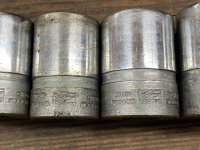
I have several items made overseas from the immediate post-war period and they are marked "Made in Occupied Japan" or "Made in Occupied Germany". The term "occupied" wasn't dropped till the mid 1950's when foreign contempt started to subside. These tools aren't marked with either "occupied Japan" or "Japan". Mikasa is subtle enough that it might pass through unsuspecting American hands without too much notice, however.
Second, how many metric tools were being sold in the states in the late 1940's? We just won the war - I don't think there'd be a big push to adopt the foreign measurement system. Plus we made most stuff here, in SAE parts. The few metric fasteners a mechanic came across could be handled by his 64ths inch tools. The major foreign influx of machinery wasn't till the 1960's, which is when most tool makers started offering metric tools big time.
So I'm thinking these tools were made in Japan for domestic use - probably industrial or the military. Some examples made it to our shores through returning veterans or American businessmen travelling back and forth early on. JMHO
Some good thoughts. I still feel the "forensics" on the set point to the time period I suggested, 1947 to mid-1950s.
There are a couple of lesser known details about the Japanese occupation and imports, which I encountered while involved with other collectibles where the postwar Japanese imports to the US were far more prevalent than tools (even predominant) and so there are many more available references and a much larger overall public knowledge base. For one, as part of the punitive process, Japan was not permitted to export for two years, which is where the 1947 date comes from.
The requirement of marking exports "occupied" Japan was rescinded during 1952.
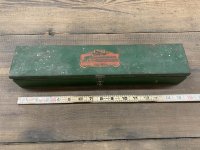
A little known aspect of the law is that the item itself may not be required to bear the COO mark as long as the packaging does. This is why we see so many Chinese tools today that have no COO on the tool itself, but must still be shown on the packaging. The same rule applied then. So, if these Mikasa sets came in cardboard boxes/sleeves that bore Made in "Japan" or Occupied Japan," the tools themselves need not have been marked and still be lawful. The original intent of this exception was for items where placing the mark directly on them would pose a problem or difficulty, or even be destructive in some way. But this "intent" was not always fully enforced--over time, it's interpretation has grown quite liberalized). In any event, the fact that this set is not marked Japan directly on the components does not in itself mean that the set wasn't imported to the US. I'd bet these sets originally had a protective cardboard box or sleeve on which the COO info was provided--finding one would eliminate much uncertainty (they almost certainly had a such protective sleeve or box to prevent damage during transport and handling).
While metric tools were extremely uncommon in the US at the time, they were not unheard of, so this in itself is not a disqualifier. I checked a single period tool mfr catalog (an online pdf presented as a 1948 Plomb/Proto catalog) and found a set of metric wrenches listed. No metric socket set though. Which may have left a gap by USA mfrs that Mikasa might try to fill--very little competition there, and I also think it would be natural to a US citizen of the day that a metric set might have to be an import and so encounter little buyer resistance.
It may be possible as bonneyman suggests that the set was made in Japan to serve the many Americans who were located there during the occupation (it is, after all, marked in English). If so, I would think it most likely between 1945-47, after which sets made for export into the US would have been more practically distributed there. Could be even that re-tooling to include a COO mark on sets that were already being made may have represented a difficulty that allowed the COO info on the outer cardboard box only. Either way, having no COO on the components does not in itself preclude export to the US.

 996C6562-E593-48A1-8803-108BC4E29DE4.jpg149 KB · Views: 187
 CB8E8F0E-8D75-40E6-9713-9C9669D2D0D6.jpg153.3 KB · Views: 249
 6D6F3F74-5976-4B29-8133-6E7444E13C5C.jpg148.5 KB · Views: 242
 FBEF2D46-98B7-442D-9204-624AC23A0763.jpg154.6 KB · Views: 176
 B028F935-6124-425F-AC90-64E651BE4A1C.jpg159.8 KB · Views: 192


