To avoid these ads, REGISTER NOW!

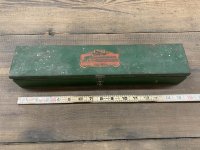
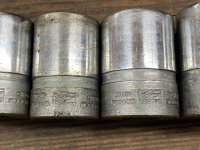
Rare socket set - cant find anything like it

Status
Not open for further replies.

Tbhamm

Active member
Joined
Sep 10, 2020
Messages
26
Location
Mississippi
I came across this socket set at an estate sale. This guy had some pretty nice tools. I havent been able to find any other hand tool with this name brand. Wondering if anyone else has ever heard of Mikasa tools? Thanks!
 

Attachments

  • 996C6562-E593-48A1-8803-108BC4E29DE4.jpg
    996C6562-E593-48A1-8803-108BC4E29DE4.jpg
    149 KB · Views: 186
  • CB8E8F0E-8D75-40E6-9713-9C9669D2D0D6.jpg
    CB8E8F0E-8D75-40E6-9713-9C9669D2D0D6.jpg
    153.3 KB · Views: 248
  • 6D6F3F74-5976-4B29-8133-6E7444E13C5C.jpg
    6D6F3F74-5976-4B29-8133-6E7444E13C5C.jpg
    148.5 KB · Views: 241
  • FBEF2D46-98B7-442D-9204-624AC23A0763.jpg
    FBEF2D46-98B7-442D-9204-624AC23A0763.jpg
    154.6 KB · Views: 175
  • B028F935-6124-425F-AC90-64E651BE4A1C.jpg
    B028F935-6124-425F-AC90-64E651BE4A1C.jpg
    159.8 KB · Views: 191
To avoid these ads, REGISTER NOW!

Private Lugnutz

Well-known member
Joined
Mar 30, 2012
Messages
30,497
Location
The Authentic Jersey Shore
I have never seen anything like it before. The steel composition and decal smacks of late 1930's to 1941 to me, but I suppose it could be and may more likely be postwar into the late 50's or so. Import for sure. Almost certainly Japan. Handsome tools. I especially like the two-tone sockets with the satin base and chromed walls. The entire set is in pristine condition. That is a very nice find. Congrats.

EDIT: What are the socket sizes? That could help date it.
 
Last edited:

Farmerjonathan

Well-known member
Joined
Nov 23, 2013
Messages
349
Location
Northwestern Indiana
My dad had the same set (except) it had a ratchet instead of a breaker bar, 3/8 drive. That sat on top of his workbench at the station and then at home, now in his shop we built before he died. Will try to remember to look at it this weekend when getting my mower out of his shop.
 

DadsTools

Well-known member
Joined
Jul 27, 2017
Messages
1,852
I've never seen this tool brand, but there's a couple of details that provide a clue. Doesn't appear to have any USA markings. Mikasa name is Japanese. The bird in flight logo would be consistent with post-war Japanese imports, which often had artistic logos which made sense to the Japanese mindset for branding but not in the USA. In other words, they used logos that projected an image of their company rather than reflecting the nature of the item itself. They probably made other items besides tools. Also, simple model numbers (only one or two digits) starting with "No." is also characteristic of 50s Japan.

Another hint is in the mfg approach. Some of the early post-war production (depending on the product) was intended to replicate high quality items from other countries. They tried to copy these items spec for spec. This would be a period from 1947 to perhaps as late as the mid-1950s. Later, the philosophy switched to how cheap they could make it to compete, not on providing items equal to other COOs, but on price.

Then there is the stamping of the specific alloy, a practice which was mostly abandoned by USA mfrs during the war because of the restricted metals and to which they never returned, choosing instead to continue with generic "alloy" or branding the metal like Diamalloy (for Diamond brand tools) and such. The Asian mfrs took up this practice where the USA makers left off, and largely continue it to this day.

So it seems to be a post-war Japan set circa 1947 to early-mid 1950s. It could have even been a single production run (not a dedicated tool company, but a company happened to make a line of tools for a short period), so there's probably not that many out there.

Nice find!
 
Last edited:
OP
T

Tbhamm

Active member
Joined
Sep 10, 2020
Messages
26
Location
Mississippi
Nice! Thank yall for all the insight. They are 1/2” sockets sized 13mm to 25mm missing a few in-between. Farmerjohnathan did your dad ever say where he found them? I was thinking of trying to sell them... I have all the socket sets I need. I know that rare doesnt always mean valuable... any idea of what a set like these might be worth? Thanks!
 

Private Lugnutz

Well-known member
Joined
Mar 30, 2012
Messages
30,497
Location
The Authentic Jersey Shore
I know that rare doesnt always mean valuable... any idea of what a set like these might be worth?
That's the dilemma for collectors with obscure rare brands. Their obscurity is what makes them interesting, but that kind of interest is different than the interest in something rare from a high-demand brand. Hard to determine a value, especially without precedence. One approach is to use eBay, start the auction low/reasonable, and let the bidders determine the value. Another approach, especially if you bought them cheap, is to sell them here or CL etc for a reasonable price. You probably still triple or even quadruple your money - like a finder's fee, and let someone else worry about true value, which may not be much more. Should fit in a medium or large USPS flat rate.
 
To avoid these ads, REGISTER NOW!

Ralf11

Well-known member
Joined
Feb 29, 2016
Messages
2,275
You know, I bet the Japanese have a guy somewhere who is a Professor of Tool History.

- not just b/c it's Japan, but industrialization was late there and a big, big thing for them to move on up and match the European colonial powers

You just have to find that guy...
 

bonneyman

Well-known member
Joined
Apr 22, 2010
Messages
8,773
Location
Desert SW
Nice set for sure!

Maybe it was for domestic use?
I have several items made overseas from the immediate post-war period and they are marked "Made in Occupied Japan" or "Made in Occupied Germany". The term "occupied" wasn't dropped till the mid 1950's when foreign contempt started to subside. These tools aren't marked with either "occupied Japan" or "Japan". Mikasa is subtle enough that it might pass through unsuspecting American hands without too much notice, however.
Second, how many metric tools were being sold in the states in the late 1940's? We just won the war - I don't think there'd be a big push to adopt the foreign measurement system. Plus we made most stuff here, in SAE parts. The few metric fasteners a mechanic came across could be handled by his 64ths inch tools. The major foreign influx of machinery wasn't till the 1960's, which is when most tool makers started offering metric tools big time.

So I'm thinking these tools were made in Japan for domestic use - probably industrial or the military. Some examples made it to our shores through returning veterans or American businessmen travelling back and forth early on. JMHO
 

Provincial

Well-known member
Joined
Sep 21, 2011
Messages
6,856
Location
Near Salem, OR
"Occupied" meant just that, defeated countries occupied by troops of the victors. Once the Allies felt the defeated countries had stable governments, they went home, and "occupied" went away and "West Germany" and "Japan" became the Country of Origin.

I think that the labels being in English implies that the set was not made for the domestic Japanese market.
 

Private Lugnutz

Well-known member
Joined
Mar 30, 2012
Messages
30,497
Location
The Authentic Jersey Shore
I think that the labels being in English implies that the set was not made for the domestic Japanese market.
:+1:

But the report of metric opening sizes on the sockets did surprise me. I did not expect to hear that.

As you guys are well aware, we did not have a big metric push here in the US until the 70's, just after the UK in the mid 60's. It's my understanding that most of the early sporadic Japanese import cars, prewar and postwar, had imperial fasteners, mainly because they copied US and British cars, and that even the earliest wave of successful Japanese imports had a head spinning mix of imperial and metric fasteners. I could be wrong about that, but the construction, decals, and the implied export context seem counterintuitive to the metric sizes to me. Maybe it's even later than we suspected.
 

DadsTools

Well-known member
Joined
Jul 27, 2017
Messages
1,852
Nice set for sure!

Maybe it was for domestic use?
I have several items made overseas from the immediate post-war period and they are marked "Made in Occupied Japan" or "Made in Occupied Germany". The term "occupied" wasn't dropped till the mid 1950's when foreign contempt started to subside. These tools aren't marked with either "occupied Japan" or "Japan". Mikasa is subtle enough that it might pass through unsuspecting American hands without too much notice, however.
Second, how many metric tools were being sold in the states in the late 1940's? We just won the war - I don't think there'd be a big push to adopt the foreign measurement system. Plus we made most stuff here, in SAE parts. The few metric fasteners a mechanic came across could be handled by his 64ths inch tools. The major foreign influx of machinery wasn't till the 1960's, which is when most tool makers started offering metric tools big time.

So I'm thinking these tools were made in Japan for domestic use - probably industrial or the military. Some examples made it to our shores through returning veterans or American businessmen travelling back and forth early on. JMHO
Some good thoughts. I still feel the "forensics" on the set point to the time period I suggested, 1947 to mid-1950s.

There are a couple of lesser known details about the Japanese occupation and imports, which I encountered while involved with other collectibles where the postwar Japanese imports to the US were far more prevalent than tools (even predominant) and so there are many more available references and a much larger overall public knowledge base. For one, as part of the punitive process, Japan was not permitted to export for two years, which is where the 1947 date comes from.

The requirement of marking exports "occupied" Japan was rescinded during 1952.

A little known aspect of the law is that the item itself may not be required to bear the COO mark as long as the packaging does. This is why we see so many Chinese tools today that have no COO on the tool itself, but must still be shown on the packaging. The same rule applied then. So, if these Mikasa sets came in cardboard boxes/sleeves that bore Made in "Japan" or Occupied Japan," the tools themselves need not have been marked and still be lawful. The original intent of this exception was for items where placing the mark directly on them would pose a problem or difficulty, or even be destructive in some way. But this "intent" was not always fully enforced--over time, it's interpretation has grown quite liberalized). In any event, the fact that this set is not marked Japan directly on the components does not in itself mean that the set wasn't imported to the US. I'd bet these sets originally had a protective cardboard box or sleeve on which the COO info was provided--finding one would eliminate much uncertainty (they almost certainly had a such protective sleeve or box to prevent damage during transport and handling).

While metric tools were extremely uncommon in the US at the time, they were not unheard of, so this in itself is not a disqualifier. I checked a single period tool mfr catalog (an online pdf presented as a 1948 Plomb/Proto catalog) and found a set of metric wrenches listed. No metric socket set though. Which may have left a gap by USA mfrs that Mikasa might try to fill--very little competition there, and I also think it would be natural to a US citizen of the day that a metric set might have to be an import and so encounter little buyer resistance.

It may be possible as bonneyman suggests that the set was made in Japan to serve the many Americans who were located there during the occupation (it is, after all, marked in English). If so, I would think it most likely between 1945-47, after which sets made for export into the US would have been more practically distributed there. Could be even that re-tooling to include a COO mark on sets that were already being made may have represented a difficulty that allowed the COO info on the outer cardboard box only. Either way, having no COO on the components does not in itself preclude export to the US.
 
Last edited:
Status
Not open for further replies.
To avoid these ads, REGISTER NOW!
Top Bottom