German Satin
Well-known member
Was reading through a thread about ratchet smoothness from 2013:-
 www.garagejournal.com
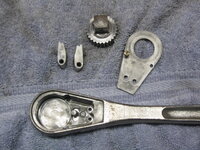
I was reading up on the various ratchet pawl styles particularly the pear head single pawl and 2 pawl designs (not to be confused with dual pawl). Not surpriseingly I stumbled across the above GJ thread. I found it really interesting and just the sort of info I was after. General consensus is that the design goes a long way in explaining the efficiency of ratchet performance and that the 2 pawl style offers a slicker, smoother or lighter operation than the single pawl. Said designs shown below.

The styles I'm talking about are from top left the 1st and 3rd image.
I think my preferred style is the 2 pawl arrangement as it tends to offer a lighter ratcheting motion. This is important when the fastener is being loosened and offers less and less resistance the looser it gets. A heavier ratcheting action will limit how much the fastener can be loosened as it's opposing resistance or friction exceeds that of the fastener and generally becomes less satisfying to use. Of course I have only offered a general brush stroke on the subject and there are others factors to take into account as discussed in the original thread.
Would appreciate anyone's 2 cents ...
Ratchet "smoothness"
Can anyone explain what directly contributes to ratchet "smoothness"? I've seen some claim that their Depression-era 24-tooth ratchets are the smoothest ever made, others that it's a Dual-80 or nothing...so I know it's not tooth count, and it probably isn't machining tolerances. What is it?!
www.garagejournal.com
I was reading up on the various ratchet pawl styles particularly the pear head single pawl and 2 pawl designs (not to be confused with dual pawl). Not surpriseingly I stumbled across the above GJ thread. I found it really interesting and just the sort of info I was after. General consensus is that the design goes a long way in explaining the efficiency of ratchet performance and that the 2 pawl style offers a slicker, smoother or lighter operation than the single pawl. Said designs shown below.
The styles I'm talking about are from top left the 1st and 3rd image.
I think my preferred style is the 2 pawl arrangement as it tends to offer a lighter ratcheting motion. This is important when the fastener is being loosened and offers less and less resistance the looser it gets. A heavier ratcheting action will limit how much the fastener can be loosened as it's opposing resistance or friction exceeds that of the fastener and generally becomes less satisfying to use. Of course I have only offered a general brush stroke on the subject and there are others factors to take into account as discussed in the original thread.
Would appreciate anyone's 2 cents ...