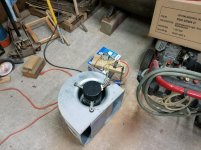
I’m re-purposing a squirrel cage blower fan and motor, salvaged from my air handler after upgrading my HVAC system, for use as a blower in my shop. Although I did something similar many, many years ago, it was back when I was a little smarter and electric motors were much simpler with a just a starting capacitor and hooking up a couple wires and voila!.
I’ve got a GE ½ HP motor that will run on 120v or 240v. The rub, in my case, is that it’s an electronically commutated motor (ECM), which is new to me.
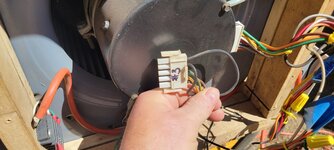
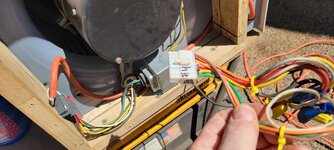
By way of GoogTube, I’ve discovered it’s actually an ECM 2.3 variable-speed motor, with both 5-pin and a 16-pin connectors; 5-pin for main power (120v or 240v), and 16-pin for low voltage (24v AC, DC maybe?) signals to the motor controller. Not entirely ancient technology like I was used to, but not leading edge tech either.
It’s my understanding that the HVAC OEM would configure the ECM, unique to the model and size of the HVAC system, providing multiple airflow and comfort options, dependent upon the demands of the HVAC system it was installed in. In my case, it rode in a Trane air handler, supporting a 3.5 ton heat pump, and from what I can tell, there were some speed configuration settings, such as comfort or efficiency, multiple speeds in fan only mode, and on and off delays.
Using the vast power of Al Gore’s internet, I found a video that gave a me a basic blower go/no go test that identified which pins needed 24vAC power and I was able to make wind with it, using 240v for the main power and a 120v/24v AC transformer for the control power. I understand the need to throttle the discharge somewhat to put some load on the blower.
When I plugged in the power to the transformer, I got a soft start and a slow ramp-up to speed. When I unplugged the transformer, it ran for about 90 seconds or so before shutting off. I ran the blower for about 30 minutes and I varied the discharge and was able to monitor run current and motor temperature. It all appeared good,
Now I want to ‘configure’ it for long-term use as a shop fan. Soon, it will ride in a ‘box’ with the appropriate electrical/rotating machinery accoutrements and safety features (and stickers, of course). My goal is to get the highest speed available, or if possible, different speeds, but lacking the HVAC control board to ‘experiment’ with and not being certain that control signals generated from a HVAC control board are solely volts AC, I figured I’d ask here if anyone could provide me some greater insight, vice me just swapping control power leads around and mixing AC and DC and letting the smoke out.
I’m guessing I could just use the go/no go method I used in my test, and introduce a switch for the transformer to turn it on and off, but I figured there were experts here who might know a better way. Also, I’ve either got to get a 240v-24v transformer or find the correct pins to install a jumper in the 5-pin connector that would allow me to run solely on 120v main power.
Anyone? Bueller?
Thanks!
I’ve got a GE ½ HP motor that will run on 120v or 240v. The rub, in my case, is that it’s an electronically commutated motor (ECM), which is new to me.
By way of GoogTube, I’ve discovered it’s actually an ECM 2.3 variable-speed motor, with both 5-pin and a 16-pin connectors; 5-pin for main power (120v or 240v), and 16-pin for low voltage (24v AC, DC maybe?) signals to the motor controller. Not entirely ancient technology like I was used to, but not leading edge tech either.
It’s my understanding that the HVAC OEM would configure the ECM, unique to the model and size of the HVAC system, providing multiple airflow and comfort options, dependent upon the demands of the HVAC system it was installed in. In my case, it rode in a Trane air handler, supporting a 3.5 ton heat pump, and from what I can tell, there were some speed configuration settings, such as comfort or efficiency, multiple speeds in fan only mode, and on and off delays.
Using the vast power of Al Gore’s internet, I found a video that gave a me a basic blower go/no go test that identified which pins needed 24vAC power and I was able to make wind with it, using 240v for the main power and a 120v/24v AC transformer for the control power. I understand the need to throttle the discharge somewhat to put some load on the blower.
When I plugged in the power to the transformer, I got a soft start and a slow ramp-up to speed. When I unplugged the transformer, it ran for about 90 seconds or so before shutting off. I ran the blower for about 30 minutes and I varied the discharge and was able to monitor run current and motor temperature. It all appeared good,
Now I want to ‘configure’ it for long-term use as a shop fan. Soon, it will ride in a ‘box’ with the appropriate electrical/rotating machinery accoutrements and safety features (and stickers, of course). My goal is to get the highest speed available, or if possible, different speeds, but lacking the HVAC control board to ‘experiment’ with and not being certain that control signals generated from a HVAC control board are solely volts AC, I figured I’d ask here if anyone could provide me some greater insight, vice me just swapping control power leads around and mixing AC and DC and letting the smoke out.
I’m guessing I could just use the go/no go method I used in my test, and introduce a switch for the transformer to turn it on and off, but I figured there were experts here who might know a better way. Also, I’ve either got to get a 240v-24v transformer or find the correct pins to install a jumper in the 5-pin connector that would allow me to run solely on 120v main power.
Anyone? Bueller?
Thanks!