
You are using an out of date browser. It may not display this or other websites correctly.
You should upgrade or use an alternative browser.
You should upgrade or use an alternative browser.
Ready for tomorrows sun.
- Thread starter 2011laramie
- Start date

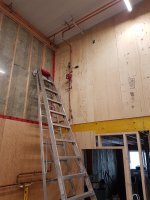

OP
2011laramie
Well-known member

Denwood
Well-known member
Awesome project. I did a pile of research/measurements/analysis on my solar pool project, including a live data feed of BTU output. Very interested in your measurements.
https://www.garagejournal.com/forum/showthread.php?t=397005&page=3
Max output on the 12x20' array was 90 000 BTU/hour on a hot day (calculated on actual measured flow of 1548GPH and delta temps via DS18B20 digital probes)...so your estimate of 350 000 K per hour is likely high from a glazed 12x19 in winter sun.
What temps are we seeing on the digital gauge?
Was your shop cold to start? Looks like 40F supply and 90F back? What were outside temps during this time? My guess is that you'll get much better efficiency by ramping flow a lot higher. Your delta between outside temps and return water is quite high...so you're losing a fair bit to heat radiated to ambient outside.
https://www.garagejournal.com/forum/showthread.php?t=397005&page=3
Max output on the 12x20' array was 90 000 BTU/hour on a hot day (calculated on actual measured flow of 1548GPH and delta temps via DS18B20 digital probes)...so your estimate of 350 000 K per hour is likely high from a glazed 12x19 in winter sun.
What temps are we seeing on the digital gauge?
Was your shop cold to start? Looks like 40F supply and 90F back? What were outside temps during this time? My guess is that you'll get much better efficiency by ramping flow a lot higher. Your delta between outside temps and return water is quite high...so you're losing a fair bit to heat radiated to ambient outside.
Last edited:
OP
2011laramie
Well-known member
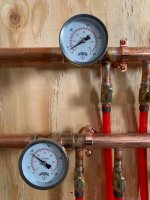
I got the temp gauges going in and out of the floor, which is a direct feed to the inlet and outlet of the collector. Ya the shop was dead cold for this start up, its been around -10C around alberta lately.
The digital gauge is reading air temp inside the collector box. Pump is plugged into the cooling mode of the digital controller, so when the box gets hot, it turns the pump on to cool the box by bringing in cold glycol.
The digital gauge is reading air temp inside the collector box. Pump is plugged into the cooling mode of the digital controller, so when the box gets hot, it turns the pump on to cool the box by bringing in cold glycol.
OP
2011laramie
Well-known member
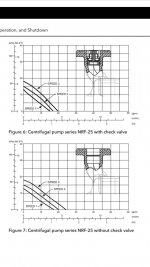
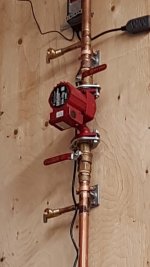
Ive been racking my brain how to figure out flow for this pump. I was looking at getting a variable area flow gauge and soldering it in on the vertical riser on the return from the floor. But then i thought, theoretically cant i just take pressure readings off the suction and discharge of the circulator, take that differential psi and multiple that by 2.3 to get feet of head resistance. Than plot that against the pump curve chart?
BTU/hr = GPM x delta T x 500.4
Right now, the pump is on setting one. Im away from the shop for a while cause i left for work. When i get back ill change the pump settings and try different flows.
BTU/hr = GPM x delta T x 500.4
Right now, the pump is on setting one. Im away from the shop for a while cause i left for work. When i get back ill change the pump settings and try different flows.
Attachments
Last edited:
jkeyser14
Well-known member
Nice setup. Keep posting results.
Denwood
Well-known member
You could figure flow, but if you can adjust it, just increase (a lot) to drop your delta. The larger the difference between panel internal temp and outside ambient, the less efficient your system becomes. So if you increase flow so delta between supply and return is just 10C, you’ll likely find that the actual BTUs pulled from your array increases.
SGKent
Banned
do you have a way to store that summer heat to use it in winter?
OP
2011laramie
Well-known member
Did a quick pump pressure survey today, on a sunny day on pump setting 1 its around 65000 btu/hr.
I did todays pressure survey with no sun so the glycol was actually at minus 10°C, which would have more pumping resistance than warm glycol. So theoretically with hot glycol it might actually be recovering more btu.
Hoping tomorrow is more sunny so i can run some more numbers
Also, with to collector at 65°C and it -6°C outside, its losing roughly 18000 btu/hr through the glazing. Im hoping i can run it on setting 2.
I did todays pressure survey with no sun so the glycol was actually at minus 10°C, which would have more pumping resistance than warm glycol. So theoretically with hot glycol it might actually be recovering more btu.
Hoping tomorrow is more sunny so i can run some more numbers
Also, with to collector at 65°C and it -6°C outside, its losing roughly 18000 btu/hr through the glazing. Im hoping i can run it on setting 2.
Last edited:
larry4406
Well-known member
Interesting project!
Show us your build of the collector and the floor system.
Show us your build of the collector and the floor system.
Nice, I have something similar in my shop. I built my collector into my south wall using ideas from www.builditsolar.com . My signature has a link to my build, keeps my shop around 50 generally. Its tough right now as there is less than 9 hours daylight in Maine right now. Go a few days without sun and the temp drops. Lowest I've seen it is 39. I'm not getting the delta T you are. My thermometers on radiant manifold are screwed up so I can't really tell. I just guessed on my pump, 009 Taco stainless, it was cheap off Ebay 
I will say once its been running its been pain free. Done nothing to it since its start up except change out differential controller.
I use woodstove to get temps up if I'm out there for any length of time.
I will say once its been running its been pain free. Done nothing to it since its start up except change out differential controller.
I use woodstove to get temps up if I'm out there for any length of time.
OP
2011laramie
Well-known member
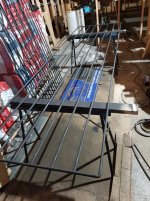
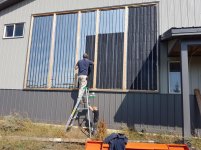
A few pics from construction of the panel. Theres five banks of risers with flat black painted aluminum plates that i bent in the ole all manual hammer press lol(it was all 6" wide rolled flashing that i cut into 4ft sections and then hammered the groove into for a tight fit against the risers. Its got 1.5" polyiso insulation behind the aluminum flashing that the painted risers are attached too. Inside ive got 1" supply and return manifolds and piping over to the distribution header into the floor. The floor has 1500 feet of oxy barrier pex on 12.5" centers (cheated the distances to get 1500 ft of pex to fit in a 1700sq ft bay.
This solar heated bay was going to be cold storage side of the shop, so if it has temp swings thats ok. Ill have a boiler system on the other side and ill pipe glycol over for a hydronic fan coil unit that i can turn on so if i wanna work on the solar heated bay i can heat it as i want too
This solar heated bay was going to be cold storage side of the shop, so if it has temp swings thats ok. Ill have a boiler system on the other side and ill pipe glycol over for a hydronic fan coil unit that i can turn on so if i wanna work on the solar heated bay i can heat it as i want too
Attachments




OP
2011laramie
Well-known member
Ya walrus, your shop is where i got the initial idea from. I asked you a few questions on your thread.
Right now the attic insulation isnt complete so every night the slab cools right down. Im planning on finishing the attic insulation this week.
Right now the attic insulation isnt complete so every night the slab cools right down. Im planning on finishing the attic insulation this week.
HoosierBuddy
Well-known member
Very cool project.
On calculating flow...dumb idea, but instead could you just measure flow?
Thinking you might have a drain somewhere that you could put a gallon jug under and use a stop watch to measure how many seconds it takes to fill?
Not sure if that's possible or not...
Again...super job!
Phil
On calculating flow...dumb idea, but instead could you just measure flow?
Thinking you might have a drain somewhere that you could put a gallon jug under and use a stop watch to measure how many seconds it takes to fill?
Not sure if that's possible or not...
Again...super job!
Phil
OP
2011laramie
Well-known member
Cant really do that, cause initial release would be a flow/presre release from the system presure.
Ya walrus, your shop is where i got the initial idea from. I asked you a few questions on your thread.
Right now the attic insulation isnt complete so every night the slab cools right down. Im planning on finishing the attic insulation this week.
Be interesting to hear how it works once insulation is finished up. I've been watching a timber frame "barn" , really a home, being built. They are running a propane heated floor while doing the insulation on top of the roof. 9 inches of sheet foam over tongue and groove 2 bys. They say every time they get another section done the temps go up in building .
OP
2011laramie
Well-known member
We finished the roof tuesday afternoon. 235 bags of cellulose blown up there. But of course, get that done and i had to leave again for work. I might order a temperature logger online and set it up to take readings every 30 minutes or something.
nadogail
Well-known member
I am of the opinion that tapping into solar energy is still in it's infancy.
OP
2011laramie
Well-known member
Seems to be working good, lots of air bubbles floating around.( system doesnt have an air separator installed yet) the other day it kicked on at 930 am. And ran till probably 430.
Seems to be working good, lots of air bubbles floating around.( system doesnt have an air separator installed yet) the other day it kicked on at 930 am. And ran till probably 430.
Do you have expansion tank? You really need the air scoop. The length of time running sounds about right except I'm dark at 4.30

I am of the opinion that tapping into solar energy is still in it's infancy.
I would agree with you, but unless it is a diy built collector bank as discussed here the economics of solar thermal just aren't there. the best return for the solar dollar today is PV.
OP
2011laramie
Well-known member
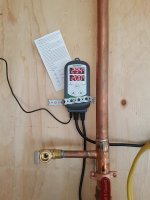
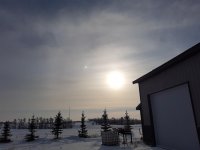
Well its -22C outside, i checked the shop first thing in the morning and it was -6 inside.
Sun has kinda been trying to make an appearance most of the day. I went out and it was 18 in the collector then it warmed up more and started the pump (starts at 25C).
These pics were within minutes of the pump starting.
Sun has kinda been trying to make an appearance most of the day. I went out and it was 18 in the collector then it warmed up more and started the pump (starts at 25C).
These pics were within minutes of the pump starting.
Attachments

dfiler2
Well-known member
The Taco 2218 pump works well in these situations and will give you the flow on a small screen, the pump will speed up and slow down depending on the delta you are looking for.
https://www.tacocomfort.com/products/variable_speed_products/vt2218/index.html
https://www.tacocomfort.com/products/variable_speed_products/vt2218/index.html
OP
2011laramie
Well-known member

OP
2011laramie
Well-known member
Beautiful sunny morning here today. But extremely cold.
Went out at 9:45am to see how its doing and suprised it was running already. Sun is still on quite an angle from the east and the lean to is casting a shadow still.
Shop was -10C inside, not bad givin the temps overnight and no other heat source.
Went out at 9:45am to see how its doing and suprised it was running already. Sun is still on quite an angle from the east and the lean to is casting a shadow still.
Shop was -10C inside, not bad givin the temps overnight and no other heat source.
Attachments
-
 20200115_094536.jpg147.5 KB · Views: 57
 -
 20200115_094750.jpg63.2 KB · Views: 54
 -
 20200115_094703.jpg92.8 KB · Views: 55
 -
 Screenshot_20200115-100652_Gallery.jpg57.8 KB · Views: 50
 -
 20200115_094435.jpg100.9 KB · Views: 41
 -
 20200115_094437.jpg82.5 KB · Views: 42
 -
 20200115_094440.jpg136.9 KB · Views: 51
Last edited:
OP
2011laramie
Well-known member
10:45am sun,
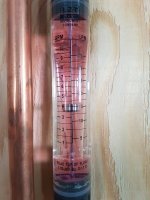
Pump on highest setting
60F going into floor, 42F return temp.
4.2gpm on the new flow gauge.
Air separator installed and moved expansion tank to tie into air separator.
Without calculating the variables for the 50/50 glycol and using just water numbers.
4.2gpm x (60-42) x 500.4 = 37800BTU/hr. Not as good as i originally thought, but back to where i expected it. Flow gauge was a nice touch.
12:30, the most direct sun without a single trace of a cloud. = 45000btu/hr.
The glycols warmed up a bit, so its easier to pump
Pump on highest setting
60F going into floor, 42F return temp.
4.2gpm on the new flow gauge.
Air separator installed and moved expansion tank to tie into air separator.
Without calculating the variables for the 50/50 glycol and using just water numbers.
4.2gpm x (60-42) x 500.4 = 37800BTU/hr. Not as good as i originally thought, but back to where i expected it. Flow gauge was a nice touch.
12:30, the most direct sun without a single trace of a cloud. = 45000btu/hr.
The glycols warmed up a bit, so its easier to pump
Attachments

Last edited:
Denwood
Well-known member
45K BTU sounds pretty good given the cold temps..and a lot more inline with what I was predicting for your array. I'd measured a max of 90K BTU in an hour (during a hot summer day) from our solar pool array @12'x20'...and that was mounted to a hot asphalt roof.
It would be worth trying to up that flow x2 and repeat your measurements. I suspect you could raise efficiency a lot as 60F in means you're loosing a lot to ambient still. You can add a pump in series to double(ish) your flow.
You really need to know your slab temp to find that sweet spot with respect to flow/efficiency.
Btw, I don't think you've posted your array construction details. Would be great to see what you did there. Thanks again for posting real data
It would be worth trying to up that flow x2 and repeat your measurements. I suspect you could raise efficiency a lot as 60F in means you're loosing a lot to ambient still. You can add a pump in series to double(ish) your flow.
You really need to know your slab temp to find that sweet spot with respect to flow/efficiency.
Btw, I don't think you've posted your array construction details. Would be great to see what you did there. Thanks again for posting real data
Last edited:
OP
2011laramie
Well-known member
Im not sure Walrus,
My temp probe is measuring air temp and is fastened to one of the black absorbers, so that might be skewing the number a bit.
What are you temps in and out of your collector?
My temp probe is measuring air temp and is fastened to one of the black absorbers, so that might be skewing the number a bit.
What are you temps in and out of your collector?
Im not sure Walrus,
My temp probe is measuring air temp and is fastened to one of the black absorbers, so that might be skewing the number a bit.
What are you temps in and out of your collector?
My temps out of collector are a few degrees warmer than the floor. Collector temps can go over a hundred but outlet temps are still a few degrees over the floor temps. Might be able to get that delta T higher with better collectors or by slowing down flow so fluid stays in collector longer? I haven't messed with it as my shop is in the 50s and if not a few sticks of wood gets it in the 60s.
You should be seeing some big collector temps now
Denwood
Well-known member
That high delta is a strong indicator that flow needs to go up a lot. Do that and efficacy will also increase with less loss from the array to ambient outside temps. You really need to measure the fluid temp at array exit, )not the air temp in the collector) to dial in flow for max efficiency.
Walrus. 3-4 degrees sounds about right. A high delta means a lot of efficiency loss, particularly if ambient temps are low. Your array is always radiating heat back to ambient. Keeping that delta as low as possible will dramatically change the system efficiency. This is just about maximizing BTUs to your slab and does not apply to a non-stratified domestic water system where a higher delta would be the goal.
If you have a Zwave hub in your home, you can monitor the fluid temps:
1: Use a thermowell in-line to your plumbing.
2. Pick up a few DS18B20 sensors ($10 each)
3. Use the Fibaro Universal sensor to connect up to four sensors.
I take this data and combine with flow measurements to graph real time BTU performance of our solar array. If interested I can post a few links on the project. Hundredgraphs.com plugs into this data for free: https://community.smartthings.com/t/smartthings-swimming-pool-solar-heat-automation-diy/131994/5
This is the live graph of my system. It’s a bit misleading at this moment as it’s winter here so the roof temp and a few other sensors are offline.
https://www.hundredgraphs.com/public/denwood
Sensors 1, 3 and 5 are live and correct as the Zwave/Ds18b20 sensors are solar powered and power themselves all year. One is measuring ground temps, the other two are in the drained pool plumbing
In any case, the sensors and graphs really helped sort out system efficiency so my flow target ended up around 1500 GPH. I also observed that max gain due to the array and roof configuration was actually 2-3pm every day at a high of about 98 000 BTU/hour.
Walrus. 3-4 degrees sounds about right. A high delta means a lot of efficiency loss, particularly if ambient temps are low. Your array is always radiating heat back to ambient. Keeping that delta as low as possible will dramatically change the system efficiency. This is just about maximizing BTUs to your slab and does not apply to a non-stratified domestic water system where a higher delta would be the goal.
If you have a Zwave hub in your home, you can monitor the fluid temps:
1: Use a thermowell in-line to your plumbing.
2. Pick up a few DS18B20 sensors ($10 each)
3. Use the Fibaro Universal sensor to connect up to four sensors.
I take this data and combine with flow measurements to graph real time BTU performance of our solar array. If interested I can post a few links on the project. Hundredgraphs.com plugs into this data for free: https://community.smartthings.com/t/smartthings-swimming-pool-solar-heat-automation-diy/131994/5
This is the live graph of my system. It’s a bit misleading at this moment as it’s winter here so the roof temp and a few other sensors are offline.
https://www.hundredgraphs.com/public/denwood
Sensors 1, 3 and 5 are live and correct as the Zwave/Ds18b20 sensors are solar powered and power themselves all year. One is measuring ground temps, the other two are in the drained pool plumbing
In any case, the sensors and graphs really helped sort out system efficiency so my flow target ended up around 1500 GPH. I also observed that max gain due to the array and roof configuration was actually 2-3pm every day at a high of about 98 000 BTU/hour.
Last edited:
Cool, got any pics of your panels or other parts of your system.?That high delta is a strong indicator that flow needs to go up a lot. Do that and efficacy will also increase with less loss from the array to ambient outside temps. You really need to measure the fluid temp at array exit, )not the air temp in the collector) to dial in flow for max efficiency.
Walrus. 3-4 degrees sounds about right. A high delta means a lot of efficiency loss, particularly if ambient temps are low. Your array is always radiating heat back to ambient. Keeping that delta as low as possible will dramatically change the system efficiency. This is just about maximizing BTUs to your slab and does not apply to a non-stratified domestic water system where a higher delta would be the goal.
If you have a Zwave hub in your home, you can monitor the fluid temps:
1: Use a thermowell in-line to your plumbing.
2. Pick up a few DS18B20 sensors ($10 each)
3. Use the Fibaro Universal sensor to connect up to four sensors.
I take this data and combine with flow measurements to graph real time BTU performance of our solar array. If interested I can post a few links on the project. Hundredgraphs.com plugs into this data for free: https://community.smartthings.com/t/smartthings-swimming-pool-solar-heat-automation-diy/131994/5
This is the live graph of my system. It’s a bit misleading at this moment as it’s winter here so the roof temp and a few other sensors are offline.
https://www.hundredgraphs.com/public/denwood
Sensors 1, 3 and 5 are live and correct as the Zwave/Ds18b20 sensors are solar powered and power themselves all year. One is measuring ground temps, the other two are in the drained pool plumbing
In any case, the sensors and graphs really helped sort out system efficiency so my flow target ended up around 1500 GPH. I also observed that max gain due to the array and roof configuration was actually 2-3pm every day at a high of about 98 000 BTU/hour.
Denwood
Well-known member
Keep in mind that my system is for solar pool heating so some of the system variables are different. It's not glazed (unglazed is more efficient for pool solar, but definitely not for space heating) and it's mounted to a black asphalt roof. Attic radiant heat almost certainly is a factor so some BTUs are being harvested from the attic itself and not just sun.
My solar heating thread is here: https://www.garagejournal.com/forum/showthread.php?t=397005&page=1
I added to the system by page 3..and this year am installing yet another 80 square feet of collector.
Having a defined body of water makes BTU calcs a bit simpler. Max gain in a day based on measured flow and temp delta given the known volume of water was about 470 000 BTU. Max BTU/hour I observed was about 90 000, with outside ambient temps in the 85F range.
The principles though of matching flow to a low delta and pumping max BTUs into a heat sink is the same though. With a slab and inside space you really need to know three things:
1. The slab temp (so your're never actually cooling your slab!!)
2. Fluid array Input temp (likely very close to slab temp)
3. Fluid array Output temp (should never be less than your slab temp)
Pumps like the Taco solar series below put it all in one package:
https://www.tacocomfort.com/product..._speed_solar_control_00_circulator/index.html
These change the flow automatically based on delta temps..so are likely the best choice for in floor solar radiant where you aren't using a stratified storage tank. You just need to monitor the 3 factors above to make sure you are never inadvertently cooling your slab! Those cheap temp sensors (DS18B20 ) are perfect for this application if you're rolling your own control system.
My solar heating thread is here: https://www.garagejournal.com/forum/showthread.php?t=397005&page=1
I added to the system by page 3..and this year am installing yet another 80 square feet of collector.
Having a defined body of water makes BTU calcs a bit simpler. Max gain in a day based on measured flow and temp delta given the known volume of water was about 470 000 BTU. Max BTU/hour I observed was about 90 000, with outside ambient temps in the 85F range.
The principles though of matching flow to a low delta and pumping max BTUs into a heat sink is the same though. With a slab and inside space you really need to know three things:
1. The slab temp (so your're never actually cooling your slab!!)
2. Fluid array Input temp (likely very close to slab temp)
3. Fluid array Output temp (should never be less than your slab temp)
Pumps like the Taco solar series below put it all in one package:
https://www.tacocomfort.com/product..._speed_solar_control_00_circulator/index.html
These change the flow automatically based on delta temps..so are likely the best choice for in floor solar radiant where you aren't using a stratified storage tank. You just need to monitor the 3 factors above to make sure you are never inadvertently cooling your slab! Those cheap temp sensors (DS18B20 ) are perfect for this application if you're rolling your own control system.
Last edited:
OP
2011laramie
Well-known member
Still havnt got the shops boiler system fired up. Soon though.
The only source of heat is the solar system currently.
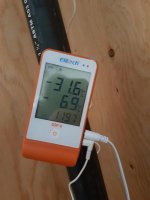
I bought a temperature logger for the recent cold snap we had.
The outside temp is temp 1
The inside temp is temp 2
The coldest the inside of the shop got was -9°C, the low range for the outdoor sensor was set at -35°C and you can see it hit that for a few nights. You can see the little spikes on the inside temp was days when the solar collector fired up.
The only source of heat is the solar system currently.
I bought a temperature logger for the recent cold snap we had.
The outside temp is temp 1
The inside temp is temp 2
The coldest the inside of the shop got was -9°C, the low range for the outdoor sensor was set at -35°C and you can see it hit that for a few nights. You can see the little spikes on the inside temp was days when the solar collector fired up.
Attachments

Ak Jim
Well-known member
Maybe I missed it but what are the R values for the walls, ceiling, and garage doors?
OP
2011laramie
Well-known member
R28 ROXUL in the walls.
R12 or 16 garage doors
R60 cellulose in the ceiling
R12 or 16 garage doors
R60 cellulose in the ceiling