To avoid these ads, REGISTER NOW!

reasonably priced vernier caliper

alfadan

Well-known member
Joined
Mar 9, 2007
Messages
2,106
Location
Augusta, ks
What grinds my gears is to see someone using a set of calipers as a scribing tool when attempting to do layout work. I equate that to using the screen of a good phone along with some water and Ajax to scrub pots and pans.
If it is a junk set of calipers, then fine, but it sure does not provide the learning of proper use of tool habits to new people who see it.
Some cheapy HF calipers are good for this!
 
To avoid these ads, REGISTER NOW!

dscheidt

Well-known member
Joined
Apr 26, 2017
Messages
2,888
I'm sure you know this, but I just want to mention it for those who may not. There were older Mitu models designed this way: they didn't remember zero when they were turned off. I don't think they make models like this any longer, but I still have a couple of those that require zero reset every time you turn them on. Using them for a long time created a habit when I do it (or, at least, recheck zero like I do with dial calipers) even with those models that don't require it.

Last time I looked, Mitutoyo still listed non-absolute models in the catalog. That's there branding for models that can read the scale and determine an actual location (as opposed to just movement away from an origin.) It's one of the things that improves battery life, because it means the read head can be totally turned off. This requires different scales and read heads, which are presumably more expensive to make. (a relative position scale is now in the realm of standard cheap PCB fab, which is why there are $10 digitial calipers that have sub-thou accuracy.)

Strictly relative scales can also be made somewhat more finely divided, which is why they're still around for some uses on higher end equipment.
 

jmarkwolf

Well-known member
Joined
Jan 15, 2013
Messages
1,812
Location
Southeast Michigan
Last edited:

RoninB4

Well-known member
Joined
Jul 22, 2020
Messages
3,512
Location
Under My House
Yeah, there are a bunch of tricks with zeroing that you probably either forgot or just have a better method for.
-Don't know if my methods are "better" it's just how I've learned to work with what I have. Your methods work for you and that's all that's important if you get a good reading.
example: I was measuring the distance between fastener holes. Using the inside jaws, I measured one of the holes and set zero. Then I measured outside edge of one hole to the outside edge of the adjacent hole. The reading was a pretty close center to center measurement.
-I just do the math in my head or grab the always nearby calculator for these readings if my head doesn't register at the moment.
you can use a lock on a dial for stuff, but it’s not as convenient as a zero.
-I'll grant you the zero set can be faster or more convenient if it helps
On aircraft, or automotive, I often have to take a measurement where it’s not possible to read the caliper.
-If I can't see the window/dial then I can't be sure I'm getting the jaws in the correct position relative to the feature. If I can't see then something else has to be done for good numbers. There are times when I don't have good access either and I watch the dial as I rock the caliper jaws into position for the lowest reading on the dial. I also use the dial to watch for when it's increasing too as I map surfaces or distances. Your methods work for you, more than one path to the top of the mountain.
I take the measurement, hit zero, and can readjust or bump the tool getting it out no problem.
-That works too
So yeah, it’s not just metric conversions, tho that’s pretty awesome.
-Metric I either do in my head or grab the calculator if I need the exact conversion. I'm just stubborn about some things but the DRO on the jig borer is digital so I will make some concessions to the 20th century now that it's over.
 

drmarkr

ALLIANCE MEMBER
Joined
Feb 5, 2006
Messages
4,209
Location
Tucson
I'm still waiting for the OP to confirm that he's talking about actual Vernier calipers. Something tells me he's not...
 

AEAdam

Well-known member
Joined
May 27, 2023
Messages
2,737
Location
SE PA
I'm sure you know this, but I just want to mention it for those who may not. There were older Mitu models designed this way: they didn't remember zero when they were turned off. I don't think they make models like this any longer, but I still have a couple of those that require zero reset every time you turn them on. Using them for a long time created a habit when I do it (or, at least, recheck zero like I do with dial calipers) even with those models that don't require it.
I think Mitutoyo calls this ABSOLUTE, and it’s not unique to digital calipers. I think I have it on digital indicators as well.
 

RoninB4

Well-known member
Joined
Jul 22, 2020
Messages
3,512
Location
Under My House
which is why there are $10 digitial calipers that have sub-thou accuracy.)
-Not wanting to be quarrelsome but no caliper, by nature of the design, should be trusted to read sub-thou for accuracy regardless of whether the display allows 4 decimal places (.xxxx) or not. This would be especially true for a $10 caliper. How many people can actually quantify what sub-thou is? Even taking a reading off a gauge block with calipers can be misleading and is no guarantee of accuracy.
 

AEAdam

Well-known member
Joined
May 27, 2023
Messages
2,737
Location
SE PA
I'm still waiting for the OP to confirm that he's talking about actual Vernier calipers. Something tells me he's not...
I can’t for the life of me imagine a situation where vernier calipers are out some appreciable amount. That’s like saying my shovel won’t start. Both digitals and dials can jump or miss readings in a certain range.
 

PCustoms

Well-known member
Joined
Jul 23, 2011
Messages
22,604
Location
VT
@RoninB4 @AEAdam

How are you measuring holes, or hole to hole distance, with any accuracy with calipers?

Sure, if you want to know you're in the ballpark, but for most things I can't see them being the appropriate tool. It amazes me what I see people put on prints and then they tell me the checked it "with calipers".

🤦‍♂️
 

AEAdam

Well-known member
Joined
May 27, 2023
Messages
2,737
Location
SE PA
-Not wanting to be quarrelsome but no caliper, by nature of the design, should be trusted to read sub-thou for accuracy regardless of whether the display allows 4 decimal places (.xxxx) or not. This would be especially true for a $10 caliper. How many people can actually quantify what sub-thou is? Even taking a reading off a gauge block with calipers can be misleading and is no guarantee of accuracy.
After reading TONS of arguments on Practical Machinist, I got all my measuring tools and measured gage blocks for fun. That’s an eye opening experience.

I practiced with my 1” gage block or a Starrett 123 block, and I returned the same numbers within .0005 over and over again. I am a champion measurer! Everyone on PM was wrong. Mitutoyo was wrong. I can easily measure within 1/2 a tho with my calipers. Hell, I could do it with a ruler.

Then I did a blind test on a 1.0000 block and a 1.0005 and a 1.001. I could easily get them all to measure the exact same with calipers. Their frames just aren’t stiff enough. They could all read 1.0000 or 1.0005.

So if you know what you want the calipers to read, you can get that, which makes them perfect for QA people everywhere! If you really need to know a measurement, use a mic.
 

AEAdam

Well-known member
Joined
May 27, 2023
Messages
2,737
Location
SE PA
@RoninB4 @AEAdam

How are you measuring holes, or hole to hole distance, with any accuracy with calipers?

Sure, if you want to know you're in the ballpark, but for most things I can't see them being the appropriate tool. It amazes me what I see people put on prints and then they tell me the checked it "with calipers".

🤦‍♂️
Right, it’s a ball park. You should never use calipers for a hole. Remember, I was using PLASTIC calipers. If I was within .010 over 6” that was good enough.
 

dscheidt

Well-known member
Joined
Apr 26, 2017
Messages
2,888
I can’t for the life of me imagine a situation where vernier calipers are out some appreciable amount. That’s like saying my shovel won’t start. Both digitals and dials can jump or miss readings in a certain range.

Bend them. Either the measuring ears, or the beam, or both. You'd probably notice if you closed them and paid attention, but you can easily get error there.
Someone has also probably made calipers with the scale engraved wrong, either with an offset, or scaled wrong. (and I have no problem believing HF would sell them...)
 

RoninB4

Well-known member
Joined
Jul 22, 2020
Messages
3,512
Location
Under My House
@RoninB4 @AEAdam

How are you measuring holes, or hole to hole distance, with any accuracy with calipers?
-Accuracy is a word relative to what's required. I've known (and challenged) some toolmakers that claimed they could read edge to hole center distance at +/- .010 with a scale (ruler for you civilians). I challenged and had to buy coffee when he proved it.
Sure, if you want to know you're in the ballpark, but for most things I can't see them being the appropriate tool.
-Excessive accuracy can be wasted time/effort if the feature isn't critical. This can even be true for things like clearance holes when doing a tolerance stack. A hole location for a water jacket on a large injection mold doesn't require a depth mic to determine if it's located according to the print. I was machining the holes for one and saw a .4375 dimension on the print. That would mean I'd have to jig grind the hole diameter (for 1/4 NPT) and verify the location to +/-.*** when in reality the draftsman was too lazy to change the decimal designation in his CAD program to read fractional for that dimension and location. The appropriate tool is often dictated by the function of that feature.
It amazes me what I see people put on prints and then they tell me the checked it "with calipers".
-What is put on prints and what is required are sometimes two different things. Prints have to be interpreted on the shop floor sometimes, depending on the engineer or CAD drafter. Features/dimensions created by newish engineers/drafters are sometimes absurdly close tolerance for the purpose, misguided by theoretical notions, or flatly wrong. Sometimes a caliper is good enough, sometimes a micrometer isn't good enough. Having spent a good deal of my life on the shop floor and engineering my standard response for the appropriate tool is "it depends".
 

RoninB4

Well-known member
Joined
Jul 22, 2020
Messages
3,512
Location
Under My House
After reading TONS of arguments on Practical Machinist, I got all my measuring tools and measured gage blocks for fun. That’s an eye opening experience.
-Bet is was eye opening
I practiced with my 1” gage block or a Starrett 123 block, and I returned the same numbers within .0005 over and over again.
-Repeatability is precision, not to be confused with accuracy as they are NOT the same thing. Accuracy is deviation from a true distance.
I am a champion measurer! Everyone on PM was wrong. Mitutoyo was wrong. I can easily measure within 1/2 a tho with my calipers. Hell, I could do it with a ruler.
-You're my hero :beer:
Then I did a blind test on a 1.0000 block and a 1.0005 and a 1.001. I could easily get them all to measure the exact same with calipers. Their frames just aren’t stiff enough. They could all read 1.0000 or 1.0005.
-Hand/thumb pressure deflection makes the reading a variable. Also consider how perpendicular the jaws are to the beam (indicator territory). Are the jaws truly flat (indicator territory) along the ENTIRE length? How about the slight amount of play between the head and the beam that allows it to slide? @AEAdam you probably already know this, I'm posting for those unfamiliar with it.
So if you know what you want the calipers to read, you can get that, which makes them perfect for QA people everywhere!
-:unsure:
If you really need to know a measurement, use a mic.
^ This.
 

whateg01

Well-known member
Joined
Mar 13, 2006
Messages
11,227
Location
doo dah, kansas, usa
-I'll grant you the zero set can be faster or more convenient if it helps
If I'm working to a dimension on the lathe it's nice to set the calipers to that dimension and zero it then the reading on the work tells me exactly how much I have left to go. Doesn't get much easier than that.

-If I can't see the window/dial then I can't be sure I'm getting the jaws in the correct position relative to the feature.
Especially if you can get away from the knife edge it's very easy to tell when the jaws are parallel to the surface.

There are times when I don't have good access either and I watch the dial as I rock the caliper jaws into position for the lowest reading on the dial.
Can still rock the calipers just like you would a mic. Do you only use a mic where you can read the thimble?

I also use the dial to watch for when it's increasing too as I map surfaces or distances. Your methods work for you, more than one path to the top of the mountain.
Totally different than just measuring something where you can't see the display.

-Metric I either do in my head or grab the calculator if I need the exact conversion. I'm just stubborn about some things but the DRO on the jig borer is digital so I will make some concessions to the 20th century now that it's over.
Yeah, I can totally convert 9.34 mm to inches in my head. Stubborn? Yes that's what it is. Isn't the dro just a big caliper without jaws? Why submit to that kind of laziness when you can still count turns of crank?
 
To avoid these ads, REGISTER NOW!

RoninB4

Well-known member
Joined
Jul 22, 2020
Messages
3,512
Location
Under My House
If I'm working to a dimension on the lathe it's nice to set the calipers to that dimension and zero it then the reading on the work tells me exactly how much I have left to go. Doesn't get much easier than that.
-You do you.
Especially if you can get away from the knife edge it's very easy to tell when the jaws are parallel to the surface.
-It's also very easy to make mistaken assumptions based upon your perceptions. I trust my instruments, you trust whatever you want to.
Can still rock the calipers just like you would a mic.
-I don't "rock" a micrometer, I feel for when it barely touches a surface.
Do you only use a mic where you can read the thimble?
-Yes. Locking the thimble and dragging it off can still allow the thimble to rotate. I prefer reading the moment of contact. You do you.
Totally different than just measuring something where you can't see the display.
-Oh, how about that. I appreciate you telling me what my methods do and don't do. I've spent 40+ years in machine shops misguided.
Yeah, I can totally convert 9.34 mm to inches in my head.
-Did you have a contributing point to make or are you just trolling once again?
Stubborn? Yes that's what it is.
-Your board name seems to reveal your motivations.
Isn't the dro just a big caliper without jaws?
-Perhaps by over-simplifying that single purpose. Some do much more than linear measurement y'know.
Why submit to that kind of laziness when you can still count turns of crank?
-Geez I dunno, does cumulative pitch error (CPE) mean anything to you?
 

PCustoms

Well-known member
Joined
Jul 23, 2011
Messages
22,604
Location
VT
Man, there's a lot of people in this thread that wouldn't make it in a modern shop or inspection department.
 

RoninB4

Well-known member
Joined
Jul 22, 2020
Messages
3,512
Location
Under My House
Wrong. Repeatability is not precision. I can repeatably measure to the nearest foot the diameter of a pencil lead. That's not precise, but it's accurate.
-Taken from a website, the definition is consistent with others. Do a search and educate yourself.

What Is Accuracy?​

accurate-notprecise.pngShots with high accuracy, low precision
Accuracy is a measure of how closely your experimental measurements agree with known values. The closer your measurements are to the known value, the more accurate the measurement.

If you think of the known value as the bullseye on a target, accurate shots (or measurements) mean the average of your shots is at or near the bullseye. The shots in this picture are accurate, but they are all over the target. This brings up the concept of precision.

What Is Precision?​

precise-notaccurate.pngShots with high precision, low accuracy.
Precision is a measure of how close your experimental measurements agree with each other. The closer each measurement is to the other measurements, the more precise your measurement.

If the measurements were shots in a target, the closer the holes are to each other, the more precise the shots. Here, the shots are all clustered together. They would be considered a precise collection of shots. The only problem is they are not very accurate.
 

50of4064

Well-known member
Joined
Mar 24, 2019
Messages
72
Location
Whittier, CA.
Without reading all the responses, has 1redTA identified what "reasonably priced," is to him?
We have covered, accurate, grouped, precise ...all very well put by the way
 

AEAdam

Well-known member
Joined
May 27, 2023
Messages
2,737
Location
SE PA
Without reading all the responses, has 1redTA identified what "reasonably priced," is to him?
We have covered, accurate, grouped, precise ...all very well put by the way
I think the quick answer is iGaging Chinese calipers for $50. Make sure you get models with CR2032 batteries.

Note they are IP54 which isn’t much protection from liquids. If you are going to mess with cleaners, coolants etc, spend more.

In my one minute of googling I found these which look intriguing.


MJD1

Well-known member
Joined
Dec 28, 2014
Messages
607
What grinds my gears is to see someone using a set of calipers as a scribing tool when attempting to do layout work. I equate that to using the screen of a good phone along with some water and Ajax to scrub pots and pans.
If it is a junk set of calipers, then fine, but it sure does not provide the learning of proper use of tool habits to new people who see it.
They do make specialty " scribing calipers" with carbide tipped jaws. Even plain calipers would have to have scribed a shiton of hardened material with insane amount of pressure to ever damage the tips.
 

no704

Well-known member
Joined
Apr 27, 2016
Messages
5,212
Got some chips in my dial gear the other day. Wouldn’t open or close past maybe a half inch. Pulled out the shim and cleaned the rack. Back up and working in about 2 minutes.
 

Steve_P

Well-known member
Joined
Sep 15, 2010
Messages
5,182
Used Mitutoyo 6" digital on Marketplace should be 50 to 80 bucks. Long as it's in good shape it'll live almost forever in the hobby/weekend user life as long as it's not dropped too many times

Big difference between them and the cheap knockoffs is battery usage. Mitutoyo batteries last years, cheap knockoffs months if you're lucky


The issue is that probably >90% of Mitutoyo digital calipers in circulation in the US today are Chinese counterfeits. Before I'd buy a used Mitutoyo assuming it's real, at a premium price, on FB or Ebay, I'd just buy a new generic digital and a few packs of batteries. Yes, I'm sure there are certain tiny details to determine real from fake, but that may change tomorrow.

If someone wants Mitutoyo, you need to buy it from a real vendor, like McMaster, and not on Ebay, Amazon, FB....
 

Chipm

Well-known member
Joined
Mar 10, 2020
Messages
428
Location
Georgia
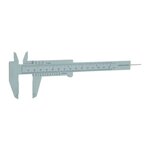
I found a plastic Vernier caliper in an old toolbox I was given and found it very useful, so I bought a NOS Craftsman off eBay. Yes, Vernier. No dial, no batteries, simple unless you need to read it and don't have glasses handy.
 

alfadan

Well-known member
Joined
Mar 9, 2007
Messages
2,106
Location
Augusta, ks
I have an old Helios brand vernier with the 1/128ths scale. I can't figure that **** out to save my life!
 

RTM

Well-known member
Joined
May 13, 2019
Messages
13,126
Location
SF Bay Area
People are calling digital calipers "verniers"

Kinda common.

I have an old Helios brand vernier with the 1/128ths scale. I can't figure that **** out to save my life!
Based on these two responses, I have no idea what a good snarky response is. 😉

I have a 1/128 and 1/1000 caliper, as posted above. Both make me think way too hard, and use a magnifier. The digital is easier to blame errors on, the true vernier it’s usually my error.
 

cannuck

Well-known member
Joined
Nov 30, 2021
Messages
4,609
Location
Rural SK
@RoninB4 @AEAdam

How are you measuring holes, or hole to hole distance, with any accuracy with calipers?

Sure, if you want to know you're in the ballpark, but for most things I can't see them being the appropriate tool. It amazes me what I see people put on prints and then they tell me the checked it "with calipers".

🤦‍♂️
In many cases a caliper is the ONLY tool that can measure hole-to-hole center distances with any degree of accuracy. You do so for smoothe bore holes by measuring outside to outside, then inside to inside and add the two together and divide by 2. For threaded hole I run a short bolt with some unthreaded shank in to bottom out or if too shallow with a locknut to center the bolt in the threads then measure the straight shank spreads and calculate as above.
 

50of4064

Well-known member
Joined
Mar 24, 2019
Messages
72
Location
Whittier, CA.
Without reading all the responses, has 1redTA identified what "reasonably priced," is to him?
We have covered, accurate, grouped, precise ...all very well put by the way
Ok, I have looked on EB, OU, FBM...everyone thinks they are selling gold, and some of that stuff looks like what the stray cat leaves in the wife's garden.
I did buy a very good used Sterret dial caliper and it has more than filled my needs. I paid $50 for it a few years back. The market has gone up, and I don't believe I would get that same price for the quality of the tool, today. It was a find!
If you haven't purchased a caliper yet, good luck with your quest. If you have, post an update with pictures of your new find.
 
Last edited:

AEAdam

Well-known member
Joined
May 27, 2023
Messages
2,737
Location
SE PA
Clearly that (Sterret dial caliper) is a fake!
I’ve gotten a lot of good deals on Starrett tools on eBay from people who couldn’t be bothered to read the name carefully on the tools they were selling. Mitutoyo same.

I bought a Starrett Crystal Pink surface plate for $10 from a guy who listed it as marble.
 
Last edited:

AEAdam

Well-known member
Joined
May 27, 2023
Messages
2,737
Location
SE PA
I found a plastic Vernier caliper in an old toolbox I was given and found it very useful, so I bought a NOS Craftsman off eBay. Yes, Vernier. No dial, no batteries, simple unless you need to read it and don't have glasses handy.
I too love them and have several. I use them as paint stirrers.
 
To avoid these ads, REGISTER NOW!
Top Bottom