To avoid these ads, REGISTER NOW!

Rebuilding a monarch 10ee lathe

OP
G

Grant Gunderson

Well-known member
Joined
May 17, 2013
Messages
2,320
Location
Bellingham, WA
My Vegas shoot went really well. We avoid the typical Vegas stuff, and spent all of our time up at Lee Canyon where the temps where in the Low 70's despite Vegas only being 45 minutes away and over 100.
2208237611.jpg
2208242983.jpg
The biking was better than expected and I think they are going to do quite well as a mountian bike destination. After getting caught up with work, family stuff, and general bike and shop maintenance is finally back to focusing on the lathe.

I got a McMaster order in with a few small supplies I have been needing to button up a few things.
Screen Shot 2022-09-09 at 9.08.09 PM.png
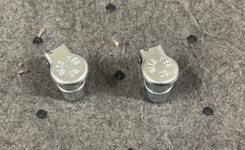
I ordered two of these oil cups for the tail stock, as I was missing the factory button style caps.
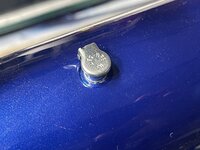
IMG_8198.jpeg
They just press right in. Unfortunately one has a broken hinge so I'll need to get a replacement for the second one. I also ordered some
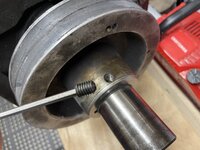
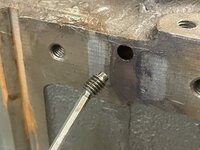
10-24X ½" snake-eye screws in stainless steal as the compound wheel was missing the proper screw.
IMG_8199.jpeg
I injected the threads with some Tef-Gel (my go to anti-seize these days) then screwed in the screw.
IMG_8204.jpeg
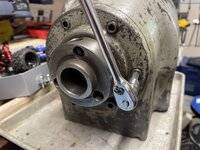
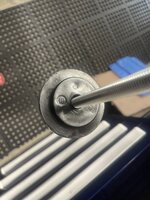
I used an adjustable pin spanner for this that I had left over from my days in camera repair. This looks way better than the SHCS that the previous owner had in its place.
IMG_8205.jpeg
I also ordered new hardware for the tailstock alignment screws. I went with 316 stainless for these. They are a ⅜-24 X 3" bolts.
IMG_8206.jpeg
They also got a good coating of the Tef-Gel before I installed them.
IMG_8209.jpeg
IMG_8211.jpeg
 
Last edited:
To avoid these ads, REGISTER NOW!
OP
G

Grant Gunderson

Well-known member
Joined
May 17, 2013
Messages
2,320
Location
Bellingham, WA
IMG_8051.jpeg
I also ordered a Siemens ESP200 Thermal Overload really for additional protection of the motor. I am leaving the factory heater protection in place, but this modern version is for piece of mind. Unlike the heater protectors this unit basically acts like a built in clamp meter. the 3 wires that feed power to the motor (T1, T2, T3 (#3)) each get feed through one of the holes in the unit. Then you connect wires from the #95 and #96 terminals on the unit into main contactor coil circuit. The idea is when this unit gets tripped, it breaks the power circuit that energizes the coil, and in turn shuts the lathe off.
IMG_7975.jpeg
To connect it to the starter, I removed the jumper going from the stock heater protection to the coil.
Screen Shot 2022-09-09 at 9.24.49 PM.png
So in theory, if the motor is overloaded (drawing too much current) either system is capable of shutting the system down. Since there is no room to mount the unit in the existing area of the main contactor, I am remotely mounting it in the same box that is housing the capacitors. This resides in the compartment on the back of the lathe where a coolant pump would typically be installed. So I removed the T1 and T2 wires that feed the motor panel from the contactor.
Screen Shot 2022-09-09 at 9.28.50 PM.png
Underneath the contactor is a ½" pipe plug. Its originally there for running power to an optional coolant pump, so its the logical way to run the T1, T2 and the switching wires for the thermal overload.
IMG_8038.jpeg
a ⅜ ratchet was perfect for removing the plug.
IMG_8043.jpeg
I then ran watertight conduit to the box on the back of the lathe. This should ideally keep the wires free from oil and other contaminants.
IMG_8042.jpeg
I am using the "all metal" version of the watertight conduit connectors. These are way more robust, as an internal ****** gets screwed into the conduit, and it then works just like a typically compression fitting. Where as the plastic style just relies on the friction of the tube to hold it in. Worth the extra $1 in my opinion.
IMG_8052.jpeg
The overload has these square style ports that you feed the switch wires into. While you could just push the bare wire in and clamp it down, the proper way is to use a wire ferrule.
IMG_8055.jpeg
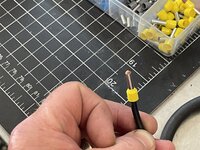
Slide it over the stripped end of the cable, with the bare wires flush with the end.
IMG_8056.jpeg
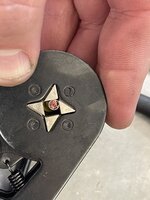
I then use a square ratcheting crimper.
 
OP
G

Grant Gunderson

Well-known member
Joined
May 17, 2013
Messages
2,320
Location
Bellingham, WA
IMG_8060.jpeg
The square ratcheting crimper leaves these ridges into the now box formed cable end. These priovide for better clamping with the units clamp screw.
IMG_8071.jpeg
Now that I am hopefully done with needing access to the main contactor area I chased, then injected the bolt holes for the cover with some Tef-Gel.
IMG_8074.jpeg
I had to grind down the diameter of the heads of the new stainless SHCS to get them to fit.
IMG_8075.jpeg
All buttoned up.
IMG_8062.jpeg
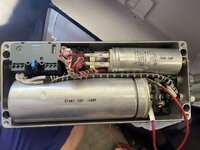
Ideally it would have been nice to have a larger box for this, but I am using the largest one I could find that would still fit the space in the back of the lathe. This is it before I hooked the T1, T2 and #3 leads from the motor through the overload and terminated to the terminal block inside of the box that the T1, T2 lines hooks to from the contactor as well as the start / run capacitor circuit. Feeling confident that I had kept all of the wires straight with the my labeling, it was time to test it.
IMG_8099.jpeg
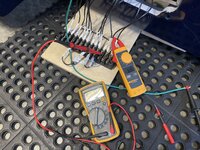
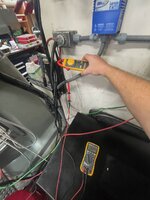
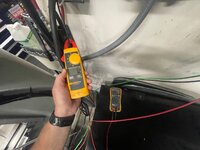
Humm, sustained 52 amps on T1 and only 117.5V one T3 something is obviously wrong. In my prior testing, I was only getting 40ish amps on immediate startup before it almost instantly dropped down to 9.5amps and T3 read 503VAC before. I am using a larger run cap to hopefully reduce that 500VAC number, that doesn't explain this. I then used the continuity feature of the meter to verify I had T1, T2 and #3 leads from the motor to the capacitor box correct. Turns out I had reversed T2 and #3. ****. I guess thats what I get for finishing that portion of the wiring late at night. I then verified that I had the wires correct from the main contactor, and the start circuits correctly wired and tried another test.
IMG_8125.jpeg
Ok, T3 is now reading 503.6V, so same as I had in prior testing, so thats ok, but T1 is now reading 68.9 Amps!!! Something is still clearly wrong. I shut the lathe down quickly and proceeded with one more test, but this time with the clamp meter on L1 feeding the lathe from the 30 amp breaker in breaker box, it read the same. Something is clearly not right. Looking at the circuity, its pretty clear that when I had T2 and #3 reversed I had the high voltage on the wrong side of the potential relay thats supposed to cut the start cap out of the circuit. I'm fairly certain I fried the relay, so ordered a replacement. I then tested the resistance of each of the motors oils and got 0.7Ω and 0.9Ω values on the various coils. Exact same as I had in prior testing, ok thats good. I then megged the motor again testing each coil to ground, as well as testing each coil to each coil. All of the tests with the Megger resulted in >4000MΩ so the motor test fine. I also verified that it spins freely by hand so its not locked up. What is puzzling is that with that much current being drawn it didnt trip the 30amp breaker on the sub panel, nor the 50 amp breaker that feeds the sub panel. It also didnt trip either of the 30 amp fuses in the disconnect, nor did it trigger either of the motor overloads. I then tested the fluke clamp meter on the individual leads that power my Bridgeport's motor, and got reasonable values, so I am fairly certain the clamp meter is working properly. I then verified the capacitors with the Fluke 117 and both read the same amount of capacitance and prior to testing, so I beige they are still good. So I think I have checked off the various possibilities, so next plan is to re-test when the new relay arrives. Hopefully on Monday.
 
Last edited:
matt_i

Well-known member
Joined
Mar 14, 2008
Messages
10,728
Location
SE Michigan
Great thread, enjoy all of your special tools and techniques! Wish my shop was 10% of that well organized!!

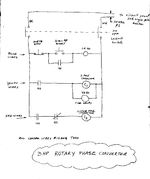
I'm not totally following the phase conversion here, I'm not sure if you have a full wiring diagram bur it can really help out. This is ~20yo information at this point but thought maybe it could help.

Essentially in my static converter I used a timing relay instead of the potential relay. Takes a bit of tuning and can change based on the weather but its pretty simple. One diagram for the "control" and the other for "power" wiring. This is a 3hp design but I'd just size the wiring, contactors and start cap up to what's needed for the larger motor.

Breaking into the motor to separate the starpoint is advanced I will say! It seems like it might have some advantages if the motor has to be reversed but my very limited knowledge of the M-G set is that it only spins a single direction.

phase_control_logic.gif

phase_field_wiring.gif
 
OP
G

Grant Gunderson

Well-known member
Joined
May 17, 2013
Messages
2,320
Location
Bellingham, WA
Great thread, enjoy all of your special tools and techniques! Wish my shop was 10% of that well organized!!

I'm not totally following the phase conversion here, I'm not sure if you have a full wiring diagram bur it can really help out. This is ~20yo information at this point but thought maybe it could help.

Essentially in my static converter I used a timing relay instead of the potential relay. Takes a bit of tuning and can change based on the weather but its pretty simple. One diagram for the "control" and the other for "power" wiring. This is a 3hp design but I'd just size the wiring, contactors and start cap up to what's needed for the larger motor.

Breaking into the motor to separate the starpoint is advanced I will say! It seems like it might have some advantages if the motor has to be reversed but my very limited knowledge of the M-G set is that it only spins a single direction.

phase_control_logic.gif

phase_field_wiring.gif
Thanks!
This is the schematic of the motor wired for typical 3 Phase High Voltage. The coils are in series.
Screen Shot 2022-07-05 at 7.57.26 PM.png
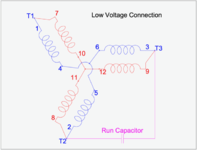
This is a typical Low-Voltage setup with a run-capacitor. The coils are parralell.
screen-shot-2022-07-05-at-8-13-09-pm-png.png
This is the Steelman configuration.
Screen Shot 2022-07-05 at 8.04.56 PM.png
Notice how its very similar to the low-voltage circuit, but T3 is wired in series, same as the High-voltage circuit.
Screen Shot 2022-09-09 at 11.08.38 PM.png
This is the Steelman configuration with the start/run circuit drawn in. I may switch to a timing relay if the potential relay proves un-reliable. My plan ones I get my current issue figured out, is to test both the Steelman and the Low-Voltage configuration under load using my scope to better understand the difference between the two methods before deciding on the final configuration. The nice thing is I have options with they way I have done it so far.
 

RickP

Well-known member
Joined
Jan 15, 2013
Messages
1,550
Location
Annapolis, MD
I've been reading your thread and finally caught up to present day -- what an incredible job on the restoration! Not only are the mechanical parts top notch, but the electrical restoration/changes are over the top. I'm sure you'll get this issue figured out quickly and put it to work.
 
OP
G

Grant Gunderson

Well-known member
Joined
May 17, 2013
Messages
2,320
Location
Bellingham, WA
Ok, so I tested each winding with my clamp meter by applying 120V ac across each one. I only got a few seconds before it blew the fuse each time on the extension reel I used. So these are possibly just start up amperage, but they do seem quite high. The motor does start to spin with each coil test.

So for coil 1-4 I got 47.8 AMps
Coil 7-10 I got 48 amps
coil 9-12 I got 47.8 amps
coil 6-3 I got 48 amps
coil 11-8 I got 47.8 amps
coil 2-5 I got 48 amps

I also tested the clamp meter VS my Fluke 117 using one of the power leads for my Bridgeport.
The clamp meter consistently read high, but by carrying amounts.
image.jpeg
1.8 Vs 1.3 A
image.jpeg
1.4 VS .993 A
image.jpeg
1.2 Vs .835 A
image.jpeg
1.4 VS 1.2 A

So that is less than confidence inspiring for the clamp meter, but I dont think it explains such high values with the motor windings.
image.jpeg
The name plate for the motor reads max 6.6 Amps at 440V isn't that spread over 4 windings in series?
image.png
It reads 13.2 amps at 220 V I believe thats across two sets of windings in series in parallel.
image.png
So then with 120V with just one winding would that make sense for the higher amperage ?

Now, If I do some basic math with Ohms law V=IR, plugging in the measurements I recorded lets see if we can make sense of it all.

so 48AX0.7Ω = 33.6 V.
or I = V/R so 120V / 0.7Ω = 171A
or R = V/I so 120V/48A= 30Ω

None of the calculated numbers work out with the data I recorded. Something is clearly wrong.

Humm. If I take the numbers I got from one winding and multiplied it by 4 (for having 4 windings in series) I then get numbers that make sense for what I am reading.

33.6V x 4 windings would be 134.4V
120v / (.7Ω x4 windings) = 42.8A
120V / 48A x 4 windings) 0.625Ω

Does this make sense? Or am I just talking myself into thinking it does? Or have I just proven I'm off everywhere by a factor of 4? I think I need to calculate the equivalent for the numbers I got at @220 and @440 for a single coil if that makes sense.
 

American Locomotive

Well-known member
Joined
Jan 8, 2017
Messages
10,977
Location
Rhode Island
Those calculations only work for pure resistive loads. A motor is not a resistive load and has inductive reactance. You'd have to measure the inductance of each winding, calculate the effective impedance at 60Hz, and then that would get you a starting point. But the spinning rotor further complicates things.
 
OP
G

Grant Gunderson

Well-known member
Joined
May 17, 2013
Messages
2,320
Location
Bellingham, WA
In the test I just did above, applying 120Vac to each winding separately produced a consistent 47~48Amps on each one!

With 120 VAC applied to Winding 1-4 47A
With 120 VAC applied to Winding 2-5 48.A
With 120 VAC applied to Winding 3-6 48A
With 120 VAC applied to Winding 7-10 48A
With 120 VAC applied to Winding 8-11 47A
With 120 VAC applied to Winding 9-12 47A

I then placed the Jumpers for the standard Low-Voltage wiring configuration
image.png
T1 ~T2 0.8Ω
T2~T3 0.8Ω
T3~T1 0.8Ω

With the Megger I get
T1~ground >4000MΩ
T2~ground >4000MΩ
T3~ground >4000MΩ

Applying 120VAC across T1 and T2 I get 41A on each briefly before I trip the fuse on the extension reel. Motor just humms.
Applying 120VAC across T2 and T3 I get 41A on each briefly before I trip the fuse on the extension reel. Motor just humms.
image.jpeg
For what its worth, I have not touched these bottom motor winding terminals since I did my previous testing and has amperage on T3 in the 9Amp range after start up amperage around 40.

With no power to it and each winding independent of each other I get the following:
Winding 1-4 0.9Ω
Winding 2-5 0.9Ω
Winding 3-6 0.9Ω
Winding 7-10 0.9Ω
Winding 8-11 0.9Ω
Winding 9-12 0.9Ω

I then tested each set of windings individually using a 100 watt incandescent light bulb in series with the motor leads. This acts as a variable resister to knock the amperage and voltage down to more reasonable levels to test.
image.jpeg
It's amazing how hard it is to find an incadensent light bulb these days. I bought the only package of 100 watt bulbs my local Lowes had. Heck, I haven't even seen a traditional bulb in 10 years as are last two houses have had all florescent and now all LED lighting.

Here are my test results with this setup:
Winding 1-4 0.5 Amps 3.45 VAC
Winding 2-5 0.5 Amps 3.54 VAC
Winding 3-6 0.5 Amps 3.89 VAC
Winding 7-10 0.5 Amps 3.81 VAC
Winding 8-11 0.5 Amps 3.76 VAC
Winding 9-12 0.5 Amps 3.27 VAC

So that gives me roughly 7 ohms VAR's (volt / amp reactance) per winding, so pretty sure I do not have a shorted turn, but it seems like its double what it should be. I'm a bit stumped on why it seems to be drawing so much current. At this point, its time to move on with other projects on the late, and give the brain a rest and then re-visit it with a fresh mind.
 

Attachments

  • image.jpeg
    image.jpeg
    296.5 KB · Views: 2

matt_i

Well-known member
Joined
Mar 14, 2008
Messages
10,728
Location
SE Michigan
It does seem like your windings are good condition and similar basic resistance.

One of the disadvantages of the Steelman is that you can't go test it on another AC motor without customizing it.

Does Steelman have any tech support where you could get to speak with an actual product engineer? If you can find the right person, likely they have seen several scenarios where the motor won't run as expected and they helped develop troubleshooting.

Alternative idea would be to haul the motor itself out, find a shop with 3phase where you can connect high or low voltage and let it work in the original configuration...that will tell you very quickly if there's a problem. If you know an industrial electrician they will probably "have the right connections" har de har har. But also being serious :)

Third alternative would be to see if there's a motor repair shop in your area...they probably have the knowledge and test capability to troubleshoot your issue.
 
Last edited:
OP
G

Grant Gunderson

Well-known member
Joined
May 17, 2013
Messages
2,320
Location
Bellingham, WA
With a much needed break from dealing with the electronics, I decided to start working on the headstock. First step is removing the spindle lock.
IMG_8276.jpeg
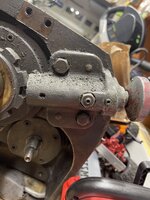
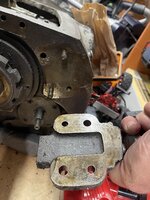
It's held on by two bolts, and two pins.
IMG_8283.jpeg
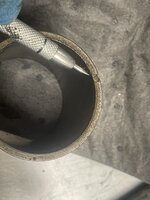
Once the bolts where out, it took a bit of wiggling to free it from the pins. You can see the filters mark in the circle just above the hole center line at bottom.
IMG_8286.jpeg
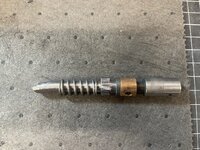
The business end of the locking pin is pretty haggard.
IMG_8295.jpeg
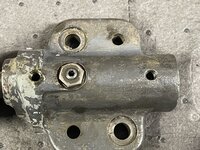
There is a series of set screws on each end. Underneath a standard set screw is an additional dog point set screw on the handle end.
IMG_8298.jpeg
In the center there is a nut securing another dog point set screw.
IMG_8300.jpeg
The set screw and the nut came out together.

IMG_8308.jpeg
The handle is held on by a straight pin. It tapped out pretty easily. I started the process with a short pin punch, then transtioned to a longer one to get it out.
IMG_8310.jpeg
The plunger pin is obviously bent. Since the end was mangled with no flat spot to push on, I used a starter punch in the about vise.
IMG_8315.jpeg
The handle end of the shaft is sitting in my Starrett bench block to hold the assembly steady.
IMG_8325.jpeg
Here you can see that the plunger shaft is clearly bent.
 
OP
G

Grant Gunderson

Well-known member
Joined
May 17, 2013
Messages
2,320
Location
Bellingham, WA
IMG_8328.jpeg
Upon closer inspection, I realized there is a pin holding each of the steel parts on that trap the bronze bushing. Those pins where ground flush with the exterior surface, so I used a starter punch and the bench block to tap them out.
IMG_8332.jpeg
Once the two pins where out, I used the arbor press again with a long steel pin punch to press the shaft out of it.
IMG_8334.jpeg
The center pin is soft steel. Its 0.3700" so it appears to be an undersized ⅜ pin.
 
OP
G

Grant Gunderson

Well-known member
Joined
May 17, 2013
Messages
2,320
Location
Bellingham, WA
Next up is removing the spindle.
IMG_8247.jpeg
There is a single long setscrew / pin on the backside of the headstock that locks into a grove for the front bearing assembly to prevent rotation. It has to come out.
IMG_8251.jpeg
Next, the drive pully is secured by a single large setscrew.
IMG_8254.jpeg
I then used my Posilock #106 puller to remover it with some random steel scrap that had come with the lathe to press against.
IMG_8267.jpeg
I used a brass pin punch to remove both of the woodruff keys that aligned the fully to the shaft.
IMG_8420.jpeg
The notched ring that the spindle lock engages was on quite firmly. None of my pullers had the reach to remove it. So I used pry bar, slowly working my way around under it was loose. I then used a piece of hard wood to tap it off.
IMG_8426.jpeg
You can't press it off when you pull the spindle as it has a woodruff key under it as well. Same size as the other two.
IMG_8379.jpeg
All 6 of the SHCS that hold the front retaining ring come off.
IMG_8396.jpeg
I then threaded a 12" section of ⅜ all thread into each of the holes. Next I measured the outside distance across the rods. This minus ⅜" is the diameter of the bolt hole pattern.
IMG_8399.jpeg
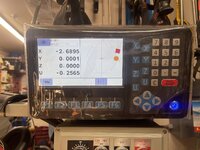
Pluging the diameter into the DRO on the mill along with the number of holes, gives me the bolt hole pattern. Just move to the coordinate the DRO says for each hole. It make the hole process go super quick, I used a ⅜" fostner bit and a ⅝" foster for the center hole.

The board gets slid over the ⅜" all thread and is secured on both sides by a nut and washer. I then passed the ⅝" all thread through the center hole in the board through the spindle and a scrap board on the back end.
IMG_8432.jpeg
 
OP
G

Grant Gunderson

Well-known member
Joined
May 17, 2013
Messages
2,320
Location
Bellingham, WA
Before I pressed the spindle out, I spent a bunch of time inspecting the gears. With the woodruff key slots in the spindle point up, I found a set of reference marks on the tachometer gear.
IMG_8384.jpeg
I then marked the top center line of the clutch gear as well.
IMG_8386.jpg
I also scribed "UP" above it. I then proceeded very slowly to press the spindle out. It took very little force with the wrenches to get it to move. Part of my concern was if the tach gear would fit through the bore, as my tach gear had no set screw on it.
IMG_8434.jpeg
As I slowly moved it forward I would rotate the spindle to make sure the gear was free. It ended up fitting through with no issues.
IMG_8441.jpeg
As the front bearing assembly pulled out, I used a sharpie to draw the top center line along the bearing unit. and also marked the top center of the head stock and the front bearing retainer.
IMG_8451.jpg
Notice the factory "V" mark that indicated the top center position of the spindle
IMG_8470.jpg
In addition to my Top center line on the clutch gear, I also scribed "front" and an arrow pointing to the bed side of the head stock to make sure it goes back in the correct direction.
IMG_8474.jpeg
Note the indicator mark on the phenolic tach gear, the spindle bearing retainer and the spindle bearing assemblies all light up.
IMG_8476.jpg
The phenolic gear just pulls right off. It's only held on by a small woodruff key. Note in addition to the stop center scribe mark, I found that someone had put a second set on the gear and the spindle bearing retainer indicating where the woodruff key slot is. There is evidence that someone tried to press it on in the wrong spot before. Luckily its not broken! You can also see some damaged to the bearing lock ring that some must of used a screw driver on it, instead of using the correct hooked spanner wrench. So either the bearings have been replaced at somepoint, or someone adjusted the pre-load. No idea of which yet.
 
OP
G

Grant Gunderson

Well-known member
Joined
May 17, 2013
Messages
2,320
Location
Bellingham, WA
With the spindle out, you can get a better sense of how beefy it is!
IMG_8653.jpeg
The bearing locking ring holds the front spindle bearings in place, and thus the front bearing retainer. As much as I would like to take the front bearing retainer off for painting, I think I am going to leave it on there. Those bearings are damn hard to come buy and if you can find them, they are extremely expensive. So probably best to leave it be.
IMG_8482.jpeg
At the 6 o'clock position on the front bearing retainer plate, there is an oil drain. Mine was completely clogged full of ****. I got most of it out with a pick. Hopefully a good flushing will clean the rest of it out. If not, I might have to take the bearing assembly apart.
IMG_8483.jpeg
The 3 spindle lock cams, each have a detent screw associated with them. I removed the screws.
IMG_8484.jpeg
Then used a pick to pull out the detent spring behind each of them.
IMG_8486.jpeg
I could then push the lock camps into the center of the spindle to remove.
IMG_8488.jpeg
Followed by the detent plunger.
IMG_8490.jpeg
I scraped the old gasket off of the front of the head stock. There is an oil return line at the 6 o'clock position. Its fully clogged as is going to take some effort to get it to flow again.
IMG_8493.jpeg
I then removed the pipe cap on the head stock drain. Oiled flowed from it very slowly. Its probably clogged at 80%. While the oil was draining, I turned my attention to the front of the head stock.
IMG_8496.jpeg
I removed the oil fill plugs, then started to work on the oil sight gauges. All of them are either missing the sight glass, or the sight glass is broken, so I will have to replace the glass.
IMG_8498.jpeg
I was able to get one of them out using a splunger tool. You can see the cork gasket still in the bore. The cork has glued the other two in, so I'll need to try some solvent or heat on them.
 
OP
G

Grant Gunderson

Well-known member
Joined
May 17, 2013
Messages
2,320
Location
Bellingham, WA
The mounting plate for the forward / reverse switch has for small screws holding it on.
IMG_8501.jpeg
I had to clean the heads out with a dental pick, so I could get enough purchase with a hex socket to break them loose. They where quite stubborn.
IMG_8506.jpeg
I then used a splunger tool to break the seal between the plate and the paper gasket behind it.
IMG_8507.jpeg
Note, the small detent pin, and the detent spring behind it.
IMG_8512.jpeg
The clutch shifter tube packing nut, is above, you can see some of the packing behind it.
IMG_8514.jpeg
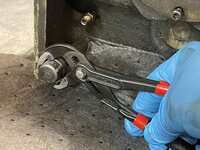
I removed it with my old camera spanner wrench... one of the straight attachments seem to have gotten lost in the top of my tool chest. I need to clean that out....
IMG_8517.jpeg
The clutch shifter tube packing nut removed and the string packing that was behind it. I wonder if I could replace the sting packing with an oil seal?
IMG_8519.jpeg
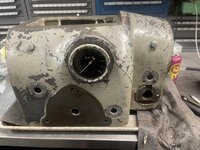
I then flipped the headstock on to its nose. With the spindle out, its still F'n heavy! The mounting brackets and their bolts get removed, so it will sit flat on the bench to work on it.
IMG_8521.jpeg
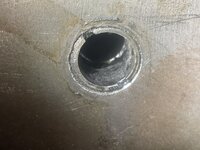
Note the two holes along the center line. They each have a set screw
IMG_8524.jpeg
Followed by a Dog point set screw under them.
IMG_8527.jpeg
I believe these secure the reverse idler studs.
 

tarmy

Well-known member
Joined
May 28, 2014
Messages
4,688
Location
Nor Cal
lovin’ the detailEd postings…been following for some time.

you could use packing cord that they use in boats for the shaft instead of that string, just a thought.
 
OP
G

Grant Gunderson

Well-known member
Joined
May 17, 2013
Messages
2,320
Location
Bellingham, WA
IMG_8530.jpeg
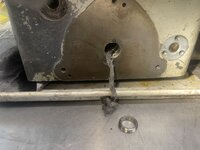
The ¼" x 3" pipe ****** was awfully tight. I ended up having to do the tighten it to loosen it trick before I could get it to budge. The bijour oil fitting next to it, has no numbers on it. I'll have to figure out what size it is before I order one. Id compare it to my saddle ones, but thats already back on the lathe. This unit doesn't not appear to have the metering screens in it either.
IMG_8539.jpeg
After the headstock had been sitting on its nose for a while, the rear spindle bearing spacer slid out under its own weight.
IMG_8541.jpeg
There is a factory mark "D" on the end opposite the bed.
IMG_8546.jpeg
The spindle clutch gears are each held in place by a set screw.
IMG_8552.jpeg
With a dog point set screw under it. Note the Left Hand (rear) spindle clutch gear has a longer dog point holding it in then the (front) Right Hand gear
IMG_8548.jpeg
I placed a witness mark on it top center. It also has two factory dimple marks to indicate this as well. The left hand gear also has a "M" stamped on it.
IMG_8561.jpeg
The Right Spindle clutch gear (front) has the shorter dog point screw.
IMG_8578.jpeg
The spindle clutch fork is held in place by two SHCS that each have a lock washer under them.
IMG_8584.jpeg
It has to come out to get the gears out.
IMG_8598.jpeg
I then removed the set screw on the right hand reverse gear. That gear is located under the tachometer and I didnt want to risk breaking any gear teeth when I pressed out the Right (front) spindle clutch gear.
 
To avoid these ads, REGISTER NOW!
OP
G

Grant Gunderson

Well-known member
Joined
May 17, 2013
Messages
2,320
Location
Bellingham, WA
I'm not a fan of pounding to taping on bearings, when they can be pressed out. So in order to get the spindle clutch gears out, I needed to make a makeshift press.
IMG_8592.jpeg
Some all thread and the plastic drifts out of a cheap seal press kit I had did the trick.
IMG_8593.jpeg
In order to help keep things aligned, and to prevent the press from binding or the all thread from hitting the machined surfaces I used smaller plastic drifts that fit into the bore.
IMG_8594.jpeg
The other end I used a plate across the rear bearing retainer.
IMG_8595.jpeg
The Right (front) spindle clutch gear pressed out very easily.
IMG_8599.jpeg
IMG_8600.jpeg
Note the factory alignment marks on the bed end.
IMG_8602.jpeg
View from the front of the spindle toward the end-gear side.
IMG_8613.jpeg
 
OP
G

Grant Gunderson

Well-known member
Joined
May 17, 2013
Messages
2,320
Location
Bellingham, WA
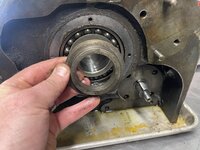
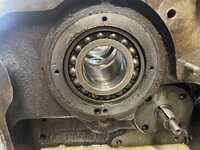
The rear spindle bearing retainer is hold on by 4 SHCS. With those removed I couldn't get it to budge.
IMG_8614.jpeg
Luckily there was enough space between the bearing and the inner oil throw plate to get my Posilock internal bearing puller. A couple hits with the slide hammer attached and it came right off.
IMG_8617.jpeg
IMG_8619.jpeg
IMG_8622.jpeg
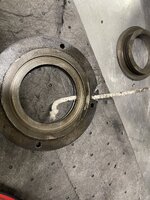
Note the oil return passage just off of the 6 O'clock position.
IMG_8625.jpeg
It corresponds to the channel as marked by this pipe cleaner. The oil throw plate channels the return oil into a groove in rear bearing retainer plate and then back to the return passage via this.
IMG_8628.jpg
I put a witness mark at top center on the bearing here.
IMG_8631.jpeg
To remove the bearing, I used my shop made puller setup again, but this time with a section of 4" abs pipe as a bearing catching cup.
IMG_8633.jpeg
The bearing is a New Departure 5210. It's marked with an "r" and has a check mark on it along with "12XX" that looks like a factory scribe mark. Not idea what any of those designations mean. The bearing feels to be in good shape.
 
OP
G

Grant Gunderson

Well-known member
Joined
May 17, 2013
Messages
2,320
Location
Bellingham, WA
To get the Left Hand (rear) spindle clutch gear out, I first removed the set screws on both the Left hand reverse gear and the reverse idler gear to prevent from damaging any of the gear teeth.
IMG_8641.jpeg
The reverse idler gear had a very long dog point set screw.
IMG_8646.jpeg
The left hand reverse gear had a much shorter dog point.
IMG_8636.jpeg
I then used the same puller setup as before, but this time with a piece of scrap ply over the nose end.
IMG_8637.jpeg
IMG_8638.jpeg
That gear took considerably more effort to press out than the front!
IMG_8648.jpeg
IMG_8651.jpeg
The bearing at first felt like it had an issue, but after playing with it a bit, I think the bearing / gear stack is way looser than the front, so I'll probably take it apart and see if I can adjust it.
 
OP
G

Grant Gunderson

Well-known member
Joined
May 17, 2013
Messages
2,320
Location
Bellingham, WA
Ummm… “splunger”!?!
Typo. The software keeps auto correcting Spudger to what it thinks is correct. Amazon has a ton of different sets, all seem to be the same quality. I find they do a great job when nothing else will work. I also have a set of dental grade spatulas that work as well.
IMG_2449.jpeg
lovin’ the detailEd postings…been following for some time.

you could use packing cord that they use in boats for the shaft instead of that string, just a thought.
Thanks, I've learned a lot on here by following other's detailed threads, so hopefully this can do that same for others. Regardless its nice to have the input and sugestions from others when trying to solve some of the issues.

I'm really not familiar with packing seals at all. From what I have read it seems like packing seals will always seep a bit, but gland seals wont. The advantage of packing seals is they tend to not fail catastrophically like a gland seal would, but I dont think thats an issue in this case. Probably comes down to if I can find the correct gland seal size.
What a tremendous amount of work you've put in to get it this point -- I'll bet when you finish it will be better than the day it left the factory!
Thanks. I doubt it will be better than when it left the factory, but hopefully I can get it close. I took it on more as a learning process than anything else, and with that, its already been a great success.
 

tarmy

Well-known member
Joined
May 28, 2014
Messages
4,688
Location
Nor Cal
Packing seal is basically heavy cord…and yes it is designed to weep water. It depends on how many wraps and how tight the nut is set on the material. My thought was that is would soak up the oil and NOT weep that heavier/denser oil vs. water. Not sure if it would work, but I have used it for something similar on a pump where there was no pressure behind the seal and it worked well. some of them have a bit of a wax type coating that helps seal the shaft…just an option. Good luck on the hunt for the actual correct part.
 
OP
G

Grant Gunderson

Well-known member
Joined
May 17, 2013
Messages
2,320
Location
Bellingham, WA
Up next is removal of the reverse shaft from the head stock.
IMG_8664.jpeg
The rear bearing retainer for the reverse shaft was quite stuck. I ended up tapping it with a drift and a hammer to get it to rotate free.
IMG_8666.jpeg
I could then pry it up free.
IMG_8667.jpeg
It has a Victor 60250 oil seal in it.
IMG_8672.jpeg
I used a blind bearing puller and a slide hammer to remove the oil seal as there was no way to push it out from behind.
IMG_8687.jpeg
It's 44.5" OD, 1MM thick and the shaft is 25MM. Its not a common size. Based upon a post I found on PM, I ordered two of these. AVX #TC25x44.5x6.
IMG_8689.jpeg
I had previously removed the setscrews from the reverse gears to get the clutch gears out.
IMG_8694.jpeg
Using a long pry bar, I was able to slide the gears a bit on the shaft, but not easily. I suspect the woodruff keys for them may be burred.
IMG_8698.jpeg
To protect the gears from the shaft pulling forces, I placed a piece of ½" scrap ply between the rear gear and the headstock housing, then placed another block of scrap hardwood between the two gears.

Based upon that same thread referenced above, I put together a puller to remove the rear bearing, the reverse shaft and both reverse gears.
IMG_8688.jpeg
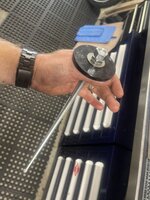
The reverse shaft end is ⅜-24 fine thread. Using a coupling nut and an extra ⅜-24 bolt that I had ordered for the tail stock I made a puller with some steel cups and tubing from a truck ball joint press kit I have.
IMG_8691.jpeg
 
OP
G

Grant Gunderson

Well-known member
Joined
May 17, 2013
Messages
2,320
Location
Bellingham, WA
Top view of the setup
IMG_8702.jpeg
It took quite a bit of force to pull the shaft and the bearing free. I think you would have a hell of a time doing it with a slide hammer setup.
IMG_8706.jpeg
The RH (front) gear slid off pretty easily
IMG_8713.jpeg
I marked it and the side facing the lathe's bed with a carbide scribe on a non wear section of it.
IMG_8716.jpeg
I had to add some more tubing to the puller to get the LH (rear) gear off of the shafts woodruff keys. It was quite stubborn
IMG_8720.jpeg
It also got marked with the carbide scribe
IMG_8725.jpeg
The rear reverse bearing was a loose slip fit on the reverse shaft. Its a New Departure 5205D. its 52mm OD and 25MM ID X 20.57mm thick
IMG_8731.jpeg
The Woodruff keys In the reverse shaft where quite stubborn to get moving.
IMG_8734.jpeg
I ended up placing the shaft into my Starrett bench block to keep it steady so I could tap the woodruff keys out with a brass pin punch. I believe they are a size 4.
IMG_8751.jpeg
I used a slide hammer and a blind bearing puller to remove the front bearing from the head stock casting.
IMG_8752.jpeg
Its a New Departure 3204 bearing, but there is a 4 scratched in front of that number. I believe this signifies it has a snapping on it. Both of the reverse shaft bearings felt a bit chunky, so I ordered new-old stock replacements for them.
 
OP
G

Grant Gunderson

Well-known member
Joined
May 17, 2013
Messages
2,320
Location
Bellingham, WA
Packing seal is basically heavy cord…and yes it is designed to weep water. It depends on how many wraps and how tight the nut is set on the material. My thought was that is would soak up the oil and NOT weep that heavier/denser oil vs. water. Not sure if it would work, but I have used it for something similar on a pump where there was no pressure behind the seal and it worked well. some of them have a bit of a wax type coating that helps seal the shaft…just an option. Good luck on the hunt for the actual correct part.
Looking at the bore, its threaded all the way back, so I think thats why the factory used packing rope for the seal.
 
OP
G

Grant Gunderson

Well-known member
Joined
May 17, 2013
Messages
2,320
Location
Bellingham, WA
Next up is removal of the head stock idler shaft assembly. I the photo bellow the Reverse Idler gear assembly is loose as I removed the set screw on the lock collar so that would slide when I removed the Left Hand Spindle Clutch Gear.

IMG_8743.jpeg
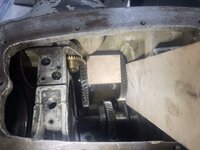
There is an Idler gear stud pressed into the forward bulk head of the head stock, as well as into the rear wall of the head stock. This holds the Spindle Clutch Fork rack captive along with the Reverse Idler gear and the Tachometer Splash gear (in font of the bulk head).
IMG_8740.jpeg
I had previously removed the set screw in the Reverse Idler gear lock collar, so I started by removing the set screw in the Tachometer Splash Gear Lock Collar.
IMG_8521.jpeg
I had also previously removed the set screws, and the Dog point setscrews under them from the bottom of the Head Stock casting. The two holes along the center line correspond to both of the Idler gear studs.
IMG_8750.jpeg
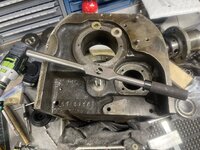
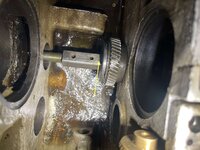
The ID of the Reverse Idler gear assembly is large enough it will slide forward over the rack for the Clutch Fork. You can now see the forward portion of the Reverse Idler Gear Stud L.H. This needs to get pressed out through the rear wall of the Head stock. The problem is there is the Reverse Idler Stud Plug.
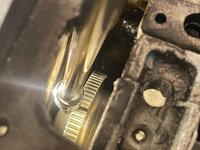
IMG_8761.jpeg
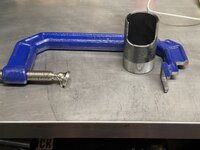
I used the cheapest 8" C clamp I could find in town, and machined a from in it on the mill.
IMG_8790.jpeg
I also machined out a section of a 4" long section of 2" Iron pipe. These will be my press.
IMG_8762.jpeg
I first used a blow torch to heat the Idler Gear stud and it's plug. I kept heating it while I drank a beer to make sure it was good and warm. I then tested to see how snug it was by using a large steel pin punch to see if I could get the Plug to budge. The plug would not move, but the entire gear stud with the plug in it did. move into the casting my about ⅛". Ok good, I'll see if I can press them out together.
IMG_8771.jpeg
Here is the setup with the puller. The fork I machined into the C-clamp fits over the Clutch Fork Shifter Shaft and allows me to press on the center line of the Gear Stud, with the cut out in the Steel pipe allowing me to keep the Clamp in line. Well, that was the theory at least. It wouldn't budge. Ok, time for plan B.
IMG_8766.jpeg
My 5Lb slide hammer is for my Posilock gear puller. Its a propriety thread. I have no metric or SAE taps that match it, despite having a very complete tap selection. So I opted to use my 2Lb slide hammer. It uses a M14-2 thread. So I drilled and tapped the plug for that. I'm a big fan of the Starrett tap handles.
IMG_8769.jpeg
It took very little effort with the slide hammer to pull out the plug. Interesting as when I tapped on it with the pin punch it wouldn't move, but the Gear Stud would. WTF?
 
OP
G

Grant Gunderson

Well-known member
Joined
May 17, 2013
Messages
2,320
Location
Bellingham, WA
IMG_8778.jpeg
I then tried my C-Clamp press again, and the Gear stud pressed out quite easily. All I can think of, is that plug serves to keep head stock oil from leaking out, but also acts as a bit of a wedge to hold the Gear stud in, wich seems a bit over kill as there is a dog point setscrew that also retains it. When I put it back together, I can either put the plug back in with a set screw in it, or I think I might just bore that hole. out a bit larger and tap it for a pipe plug, or a threaded brass plug. Thoughts?
IMG_8780.jpg
Here it is with the Rear Idler Gear stud removed. Note on the Clutch Fork shifter rack, there is a factory dimple witness mark. This indicates the side that is on the Bed end.
IMG_8792.jpeg
Here is the assembly removed, L to Right, Fork shifter rack, Idler Gear retaining ring, Idler gear, Idler gear washer, LF (rear) Idler Gear Stud. Plug.
IMG_8799.jpeg
Note, the notch in the Idler Gear washer, it has to fit over the pin on the Idler gear stud. The busing needs to get pressed back in with the pin up. To the right of the pin is a oil passage hole.
IMG_8806.jpeg
The Idler Gear bearing is a New Departure 3205 WT. Does anyone know what the WT designation is for? I'm going to replace it if possible.
IMG_8801.jpeg
This is how the Rear Idler gear assembly should look on the stud.
 
OP
G

Grant Gunderson

Well-known member
Joined
May 17, 2013
Messages
2,320
Location
Bellingham, WA
The Tachometer splash gear assembly has very little space in the forward bulkhead of the headstock.
IMG_8785.jpeg
In order to remove it, I cut a section of ⅛" steel rod, and slid it into the Oil passage under the spindle. I then placed my Starrett bench block in it, to reduce the likely hood of bending it as I tapped it with a hammer. This pushed on the locking ring for the Tachometer splash gear.
IMG_8783.jpeg
That moved the Gear stud just far enough into the main section of the head stock, so I could use a long magnetic pickup tool to lower a ⅜ nut between the locking and the front of the headstock.
IMG_8787.jpeg
I then ran a section of ⅜ all thread though the gear stud and threaded it into the nut I held in place with the magnetic pick up tool. I could then use the threaded rod to press the gear stud out into the main section of the head stock.
IMG_8812.jpeg
You can see where the gear assembly dropped into the forward bulk head. I fished it all out with the magnetic pick up tool.
IMG_8825.jpeg
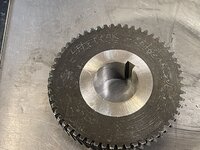
The tachometer splash gear uses the same gear as the reverse idler gear. This bearing is defiantly bad, so I will need to replace it.
IMG_8821.jpeg
This is what the entire assmbly looks like.
IMG_8828.jpeg
The pick indicates the setscrew hole in the bottom of the bore for the front gear stud.
IMG_8832.jpeg
This one points to the location for the rear gear stud set screw.
 
OP
G

Grant Gunderson

Well-known member
Joined
May 17, 2013
Messages
2,320
Location
Bellingham, WA
Hindsight is often 20/20. After you complete a task it’s often that you have a clear picture of it and can come up with a better way of doing it next time. So for the next guy trying to remove the Idler shaft assembly I’d suggest trying the following.
image.jpeg
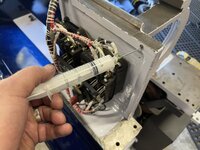
First I’d use a needle attachment on a grease gun and inject this oil passage with grease. This might pop the rear plug out without having to use a slide hammer. It’s a trick often used to remove blind bearings, so probably worth a shot here.
image.jpeg
Then use ⅛” steel rod to tap the forward gear stud back just a bit. ⅛” or so should be fine. Then lower a ⅜ jam nut ( you will want a ham nut as it’s thinner than a standard nut) down to be in line with center of the idler shaft. Insert ⅜ all thread from rear of head stock using a piece of modified pipe on the end to press the entire assembly out together. Even if you have to drill and tap the rear plug, do it with a ⅜ tap and using the all thread you can skip on needing the slide hammer.
 
OP
G

Grant Gunderson

Well-known member
Joined
May 17, 2013
Messages
2,320
Location
Bellingham, WA
Next on the list is to remove the Tachometer.
IMG_8341.jpeg
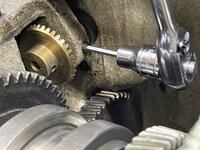
The Tachometer end bevel gear has a set screw that needs to get removed.
IMG_8347.jpeg
The the set screw that holds the Tachometer's shaft brass bushing needs to get removed from the Tach bracket.
IMG_8346.jpeg
I then tried to remove the Bevel gear with an automotive trim clip tool. Problem is there wasn't enough clearance to slide it off of the shaft.
IMG_8351.jpeg
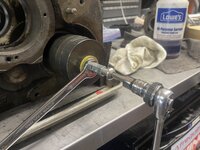
I then used a ⅜" ignition wrench to remove the two nuts that hold the tachometer in place.
IMG_8353.jpeg
Having a magnetic pickup tool in place next to the nut as I was about to remove it, kept it from dropping into the basin. I then tried tapping on the tachometer's studs to push it out of the case. No luck.
IMG_8388.jpeg
Thinking the front bezel might be wedging it in place, I used a Spudger tool to remove the front bezel. It just pulls off once you get it going.
IMG_8836.jpeg
The front bezel has a gasket inside of it, then the glass, followed by two more layers of gasket. I tried again to tap the tachometer out. No such luck. I then did some research on PM and noticed that a few people have found some glue / gasket material behind the tachometer gluing it in place. So I used a blow torch to heat it just a bit to see if that softened the adhesive. The heat worked and I was able to push the tachometer slightly forward by tapping on the studs with a long brass drift.
IMG_8860.jpeg
Ok, its part way out, but its binding on the bushing the fits into the tachometer bracket. At this point, I put the front bezel and glass back on to protect it.
IMG_8358.jpeg

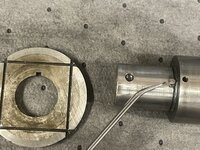
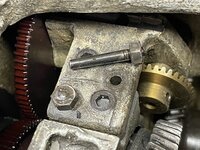
The Tach bracket is held in place by two threaded tapper pins and two SHCS. To get the tampered pins you, you tighten the nuts on the end, jacking them out. AT this point, I could wiggle the bracket a bit, but not enough to free tachometer, and I was worried I might damage the phenolic gear.
IMG_8839.jpeg
The gear is held in place by a pin with cotter pin though it. Using a long angled pick and a long hooked pick, I got the cotter pin out.
 
OP
G

Grant Gunderson

Well-known member
Joined
May 17, 2013
Messages
2,320
Location
Bellingham, WA
IMG_8845.jpeg
Tapping on a long thin pin punch got the pin moving.
IMG_8847.jpeg
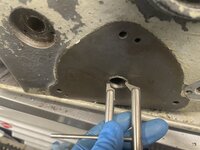
I could then extract the pin using my long Knipex needle nose pliers. There is very little space back there. Turns out, not enough room to push the phenolic gear off of the bracket.
IMG_8861.jpeg
However that process seemed to help loosen the bushings fit in the bracket, and I was able to pull the tachometer out!
IMG_8863.jpeg
backside of the tach.
IMG_8868.jpeg
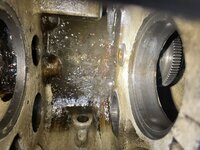
and its home in the casting. Note the black adhesive gasket maker used to seal the main shaft. Also note their was two layers of cork gasket material behind the tach. Pretty impressive oil draining in there too.
IMG_8873.jpeg
My work getting the phenolic gear off of its shaft wasn't wasted. Turns out you need to be Abel to slide it off of its shaft to get the bracket out anyways.
IMG_8876.jpeg
The tachometer bracket.
IMG_8882.jpeg
I then used some heat on the two remaining oil sight gauges on the front to try to loosen the cork gaskets grip on them.
IMG_8886.jpeg
After a couple of minutes with the torch I was able to use a pin punch in the screw holes, to rotate them with some tapping. I could then pull them out.
IMG_8887.jpeg
The headstock casting is now fully stripped. Time to let the lacquer thinner do its job.
 

Cruzan80

Well-known member
Joined
Jul 22, 2015
Messages
4,242
Location
Denver, CO
Next on the list is to remove the Tachometer.
IMG_8341.jpeg
The Tachometer end bevel gear has a set screw that needs to get removed.

At first glance, it looked like an optical illusion. My guess is the set screw was on there pretty tight!

(Looking at the twist in the hex bit)...
 
OP
G

Grant Gunderson

Well-known member
Joined
May 17, 2013
Messages
2,320
Location
Bellingham, WA
At first glance, it looked like an optical illusion. My guess is the set screw was on there pretty tight!

(Looking at the twist in the hex bit)...
Those Snapon hex sockets seem to be made of butter. They are no where as good as my PBSwiss or Nepros ones, but I haven't found any really good ones in SAE sizes yet.
 

ricleh

Well-known member
Joined
Nov 2, 2007
Messages
1,447
Location
Sacramento, CA
Those Snapon hex sockets seem to be made of butter. They are no where as good as my PBSwiss or Nepros ones, but I haven't found any really good ones in SAE sizes yet.
The Snapon gold colored ones seem to be much stronger. Also I would try using a shorter length hex bit.
 
OP
G

Grant Gunderson

Well-known member
Joined
May 17, 2013
Messages
2,320
Location
Bellingham, WA
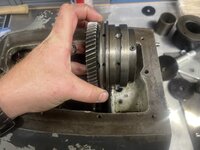
The LH ( rear ) spindle clutch gear assembly felt pretty rough.
IMG_8894.jpg
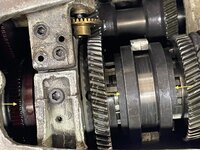
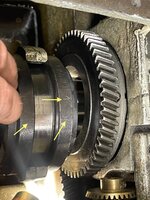
The lock collar is held in place by 4 dog point set screws. The set screws had been pinned in place by the factory with a bunch to keep them from backing out. Note the double dot witness marks on the retaining ring collar and the back of the gear shaft.
IMG_8938.jpeg
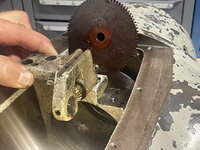
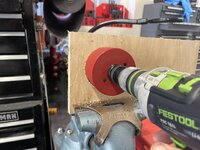
The gear shaft and the lock ring on both a light press fit. To get it apart, I used a 3-⅞" hole saw to cut a hole in some scrap plywood to hold the gear assembly.
IMG_8945.jpeg
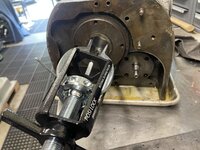
I then used a large drift out of a wheel bearing kit to press the gear shaft enough to get the lock collar off.IMG_8944.jpeg
With it out of the way, I then repositioned and finished pressing the gear out of the mounting collar.
IMG_8948.jpeg
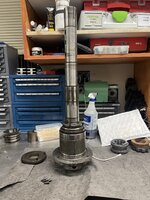
L to R, inner sleeve, gear, mounting colar, lock ring.
IMG_8952.jpeg
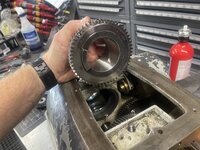
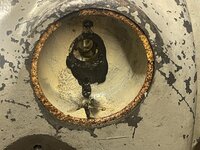
Well there is the problem. Looks like some foreign debris got sucked into it at some point and galled up the gear shaft pretty good.
IMG_8955.jpeg
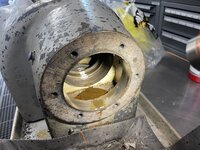
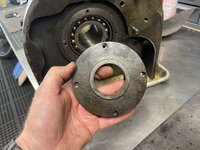
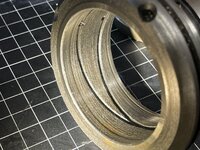
Ugh, looking inside the mounting collar, it got pretty torn up by whatever it was. Hopefully I can find a replacement part!
 
To avoid these ads, REGISTER NOW!
Top Bottom