To avoid these ads, REGISTER NOW!

Rebuilding a monarch 10ee lathe

OP
G

Grant Gunderson

Well-known member
Joined
May 17, 2013
Messages
2,322
Location
Bellingham, WA
Removal of Halfnut assembly
IMG_9943.jpeg
IMG_9946.jpeg
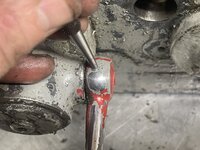
The half nut lever is held in place by a tapper pin, on this one I had to tap it out from the bottom side of the lever.IMG_9950.jpeg
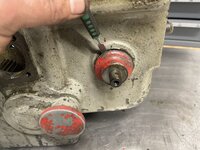
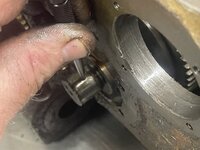
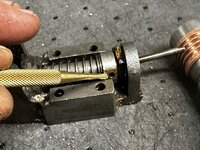
I used a Spudger to remove the half nut washer from the shaft.
IMG_9953.jpeg
IMG_9955.jpeg
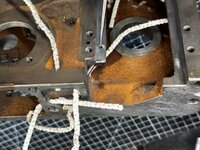
The half nut assembly is filthy and covered in grease! ugh. The Left and Right hand clamp are each held in place by 4 SHCS
IMG_9958.jpeg
The RH clamp (if viewed from front of Apron, Monarch's nomenclature note mine) has 4 identical SHCS, same size as the top two o note LH clamp. The LH clamp uses longer ones for the bottom.
IMG_9959.jpeg
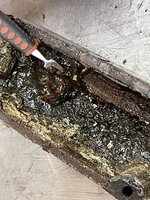
I used the spudger to scape away some of the hardened grease to get the larger LH clamp bracket off.
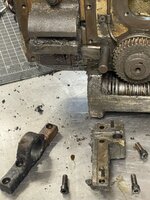
IMG_9964.jpeg
IMG_9968.jpeg
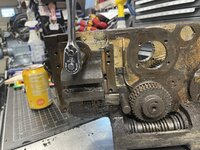
The nuts retaining the halfnuts wouldn't budge with a ratchet.
IMG_9971.jpeg
But, my Milwaukee impact wrench made quick work of removing them.
 
To avoid these ads, REGISTER NOW!
OP
G

Grant Gunderson

Well-known member
Joined
May 17, 2013
Messages
2,322
Location
Bellingham, WA
IMG_9973.jpeg
IMG_9974.jpeg
IMG_9976.jpeg
what a mess! Into the ultrasonic it goes!
IMG_9978.jpeg
The half nut arm bolt then can slide right out. Both of them are identical.
IMG_9980.jpeg
Both ahed nuts removed.
IMG_9993.jpeg
The Halfnut cam assembly then pulls right out.
IMG_9998.jpeg
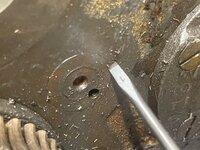
It has two set screws 180 apart. I removed those. Looks like someone used some red lock tight on it too.
IMG_0002.jpeg
I then placed the unit in my Wilton vise with copper soft jaws and tried to take it apart with a pin spanner. No luck. I then tried heat, and no luck. The cams are not moving freely, so I'd like to get it apart and see why.
 
OP
G

Grant Gunderson

Well-known member
Joined
May 17, 2013
Messages
2,322
Location
Bellingham, WA
Next is removal of the compound gear.
IMG_0005.jpg
First the Scotch key gets removed from the backside of the apron
IMG_0013.jpeg
Just like the rest of them it consists of a setscrew and a retaining screw.
IMG_0015.jpeg
From the back of the Apron, I pushed the Compound Gear Stud out with a brass drift.
IMG_0016.jpeg
IMG_0017.jpeg
Leaving the drift in place while I pulled the stud from the front, kept the gear from dropping.

IMG_0020.jpeg
I marked the side that faces the Rear of the casting with a "R"
IMG_0021.jpeg
I then removed the bushing with a larger drift.
IMG_0024.jpeg
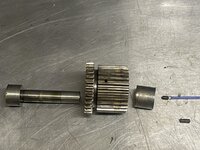
Compound Gear laid out Front to Back
 
OP
G

Grant Gunderson

Well-known member
Joined
May 17, 2013
Messages
2,322
Location
Bellingham, WA
Longitudinal Friction removal. This went easier than the cross feed version, as I learned a bit from that one.
IMG_0027.jpeg
IMG_0033.jpeg
Once again the lever is held in place by a tapper pin
IMG_0034.jpeg
By now, I think I got removing them down to a science.
IMG_0032.jpeg
Dogpoint setscrew that retains the lever shaft gets removed.
IMG_0036.jpeg
The lever didnt want to pull out, so I used a brass pin punch to tap it out.
IMG_0038.jpeg
IMG_0040.jpeg
The 4 brass countersink screws holding the bearing retainer in place get removed.
IMG_0042.jpeg
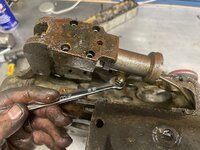
It took quite a bit of effort with the Spudger to pry the retainer free.
IMG_0044.jpeg
IMG_0046.jpeg
4 SHCS hold the friction front cover on.
 
OP
G

Grant Gunderson

Well-known member
Joined
May 17, 2013
Messages
2,322
Location
Bellingham, WA
IMG_0050.jpeg
The friction stem nut gets unscrewed.
IMG_0051.jpeg
IMG_0054.jpeg
Note the oil line that feeds the weep hole for the longitudinal friction. That oil line was in the hole. I removed it to remove the assembly.
IMG_0057.jpeg
Tapper pin gets removed from rear of the shaft
IMG_0059.jpeg
IMG_0061.jpeg
I used a brass pin punch to tap the shaft forward enough to remove the rear collar and rear thrust bearing
IMG_0062.jpeg
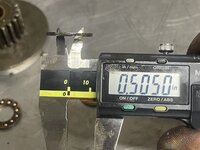
The front and rear Thrust bearings are 0.435" thick
IMG_0064.jpeg
1.1870" OD
IMG_0071.jpeg
One of the ID's is 0.500
IMG_0072.jpeg
The other is 0.5625"
 
OP
G

Grant Gunderson

Well-known member
Joined
May 17, 2013
Messages
2,322
Location
Bellingham, WA
IMG_0075.jpeg
Someone once told me the correct way to orientate a Thrust bearing with the two different ID's is for the larger diameter side to go on first, then the bearing race then the smallest diameter side on the outside. Is that correct?
IMG_0076.jpeg
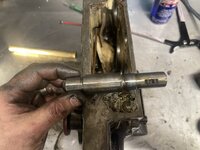
The friction shaft assembly then gets pulled out.
IMG_0078.jpeg
Note the oil weep hole faces up.
IMG_0094.jpeg
The friction disk and gear come out as a unit
IMG_0098.jpeg
The other friction gear (front side) comes out with the inner thrust bearing, spring and washer in it. Note the oil weep hole goes on top
The inner Thrust bearing is 0.2550" thick
IMG_0102.jpeg
It's od is 0.8700"
IMG_0104.jpeg
The ID is 0.50"
IMG_0108.jpeg
IMG_0112.jpeg
And here is the longitudinal friction assembly all laid out
 
OP
G

Grant Gunderson

Well-known member
Joined
May 17, 2013
Messages
2,322
Location
Bellingham, WA
WE are starting to get down there! Time to remove the Hand wheel shaft. Note this also is the cam for powering the oil pump.
IMG_0116.jpeg
First up is to remove the bearing retainer plate.
IMG_0119.jpeg
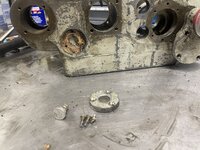
Its held in place by 4 countersink screws. Despite religiously cleaning out each of the screw heads on the lathe with a dental pick prior to removing them, I apparently didnt get enough of the gunk out of these one and rounded the head. ****.
IMG_0122.jpeg
I drilled it with a Left Hand drill bit, thinking I would most likely need to use a screw extractor, but to my surprise it came right out with the Left hand bit! What a relief!
IMG_0125.jpeg
The bearing retainer on the back also gets removed.
IMG_0128.jpeg
Luckily none of its 4 countersink screws gave me any issues.
IMG_0130.jpeg
rear bearing retainer remvoed
IMG_0137.jpg
Since I had removed the hand wheel months ago, and its in a box, I needed a way to hold the shaft. So I inserted a new keyway that I had on hand, and held it in place with my non-marring pliers
IMG_0136.jpeg
This allowed me to remove the bearing retaining screw on the back with my pin spanner. It was on extremely tight!
IMG_0140.jpeg
Bearing retaining screw
IMG_0142.jpeg
A brass drift pushes the shaft out from the rear
 
OP
G

Grant Gunderson

Well-known member
Joined
May 17, 2013
Messages
2,322
Location
Bellingham, WA
IMG_0144.jpeg
IMG_0146.jpeg
Out comes the gear cam for the oil pump. The cam side faces the front.
IMG_0147.jpeg
I marked the rear side with a "B"
IMG_0153.jpeg
To get the woodruff key out of it, I placed the shaft assembly on my Starrett V-blocks so I could tap it out.
IMG_0155.jpeg
The cam bushing then slides off, followed by the bearing.
IMG_0161.jpeg
The hand wheel / Oil pump cam uses two New Departure C88503 Bearings.
IMG_0164.jpeg
The bearing OD is 40mm
IMG_0169.jpeg
The ID is 17mm
IMG_0167.jpeg
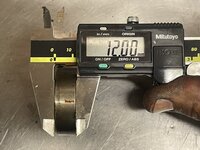
The race is 12mm
IMG_0165.jpeg
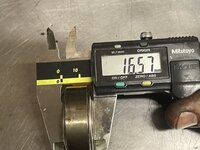
and the total thickness is 16.57mm
 
OP
G

Grant Gunderson

Well-known member
Joined
May 17, 2013
Messages
2,322
Location
Bellingham, WA
IMG_0175.jpeg
Hand wheel / Oil pump cam shaft fully laid out Back to Front

Next is removal of the Lower Idler assembly.
IMG_0180.jpg


IMG_0203.jpeg
The Scotch lock set screw gets removed,
IMG_0205.jpeg
Then the locking screw
IMG_0206.jpeg
The lower Idler Gear Stud can then get pushed out from the back of the apron
IMG_0208.jpeg
and out comes the Lower Idler Gear
IMG_0212.jpeg
The bushing then gets pushed out of the back of the apron.
 
Last edited:
OP
G

Grant Gunderson

Well-known member
Joined
May 17, 2013
Messages
2,322
Location
Bellingham, WA
Next is removal of the Feed Reverse / worm wheel and worm
IMG_0176.jpeg
IMG_0177.jpeg
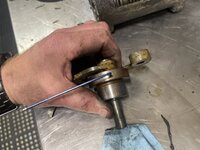
Oncer again there is a taper pin holding the knob on.
IMG_0184.jpeg
I was covered in oil / grease by this point and couldn't get it to budge. So ill do it latter in the arbor press.
IMG_0182.jpeg
The 4 countersink screws get removed from the bearing cap.
IMG_0186.jpeg
This bearing cap is also pinned, so You have to pull it out.
IMG_0188.jpeg
I then tried to remove the pin from the shifter fork but it wouldn't budge from this direction.
IMG_0190.jpeg
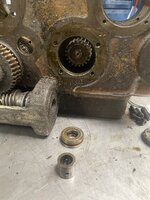
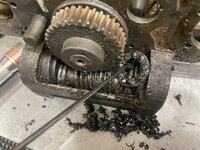
Turning my attention to the back of the apron, I fished out a ton of chips from the worm, and managed to also fish out the thrust bearing on either side of the worm. What a mess. I'll have to give the bearings a good cleaning before I can measure them.
IMG_0193.jpeg
With all of that **** out of the way, I could then finally rotate the worm wheel so that I had access to the setscrew holding it on.
IMG_0196.jpeg
A gear puller would be ideal to get it off, but I didnt have a puller that would fit behind it. So I tapped the shaft forward with a drift.
IMG_0201.jpeg
That pushed the front bearing out. It is a New Departure C88504
 
OP
G

Grant Gunderson

Well-known member
Joined
May 17, 2013
Messages
2,322
Location
Bellingham, WA
I was then able to get the worm gear off of the shaft
IMG_0218.jpeg
And then lift out the Worm
IMG_0220.jpeg
I now had access to remove the 4 countersink screws holding on the rear bearing retainer
IMG_0224.jpeg
IMG_0226.jpeg
IMG_0229.jpeg
I could then remove the shaft with the bearing
IMG_0235.jpeg
With the woodruff key out, the bearing slides out.
IMG_0238.jpeg
IT is also a New Departure C88504
IMG_0245.jpeg
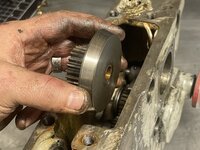
I could then lift out the feed / reverse gear
IMG_0248.jpeg
The Rear side got marked with an "R"
 
OP
G

Grant Gunderson

Well-known member
Joined
May 17, 2013
Messages
2,322
Location
Bellingham, WA
Finally down to the end! Time to remove the Oil Pump
IMG_0263.jpeg
I removed the Oil fill plug and the Oil Sight Gauge.
IMG_0265.jpeg
With the apron upside down, I now have access to the 6 SHCS that hold the oil pump housing on to the Apron
IMG_0267.jpeg
With all 6 SHCS out, I then used a gasket scraper to pry it off
IMG_0268.jpeg
IMG_0270.jpeg
I doubt thats ever been off of there!
IMG_0273.jpeg
4 SHCS hold the pump in place.
IMG_0275.jpeg
I could then lift the pump out to remove the oil line from it.
IMG_0280.jpeg
With the apron still upside down, I now had access to the other side of the Shifter Fork Pin that couldn't get out before
IMG_0282.jpeg
IMG_0285.jpeg
It tapped out easily from the bottom.
 
OP
G

Grant Gunderson

Well-known member
Joined
May 17, 2013
Messages
2,322
Location
Bellingham, WA
I could then remove the Shifter Fork
IMG_0290.jpeg
Followed by the Shifter knob shaft and the front bearing retainer
IMG_0298.jpeg
IMG_0301.jpeg
On the bottom of the Worm housing, there is two large Dog Point Set screws that hold the bushings in place on either side of the worm.
IMG_0303.jpeg
With those out, I could then tap out the Bushings
IMG_0308.jpeg
I then discounted the Oil Lines from the Tee.
IMG_0318.jpeg
IMG_0315.jpeg
And remove it
IMG_0323.jpeg
IMG_0325.jpeg
 
OP
G

Grant Gunderson

Well-known member
Joined
May 17, 2013
Messages
2,322
Location
Bellingham, WA
The Apron is now fully stripped!
IMG_0327.jpeg
IMG_0329.jpeg
I dropped the Apron, Gear Box and the Head Stock off at a local motor shop to get them put through their hot solvent tank for a good cleaning.

I can now say that I have fully torn a Monarch 10EE down to the very last screw! Lets see if I can actually put it back together!

Time for a Beer or 3!
 
Last edited:
OP
G

Grant Gunderson

Well-known member
Joined
May 17, 2013
Messages
2,322
Location
Bellingham, WA
I dropped the castings off at a local motor rebuilding shop so they could clean them in their hot solvent tank.
IMG_0333.jpeg

IMG_0072.jpeg
IMG_0078.jpeg
Only costs me $50 and he had it done overnight. Pretty impressive on how clean he got them. It would have taken me days and at least that in Laquer Thinner and I doubt I would have gotten them that clean! I flushed all of the bores with pressurized denatured alcohol and cleaned them out with a some brushes / pipe cleaners just to make sure there was nothing left in them.

I was hoping hot solvent bath would have helped free the gunk in the Apron's oil lines, but that was to no avail.
IMG_0018.jpeg
IMG_0031.jpeg
IMG_0045.jpeg
So I removed all of the oil lines and cleaned the passages with pipe cleaners.
IMG_0052.jpeg
IMG_0054.jpeg
I then painted all of the internal parts and the insides of the Headstock, Apron and Gear box with Rustoleum Tub and Tile paint. Apparently its no longer in production but I found a quart of NOS online. It is a two part Acrylic Epoxy paint, so it should cure quite hard and since it's and Acrylic Epoxy, it should be very resistant to Oil, water etc. If I hadn't found the Tub and Tile paint, I would have used Glyptal As it's commonly used for the same purpose in high-end motor builds.
IMG_0083.jpeg
IMG_0085.jpeg
The one nice thing about Epoxy paints, is they can be removed quite easily with Aceton, especially if you do it before they reach full cure. In this case thats 3 days, so I can use some long cotton swabs and clean the insides of the all of the bores to make sure there is no issues with it latter.
 
To avoid these ads, REGISTER NOW!
OP
G

Grant Gunderson

Well-known member
Joined
May 17, 2013
Messages
2,322
Location
Bellingham, WA
While the paint was drying, I decided to clean the Oil Pump.
IMG_0334.jpeg
There was at least a ½" of sludge in the sump, so I figured the oil pump desperately needed a good cleaning.
IMG_0088.jpeg
Here is the unit as I removed it from the Apron.
IMG_0091.jpeg
Notice the direction that the Bronze lever that rides on the oil pump cam goes. We will have to make sure it goes back in the same orientation. As you can see the filter is filthy!
IMG_0099.jpeg
The filter pack is held in place by a small retaining ring thats easily removed with a pick.
IMG_0102.jpeg
With the retaining ring out, there is another metal ring that holds the felt filter in place. It has a "C" profile with the rounded side facing out.
IMG_0104.jpeg
The felt comes out next. It is 1.25" in diameter and 3/16" thick. So would probably be pretty easy to cut your own replacement.
IMG_0107.jpeg
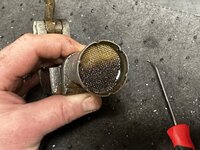
Bellow the felt is a fine mesh screen.
IMG_0111.jpeg
And bellow that is a coarser mesh screen.
IMG_0120.jpeg
Here is the entire filter pack from inner to outer. I'm going to order a new replacement. Now, wouldn't it make sense for that filter pack to be in the reverse order?
IMG_0118.jpeg
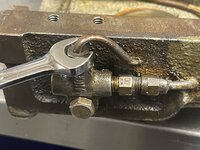
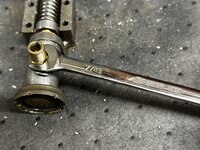
Bellow the filter pack is the Inlet check Valve. It's 7/16-20 thread and is Bijur part number S-176. It's easily removed with a #5 hollow ground screw driver.
 
Last edited:
OP
G

Grant Gunderson

Well-known member
Joined
May 17, 2013
Messages
2,322
Location
Bellingham, WA
IMG_0122.jpeg
That little inlet valve is $107!!! The ball in it wont move at all. I'm hopping a good bath in the Ultrasonic will get it going again!
IMG_0096.jpeg
The outlet check valve unscrews with a 7/16 wrench. According to my Monarch manual, it is Bijur Part # B-3815. That is a 2# check valve. Searching the PM forums it seems there is some discussion about it supposed to be a 5# or possibly a 20# check valve, but the manual I have specifics that part number and its 2#. So I'm going to order that as a replacement, and hopefully the parts numbers haven't changed over the years! Under that check valve is a small sealing washer. I'm ordering a replacement form McMaster as it was in pretty bad shape.
IMG_0128.jpeg
To get the pump housing off of the piston, I placed a drill bit into the outlet bore, and used one of my Snapon Low-Torque wrenches to back off the thin retaining nut.
IMG_0129.jpeg
The bronze lever is held in place by a tapper pin.
IMG_0132.jpeg
IMG_0134.jpeg
With the pin out, I could then press the pivot shaft out with my arbor press
IMG_0136.jpeg

This retaining ring holds the piston rod into the main shaft and the spring.
IMG_0144.jpeg
It's threaded on, but for the life of me, I couldn't get it to budge. Also its worth noting that small hole, is meant to face down in the casting.
IMG_0153.jpeg
And here is everything all laid out after a good soak in the ultrasonic. That did managed to free up the inlet check valve, so hopefully its good to go and I wont have to spend $107 to replace it.
Screen Shot 2022-09-24 at 12.01.48 AM.png
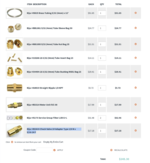
The parts for the rest of the oil line system for the Apron are going to be expensive enough. But I will have enough line material left over to convert my Bridgeport to a one shot system at somepoint, but thats still another $350+ in meter units, and pump, etc.
 

csp

Well-known member
Joined
Mar 23, 2010
Messages
5,719
Location
Franktown, CO
Out of curiosity, why are you measuring/ordering new bearings in millimeters? I would expect a US made lathe from this era to be spec'd with SAE sized bearings.
 
OP
G

Grant Gunderson

Well-known member
Joined
May 17, 2013
Messages
2,322
Location
Bellingham, WA
Out of curiosity, why are you measuring/ordering new bearings in millimeters? I would expect a US made lathe from this era to be spec'd with SAE sized bearings.
Almost all cartridge bearings are metric. The is most likely do to SKF and *** inventing them in Europe. These had been around for quite a while before Monarch began production of the 10EE and had become the standard.

I believe Timken invented a tapered roller bearing that used inch standards however.

New Departure who made almost all of the original bearings in the lathe, was a very large US bearing mfg at the time, and had lines of bearings in both SAE and metric, but the metric line made up way more of their catalog. A side note, New Departure also invented the coaster brake for bikes, and eventually got folded in to GM.

The challenge here is the ND bearings do not use a standard bearing number system, and I haven't found a good cross reference, so I need to measure each one.

What is interesting is the thrust bearings are all in inch sizes.

I guess its kine like how spark plugs are always metric threads, even on American engines with the exception of some very early Fords.
 
OP
G

Grant Gunderson

Well-known member
Joined
May 17, 2013
Messages
2,322
Location
Bellingham, WA
I decided to take the Feed Shaft apart next, so I could better prep it for paint.
IMG_0208.jpeg
The Feed Shaft gear is held on to the rear by a set screw.
IMG_0207.jpeg
The gear is on a woodruff key, and it was quite tight, so I decided to aproach it from the opposite end.
IMG_0211.jpeg
The shaft is held in place by a conical bearing retaining nut, and #4 lock washer.
IMG_0212.jpeg
With those off, I cold pull the aft out from the other end.
IMG_0214.jpeg
Note this retaining ring
IMG_0216.jpeg
IMG_0218.jpeg
Its supposed to be in this groove to hold the bearing in place. That wasn't the case with mine.
With the Feed Shaft out and apart, I could then remove the Belt Tightener bracket
IMG_0226.jpeg
It's held in place by a single bolt and is a light press fit on the shaft.
IMG_0229.jpeg
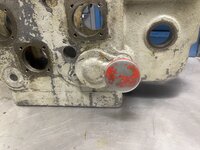
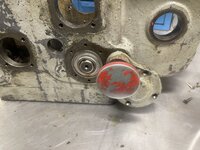
I then tapped out the Oil Fill cap assembly.
IMG_0261.jpg
It was in there pretty snug. I'm going to see if I can polish it up. I also checked and McMaster sales these as well.
 
OP
G

Grant Gunderson

Well-known member
Joined
May 17, 2013
Messages
2,322
Location
Bellingham, WA
Next up was stripping down the lead screw feed shifter.
IMG_0266.jpeg
IMG_0267.jpeg
The knob is held in place by a Snake Eye screw.
IMG_0270.jpeg
With all of these on the lathe, I decided it was time to buy a nicer Pin Spanner. This is a Facom 117.B. And its got a full set of interchangeable pins, and it locks to what ever span width you need.
IMG_0160.jpeg
So between this one, my Bike ones and my small camera one (not pictured) I should have my basis covered!
IMG_0271.jpeg
With the screw out, there is a spring behind it that gets removed next.
IMG_0274.jpeg
The knob can then be slid off of the shaft.
IMG_0276.jpeg

There is a woodruff key on the shaft that has to get removed.
IMG_0277.jpeg
I then used a dental pick to remove as much old paint as possible between the plaque and the casting.
IMG_0280.jpeg
The three countersunk screws holding the plate on get removed along with the plate.
IMG_0285.jpeg
The backing plate is held on by 3 SHCS.
 
OP
G

Grant Gunderson

Well-known member
Joined
May 17, 2013
Messages
2,322
Location
Bellingham, WA
I let curiosity get the best of me, and I decided to tear the spindle apart. On one hand I thought its best to not mess with those bearings, but on the other hand I am this deep into the lathe, I will be kicking my self latter if I dont properly clean it.
IMG_0291.jpeg
First I marked the outer race alignment with a sharpie and a light scribe. Turns out I didnt need to do this, but its cheap insurance to align it latter.
IMG_0295.jpeg
Next, I used a brass drift to remove the woodruff key from the shaft. It was really in there!
IMG_0296.jpeg
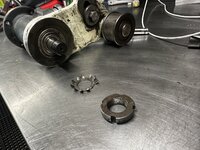
The bearing retaining nut, has two set screws that lock it in place. Each set screw has a brass plug under it to protect the threads.
IMG_0298.jpeg
With the setscrews out, I placed a brass drift in the nose of the spindle, and used a hooked spanner wrench to remove it. IT was on firm and snug, but not incredibly tight.
IMG_0301.jpeg

The lock nut is N12 and the text faces away from the bearing stack.
IMG_0303.jpeg
I wiped most of the oil off and placed an indicator mark with a sharpie.... once again turns out I didnt need to do that, but I wanted to make sure I could put it back together with the exact same alignment.
IMG_0310.jpeg
I then lifted the bearing cap and the rear of the two front Duplex bearings off
IMG_0309.jpg
That leaves the inner and the outer Bearing spacers, and look what I found. Factory alignment marks on the Spindle for the Front Duplex bearing stack. Ok, if they did that, then I bet they also put indicators on the bearings too.
IMG_0321.jpg
The outer space appears to have one as well on the inside, but according to my marks, this wasn't aligned with the others. The notch on the side of it is for the retaining screw on the side of the head stock. So I'll clean it up and see what makes sense. Maybe I'm missing something, or it moved on assembly. I dont know.
IMG_0323.jpg
Looking at the spindle with the bearing spacers removed, you can see there is a lower factory indicator mark on the spindle in addition to the uppers, so they really want those bearings in the correct orientation with the inner races. I couldn't see a mark on the bearing, so I made one with a fine point Sharpie just to make sure.
 
OP
G

Grant Gunderson

Well-known member
Joined
May 17, 2013
Messages
2,322
Location
Bellingham, WA
IMG_0331.jpeg
Here are the various aligment marks in relationship to each other. Notice the "V" that was top center when I pulled the spindle from the headstock is close but not aligned to the factory bearing alignment marks. There is another short aligment mark on the front that does align with the "V". I also found a "T" on the backside of the Spindle flange, so guessing this is a fitters mark from hand fitting the front spindle retainer to it.
IMG_0341.jpeg
On the reverse side of the spindle is a paint splotch... looks like the original paint from the inside of the head stock and another fitters mark.
IMG_0357.jpeg
Here is the alignment mark for the inner race. The outer race mark, according to my research is the high point for the bearing. One of my Front Duplex bearings had a "12XX" on it. This matches the rear spindle bearing and I believe that is the amount of eccentricity the bearing has, so the factory installed a full match set of Front spindle bearings and rear spindle bearings. However, I have reason to believe one of my Front Duplex bearings was replaced at some point at has a "13XX" so seems like they tried to match it as close as possible..... Interesting.
IMG_0371.jpeg
The front Spindle bearing retainer plate, had what looks like a ton of extra gasket compound that was blocking most of the front oil labyrinth seal and ports. So Glad I took it apart to clean it.
IMG_0369.jpeg
 

slodat

ALLIANCE MEMBER
Joined
Feb 6, 2010
Messages
3,682
Location
Central-ish, WA
IMG_0270.jpeg
With all of these on the lathe, I decided it was time to buy a nicer Pin Spanner. This is a Facom 117.B. And its got a full set of interchangeable pins, and it locks to what ever span width you need.
Ordered this pin spanner. Excellent tool that I've needed and didn't know what to look for. Thank you!

Again, exceptional work on the 10EE!
 
OP
G

Grant Gunderson

Well-known member
Joined
May 17, 2013
Messages
2,322
Location
Bellingham, WA
Ordered this pin spanner. Excellent tool that I've needed and didn't know what to look for. Thank you!

Again, exceptional work on the 10EE!
Glad I could help you spend your money!

One thing I did on the spanned was grind down the area on the inside between the pin heads so I could use it on smaller pins with closer spacing.
 
OP
G

Grant Gunderson

Well-known member
Joined
May 17, 2013
Messages
2,322
Location
Bellingham, WA
I did a bit of a deep dive into the bearings for my 10EE and complied a pretty complete list of all of them, minus the Cross Feed, compound and tail stock thrust bearings. Here is a thread with that list. I included an google dock link to an Excel file with them as well that also includes modern replacements for many of them and my notes. I was able to order all new bearings for my machine, except for the Front Spindle Duplex set for under $800

I was chatting about the spindle bearings with my Dad the other night and he then sent me this email.

“Grant talking about bearings made me think about when I designing an inspection device for use in a hot cell where the the heat and extreme radiation existed, such as the bearing grease could not stand the environment. I went with a sleeve bearing made of Graphite. the results were such as no break downs occurred. DAD”

Guess I have it easy in the search for 10EE bearing replacements!
 

dutchgray

Well-known member
Joined
Sep 28, 2014
Messages
6,468
Location
Dorset. England.
The front double row Gamet spindle bearing in my 13" DSG lathe would cost more than I paid for the machine, then there is the single row Gamet rear and the centre plain bearing as well.
Luckily they should last the life of the machine as long as the oil is kept good and kept flowing.
 
OP
G

Grant Gunderson

Well-known member
Joined
May 17, 2013
Messages
2,322
Location
Bellingham, WA
I spent pretty much all of last week getting something like 25 parts ready for paint.

First, I sprayed a two part Epoxy etching primer on the castings.

IMG_0436.jpeg
I then proceeded with the body filler. Multiple coats of bond each sanded as flat as I could get them with 80 grit and a long Mirka hand block to keep things flat as possible.
IMG_0446.jpeg
Once I got things relatively close with the standard Bondo, I applied a two part glide coat, and then sanded with 240 Grit.
IMG_0481.jpeg
I used a sharpie to mark the low spots, so I could concentrate on building those back up.
IMG_0478.jpeg
Finally I spread one more layer of the standard Bondo glide coat over everything.
IMG_0476.jpeg
And then sanded to 400
IMG_0485.jpeg
What a never ending job. BTW the garage is a damn disaster right now, we have a kitchen remodel going on, so have been out of the house the last 10 days while we had the hardwood floors redone. After all of that I sprayed it with a Highbuild urethane primer yesterday and then wet sanded that with 600 grit... came out smooth as glass. Today I washed it down with the Lumabase oil and grease remover, let it dry then I sprayed it with a Sealer coat, then the metallic color coat, and things where looking amazing!
Finally starting to feel a bit more confident in the whole process. I then went to spray the 2K clear coat and everything went south in a hurry. I started with the back side of the head stock and it looked great. Soon as I moved to the front, it went to hell.
IMG_0511.jpeg
I started to get a massive amount of orange peel. Not just one one of the parts, but all of them. I checked the gun settings after I first noticed it and it the same that I have been using.
IMG_0508.jpeg
The TDS for the Lumabase products I am using, clear state that if there is an issue with the polly, to not stop until there is at least two coats on. In stead of the recommended 15 min flash, I gave it 20 and did another coat.
IMG_0514.jpeg
That only made it worse. Its the exact same paint system I used on the rest of it, I followed the same process to a "T" and I know the mix ratio was dead on using my Sata mixing cups. Only thing different was I opened a fresh can of Poly and a fresh can of Activator. 2+ hours later the Poly still hasn't really set up and you can see it is sagging. Something is obviously F'd. Either I didnt give the color enough time to finish flashing (did it by the book with a timer and at above the recommended temp), or the poly product is bad. It was weird when I mixed It, you couldn't really see it changing like I have been able to in the past.

It usually stiffens up quite quickly. Its been almost 5 hours now and its still fully wet.

So my thoughts are to let it sit overnight. Hopefully it hardens and is thick enough I can sand smooth with a progression of 1K~4K grits and then polish. Otherwise, I need to aggressively remove it, and start over with either the Ureathane primer or the Sealer.

If it doesn't harden, my thoughts are to wash it all off with Acetone... that will be a messy job!

ARGH.
 
Last edited:

Jswain

Well-known member
Joined
Apr 26, 2013
Messages
2,463
Location
Calgary, AB
That honestly *****, hopefully you can sand it out! Just think of how nice it'll look all back together! Lol
 
OP
G

Grant Gunderson

Well-known member
Joined
May 17, 2013
Messages
2,322
Location
Bellingham, WA
That honestly *****, hopefully you can sand it out! Just think of how nice it'll look all back together! Lol
After a full week of sanding, I'm not looking forward to doing that again. None of these parts where easy to sand as they all had complex curves. I am so damn great full I dont do body work for a living!
 
OP
G

Grant Gunderson

Well-known member
Joined
May 17, 2013
Messages
2,322
Location
Bellingham, WA
Thinking about it some more, I really don't think it's contamination. There was no issues with any of the other coats that when on yesterday, and there has been no silicone, or oil used since before the castings where hot stripped. All of the home remodel stuff has been going / coming from the other side of the house. The garage is just full from storing all of our stuff during that process.

Checking the parts this morning, and the poly still hasn't set up at all. I am almost certain it was a bad can of activator. Both the activator and the poly cans where unopened, but have been sitting on a shelf in the garage for a year. So thinking the can of activator must have expired.

I used brush cleaner and some rags and it wiped the polly right off and left the color base coat pretty mostly intact.
IMG_0519.jpeg

IMG_0520.jpeg
So that pretty much solidifies to me it was bad activator. The polly didnt kick / crosslink at all. So thankfully all of the body work is intact and I now have a very expensive "guide coat" top wet sand with 600. Once it is all wet sanded, I will clean it twice with the wax and grease remover, then do the Sealer, Color and poly coats again, but using brand new Polly from the store. Not using these cans again! Apparently I am now going to be making lemons out of lemonade this week.
 
Last edited:
OP
G

Grant Gunderson

Well-known member
Joined
May 17, 2013
Messages
2,322
Location
Bellingham, WA
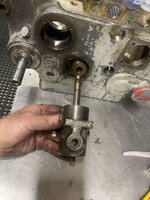
Well after the disaster with the clear coat, I took the remnants of those cans down to the local auto body supply shop where I have been purchasing my paint, and explained to them what happened. They told me they did in fact have a bad batch, and they credited me for it. Ok thats fine and dandy, but I still needed some clear, but they where fully sold out of the 2K 4:1 mix clear I was using. Evidently they had pulled of the catalyst form there shelves and the mfg wasn't supposed to make another batch for 2+ months according to them. Well ****, thats not going to work with my time schedule. So I ended up buying the Lumabase 3K 2:1 clear. This is a high-solids clear, so should be even more durable than what I was using. Problem is they only have it in gallons, and after the credit for the 4:1 stuff it still cost me $260 ouch.
68722852581__9BBA062F-450B-4F4B-9A8C-DCB62F480609.jpeg
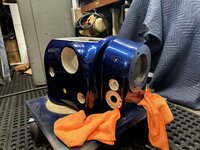
I did another batch of parts and re-painted the first set.
68722843926__DDFE4589-3673-46D1-BBEB-9361CCB163CC.jpeg
68722842534__02D4F89C-B964-4EBA-B8DC-99C915B3E352.jpeg
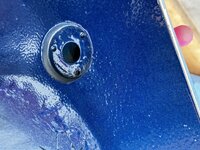
It aint perfect, as I was painting outside in a tent and still got some particulate fall out on it from all of the wildfire smoke in the air, but I am damn happy with it. I can say tis the best of my ability given that I have to paint in an uncontrolled environment. I cranked the heater in the garage to 80 and let it cure for a few days. BTW the silicone painters plugs I used did a great job of keeping the bores paint free.

All thats left to paint now is the two drive end panels.
IMG_0540.jpeg
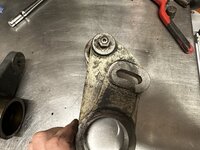
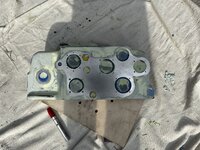
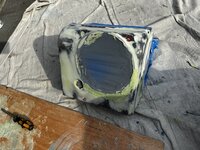
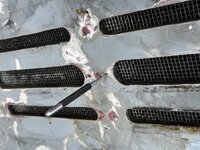
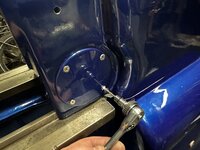
In order to properly strip them, I needed to remove these vent screens. Each is held on by 8 drive screws.
IMG_0545.jpeg
A pin punch from the backside and a bunch of tapping with a hammer, eventually drove them all out. I now have it stripped and sanded. Hopefully I will get the two part epoxy primer on today and can then start the body work on it tomorrow...

Moving along I can start to work on getting the Headstock back on the lathe. I think it would make more sense to wait to install it until I get it fully assembled with the spindle, but I am out of workbench space, and quite frankly I feel its less likely to get scratched on the lathe then the shop floor with my 5 year old rinding his bike into the garage.
IMG_0548.jpeg
First thing to go back on, is this oil deflector plate that goes under the rear side of the headstock. I had to file down the screw head to make sure it was fully flat with the plate.
IMG_0550.jpeg
I then cleaned up the two alignment pins for the headstock with some grey scotch bright.
IMG_0553.jpeg
I then coated them with some Tef-Gel antisieze and tapped them into the holes in the bed.
IMG_0562.jpeg
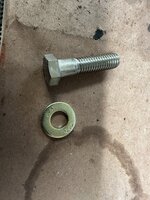
The gear-end clamps for the headstock are getting new ⅜-24x1.25 stainless bolts coated with Tea-Gel, and grade 8 washers. These have to get installed into the base of the headstock before lifting it on.
IMG_0566.jpeg
My buddy came by and helped me lift it on after we had a few beers. The alignment pins in front and the rear "V" way aligns the headstock to the base. I then tightened the rear clamps.
 
OP
G

Grant Gunderson

Well-known member
Joined
May 17, 2013
Messages
2,322
Location
Bellingham, WA
IMG_0564.jpeg
The front headstock clamp bracket uses two, ½-2" stainless bolts coated in tea-gel and two grade 8 washers.
IMG_0565.jpeg
FYI for those that dont know this, washers always have a flat, square edged side, this always faces the part, the side with the rounded edges and in the case of these grade 8 washers the text, faces out towards the bolt head. With the front clamp bracket in place the headstock is now secured. Once I get the spindle in, I will have to buy a "test bar" -Anyone have recommendations? So that I can check the headstock alignment, I may need to very slightly shift the rear of it one way or the other.
IMG_0569.jpeg
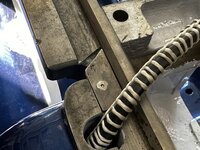
I then pulled the wiring for the drum switch up through the hole in the case of the headstock cavity. This is to the right of the bore for the switch it's self, and its a pain in the *** to get those wires snaked through, especially since I already had the termainals on them. I only lost minimal blood doing it.
IMG_0571.jpeg
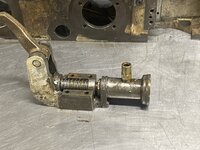
Main contactor cover back on. There is a very slight difference in the fitting of the head stock casting over it. Either I need to tweak the headstock alignment slightly, or its just a difference in how they where cast.
IMG_0573.jpeg
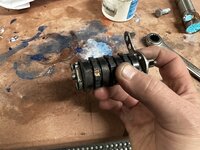
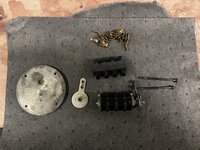
I had taken apart the drum switch and cleaned it in my ultrasonic. I still would like to fine a replacement as some of the contacts are very worn. Still useable but not ideal. The main body is held together by two long contersinked screws.
IMG_0583.jpeg
Here is the general layout for the rest of it The second set of long countersink screws hold the switch unit together as well as mount it to the rear plate cover.
IMG_0584.jpeg
All together minus the contacts.
IMG_0590.jpeg
I then chased all of the threaded holes in the head stock, the switch uses an 8-32 thread, since they dont make thread chasers this small I used a tap.
IMG_0607.jpeg
Elsewhere with the larger threads I could use my thread chaser tap. I wanted to do this now, while the headstock was empty to prevent any contaminations from chasing the threads.
IMG_0609.jpeg
Note, some of these where clearly drilled by hand by the factory.... thats no where close to square!
 
OP
G

Grant Gunderson

Well-known member
Joined
May 17, 2013
Messages
2,322
Location
Bellingham, WA
IMG_0601.jpeg
Despite having the casting dipped and hot stripped, there was still a ton of **** in the threads!
Ok back to the switch.
IMG_0587.jpeg
I had scribed the switch connections on it prior to disassembly, so it was just a matter of matching things up to wire it back together.
IMG_0594.jpeg
The switch assembly gets installed with the two small mounting screws for it facing the gear end of the lathe. Its retained by 4 stainless countersunk screws coated in Tefgel. I didnt fully crank them down at this stage, so I could align the front side of the switch assembly with it.
IMG_0611.jpeg
Here is the layout for the front side of the switch. Since this doesn't get lubed in operation, I coated the shaft with super lube. I am using. new stainless taper pin as well. Its a #2
IMG_0614.jpeg
With everything lined up, I used a #2 taper pin reamer to clean up the bore.
IMG_0616.jpeg
I supported the shaft on V-blocks and coated the pin with tefgel and tapped it home. I then filed the long end flush with the shaft.
IMG_0618.jpeg
I had gotten some body filler into the bore holes for the large taper pin that holds the handle on. I used my PB-swiss hand held reamer to clean it out.
IMG_0626.jpeg
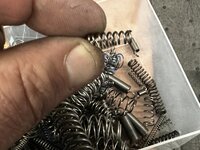
The handle has a ball detent. The factory spring was quite weak, so I went to my stock of random springs and found one that was a correct fit. Its better than the factory one, but could honestly be a bit stronger.
IMG_0620.jpeg
I put a bunch of super lube in the bore, and inserted the spring.
IMG_0621.jpeg
Followed by the ball. I measured it, in case it ever goes missing. Its 0.2190 in diameter. I then coated the large taper pin with tefgel and using a brass drift drove it in, securing the handle over the detent.
 
To avoid these ads, REGISTER NOW!
Top Bottom