To avoid these ads, REGISTER NOW!

Recommend buck boost for Magnetic brake

Whiskeymike

Well-known member
Joined
Oct 31, 2013
Messages
775
Location
Austin, TX
Just got a Baileigh magnetic brake. It accepts 220v at 13amp and has warnings that voltage needs to be within +/- 5%. I got everything set up and checked my voltage and it’s 247v. Can someone recommend a buck boost to bring it within range? Also, can you explain how they are normally wired in? There doesn’t seem to be much info on them.
 
To avoid these ads, REGISTER NOW!

wyliesdiesels

Well-known member
Joined
Aug 14, 2012
Messages
19,998
Location
Modesto, CA
Theres another recent thread on here about buck boost tranys.

I'll dig up some info on them.

Does the nameplate say 50hz?

When was this machine made? 220v hasnt been in use in the US for decades. Is it possible this is an older machine?

Is it USA made or foreign?

What kind of electronics does it have?

You have a pic of the nameplate?
 
OP
W

Whiskeymike

Well-known member
Joined
Oct 31, 2013
Messages
775
Location
Austin, TX
Thanks, I read the thread on the lift, but didn’t want to hijack. This is also an electromagnet circuit, not a motor, so it seemed a different topic. It’s a relatively new machine, built in late 2016. It’s 60 hertz. Yep, made in China.

On the product page, it says this.

*****IMPORTANT INFORMATION!*******
To achieve proper performance and prevent damage to the machine, the power supplied must be 220VAC +/-5% (209VAC to 231VAC). Failure to comply will damage the machine and void the warranty. Questions on this please call Baileigh Industrial 920-684-4990 before purchasing.

I’m going to call them tomorrow as it sounds like they will sell you the buck boost. But am hoping to have options in case theirs is marked up a lot.


Here’s the name plate.
 

Attachments

  • 11DE0877-57D2-46B6-A87E-DAA84392FEC8.jpg
    11DE0877-57D2-46B6-A87E-DAA84392FEC8.jpg
    126 KB · Views: 63
Last edited:

mm08822

Well-known member
Joined
Jan 13, 2012
Messages
5,894
Location
NJ
Acme# T181051, 120/240 x 12/24, 0.50 kva, buck/boost xformer....zoro dot com $100. Will cover the 13 amp load without issue.
 
OP
W

Whiskeymike

Well-known member
Joined
Oct 31, 2013
Messages
775
Location
Austin, TX
Excellent, thanks. I ordered the 181051 from Zoro. Appreciate the help.

For wiring, I assume it's as straight forward at putting the two legs on the high side, and output will come from the load side. I'll check out the wiring diagram.

FWIW, Baileigh wanted $330 for theirs.
 
Last edited:
OP
W

Whiskeymike

Well-known member
Joined
Oct 31, 2013
Messages
775
Location
Austin, TX
In looking at the diagram for this device - https://www.grainger.com/ec/pdf/4LEK7_1.pdf

I believe I'm supposed to use diagram I. When looking at diagram I, it shows 1 in (H4), one out(X1). I expected it to be two in, two out, reducing the voltage of each leg equally. Is this not the case or am I misinterpreting things?

I attached an image of the diagram below.
 

Attachments

  • 4LEK7_1_pdf.jpg
    4LEK7_1_pdf.jpg
    7.1 KB · Views: 25

mm08822

Well-known member
Joined
Jan 13, 2012
Messages
5,894
Location
NJ
In looking at the diagram for this device - https://www.grainger.com/ec/pdf/4LEK7_1.pdf

I believe I'm supposed to use diagram I. When looking at diagram I, it shows 1 in (H4), one out(X1). I expected it to be two in, two out, reducing the voltage of each leg equally. Is this not the case or am I misinterpreting things?

I attached an image of the diagram below.

The dwg is correct. This is a typical connection configuration for buck/boost xformers. You are thinking of an isolation style xformer.

The voltage input is created by the difference in voltage between the 2 input leads. The output is only using a portion of the input voltage as it picks off a certain percentage of it. ..............240/(240+24) '%
 

American Locomotive

Well-known member
Joined
Jan 8, 2017
Messages
10,946
Location
Rhode Island
I swear these companies must just be importing this stuff with artificially tight voltage tolerances just so they can sell you an overpriced transformer. I bet in all reality it's just a 220/50hz machine they stamped "60 Hz", and would likely be 100% fine on 240/60Hz.
 
OP
W

Whiskeymike

Well-known member
Joined
Oct 31, 2013
Messages
775
Location
Austin, TX
He said he was going to call and posted the number,, maybe I missed it but did he?

Yep, called them this morning. Anything over 231v will damage the device. They wanted $330 for the transformer from them. Hopefully this acme will do the trick.
 

Norcal

Well-known member
Joined
Mar 16, 2008
Messages
13,753
This where "There ought to be a law" has a rare value, someone imports some ****** equipment and then will not warranty it because it will not operate properly on nominal 240 volts, which is the commonly supplied voltage of the country they are importing it into.
 

zmaxmotorsports

Well-known member
Joined
Jan 11, 2013
Messages
11,948
Location
South of omaha
This where "There ought to be a law" has a rare value, someone imports some ****** equipment and then will not warranty it because it will not operate properly on nominal 240 volts, which is the commonly supplied voltage of the country they are importing it into.
:thumbup::thumbup::thumbup::thumbup:
I've never seen a machine that voltage sensitive used around a shop anyway.
 
To avoid these ads, REGISTER NOW!

sberry

Banned
Joined
Jun 18, 2005
Messages
35,747
Location
Brethren, Michigan
I looked at one of thoes brakes at one time, it could be super cool, all the advantages of a finger brake, maybe more and not terribly expensive in the grand scheme if a guy had some real work for it. I dont recall the cost.
 
OP
W

Whiskeymike

Well-known member
Joined
Oct 31, 2013
Messages
775
Location
Austin, TX
I looked at one of thoes brakes at one time, it could be super cool, all the advantages of a finger brake, maybe more and not terribly expensive in the grand scheme if a guy had some real work for it. I dont recall the cost.

Full price is $2300. I paid $1650 for a scratch and dent version from manufacturer with full warranty. It does up to 16 gauge at 48 inches. Some guys say they can do 11 gauge 12-24. But I suspect the hinges will get stressed out if you do much of that without scoring.

A couple cool things with it...

No hinges or clamps at the end, so you can do longer than 48” with care. Also because the ends are free, you can get to some spots that would be impossible on most brakes. Anything steel can be a die, so use a round pipe or solid round bar to bend a round radius of various dimensions. Or make a full circle, or enclosed channel, because you can turn it off and then slide the round/rectangle enclosed shape off the die. Check out some YouTube videos on what it can do. I got it because of the versatility.
 
OP
W

Whiskeymike

Well-known member
Joined
Oct 31, 2013
Messages
775
Location
Austin, TX
So, is the best way to wire this up....

Come out of panel, conduit to position, go into transformer, out conduit to box with outlet? Because it’s bucked down to 220v, should I label it in some special way? Any reason to not use flex conduit? I have the bender, so regular conduit is not out of the question. Just looking to make it easy as I’m already running 3 or 4 pieces of conduit down that wall brace. (Metal building with brace running horizontally 4’ high)
 
Last edited:

slow

Well-known member
Joined
Feb 26, 2006
Messages
2,596
Location
near Orlando
To be fair, most shops with 120/208 3 phase will only have 208 leg to leg, so that is likely the target customer. If it was consumers, they would offer a 240 version.
 

Norcal

Well-known member
Joined
Mar 16, 2008
Messages
13,753
To be fair, most shops with 120/208 3 phase will only have 208 leg to leg, so that is likely the target customer. If it was consumers, they would offer a 240 version.

Lot of machine shops are 120/240V 3 phase.
 

theoldwizard1

Well-known member
Joined
Feb 22, 2011
Messages
43,132
Location
SE MI
Damn chicom idiots making stuff that isnt compatable with US power service.
Concur with THAT statement !

I think the spec in the US is 240V +/- 10%. 220V is suspiciously close to 208V +10%. A 240V to 208V transformer should work.

For that matter, if you are good with Ohm's Law you can calculate a resistor voltage divider Vout = (Vin x R2) / (R1 + R2). Remember R2 is actually in parallel with the electromagnet which is about 17Ω.

You are going to need some high wattage resistors (>20W) but they will not be powered on for very long.
 

mm08822

Well-known member
Joined
Jan 13, 2012
Messages
5,894
Location
NJ
I swear these companies must just be importing this stuff with artificially tight voltage tolerances just so they can sell you an overpriced transformer. I bet in all reality it's just a 220/50hz machine they stamped "60 Hz", and would likely be 100% fine on 240/60Hz.

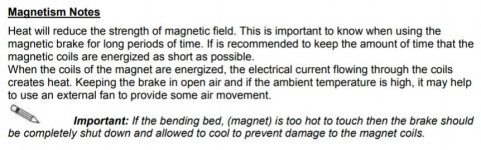
As the manual speaks of overheating coils (even under spec’d voltage), over voltage applied to the coils will only accelerate the heating/temperature rise resulting in more cool down time required for the user to contend with.

Screen Shot 03-07-18 at 03.19 PM.jpg
 

mm08822

Well-known member
Joined
Jan 13, 2012
Messages
5,894
Location
NJ
This where "There ought to be a law" has a rare value, someone imports some ****** equipment and then will not warranty it because it will not operate properly on nominal 240 volts, which is the commonly supplied voltage of the country they are importing it into.

Simply matching the local voltage spec for the equipment would be the best/easiest for all. This is some of the effects of the global market we are in and other location’s standards being a little loose.

However in this case, the mfr does spec requirements up front in the manual. This is the known equipment operating requirements. If you choose to by this mouse trap, then you comply and treat it as part of site prep. If you choose not to comply with the voltage spec, then you spin the wheel and see where you net out over time.
If the voltage spec is an issue, look elsewhere or make your own. What other options are there?
 

mm08822

Well-known member
Joined
Jan 13, 2012
Messages
5,894
Location
NJ
So, is the best way to wire this up....

Come out of panel, conduit to position, go into transformer, out conduit to box with outlet? Because it’s bucked down to 220v, should I label it in some special way? Any reason to not use flex conduit? I have the bender, so regular conduit is not out of the question. Just looking to make it easy as I’m already running 3 or 4 pieces of conduit down that wall brace. (Metal building with brace running horizontally 4’ high)

I would wire it as follows:
2 pole 20 amp cb in panel
#12 wire to 6-20R recept.
Mount b/b xformer on brake.
Connect 12-3 cord with 6-20P plug to input of xformer.
Connect output of xformer directly into brake control cabinet.

This method enables a 240v, 20A recept for other needs at “standard” voltage.
 

mm08822

Well-known member
Joined
Jan 13, 2012
Messages
5,894
Location
NJ
Concur with THAT statement !

I think the spec in the US is 240V +/- 10%. 220V is suspiciously close to 208V +10%. A 240V to 208V transformer should work.

For that matter, if you are good with Ohm's Law you can calculate a resistor voltage divider Vout = (Vin x R2) / (R1 + R2). Remember R2 is actually in parallel with the electromagnet which is about 17Ω.

You are going to need some high wattage resistors (>20W) but they will not be powered on for very long.

A 3 kva xformer would run ~$450.

Adding a voltage divider is great for constant loads. Max load is 13a for this piece, but we don’t know if it varies throughout various types of use/settings.
This method is a lot more complicated than a simple $100 b/b xformer.
Requires an enclosure, properly sized resistors, heat sink, and a mounting means within. The 2 resistors needed would be 2 ohm with >365w rating and 16.3 ohm with 4w rating.

A b/b xformer includes an enclosure, generates minimal heat, no extra component mounting provisions and is UL listed out of the box and used for its intended purpose.
 
Last edited:
OP
W

Whiskeymike

Well-known member
Joined
Oct 31, 2013
Messages
775
Location
Austin, TX
I would wire it as follows:
2 pole 20 amp cb in panel
#12 wire to 6-20R recept.
Mount b/b xformer on brake.
Connect 12-3 cord with 6-20P plug to input of xformer.
Connect output of xformer directly into brake control cabinet.

This method enables a 240v, 20A recept for other needs at “standard” voltage.

Dang it! You make a lot of sense and I just bought everything. Back to THD for some 12-3 Cord. Thanks for the advice. That seems the smarter way to do it.
 
OP
W

Whiskeymike

Well-known member
Joined
Oct 31, 2013
Messages
775
Location
Austin, TX
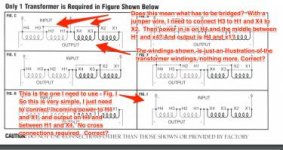
Ok, I've got everything and I'm going to wire it up tonight. I'm trying to make sure I'm reading the wiring diagram correctly so I have put a couple questions in the image so it's in context.

Thanks
 

Attachments

  • ACME_BUCK_BOOST_TRANSFORMER_SPECIFICATIONS_pdf.jpg
    ACME_BUCK_BOOST_TRANSFORMER_SPECIFICATIONS_pdf.jpg
    21.9 KB · Views: 22

mm08822

Well-known member
Joined
Jan 13, 2012
Messages
5,894
Location
NJ
Ok, I've got everything and I'm going to wire it up tonight. I'm trying to make sure I'm reading the wiring diagram correctly so I have put a couple questions in the image so it's in context.

Thanks

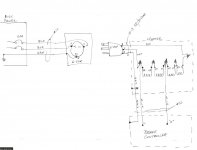
Sorry your pic was too low of a resolution to read.

Here's what you need......
ScreenShot_03092108_1800.JPG
 

rsanter

Well-known member
Joined
Dec 22, 2007
Messages
18,505
Location
visalia ca
I have one of those brakes and it is very cool. Only real issue for me is that they are overrating the capacity of the thing.
You will struggle to bend a full width 16ga steel sheet (48”) and the clamp bar will want to lift.
For narrower or thinner stuff it is great
 

6PTsocket

Well-known member
Joined
Mar 12, 2014
Messages
4,593
Theres another recent thread on here about buck boost tranys.

I'll dig up some info on them.

Does the nameplate say 50hz?

When was this machine made? 220v hasnt been in use in the US for decades. Is it possible this is an older machine?

Is it USA made or foreign?

What kind of electronics does it have?

You have a pic of the nameplate?
For years there has been a rather loose standard about what line voltage is. I have seen low voltage listed as 110, 115, 117 and 120. I have seen 220, 230 and 240 listed as the higher voltage. It does not seem that calling for 220 is some archaic standard.

Sent from my SM-G900V using Tapatalk
 

wyliesdiesels

Well-known member
Joined
Aug 14, 2012
Messages
19,998
Location
Modesto, CA
For years there has been a rather loose standard about what line voltage is. I have seen low voltage listed as 110, 115, 117 and 120. I have seen 220, 230 and 240 listed as the higher voltage. It does not seem that calling for 220 is some archaic standard.

Sent from my SM-G900V using Tapatalk

Calling for 220?

Well as has been seen here, getting the voltage correct IS important.

So what if the OP just assumed the 220v on machine label meant 240v? **** the smoke gets let out!
 
To avoid these ads, REGISTER NOW!
Top Bottom