To avoid these ads, REGISTER NOW!

Recommendations for a newby TIG welder...

Lassen Forge

Well-known member
Joined
Apr 26, 2014
Messages
15,380
Location
The romantic hills of central Umbria, Italy,
OK, I've decided I need to up my skillset, so I want to start learning TIG. Mind you, no good schools around (except the University of Youtube, and the Community College of the GJ Community) , but the biggie is this - so many choices here and there for TIG machines - what do you suggest and why? It seems totally worth is (especially for working on old/antique stuff), but how bad is this going to kick my wallet's ****, and what are the minimums I should be looking at?
Leep in mind while I DO know how to weld this is a totally new discipline for me...
TY, guys.
 
To avoid these ads, REGISTER NOW!

rlitman

Well-known member
Joined
Oct 18, 2010
Messages
24,650
Location
Long Island
For steel, you can go with a DC machine, and your wallet will be spared. If you want to touch aluminum, you'll need AC, and a severe wallet **** kicking.

However, I don't encounter much antique aluminum, or even antique steel I would TIG weld, and cast iron does not lend itself well to TIG.
 

Firebrick43

Well-known member
Joined
May 12, 2015
Messages
14,166
Location
West central Indiana
Your going to be limited to around 200 amps if using an air/gas cooled torch.

Liquid cooled is a lot bigger/more expensive but can handle much higher amps without getting hot.

Rlitman covered dc vs ac/dc.

I prefer transformer machines as they are very smooth and durable.

Inverter machines are more portable.

If working on antiques you might be better served by an aircraft oxy acetylene torch such as a smith airline or a meco midget. They would be more versatile with less buy in but some more skill / practice
 

nadogail

Well-known member
Joined
Jan 23, 2009
Messages
32,032
Location
Coronado, CA
One of these days I just might buy a TIG Torch, gas bottle and regulator and hook them up to my Hobart LS Stickmate welder.
 

dr_clyde

Well-known member
Joined
Jan 7, 2009
Messages
6,463
Location
Holland, MI
A budget is very helpful in these kind of discussions.

In the dark, knowing you're in Italy, an HTP InverTIG 221 would be my first choice. They're a bit more money than the bottom end but are excellent machines for a home shop.

I'm not sure how well Lincoln, Miller or ESAB are distributed over there, but I've had very good luck with Miller TIG machines over the years. I love my Dynasty and Syncrowave machines.
 

txvwnut

Well-known member
Joined
Jan 1, 2015
Messages
7,649
Location
Bedford, Texas
I'll second the HTP only because of your location and the price may be a little better than in the states. I run an AHP 203XI and before that a 201XD and love both of them. The 203XI is a 200 amp unit comes with a Nova pedal and Rota-flex torch and awesome customer support although I'm not a fan of having to scroll through menu selections to get where I want to be. As for learning if you can stick weld and weld with an O/A torch you probably got the skill set to tackle TIG. Get on Youtube and look up welding tips and tricks, Jody also has a website www.weldingtipsandtricks.com. His Youtube channel is very informative and instructions are given plain english and technical speak translations. Another good Youtube channel is the fabrication series. Justin has even started a subscription welding class that is done online at your pace with real instructors.
 

GeoBruin

Well-known member
Joined
May 5, 2018
Messages
3,750
It's always a wide variety of answers when you ask "what welder" type questions here. Everyone has their opinions and in most cases, there are good(ish) reasons for those opinions, but they are still just opinions and constitute a relatively small sample size.

In my opinion, we ask the wrong questions. We ask "what's the best? " or "what's good? " or "what's the best bang for the buck? " and of course we get a million different answers that boil down to "I've got this one so that's the best" with the occasional "I've been welding for half a century and this is the one we used for my industrial welding outfit" thrown in.

While these all provide some data points for a newbie, I don't think it's actually super helpful. The reality is, most welders work most of the time. What I'm most interested in is knowing is which ones don't work most of the time, or which ones have specific issues that will affect someone who does a certain type of welding. If you can wrap your head around those and avoid the ones that are relevant to you, you're left with a very large number of options to choose from, and you can select based on price, availability, or other factors that will be most meaningful to you.

In your case, some fundamental questions are:

-Do you have a hard price cap, or are you just looking for value?
-Do you need AC? As mentioned above, if you only ever plan to weld steel, it may not be relevant for you and it does ratchet up the cost not just in terms of the welder itself but also the necessary consumables.
-How big/thick/much do you plan to weld? If you're focused on sheet metal up to thin structural steel, you can get away with a smaller welder and lower duty cycles. If you want to weld thick structural steel and pipe, you're going to be looking at a different class of welder.
-Do you have any particular hangups on country of origin of availability of on site warranty service? If you need your welder to be made in your country or any particular country, that will limit the available options. If you need to be able to walk into a local service center for serivice, that will also severely limit your options.
-Finally, would you consider a used machine? There are obviously price advantages to used equipment but if you're someone that thinks you are a) likely to encounter a functional issue that would be covered by the warranty within the warranty period, and b) likely to take advantage of the warranty in the manner required by the manufacturer or distributer, a used machine may not be an option for you.

If you can answer those questions honestly, before even thinking about what specific machine you might want, it will help you frame your search, and it will help us make better recommendations.
 

finn

Well-known member
Joined
Mar 27, 2005
Messages
16,339
Location
The UP, God's country
I have three Tig machines now, a HTP Invertig, a Primeweld Tig 225, and now a Miller Multimatic 220, all AC/DC machines In different locations.

At my skill level, I can’t discern a difference in capability. I do know that at around $750 on Black Friday last year, the Primeweld cost less than half what the HTP cost many years ago ( maybe 1/3), and around 1/5 what the Miller Multimatic multi purpose machine cost a couple of months ago.
 

loganb

ALLIANCE MEMBER
Joined
Dec 29, 2011
Messages
5,613
Location
Omaha, NE
Following along as have been thinking about this exact same addition to garage/skillset as well.

For my use case:
Budget 1k to $1,250, I have helmet already
Material: Want capability for aluminum so AC required
Thickness: 3/16" is likely max so air cooled setup with lower duty cycle fine, this is all for garage based fab and small stuff, nothing structural. Based on other readings if it's 1 amp per thou of material thickness assuming this puts in a roughly 180 class machine?
Electrical supply: 240v single phase is available
Used or New: No problem with quality used equipment, most of my tools are used
Does not need to be a fancy multi-process machine if a single process machine is better. I have a basic 120v MIG box already
 

Aaron_W

Well-known member
Joined
Feb 6, 2018
Messages
2,931
Location
Northern California
I am a very inexperienced TIG welder. I took a class and have dabbled a bit on my own, that is the extent of my experience. However shopping for a machine I can help to explain some of the things you will be looking at.

If you have done Oxy-gas welding you will find some similarities with TIG. For youtube Welding Tips & Tricks (link was provided in a post above) is an excellent choice. He covers a variety of welding, but his TIG videos have been really helpful to me because he actually gets good close up video of the weld being done so you know what it should look like as you are doing it.


As mentioned AC TIG steps the price up significantly, so you need to decide if you want to be able to weld aluminum. That is the main feature of AC Tig (as well as a couple other exotic metals). Steel, including stainless can be done with DC TIG and the right gas, you can also TIG braze with DC TIG. AC TIG can easily add $1000 to the price of a decent machine.

As far as features to look for, I'd look at the bottom end as well as the upper. Some TIG welders can go down to single digit amps for very fine light work, but many only go down to 20-30amps. 20 amps will be more than low enough for most people, but if you want to weld very thin sheet metal, being able to go down to 5 amps could be something to look for.
Just as a point of reference my Miller only goes down to 20A, which is recommended for 24ga steel or aluminum. In class we had Miller Dynasty welders that could go down to 1A, which could probably weld aluminum foil. That is the difference between a $2000 machine and a $6500 machine.

The other place it seems many machines save money is by using lift start. This requires that the tip of the torch starts in contact with the material. I've never used a lift start machine to know how much this really matters, but TIG is very sensitive to contamination.
The better quality machines use HF (high frequency) start, a non-contact method. Basically the machine uses a quick burst of high energy to make the arc jump to the work when in close proximity, then it drops back to the set amps.

Pulse rate is another feature to look at, as this can help moderate the temperature of the arc. Not all TIG have a pulse option, and these that do range from a preset on or off, to a wide range of pulse rates and even variable types of pulse on the higher end machines. My Miller allows a setting from 0-150 pulses per second. The high end Miller Dynasty I used in class not only allowed much greater rate of up to 500 pulses / second, but also offered 3 pulse "wave shapes". At my skill level the range offered on that Dynasty was well beyond my abilities to notice.

If you do want AC TIG, then like DC pulsed TIG, settings range from very minimal adjustment to a lot of adjustability in rate and wave shape.

As with all welders you will want to look at duty cycle.

The brand of TIG torch, foot pedal and connections matter. You don't want to get stuck with something that uses weird proprietary hardware, that may be hard to replace. CK seems to be a common, and well respected brand of TIG torch used by many brands including some of the cheaper welders.


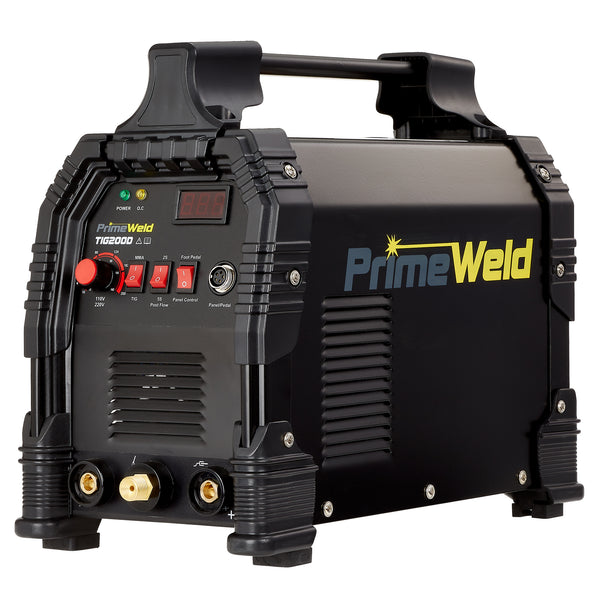
Being in another country, I'm not sure how helpful machine recommendations based on the US are, but HTP (again already mentioned) is an Italian company that gets good reviews. A lot of the inexpensive welders coming from China get much better reviews than I'd expect. Like anything cheap from China it seems like if you get a good one, they are pretty good, but if you don't it is a big headache. Return / replacement policy seems to be the most important factor for these. PrimeWeld is an affordable brand that receives a lot of positive comments on forums I belong to (including here).
 
Last edited:

rlitman

Well-known member
Joined
Oct 18, 2010
Messages
24,650
Location
Long Island
If I was going to get a dedicated TIG machine, I'd get one that's water cooled and have the ability to attach a TIG Button.
Water cooling raises the budget quite a bit, but I agree that it can make things much better. My water cooled CK torch is so much lighter in the hand than my gas cooled torch, while having a much higher current capability. But you can always start out gas cooled and add water later.

My first TIG setup was an HF box, home-made bridge rectifier and AC stick welder, so scratch start). It worked enough to let me learn what I wanted. I tried a "volume wheel" side-to-side type current control on my torch, and absolutely HATED it, which drove me to buy an SSC pedal, which I love. I still use that most of the time, but I picked up an SSC Touch 4 fingertip controller, and am quite happy with it. Happy enough that I could easily get used to using it exclusively. The TIG Button is a little more sophisticated, but is also more fragile and expensive, so I ended up ruling that out for my purposes.
 

WWheeler

Well-known member
Joined
Jun 23, 2015
Messages
4,105
Location
Middleofnowhere USA
Primeweld TIG225X or the newer TIG325X

Comparatively budget-friendly solid machines from a company with a reputation for excellent customer service.
 

dnschmidt

Well-known member
Joined
Oct 3, 2014
Messages
7,287
Location
Phoenix, AZ
Nobody can give you good advise since nobody knows what's available in your area with the exception of STEL which in America is marketed by HTP.
If you were in the USA by choices would be.

Best: HTP Invertig
Really good mid=priced machines: Primeweld and AHP
 

theoldwizard1

Well-known member
Joined
Feb 22, 2011
Messages
43,243
Location
SE MI
For steel, you can go with a DC machine, and your wallet will be spared. If you want to touch aluminum, you'll need AC, and a severe wallet **** kicking.
Well, technically, you CAN use DC TIG on aluminum. Not "friendly" for a newby.

How Good is the CHEAPEST Welder on Amazon?

This is a lightly better machine than the one shown on the video.

TOOLIOM 200A TIG Welder High Frequency TIG 110V/220V Dual Voltage TIG/Stick/Arc 2 in 1 IGBT Digital Inverter Welder TIG Welding Machine Amazon -$170 If it had a foot pedal, even as an option, it would be AWESOME !
 

jar944

Well-known member
Joined
Jul 26, 2010
Messages
5,951
Location
Northern VA
Based on reputation I'd get the htp. I went with a thermal arc 186 (now esab) and likely should have spent the extra $$
 
To avoid these ads, REGISTER NOW!

dlwilson

Well-known member
Joined
Jan 3, 2009
Messages
200
Location
West Palm Beach, FL
I started off with a Miller 300. It was the size of a refrigerator, and weighed 300 or 400 pounds. It was cooled with city water. It felt smooth, and worked great, but it was so big and heavy that when I moved I sold it rather than have it take up space in the new garage. Now I have an AlphaTIG with air cooled torch. It's very small and light, and works well enough for my amateur purposes. I do sometimes miss how that old Miller felt. I think either one of those would be a good choice for you.
 

gearhead1

Well-known member
Joined
Oct 14, 2013
Messages
1,935
Location
NC
I did research, decided on PrimeWeld and no issues with it.


Don‘t need to weld aluminum?
 

srode

Well-known member
Joined
Apr 28, 2011
Messages
450
Location
Ohio
I was looking at the Primeweld 225 also and it seems to have really high end features and a good reputation. I was also thinking about as the alternative the Primeweld 200 3in1 multi process machine and selling my Hobart 140. I don't really plan to do any aluminum, just mild steel and stainless. Guess I should start a separate thread on the two primeweld options to not contaminate this one but thought I would follow thread anyway. The only thing the 3in1 machine doesn't have that I might like is the high frequency start but not doing aluminum it's less of an issue. Stick weld isn't something I'm interested in but either will do that, and both will run on 110 which is important to me. Talking with Primeweld they said the recommend 30amp breaker for 110 on either machine but might get by with 20 amp if nothing else is on the circuit and I'm not pushing the upper end of the amperage.
 

Terra Nova

Well-known member
Joined
Feb 26, 2012
Messages
4,218
Location
Michigan
I am hoping to score a Primeweld 225x this year around Black Friday. All the research I did points to it being a great machine for the $$. Even Jody at welding tips and tricks is using and selling them. The new Primeweld 325x looks interesting and is said to address some of the shortcomings of the 225x (mainly low amperage start). But it's another $550 or so over the 225x.
 
Last edited:

dnschmidt

Well-known member
Joined
Oct 3, 2014
Messages
7,287
Location
Phoenix, AZ
I agree with everything that has been said about Primeweld. BUT YOU'RE MISSING VITAL INFORMATION. The OP is located in ITALY. It's very unlikely Primeweld is going to ship anything to Italy.
 

Terra Nova

Well-known member
Joined
Feb 26, 2012
Messages
4,218
Location
Michigan
I agree with everything that has been said about Primeweld. BUT YOU'RE MISSING VITAL INFORMATION. The OP is located in ITALY. It's very unlikely Primeweld is going to ship anything to Italy.
Easy to answer with a phone call to them. That is a good point though. May be better off looking at Fronius or Stel. Invertig is made in Italy but may have the same issue ordering through USAweld.
 
Last edited:

gearhead1

Well-known member
Joined
Oct 14, 2013
Messages
1,935
Location
NC
I agree with everything that has been said about Primeweld. BUT YOU'RE MISSING VITAL INFORMATION. The OP is located in ITALY. It's very unlikely Primeweld is going to ship anything to Italy.
PrimeWeld ships anywhere UPS ships. UPS ships to Italy. Yes it will be expensive, but Fronius cost more than Miller. Up to OP to decide if it’s worth the shipping cost.IMG_1253.jpeg
 

Jswain

Well-known member
Joined
Apr 26, 2013
Messages
2,465
Location
Calgary, AB
I would ask around some local forums / stop in some welding supply shops and see what brands of equipment they support. You don't need to necessarily buy from them, but chances are it will make your life easier if you purchase a machine somebody local supports/sells/stocks parts for.

No need to reinvent the wheel every step of the way
 

finn

Well-known member
Joined
Mar 27, 2005
Messages
16,339
Location
The UP, God's country
About the only parts I would ever expect to need for a welder are consumables like tips o rings and nozzles, liners, and maybe a liner Or regulator.

Those are all readily available on the internet for delivery anywhere in the world.
 

theoldwizard1

Well-known member
Joined
Feb 22, 2011
Messages
43,243
Location
SE MI
Another good Youtube channel is The Fabrication Series. Justin has even started a subscription welding class that is done online at your pace with real instructors.
One of my recent Favorite channels is Stick Welder. Yes, he does everything with stick (and boy is he good at it !), but more importantly, he shows the correct way to cut metal (frequently square or round tube) so that the joint comes out nearly perfect. No fill in and very little grinding. The guy is also an artist with a grinder and cut off wheel !
 

Jswain

Well-known member
Joined
Apr 26, 2013
Messages
2,465
Location
Calgary, AB
About the only parts I would ever expect to need for a welder are consumables like tips o rings and nozzles, liners, and maybe a liner Or regulator.

Those are all readily available on the internet for delivery anywhere in the world.
Imagine getting your (or your friends/relatives) daily driver up in the air, exhaust 1/3 welded on and you fucked up a liner/whip and if was 2 weeks to get a new one shipped.

Walking into a welding store that day would be kinda handy, huh?

I absolutely love online shopping, but sometimes it's nice to have options. It's like shipping a rare JDM RHD vehicle over here to be your daily driver. Why do you have to reinvent the world, get a vehicle that's available here already
 

finn

Well-known member
Joined
Mar 27, 2005
Messages
16,339
Location
The UP, God's country
Imagine getting your (or your friends/relatives) daily driver up in the air, exhaust 1/3 welded on and you fucked up a liner/whip and if was 2 weeks to get a new one shipped.

Walking into a welding store that day would be kinda handy, huh?

I absolutely love online shopping, but sometimes it's nice to have options. It's like shipping a rare JDM RHD vehicle over here to be your daily driver. Why do you have to reinvent the world, get a vehicle that's available here already
There are hundreds of thousands of people that don’t live within a hundred miles of a welding store. There are even more that don’t live within a hundred miles of a welding store that’s open seven days per week.

I don’t see this as a show stopper. At least not in my world.

I bought my first welder in 1987. The only thing that ever stopped me from welding was when I ran out of gas. I did replace a liner, but I ordered it online. It was worn out, but not a catastrophic failure. Performance gradually deteriorated.

I keep normal consumables on hand, as I imagine most people do. If the board goes out on my Miller and I want my lws to repair it, they will send it to their repair center in the next state. I won’t see the machine for a month, at a minimum. My neighbor was without his mig welder for six weeks while his was being repaired.
 
To avoid these ads, REGISTER NOW!
Top Bottom