

Ajmckay
Well-known member
This is garage related - I promise. Lots of us have refrigerators there! This one happens to be in my house - though may end up in the garage soon!
So I have a refrigerator (with a top mount freezer) that's not cooling right. Specifically, the freezer isn't cooling right therefore the refrigerator isn't getting enough cold air either. I'm conflicted because I'm not really prepared to drop $1,000 on a new refrigerator but at the same time I don't want to call for service and pay $100 for someone to tell me it's going to cost almost as much to fix. I'm willing to put $200 or so into this fridge if I can get it operational again, as I would really like to get maybe 5 more years out of it (it's almost 10 yrs old). So I'm trying everything I can do to help me decide if the refrigerator is able to be fixed within my budget or if I should buy a new one.
Make: Frigidaire
Model: FRT21H7ASB4 (top freezer, bottom refrigerator)
Date of Mfg: 09/2003 (so almost 10 years old)
No ice maker or anything
Symptoms & Time line:- Freezer isn't cooling - it's currently at just over 40 degrees Fahrenheit.
- Refrigerator isn't cooling - it's currently at about 55 degrees
- Ice cream started to get mushy around 2/7/13 and the temperature has remained stable at the current temperatures for the last week or so with minimal opening/closing
- I'm not sure what the temp was before I noticed the mushy ice cream, but it seemed fine and froze ice pretty quick so I'm assuming it was in the single digits.
- Compressor and fans running continuously except for during defrost cycles - the freezer is blowing out cold air (not sure how cold though).
- Found a bad defrost thermostat on 2/9 - there was ice accumulated on the bottom of the evaporator coils and along the right side. Manually defrosted.
- At the same time verified the defrost timer was working and the defrost heater showed resistance.
- When I went to replace the defrost thermostat on 2/19 more ice had accumulated. Expected since the thermostat was bad. Manually defrosted.
Pictures:#1 - Taken on 2/9 while diagnosing the bad defrost thermostat.
#2 - Taken on 2/19 showing the new accumulation (minimal door opening)
#3 - Close up of the old defrost thermostat - no ice near it
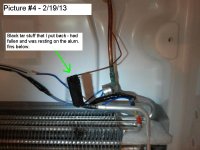
$4 - Showing new defrost thermostat installed and also showing this black tar stuff where the small diameter tube connects to the larger tube. Note that this black tar stuff had fallen off (you can see it hanging off the ice in picture #1 so I put it back on 2/9 when I first opened up the back of the freezer.
Steps taken to this point:- Turned freezer and refrigerator temperature to coldest setting on 2/8 (the day before I opened up the back of the freezer)
- Checked door seals for leaks, none found
- Vacuumed out the condenser coils under the fridge (there was a piece of cardboard stuck under there obstructing airflow out the front and they were pretty dusty)
- Verified the condenser fan was working and the compressor is running and not getting too hot, I could touch it comfortably just a few minutes after unplugging the refrigerator.
- Replaced the defrost thermostat 2/19 and verified that the defrost timer is working as is the defrost heater (the heater is getting hot now). I tricked the thermostat into thinking it was cold using the propellant from a can of compressed air. I did this last night and this morning the freezer temp was back at between 40 and 45 degrees F. The inside of the freezer was slightly above room temp. due to the hair dryer to defrost.
- Doesn't seem to be any blockage in the air vent between the freezer and the refrigerator.
So I had a few questions for you refrigeration guys:
1) I'm concerned that while the defrost thermostat was indeed faulty, it may not be causing the loss of cooling.
2) The ice build up doesn't seem severe enough to cause such a reduction in cooling - then again a friend of mine who works on cars suggested it may be messing with the thermal expansion valve. Do refrigerators have those? Is that what is under the black tar stuff where the small diameter tubing meets the larger tubing near the evaporator coils?
3) Does the formation of the ice build up indicate anything specific such as a loss of refrigerant or a leak or blockage in a certain spot?
Thanks again, any help that can be provided is much appreciated! I'm learning a lot about refrigerators because of this!
So I have a refrigerator (with a top mount freezer) that's not cooling right. Specifically, the freezer isn't cooling right therefore the refrigerator isn't getting enough cold air either. I'm conflicted because I'm not really prepared to drop $1,000 on a new refrigerator but at the same time I don't want to call for service and pay $100 for someone to tell me it's going to cost almost as much to fix. I'm willing to put $200 or so into this fridge if I can get it operational again, as I would really like to get maybe 5 more years out of it (it's almost 10 yrs old). So I'm trying everything I can do to help me decide if the refrigerator is able to be fixed within my budget or if I should buy a new one.
Make: Frigidaire
Model: FRT21H7ASB4 (top freezer, bottom refrigerator)
Date of Mfg: 09/2003 (so almost 10 years old)
No ice maker or anything
Symptoms & Time line:- Freezer isn't cooling - it's currently at just over 40 degrees Fahrenheit.
- Refrigerator isn't cooling - it's currently at about 55 degrees
- Ice cream started to get mushy around 2/7/13 and the temperature has remained stable at the current temperatures for the last week or so with minimal opening/closing
- I'm not sure what the temp was before I noticed the mushy ice cream, but it seemed fine and froze ice pretty quick so I'm assuming it was in the single digits.
- Compressor and fans running continuously except for during defrost cycles - the freezer is blowing out cold air (not sure how cold though).
- Found a bad defrost thermostat on 2/9 - there was ice accumulated on the bottom of the evaporator coils and along the right side. Manually defrosted.
- At the same time verified the defrost timer was working and the defrost heater showed resistance.
- When I went to replace the defrost thermostat on 2/19 more ice had accumulated. Expected since the thermostat was bad. Manually defrosted.
Pictures:#1 - Taken on 2/9 while diagnosing the bad defrost thermostat.
#2 - Taken on 2/19 showing the new accumulation (minimal door opening)
#3 - Close up of the old defrost thermostat - no ice near it
$4 - Showing new defrost thermostat installed and also showing this black tar stuff where the small diameter tube connects to the larger tube. Note that this black tar stuff had fallen off (you can see it hanging off the ice in picture #1 so I put it back on 2/9 when I first opened up the back of the freezer.
Steps taken to this point:- Turned freezer and refrigerator temperature to coldest setting on 2/8 (the day before I opened up the back of the freezer)
- Checked door seals for leaks, none found
- Vacuumed out the condenser coils under the fridge (there was a piece of cardboard stuck under there obstructing airflow out the front and they were pretty dusty)
- Verified the condenser fan was working and the compressor is running and not getting too hot, I could touch it comfortably just a few minutes after unplugging the refrigerator.
- Replaced the defrost thermostat 2/19 and verified that the defrost timer is working as is the defrost heater (the heater is getting hot now). I tricked the thermostat into thinking it was cold using the propellant from a can of compressed air. I did this last night and this morning the freezer temp was back at between 40 and 45 degrees F. The inside of the freezer was slightly above room temp. due to the hair dryer to defrost.
- Doesn't seem to be any blockage in the air vent between the freezer and the refrigerator.
So I had a few questions for you refrigeration guys:
1) I'm concerned that while the defrost thermostat was indeed faulty, it may not be causing the loss of cooling.
2) The ice build up doesn't seem severe enough to cause such a reduction in cooling - then again a friend of mine who works on cars suggested it may be messing with the thermal expansion valve. Do refrigerators have those? Is that what is under the black tar stuff where the small diameter tubing meets the larger tubing near the evaporator coils?
3) Does the formation of the ice build up indicate anything specific such as a loss of refrigerant or a leak or blockage in a certain spot?
Thanks again, any help that can be provided is much appreciated! I'm learning a lot about refrigerators because of this!


 I can't believe how expensive they are!