To avoid these ads, REGISTER NOW!

Remodeling old pole building

jonness

Active member
Joined
Feb 26, 2017
Messages
32
Location
Olympia, WA
I bought a property with a 24' x 36' pole building on it that I'm planning to fix-up. The building was built in 1987 (30-years-ago). One of the rear corner posts has settled 2-1/4" into the ground, and does not appear to be rotten. One of the front posts has settled 1-1/2" into the ground, and does not appear to be rotten. I'm thinking the best fix would be to auger down to the bases of the poles, jack the building up, pour 4" of concrete with rebar underneath the posts, and back-fill the holes.
 

Attachments

  • FrontPostSag.jpg
    FrontPostSag.jpg
    92 KB · Views: 91
  • RearCornerPostSag.jpg
    RearCornerPostSag.jpg
    120.8 KB · Views: 82
To avoid these ads, REGISTER NOW!
OP
J

jonness

Active member
Joined
Feb 26, 2017
Messages
32
Location
Olympia, WA
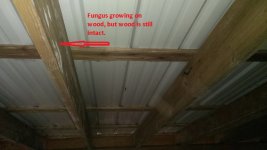
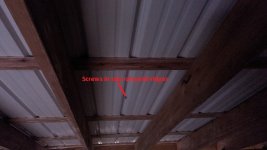
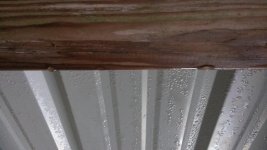
I suspect the roof is not leaking, and all of the water, fungus, and wood discoloration I'm seeing is from condensation. However the roof screws are 30-years-old. Should I get new screws one size larger and change out the screws in the entire roof? If so, what is the best kind of screws to use?
 

Attachments

  • IMAG0020.jpg
    IMAG0020.jpg
    87.6 KB · Views: 45
  • IMAG0019.jpg
    IMAG0019.jpg
    93 KB · Views: 45
  • IMAG0013.jpg
    IMAG0013.jpg
    83.2 KB · Views: 47
  • CondensationMid.jpg
    CondensationMid.jpg
    111 KB · Views: 45
  • CondensationClose.jpg
    CondensationClose.jpg
    104.7 KB · Views: 49
OP
J

jonness

Active member
Joined
Feb 26, 2017
Messages
32
Location
Olympia, WA
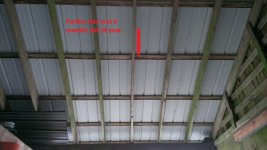
I'm at a loss about how to insulate the roof. Some posts I read say to spray foam between the joists with 2" of closed cell foam. Others say not to do this, because the foam won't go in the cracks between the purlins, and the water will condense in there and rot out the roof support. I've thought about cutting foam panels and fitting them between the 2'-on-center 8" rafters. This would leave an air gap between the wood-steel and the insulation and allow condensation to vent out between the soffit and ridge vent. But I've sometimes read not to do that either. How in the heck do you insulate a roof like this?
 

Attachments

  • IMAG0022.jpg
    IMAG0022.jpg
    113.5 KB · Views: 36

xladkalkd

Well-known member
Joined
May 26, 2013
Messages
45
I built my own pole building from timber 6x 6, 6 x 8, 4 x 10, etc. and some plywood for an enclosed tool shop and roof. I used asphalt shingles over plywood with tar paper instead of metal.

Yes if the ground is not solid, poor soil consistency, near a septic system drain field, etc. one or more poles potentially may sink into the ground. However the fix is not all that complicated, just support one corner or the area of the building with the sinking post, dig around the post and lay some concrete with metal re-bar support. Possibly you can use a better concrete than originally used as their are various types of concrete available some with additives.

Normally some re-bar laid into the standard cement works just fine.

That's a good idea of insulation of the roof. Keeping an air gap to provide some air flow reducing problems with condensation.

I've built metal roofs in the past, most were roofs made from lumber and plywood with sheet metal roofing laid on top of the plywood with tar paper, which helps to reduce condensation.

Whats may be important is to have a ridge and side vents, so air is able to flow from e.g. gable end vents up and out the ridge vent. Some people install only roof vents or both ridge and roof vents. Roof vents are usually placed at different locations approx midway between the ridge and side of the roof or gutter.

Tentatively one only needs to install gable ends and a ridge vent, instead of building a false roof providing an air gap. When I built my tool shed I left a gap near the sides of the roof to allow air to also flow in or out. Whereas building a home this area would normally be sealed and closed off. Homes now a day are often better insulated so often install wall vents are installed just underneath the gutters. Along with, sometimes, gable, roof and ridge vents.

There's different techniques to install a ridge vent, the best method imo, would be to pull up the exiting metal roof near the ridge and install lateral support one or two inches thick, between the two gable ends on either side of the ridge to support a metal roof vent that will overlap on both sides of the ridge.
 
Last edited:
To avoid these ads, REGISTER NOW!

stm317

Well-known member
Joined
Aug 8, 2017
Messages
1,339
If you're going to be replacing screws anyway, I'd remove the roof panels completely, and roll out a moisture barrier over the purlins before reattaching the roof sheets. This should prevent condensation from collecting on the underside of the roof metal. Once it's dry, you'll have more options for properly insulating the ceiling.
 
OP
J

jonness

Active member
Joined
Feb 26, 2017
Messages
32
Location
Olympia, WA
Removing the existing metal is probably the best way, but I would have to wait until summer (it rains a lot in Olympia). It also seems difficult to get the existing screw holes lined up perfectly when re-attaching the metal. I'll give it some thought. In the meantime, I've thought of another way that might work to keep the warm moist winter air in the structure from condensing on the underside of the cold metal roof and also provide a radiant barrier in the summertime.

1) Nail 1"x1"x8' spacers to the bottoms of the purlins at the corners.
2) Staple a foil radiant barrier to the 1"x1" spacers leaving a 1" air gap on both sides of the foil to allow ventilation between the ridge vent and the soffit.
3) Fill the remainder of the lower rafter with rockwool batts.
4) Staple fireproof poly to the bottoms of the rafters in order to keep moisture from going up into the rockwool. (instead of drywall because the roof is not designed for a lot of additional weight.)

Here's a rough ascii diagram of the idea. Sorry for the not-so-good drawing.
 

Attachments

  • FoilAndInsulation.jpg
    FoilAndInsulation.jpg
    87.9 KB · Views: 18
OP
J

jonness

Active member
Joined
Feb 26, 2017
Messages
32
Location
Olympia, WA
The first picture explains it better than my ascii drawing. The air gaps would vent between the soffit and the ridge vent. The existing metal would stay screwed to the top of the purlin, and the fireproof poly would be stapled under the rockwool.

The second picture shows a similar idea using breathable foil with insulation taking up the entire space under the foil. It still uses a top gap to vent between the ridge and soffit.
 

Attachments

  • InsulationPicture.jpg
    InsulationPicture.jpg
    39.2 KB · Views: 29
  • FoamStripsAndPermiatedFoil.jpg
    FoamStripsAndPermiatedFoil.jpg
    65.9 KB · Views: 29
Last edited:
To avoid these ads, REGISTER NOW!
Top Bottom