To avoid these ads, REGISTER NOW!

Remote Compressor Switch and Solenoid

eriksalo

Well-known member
Joined
Nov 29, 2007
Messages
184
Location
Colorado
I recently installed a remote relay switch and valve for my shop compressor.

I have a 7.5 Horsepower, 80 gallon compressor for my shop. The compressor is located relatively far from the shop for noise reasons and I have a number of drops (about ten) around the shop. The drops have ball valves for shutoff and the piping is all copper. Piping is 3/4" for the main deliver line and 1/2" for the drops.

The system has worked well for me for several years and there are no leaks in the copper as far as I know. However, I have found that over time small leaks form at the connectors, hoses, etc. I (sadly) don't use my shop every day and sometimes have periods where I don't use it at all. I don't like that the compressor runs whenever it wants and it's far enough away where walking out to turn off the breaker is not convenient. I try and keep on top of the leaks but if there are a few leaky hoses, it comes on once or twice per day and that seems like a waste of electricity and un-needed wear and tear.

The compressor has gone through two Sinpac start Switches ($100 each) and sets of start capacitors ($20) in the ~5 years I've had the system. I recently decided to implement a remote compressor switch system. The remote switches on both an air solenoid and an electrical contactor for the main compressor power. My inspiration came from other posts on this board so I wanted to share my results.

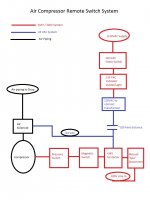
The system uses a 110V timer switch that I got from Home depot. The timer switch has buttons for times ranging from 5 mintues to 4 hours and also has a manual mode. I run the output from the timer switch to a regular 110V outlet where I got a small plug in LED nightlight. The purpose of the light is simply to show when the compressor is enabled. When the timer goes off, the light goes out. I got the 110VAC signal from an existing outlet (which you can see in my picture).

From the outlet, the 110V signal goes to a 24VAC transformer that creates a 24VAC signal. The 24VAC wire (I used some speaker wire) travels the ~100 feet to the compressor.

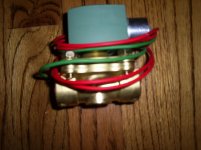
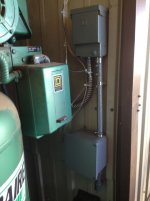
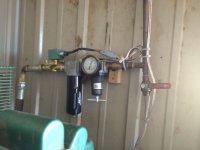
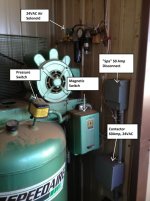
At the compressor side, I installed both an air solenoid (normally closed) and a definite purpose contactor (normally open). Both of the switches operate with 24vAC coils. Note that all of the ground wires are un-switched (that's the right way to do it). The contactor I got is three poles but I only used two since the compressor is single phase 220VAC.

Here's a BOM for the parts. Cost was about $200.

Contactor: (eBay $23)
Definite Purpose Contactor 60 AMP / 3 Pole / 24 Volt solenoid coil.
240 Volt rating: 10 single phase Horsepower, 25 three phase horsepower, 360 LRA​


Air Solenoid: (eBay) $26+9Ship)
ASCO Red-Hat 8210G2 24 VAC 1/2" NPT 2-Way Brass Solenoid Valve[/INDENT]

Transformer (eBay $10+7.5 Ship)
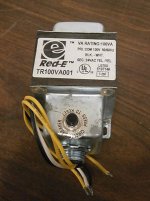
Red-E TR100VA001 120V input, 24 VAC output, 100VA rating, with circuit breaker​

Timer Switch ($23, Home Depot)
GE In-Wall Digital Countdown Timer Model #15318​

Miscellaneous:
Wire: $40 (Home Depot)
Plastic Boxes: ~$35 (For contactor and transformer, Home Depot)
Metal Boxes ~$20 (For timer and outlet, Home Depot)
Indicator Light: ~$5 (Nightlight, Home Depot)​


The system works great. Shutting off the air at the compressor makes it so that even big leaks in the shop don't cause the compressor to run when I'm not around. The compressor tank will hold full pressure for a long time. When I want to use the air, I just hit the timer (I usually push the 4 hour button) and the system works automatically (it comes on when it wants) until the timer expires.

I've attached pictures of the whole setup and a diagram of the logic.
 

Attachments

  • 2013_03_CompressorRemoteWiring.jpg
    2013_03_CompressorRemoteWiring.jpg
    92.5 KB · Views: 498
  • Compressor Air Solenoid.jpg
    Compressor Air Solenoid.jpg
    123.9 KB · Views: 323
  • Timer Switch.jpg
    Timer Switch.jpg
    16.5 KB · Views: 368
  • Main Contactor Overview.jpg
    Main Contactor Overview.jpg
    63.5 KB · Views: 351
  • Air System Closeup.jpg
    Air System Closeup.jpg
    42 KB · Views: 444
  • Compressor Wiring Overview.jpg
    Compressor Wiring Overview.jpg
    75.5 KB · Views: 501
  • Remote Switch Overview.jpg
    Remote Switch Overview.jpg
    61.4 KB · Views: 481
Last edited:
To avoid these ads, REGISTER NOW!
OP
E

eriksalo

Well-known member
Joined
Nov 29, 2007
Messages
184
Location
Colorado
A few more pictures of the components.
 

Attachments

  • Compressor Transformer.JPG
    Compressor Transformer.JPG
    66.4 KB · Views: 174
  • Compressor Contactor.JPG
    Compressor Contactor.JPG
    25.5 KB · Views: 161

Norcal

Well-known member
Joined
Mar 16, 2008
Messages
13,752
A lot of definite purpose contactors are not listed by UL or anyone else for that matter, they are marked as RU ,UL Recognized for use in UL listed equipment, but if they are not listed & only have the RU mark, they cannot be used & comply w/ NEC requirements that equipment be listed.

Definite Purpose contactors are **** anyway, the problem is that decent stuff costs way more, but since there is a Furnas starter on the compressor it was not needed, as the stuff could have been wired into the control circuit of the mag starter with a little thought & a few changes.
 

john11139

Well-known member
Joined
Oct 23, 2012
Messages
121
Location
Ohio
I guess I dont understand why you want to reinvent the wheel. I sort of had the same problem. A hose blew one week end and my compressor ran all that time. Another time we had a extreme cold spell one night and it was -20 below and my compressor tried to kick on and it burnt the motor up. After that I put a shut off at the compressor and a switch box. I just automaticly turn it off when shutting the lights off when I leave the shop. Turn in on when I go in the morning. It's just a routine habit to get into. Turn compressor off, turn lights off, throw the cat out, turn thr burgblar alarm on and lock my door.
 

OccupantRJ

Well-known member
Joined
May 15, 2009
Messages
10,975
Location
Eastern North Carolina
I guess I dont understand why you want to reinvent the wheel. I sort of had the same problem. A hose blew one week end and my compressor ran all that time. Another time we had a extreme cold spell one night and it was -20 below and my compressor tried to kick on and it burnt the motor up. After that I put a shut off at the compressor and a switch box. I just automaticly turn it off when shutting the lights off when I leave the shop. Turn in on when I go in the morning. It's just a routine habit to get into. Turn compressor off, turn lights off, throw the cat out, turn thr burgblar alarm on and lock my door.

The compressor controls can also be wired to be controlled by the shop lights.
 

LG63

Well-known member
Joined
Sep 7, 2012
Messages
1,003
Great work, nice clean installation. And like Ol' Blue Eyes, you did it your way....good for you.
 
OP
E

eriksalo

Well-known member
Joined
Nov 29, 2007
Messages
184
Location
Colorado
Thanks for the good comments. I considered most of the options you recommended. I would have liked to just put a switch somewhere convenient as john11139 suggested. However that wasn't practical for my setup. My biggest issue is I have a large shop and the compressor is about 100 feet from the breaker panel and about 100 feet (in a different direction) from the nearest point in the shop Getting to the compressor involves walking outside, around the back of the building, behind the tractor bay to the compressor bay. It's not practical to do that every time I come and go from the shop. On the plus side, I can just barely hear the beast when it is running which is great!

Of course, I could have run the 50 AMP main power wire into the shop to a switch and then to the compressor. I thought of that when I installed the unit. However, that setup would have meant adding about 100 feet to the high current line (which would have made the total run 200 feet). Seemed too long to me and my calculation said I would have needed to go to the next larger size wire due to voltage drop issues. It's also expensive wire. The 24V signal wire was cheap and I got the added bonus of being able to shut off the air at the tank which makes any leaks no big deal. Also, breakers aren't made to be switched on/off daily (you aren't supposed to use that Spa disconnect regularly) but contactors are rated to several hundred thousand cycles.

I also thought about running the relay from a light switch. That would have worked great. However, I have eight different light zones and couldn't figure out which one was the best to use and timer seemed like a good idea since I need to turn on the lights much more often than I need air.
 

Jim Johnstone

Well-known member
Joined
Apr 11, 2011
Messages
1,841
Location
Brantford, Ontario
You could have just used a regular light switch in the shop to disconnect the power to the magnetic starter on the compressor then you would only have needed to run regular 14/2 romex from the shop and compressor not the 50a wire.

That is of course assuming it is a 120 volt coil in the mag starter.

Sent from my SGH-I727R using Tapatalk 2
 

ForceFed70

Well-known member
Joined
Apr 27, 2010
Messages
3,441
Location
BC, Canada
Pretty sweet setup.

I want to do something similar. Except instead of a timer and dedicated switch, I want to tie it in to the overhead lights. Lights on = compressor on.
 

CNGsaves

Well-known member
Joined
Sep 26, 2012
Messages
13,233
Location
KS and OK
That's a nice setup with timer that you've implemented.

Would be nice IF certain level of compressor would have option for setup like yours to be a "check-the-box" option all prepared and ready to install. Mass production would provide economies of scale and would be cheaper. This could elevate one brand over another . . . like only the slow rpm high-end Quincy offered the Timer Switch for $150 add-on fee.

Enjoy that setup. It's perfect for remote located compressor.
 

MichaelP

Well-known member
Joined
Jul 27, 2009
Messages
921
Location
IL/WI border
Eriksalo,

How noisy is your Red-Hat air solenoid when it's energized? Mine is uncomfortably loud.

I'm sure it would be much more silent if connected with hydraulic rubber hoses, but this will negate the benefits of the switch if the incoming hose ruptures.
 
Last edited:
OP
E

eriksalo

Well-known member
Joined
Nov 29, 2007
Messages
184
Location
Colorado
Wow, almost 5 years since I posted this.... seems like yesterday.

The system still works great! I don't think I've had to do any maintenance since I built this last setup with the solenoid. I probably use a couple of times a week and has been solid as a rock.

The solenoid does make an annoying buzzing sound. Not too loud but persistent. The compressor assembly is far back behind the shop so I can't hear anything but do recall that the solenoid buzzes.
 
Last edited:

larry4406

Well-known member
Joined
Jan 27, 2006
Messages
19,073
Location
Northern Virginia
Good post. I've been toying with adding either an air solenoid or a 240V contactor to be energized (on) when garage lights are on.

Still have not settled on which approach is best. With the air solenoid only, compressor is charged and ready to go with a quick in-rush of air to the lines. But if there is a compressor leak somewhere upstream of the solenoid, the compressor runs unattended. With the contactor approach only, the system can slowly depressurize during off periods due to leaks at hoses, fittings, etc.

Your approach addresses both concerns.
 

MichaelP

Well-known member
Joined
Jul 27, 2009
Messages
921
Location
IL/WI border
Eriksalo,

Thank you.

The sound of the energized solenoid gets intensified by the tank and is more than annoying. The tank is in my garage next to the workshop, and the sound makes my garage visits very unpleasant. I bought 18" hydraulic hoses and intend to connect the solenoid valve between them.
 
Last edited:

Jawn

Well-known member
Joined
Jul 29, 2011
Messages
3,594
Location
Stuck in traffic, GA
I am doing something similar, but with 120vac control instead of 24vac... contactor and autodrain will be 120v powered, may possibly add a 120vac solenoid or motorized ball valve too (the motorized ball valve should be silent when not changing state, unlike the solenoid).

Originally I was going to get all crazy with it and use an Arduino for an automatic shutoff to kill it after 12 hours or so in case I forget to turn it off... then I thought why reinvent the wheel when there's an out of the box 12 hour timer available?
 

MichaelP

Well-known member
Joined
Jul 27, 2009
Messages
921
Location
IL/WI border
I am doing something similar, but with 120vac control instead of 24vac... contactor and autodrain will be 120v powered, may possibly add a 120vac solenoid or motorized ball valve too (the motorized ball valve should be silent when not changing state, unlike the solenoid).

Originally I was going to get all crazy with it and use an Arduino for an automatic shutoff to kill it after 12 hours or so in case I forget to turn it off... then I thought why reinvent the wheel when there's an out of the box 12 hour timer available?
Motorized ball valve is an excellent idea, indeed. It beats me why I didn't think about it before.

I guess I'll return the hoses and replace the solenoid with a motorized ball valve and an indicator light (LED) to indicate OPEN position. Looks like I'll need a 5-wire version of the valve to discern between OPEN and CLOSED positions. The one I'm looking at now is the US Solid 1/2" full port motorized valve with 5 wires (MSV00016): https://www.amazon.com/gp/product/B06XCQ711H/?tag=atomicindus08-20
 
Last edited:

Dragfluid

ALLIANCE MEMBER
Joined
Sep 15, 2013
Messages
17,483
Location
Pillager, MN
Eriksalo,

Thank you.

The sound of the energized solenoid gets intensified by the tank and is more than annoying. The tank is in my garage next to the workshop, and the sound makes my garage visits very unpleasant. I bought 18" hydraulic hoses and intend to connect the solenoid valve between them.

Does that solenoid produce much heat? How about a simple little box around it with some spray foam?
 
To avoid these ads, REGISTER NOW!

larry4406

Well-known member
Joined
Jan 27, 2006
Messages
19,073
Location
Northern Virginia
Funny this thread popped up, I was just looking for a valve earlier to turn my air off as most of my hose reels have small leaks. I found that Rapidair sells one that opens slowly and runs on 110v. Ill plug it into a Zwave module and then I can just tell Alexa to turn on or off the air. :)

http://www.rapidairproducts.com/page/motorized-compressor-shut-off-valve

Cue - Nice find! Makes it easy to install a switched plug on the lighting circuit and then plug the valve's power into the outlet. Lights on, compressor air enabled.
 

MichaelP

Well-known member
Joined
Jul 27, 2009
Messages
921
Location
IL/WI border
Funny this thread popped up, I was just looking for a valve earlier to turn my air off as most of my hose reels have small leaks. I found that Rapidair sells one that opens slowly and runs on 110v. Ill plug it into a Zwave module and then I can just tell Alexa to turn on or off the air. :)

http://www.rapidairproducts.com/page/motorized-compressor-shut-off-valve

Here is a suspiciously similarly looking one (but different valve body material and PSI rating): https://www.amazon.com/dp/B00PVQFTHW/?tag=atomicindus08-20

Note that your valve closes when there is no power. No power- no access to the compressed air stored in the tank (same as with a solenoid).

What makes me think is their description of how it works and the diagram they present (.pdf file at www.unitedstatesbd.com/images/unite...s/5377/files/ACCESSORIES/elect schematic .pdf). Based on the specs, when you apply power, the valve opens and disconnects from the power consumption. When you remove power, the valve closes (by a spring, I must assume). But if the valve is disconnected from the power supply after opening, how does it sense that you flipped the switch off? I am afraid that one of the ways to achieve this would be to allow the valve to oscillate: the valve opens - coil is de-enegrized by a limit switch - spring tries to close the valve - the limit switch re-enegizes the coil - the sequence repeats. This sounds ridiculous, but otherwise there should be a separately fed (by a capacitor or battery?) circuit. Any ideas?

Otherwise, it's a nice find, indeed. Thank you.
 
Last edited:

Git

Well-known member
Joined
May 18, 2008
Messages
6,894
Location
S Cal
Here is a suspiciously similarly looking one (but different valve body material and PSI rating): https://www.amazon.com/dp/B00PVQFTHW/?tag=atomicindus08-20

Note that the valve will close when there is no power. No power- no access to the compressed air stored in the tank. I'm not sure that's what I want. And even in general, I fail to see any potential benefits of this for our particular application. When there is no power, the compressor itself is off anyway.

Otherwise, it's a nice find, indeed. Thank you.

That one looks pretty decent and is priced at $60 (don't really need stainless steel)


Here is another one, that has even better reviews for $27 - (doesn't have a power cord)
https://www.amazon.com/dp/B007N0J98E/?tag=atomicindus08-20
 

Attachments

  • $70.jpg
    $70.jpg
    143.4 KB · Views: 44
  • $30.jpg
    $30.jpg
    139.8 KB · Views: 43
Last edited:

MichaelP

Well-known member
Joined
Jul 27, 2009
Messages
921
Location
IL/WI border
Git,

The first one is a motorized valve for 145psi. The RapidAir one Cue found is rated at 230 psi (and its body is made of brass vs. SS). But those specs for Chinese valves are often mixed up and, probably, out of thin air anyway. I'm pretty sure those are made at the same factory, and just have different labels.

The second picture shows a 145 psi solenoid valve, and I'm sure it will have the same sound problem as the other solenoid we discussed.
 
Last edited:

Git

Well-known member
Joined
May 18, 2008
Messages
6,894
Location
S Cal
Funny this thread popped up, I was just looking for a valve earlier to turn my air off as most of my hose reels have small leaks. I found that Rapidair sells one that opens slowly and runs on 110v. Ill plug it into a Zwave module and then I can just tell Alexa to turn on or off the air. :)

http://www.rapidairproducts.com/page/motorized-compressor-shut-off-valve

I looked up the part number on the RapidAir valve - (A20-T20-B2-B)

Looks like it is made by Toneflow in China and resellers are applying their own name brand label or changing the color of the plastic
http://www.china-tonhe.com/Products/4/

It comes in a variety of wiring configurations along with an optional indicator and/or a manual override

Here is a pretty cheap DC version in stainless for $32 on Amazon. Not sure where RapidAir is getting 230 psi, everyone else lists it at 145
https://www.amazon.com/dp/B013G0JWK4/?tag=atomicindus08-20

It just a matter of finding one in the right size and wiring - I think that since RapidAir appears to be selling the same thing, it kind of validates it at least
 

Attachments

  • SNAG-534.jpg
    SNAG-534.jpg
    38.2 KB · Views: 43

WhoWhatNow

Well-known member
Joined
Feb 22, 2011
Messages
1,884
Location
Collegeville, PA
There are a few good brands made in the USA. I am using a Jefferson. It is wired into a standard 120V outlet with a switch in the garage. It has worked great for the last 3 years in my hobby shop.

60b9b8491fc73fdfbc45ba70e6ebc708.jpg

9f25faa50cb41716e76eda52e23c40bb.jpg
 

Attachments

  • 9f25faa50cb41716e76eda52e23c40bb.jpg
    9f25faa50cb41716e76eda52e23c40bb.jpg
    295.6 KB · Views: 6
  • 60b9b8491fc73fdfbc45ba70e6ebc708.jpg
    60b9b8491fc73fdfbc45ba70e6ebc708.jpg
    243.3 KB · Views: 5

WhoWhatNow

Well-known member
Joined
Feb 22, 2011
Messages
1,884
Location
Collegeville, PA
There are a few good brands made in the USA. I am using a Jefferson. It is wired into a standard 120V outlet with a switch in the garage. It has worked great for the last 3 years in my hobby shop.

8645381b3152c958ce9942cd20e2b1d1.jpg

c72f0a76fbe1dc78fed8ec5035bc2070.jpg
 

Attachments

  • c72f0a76fbe1dc78fed8ec5035bc2070.jpg
    c72f0a76fbe1dc78fed8ec5035bc2070.jpg
    295.6 KB · Views: 4
  • 8645381b3152c958ce9942cd20e2b1d1.jpg
    8645381b3152c958ce9942cd20e2b1d1.jpg
    243.3 KB · Views: 5

Lelandwelds

Well-known member
Joined
Sep 6, 2017
Messages
2,443
Location
Central Texas
Motorized ball valve is an excellent idea, indeed. It beats me why I didn't think about it before.

I guess I'll return the hoses and replace the solenoid with a motorized ball valve and an indicator light (LED) to indicate OPEN position. Looks like I'll need a 5-wire version of the valve to discern between OPEN and CLOSED positions. The one I'm looking at now is the US Solid 1/2" full port motorized valve with 5 wires (MSV00016): https://www.amazon.com/gp/product/B06XCQ711H/?tag=atomicindus08-20

Funny this thread popped up, I was just looking for a valve earlier to turn my air off as most of my hose reels have small leaks. I found that Rapidair sells one that opens slowly and runs on 110v. Ill plug it into a Zwave module and then I can just tell Alexa to turn on or off the air. :)

http://www.rapidairproducts.com/page/motorized-compressor-shut-off-valve

Regular old ball valve are cheap. Small, nonrebuildable air cylinders are cheap. Springs are cheap. We always just flipped the breaker.

The Alexa bit is funny.
 

Git

Well-known member
Joined
May 18, 2008
Messages
6,894
Location
S Cal
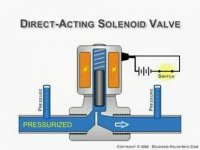
From what I learned today about valves :) is that Jefferson valve is considered a 'direct acting' valve which uses a solenoid plunger - sort of like a sprinkler valve versus a tried and true 'ball' valve

Seems to me that a tried and true ball valve has a lot less to go wrong?

direct acting valve pic:
 

Attachments

  • hqdefault.jpg
    hqdefault.jpg
    12.8 KB · Views: 68

Git

Well-known member
Joined
May 18, 2008
Messages
6,894
Location
S Cal
What about reducing the volume of air flowing through that type of valve?

When you open a ball valve - you can see what you get - it's basically the same inner diameter as the size of the pipe (3/4" in my case). When you open up one of those 'direct acting' valves, it looks like the inner passages are a heck of a lot smaller and the air has to flow up into the solenoid and then back down to get out? Does that make a difference at all on how much air can flow through the valve?

Another thought - it makes me wonder since RapidAir chose a ball valve...
 

slodat

ALLIANCE MEMBER
Joined
Feb 6, 2010
Messages
3,679
Location
Central-ish, WA
I have a hand switch by my entry door to my shop that energizes a soft start valve. A soft start valve is a much better solution in my opinion. It slowly pressurizes until 1/2 header pressure and then opens fully. This prevents slamming the system with full pressure. It also has a muffler port to depressurize the header when the valve is deenergized. I also run my compressor's contactor control circuit through my shop lighting contactor. This means the compressor can only run when I'm in the shop (lights are on).

c882a3eb40f0c1c45b6c5734e04ccc89.jpg
 

Attachments

  • c882a3eb40f0c1c45b6c5734e04ccc89.jpg
    c882a3eb40f0c1c45b6c5734e04ccc89.jpg
    63.7 KB · Views: 5
Last edited:

Git

Well-known member
Joined
May 18, 2008
Messages
6,894
Location
S Cal
Got my valve from Rapidair, it has 230psi on the specs sticker on it, it works well. I did order a cheaper version to try at work that runs on 9-24v DC and seems to be rated about 230psi as well, but havent received it yet.

https://www.amazon.com/gp/product/B06X9LWXMW/?tag=atomicindus08-20

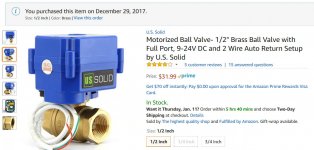
I actually ended up buying the 1/2" valve from Amazon that you linked to. So far it works great (time will tell) and I like using low voltage since my nearest outlet was about 12' away. I dug up an old 24v wall wart transformer (US Robotics - how long have I had that) and just spliced in a piece of wire to reach.

This particular switch (2 wire with auto return) will automatically close when the power is cut off - I believe it uses an internal capacitor to store the energy versus some other motorized ball valves that use a spring type mechanism to close the valve.

I also like the motorized ball valve versus the type that uses a solenoid because a solenoid has to always be energized to stay open (or closed, depending on the valve) and I believe the ball valve is less restrictive. The motorized ball valve takes 3 or 4 seconds to fully open or close which I consider to be a 'soft start' :)

So I am using a Z-Wave controlled outlet and with my Alexa Dot out in the garage, all I have to do is tell Alexa to turn the air compressor on or off. I also have an event set to run to turn it off every night just in case I forget

Well worth the $31 and I really like this solution better than using a contactor and having to rewire everything. Since the air pressure is being shut off and not the power to the compressor, when you want to use the compressor, you don't have to wait until it comes up to pressure since it is already ready to go
attachment.php
 

Attachments

  • SNAG-577.jpg
    SNAG-577.jpg
    105.1 KB · Views: 282
Last edited:

Cue

Well-known member
Joined
Jul 25, 2013
Messages
291
Location
Zebulon, NC
Cue - keep us posted. The Rapidair one is 3/4”. The one from Amazon you linked to is 1/2”

Yes, My stuff is 1/2" but the only one Rapidair has is 3/4" so I had to use adapters on it so the 1/2" one would have been better to start with but I didnt know they had them on Amazon until after ordering the one from Rapidair.

A soft start valve is a much better solution in my opinion. It slowly pressurizes until 1/2 header pressure and then opens fully. This prevents slamming the system with full pressure.

These valves are also "soft start", they slowly open to allow the pressure to come up slowly instead of all at once. My Rapidair one takes about 10 seconds to fully open.
 
Last edited:

pcmeiners

Well-known member
Joined
Aug 13, 2009
Messages
7,855
Location
In the only town in Pennsylvania, Bloomsburg.
"Another thought - it makes me wonder since RapidAir chose a ball valve... "
They choose a ball valve due to the low restriction. Solenoid/direct acting valves have a good bit of restriction. Also the ball valve shown is a high flow ball valve, regular ball valve have a mucher small ball, restricting flow. I like how some of the activator ball valve do not show the ball valve size, reason being the ball valves are not full flow valves.
 
Last edited:
To avoid these ads, REGISTER NOW!
Top Bottom