Hi Folks -
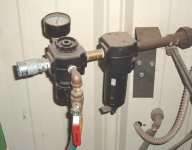
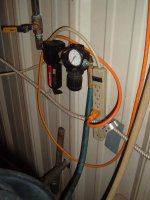
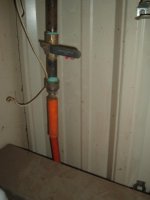
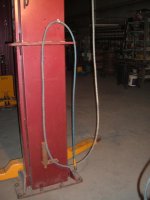
I'm working on my air distribution layout and there are several places that are not easily accessible for the usual ball valve, and drip leg arrangement. I have seen somewhere (possibly years ago on this site but I can't locate it at the moment) where people have actually remoted the drip condensate by using poly tubing and then routing the poly line back up the air pipe (zip tied) and then located the drain at an alternate location.
The theory seems sound - slugs of water that collected in the drip leg and the P trap created with the poly tubing, travel along when the ball valve is cracked at the remote location. If some slugs of water don't make it all the way, and get hung up perhaps in a dip in the tubing part way - who cares - they eventually make it after the next cycle or two anyway.
I really like this approach and began searching around for info and an education in push to connect pneumatic fittings and poly tubing.
Then I hit a bit of a snag and thought I would ask the experts on here (!) about it.
I was reading the specs for NITRA tubing and fittings on the Automation Direct website and found these phrases.
Poly tubing specs and fittings spec state – "Do not use fittings with media other than air", but in other places there are statements such as “use caution in water as product may be damaged by surge pressure”.
This is not a potable water application, and I can’t see surges being an issue as when the valve is opened and water is drained, theoretically, once the valve is closed again, there will be nothing but air in the line, or at the very least, slugs of water separated by air, and giving somewhat of a “cushion” to sudden pressure changes in the tubing and fitings. However, given that it will be used to drain condensate it will be exposed to slugs of water that will be resident in the fittings/tubing.
So, sorry for the long winded dissertation, but are there any people on here that have used this approach and can tell me whether I am on a dark path or "all good" ?
Thanks !
I'm working on my air distribution layout and there are several places that are not easily accessible for the usual ball valve, and drip leg arrangement. I have seen somewhere (possibly years ago on this site but I can't locate it at the moment) where people have actually remoted the drip condensate by using poly tubing and then routing the poly line back up the air pipe (zip tied) and then located the drain at an alternate location.
The theory seems sound - slugs of water that collected in the drip leg and the P trap created with the poly tubing, travel along when the ball valve is cracked at the remote location. If some slugs of water don't make it all the way, and get hung up perhaps in a dip in the tubing part way - who cares - they eventually make it after the next cycle or two anyway.
I really like this approach and began searching around for info and an education in push to connect pneumatic fittings and poly tubing.
Then I hit a bit of a snag and thought I would ask the experts on here (!) about it.
I was reading the specs for NITRA tubing and fittings on the Automation Direct website and found these phrases.
Poly tubing specs and fittings spec state – "Do not use fittings with media other than air", but in other places there are statements such as “use caution in water as product may be damaged by surge pressure”.
This is not a potable water application, and I can’t see surges being an issue as when the valve is opened and water is drained, theoretically, once the valve is closed again, there will be nothing but air in the line, or at the very least, slugs of water separated by air, and giving somewhat of a “cushion” to sudden pressure changes in the tubing and fitings. However, given that it will be used to drain condensate it will be exposed to slugs of water that will be resident in the fittings/tubing.
So, sorry for the long winded dissertation, but are there any people on here that have used this approach and can tell me whether I am on a dark path or "all good" ?
Thanks !