To avoid these ads, REGISTER NOW!

Removing broken screws in mahogany

67CarGuy

Well-known member
Joined
Feb 6, 2008
Messages
763
Location
Outside Boston, MA
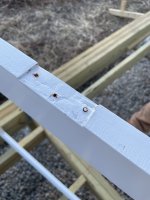
So the new house needed a storm door/screen door, and thus a new wood (mahogany) storm door was ordered. Cost a pretty penny, but looks great and should last quite a while. It came bare, so we primed and painted it, mortised out for the hinges, and went to hang it. Drilled three holes for the first hinge, screwed in the first of the brass screws that came with the hinge (the hinges that were provided by the door company), and watched as the screw promptly snapped off with about 1/4" left to go. OK, let's try this again. Predrilled for the second hinge, started a second screw *by hand* and didn't that one just snap off like the first one. :mad:
IMG_5416.jpeg

So now the door is back in the shop, and I'm trying to figure out how I can get these two broken screws out. My first thought was "I'll use the EZ-Outs!" which was well received by everyone until I realized that a #1 screw extractor appears to be the smallest they make, and not only is that just about the same size as the screw it's trying to remove, it really doesn't want to bite into the brass, it just keeps tearing it out. Maybe my method(s) are off...

The next idea (which has yet to be tried) is to take a plug cutter and drill out the wood around the screw, then glue in a dowel and pre-drill for a screw again. But before I go to that hassle, I wanted to check with the GJ brainiacs here and see if there's something I'm missing. Any and all advice will at least be read, if not followed!
 
To avoid these ads, REGISTER NOW!

PCustoms

Well-known member
Joined
Jul 23, 2011
Messages
22,712
Location
VT
Eeeeek, painted mahogany?

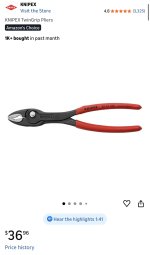
Someone used to sell a hollow screw extractor just for this, I've got one somewhere. I'd try vise grips, or maybe a small chisel to get some bite and twist it out.

Edit:


Davefr

Well-known member
Joined
Jan 7, 2010
Messages
11,823
Location
OR
I'd cut out a little bit of wood surrounding the screw so you can get some small vise grips tightly locked onto what's left of the shank. (small or needle nose vise grips). Brass screws break pretty easy in hardwoods unless you have a perfectly sized pilot hole. I'd avoid brass.
 
OP
6

67CarGuy

Well-known member
Joined
Feb 6, 2008
Messages
763
Location
Outside Boston, MA
There's a Woodcraft close enough to me... I'll at least give them a call and see if they have one in stock.
@Davefr what tool would you use to remove the wood surrounding the screw? A small chisel, perhaps?
 

Dave455

Well-known member
Joined
Mar 19, 2013
Messages
5,805
Location
Sussex, England
I bet it’s well stuck in there!

I’d probably try drilling it out. Ideally with a “ slow helix” drill, but as it would be a relatively small hole you might get away with it.

I find that the combination of hardwood and brass screws to be an awkward one. I would ensure that the pilot hole is big enough. If in doubt, go a size up.

If you are using “traditional” screws you may need two pilot holes, one size to allow clearance around the shank, and another to be a pilot for the threaded part. Newer pattern screws, threaded all the way, won‘t need this.

I also generally try to find a steel screw of the same size and profile, and drive that in first, then remove it and go for the brass. I do this primarily to prevent damage to the screw slot, but it allows me a “trial” to see how tight the screw is.

Many modern “brass” screws, particularly those supplied with things, seem to be incredibly poor quality. I doubt that they are genuine brass. I would either switch them for a decent brass screws, or use a steel one with a good coating.
 

Davefr

Well-known member
Joined
Jan 7, 2010
Messages
11,823
Location
OR
There's a Woodcraft close enough to me... I'll at least give them a call and see if they have one in stock.
@Davefr what tool would you use to remove the wood surrounding the screw? A small chisel, perhaps?
Small chisel, hobby knife, Dremel w/router bit, maybe even a small screwdriver. I think all you'll need is about 1/4" of exposed shank and tighten the vise grips at tight as you can.
 

RTM

Well-known member
Joined
May 13, 2019
Messages
13,142
Location
SF Bay Area
generally try to find a steel screw of the same size and profile, and drive that in first, then remove it and go for the brass. I do this primarily to prevent damage to the screw slot, but it allows me a “trial” to see how tight the screw is.

Many modern “brass” screws, particularly those supplied with things, seem to be incredibly poor quality. I doubt that they are genuine brass. I would either switch them for a decent brass screws, or use a steel one with a good coating
Complete agreement with this strategy. I buy vintage brass screws when I can find them, to avoid this issue. The woodriver tool above might be better than vise grips etc, as you may break the screw off a second time.
 

KnurledNut

Well-known member
Joined
Jan 28, 2011
Messages
8,126
Location
n/a
That looks like a brass colored steel screw. A magnet would answer that.
I would center punch it and drill it out with a small left hand drill.
A drill guide could be used, but I would just freehand it.
Be aware some of those hinge screws are a #9 and can be hard to find in-store individually.
I did commercial hardware for a while and found myself in all kinds of problem solving situations like this.
 
OP
6

67CarGuy

Well-known member
Joined
Feb 6, 2008
Messages
763
Location
Outside Boston, MA
While trying to drill it out for the EZ-out it kept giving me brass-colored swarf, so unless the screw manufacturer dyes their steel...

I like your idea, @Dave455!
try to find a steel screw of the same size and profile, and drive that in first, then remove it and go for the brass. I do this primarily to prevent damage to the screw slot, but it allows me a “trial” to see how tight the screw is.
But first I've got to get the old one out.
 

LOW1

Well-known member
Joined
Jul 20, 2018
Messages
2,640
Location
ontario
I would use the “excavate then vise grip” method.

And then replace all of the screws with very high quality ones. That’s an expensive door that deserves better screws on both the door side and the jamb side.
 

yhprum

Well-known member
Joined
Jul 27, 2006
Messages
1,389
Location
Brisbane Australia
Since it’s soft material, it may be possible to drill out the broken shank and as you mentioned, fit and glue in a piece of hardwood dowel. Pre drill the holes for the new steel screws and maybe lube the screws with some soap or wax before reinstalling them.
 

MoonRise

Well-known member
Joined
Nov 5, 2010
Messages
4,028
Location
NJ
Re: the screw install

Find a STEEL screw of the exact same size as the brass, use that steel screw in a properly prepared predrilled hole, remove the steel starter screw, and then install the brass screw BY HAND (no power tool for the install of the brass screw).

Also use a little bee's wax or paraffin wax (standard candle wax) on the screw threads when you drive them in (steel or brass). It helps to lubricate the threads. Do NOT use bar soap, it is hydroscopic.

For removal, you can try the sharpened tube wood screw remover tool. But I would probably try vise grip pliers first. Gentle excavation of the wood to get just enough space for the pliers to grip the screw remains.

If that doesn't work (either one, pliers or sharpened tube), next step would be to remove wood (and thus the broken screw remains) and replace the wood with more wood glued in place.

You could try to drill or grind out the broken screws, but that is usually fiddly and fussy going. Dremel or other mini die grinder type tool and the appropriate bits to nibble away and core out the screw center. Fiddly and fussy.

And I'm also in the 'why did you paint some nice mahogany'?

Depending on the size (diameter and length) of those original screws, you might want to look into upsizing them now.

And typically dowels are made with the grain running axially (long wise), which is nice if the dowel is glued into a hole and resists shear across the diameter.

But not so good for a screw driven into the dowel end grain. Use a plug cutter and make face grain plugs and install them into to holes if you need to plug said holes and removing the broken screws.

Mahogany with moisture will be slightly acidic and will corrode brass to at least some extent. You might want to look into replacing the brass screws with stainless steel screws.

Mahogany and brass indoors is a nice look. But you have painted wood (which happens to be Mahogany) in an exterior environment. I'd go for stainless steel screws instead of brass screws in this case.

🍺
 

Dave455

Well-known member
Joined
Mar 19, 2013
Messages
5,805
Location
Sussex, England
While trying to drill it out for the EZ-out it kept giving me brass-colored swarf, so unless the screw manufacturer dyes their steel...
I suspect it is brass, but good quality brass is expensive, so there seem to be an abundance of screws that are not up to standard.

You can get reasonable quality new, but they are expensive.

As RTM said, vintage screws are generally great. They all seem to be up to a standard.
I like your idea, @Dave455!

But first I've got to get the old one out.
Yes. Some good ideas here. Good luck.
Almost looks like Monterey Jack instead of steel, on closer inspection.
I very much doubt it’s genuine Monterey Jack either….
:ROFLMAO:
 

LopezBart

Well-known member
Joined
Oct 13, 2023
Messages
2,539
Location
Lopez Island, WA
I'd be inclined to drill out and dowel the holes and try again.... if you need salt spray corrosion resistance, use silicon bronze screws with Frearson heads like one does w/ a boat; brass is useless and stainless is dubious over the long haul due to chloride corrosion issues (stainless suffers from crevice corrosion when exposed to chloride ions in the absence of oxygen). With copper at over $5/lb, the temptation to use lots of zinc in the brass is strong. If salt spray isn't an issue, stainless (either 18-8/304 or 316) works well.

Regardless of the material used, don't just drill a pilot hole; use a proper pilot so the shank has clearance so you can drive the screw w/o too much torque.


1766262720826.png
 

JohnX14

Well-known member
Joined
Jun 2, 2014
Messages
553
Location
Boston 'burbs
I'm in the drill out and dowell it camp. The broken screw isn't coming out of mahogany easily whether it's with an extractor or vise grips.
 

neophyte

Well-known member
Joined
Apr 23, 2012
Messages
9,619
Location
Pennsylvannia
If you gave an oscillating tool like a multimaster, a cheap blade fir cutting metal could be ground narrow to slot the screw top to try to screw the screws out.
Another option might be to wedge the screws around to the side to try to widen the hole so the screws unscrew more easily, and then once the broken screws are removed, to pour water in the holes to re-expand the wood in the screw holes so the holes are tight later for replacement screws.

You could try drying out the screw hole with a hair dryer or low setting on a heat gun, to loosen the wood, but that could also make the grip on the screw tighter.


The normal method for screw holes for brass screws is to screw a steel screw of the same size in first (or preferably stainless steel since ss is usually harder and stronger than regular hardware steel), and then to remove the steel or SS screw, and then screw in the brass screws.
Most hardware store brass screws are rather soft and weak.
 

Nobody-named-Olli

Well-known member
Joined
Jan 9, 2025
Messages
1,591
Location
North Rhine-Westphalia; Germany
Personally, if I can grab the remains of the screw with either screw extraction pliers or vise grips, I carefully heat the screw, and only the screw, with a soldering iron to weaken the woods Lignin - and then back them out with the pliers. This has worked for me. However, any pliers will be very hard on the brass, so be careful not to destroy what little surface to work with you have.

This is a technique also used by restorers.

Kind regards,
Olli
 
To avoid these ads, REGISTER NOW!

seber

Well-known member
Joined
May 31, 2016
Messages
4,195
Location
Deep East Tx.
Excavation then engineer's pliers. You may have to drill and dowel after that. When I need brass screws for looks, I first use a steel screw to form the thread.
 
OP
6

67CarGuy

Well-known member
Joined
Feb 6, 2008
Messages
763
Location
Outside Boston, MA
I hear everyone on the "why are you painting mahogany" question. The trim is white, the other doors are white... hence, white painted door. But it also sees lots of sun (Southern exposure) and has no roof over it (opens on to a deck). All that said, the choice has been made, the door has been bought, and that's what we're using (sunk cost fallacy be damned!).

The local Woodcraft store had a screw extractor in stock that appears to be the right size, so if I can't get a good purchase on the remains with some vise grips then we'll give the extractor a go. Mahogany dowels picked up too, along with some new (non-brass) screws. Thanks for all the replies, folks!
 

Beerhippie

Well-known member
Joined
Oct 13, 2023
Messages
9,761
Location
Far NE Oregon
I hear everyone on the "why are you painting mahogany" question. The trim is white, the other doors are white... hence, white painted door. But it also sees lots of sun (Southern exposure) and has no roof over it (opens on to a deck). All that said, the choice has been made, the door has been bought, and that's what we're using (sunk cost fallacy be damned!).

The local Woodcraft store had a screw extractor in stock that appears to be the right size, so if I can't get a good purchase on the remains with some vise grips then we'll give the extractor a go. Mahogany dowels picked up too, along with some new (non-brass) screws. Thanks for all the replies, folks!
After a quarter of my life spent sanding and refinishing teak "bright work" on a sailboat, I applaud your decision to go with paint!
 

KnurledNut

Well-known member
Joined
Jan 28, 2011
Messages
8,126
Location
n/a
IMG_9980.jpeg
These would probably get them out
They more I look at that steel colored brass screw (lol), I do believe screw extraction pliers would work well. I would take a small socket slightly bigger than the screw and hammer it over it to indent the wood around it enough to get a good purchase.
 

Ohio Andy

Well-known member
Joined
Jul 31, 2024
Messages
2,283
Location
Columbus, Ohio
So the new house needed a storm door/screen door, and thus a new wood (mahogany) storm door was ordered. Cost a pretty penny, but looks great and should last quite a while. It came bare, so we primed and painted it, mortised out for the hinges, and went to hang it. Drilled three holes for the first hinge, screwed in the first of the brass screws that came with the hinge (the hinges that were provided by the door company), and watched as the screw promptly snapped off with about 1/4" left to go. OK, let's try this again. Predrilled for the second hinge, started a second screw *by hand* and didn't that one just snap off like the first one. :mad:
IMG_5416.jpeg

So now the door is back in the shop, and I'm trying to figure out how I can get these two broken screws out. My first thought was "I'll use the EZ-Outs!" which was well received by everyone until I realized that a #1 screw extractor appears to be the smallest they make, and not only is that just about the same size as the screw it's trying to remove, it really doesn't want to bite into the brass, it just keeps tearing it out. Maybe my method(s) are off...

The next idea (which has yet to be tried) is to take a plug cutter and drill out the wood around the screw, then glue in a dowel and pre-drill for a screw again. But before I go to that hassle, I wanted to check with the GJ brainiacs here and see if there's something I'm missing. Any and all advice will at least be read, if not followed!
Especially when I'm concerned about brass screws snapping, the first thing that I do after pre-drilling is I drive a Steel screw of the exact same specs. Then I back that screw out and put a little wax on the brass screw. I've never broken a screw doing this. Note I have broken brass screws when I didn't do this. So whenever I buy brass screws, I try to buy similar steel screws at the same time
 
Last edited:

neophyte

Well-known member
Joined
Apr 23, 2012
Messages
9,619
Location
Pennsylvannia
I hear everyone on the "why are you painting mahogany" question. The trim is white, the other doors are white... hence, white painted door. But it also sees lots of sun (Southern exposure) and has no roof over it (opens on to a deck). All that said, the choice has been made, the door has been bought, and that's what we're using (sunk cost fallacy be damned!).

The local Woodcraft store had a screw extractor in stock that appears to be the right size, so if I can't get a good purchase on the remains with some vise grips then we'll give the extractor a go. Mahogany dowels picked up too, along with some new (non-brass) screws. Thanks for all the replies, folks!
I just figured you wanted the rot resistance mahogany provides, along with the extra hardness and strength, compared to something like pine or cedar.
 

drmarkr

ALLIANCE MEMBER
Joined
Feb 5, 2006
Messages
4,211
Location
Tucson
FWIW, I do not consider mahogany to be a particularly hard wood...in fact it's on the soft side of the scale. Honduran anyways, which is what I've typically worked with.
 

Ohio Andy

Well-known member
Joined
Jul 31, 2024
Messages
2,283
Location
Columbus, Ohio
FWIW, I do not consider mahogany to be a particularly hard wood...in fact it's on the soft side of the scale. Honduran anyways, which is what I've typically worked with.
All the mahogany types I've worked with have been soft... But have not worked many just a couple.
 
Last edited:

terrific

Well-known member
Joined
Nov 22, 2021
Messages
329
Grabit makes really small ez-outs. Micro#1 for No.5&6 bolts, Micro#2 for No.8. Left-handed bits commonly go down to 1/16". I have no experience using extractors on brass. It sounds like they might go straight through.
 

dnschmidt

Well-known member
Joined
Oct 3, 2014
Messages
7,272
Location
Phoenix, AZ
Especially when I'm concerned about brass screws snapping, the first thing that I do after pre-drilling is I drive a Stihl screw of the exact same specs. Then I back that screw out and they put a little wax on the brass screw and my screw that in. I've never broken a screw doing this. Note I have broken a lot of screws though that were asked when I didn't do this. That's why that's how I do it now. So whenever I buy brass screws, I try to buy similar steel screws at the same time
Is using the German spelling of Stihl an Ohio thing!
 

MOS3522

Well-known member
Joined
Nov 6, 2022
Messages
1,777
Location
Colorado
I'd cut out a little bit of wood surrounding the screw so you can get some small vise grips tightly locked onto what's left of the shank. (small or needle nose vise grips). Brass screws break pretty easy in hardwoods unless you have a perfectly sized pilot hole. I'd avoid brass.


^^ This because if it's under a hinge a little wood filler epoxy to restore the surface will not be seen.
 

snorvet

Well-known member
Joined
Oct 29, 2005
Messages
777
Location
Northern Illinois
Another vote for drill out and dowel. And glue the dowel into the door with Titebond III. And don't use brass screws. I've done this a lot and works fine.

Also I have removed the broken screw when I can leave as little a hole as possible, filling the hole with wood slivers to give the new screw a tight fit.
 

Davefr

Well-known member
Joined
Jan 7, 2010
Messages
11,823
Location
OR
Another vote for drill out and dowel.
If he chooses the dowel method he should use a hardwood dowel cut from straight grain hardwood vs end grain. End grain will be weak for screwholding and most store bought dowels are end grain. Hinges need strength.

I think he should start with the excavate/vise grip method because he has nothing to loose since the dowel method can always be Plan B.
 

woody 73

Well-known member
Joined
Apr 14, 2009
Messages
11,542
Location
The Great State Up North
This post brought back a flood of old memories from back in the day; Many, many years ago when my father started teaching me about wood screws and pre-drilling, he always would grab for either an old bar of soap or a wax crayon. out they would come as he rubbed each screw to be installed in a small wood project. Dad I would say what are you doing and he would smile and say it makes that old screw slide in with great ease and it would make it easier to screw them into the wood.

I don't know if an old wife's tale was, but it seemed to work, and I never had any broken screws in all these many years. OP thanks for that long ago forgotten memory of my father from back in the day, I sure miss those times.
 

Nobody-named-Olli

Well-known member
Joined
Jan 9, 2025
Messages
1,591
Location
North Rhine-Westphalia; Germany
Not unheard of in construction. Certainly not an ”old wife’s tale”.

But it’s getting rare these days, as many construction type fasteners come already coated/ with “gliding capabilities” from their respective manufacturers. Older carpenters/joiners/roofers definitely have this trick up their sleeve.

For an application like this, it is excellent advice, though. A block of paraffin is a good friend in a wood shop.

Kind regards,
Olli
 

KnurledNut

Well-known member
Joined
Jan 28, 2011
Messages
8,126
Location
n/a
This post brought back a flood of old memories from back in the day; Many, many years ago when my father started teaching me about wood screws and pre-drilling, he always would grab for either an old bar of soap or a wax crayon. out they would come as he rubbed each screw to be installed in a small wood project. Dad I would say what are you doing and he would smile and say it makes that old screw slide in with great ease and it would make it easier to screw them into the wood.

I don't know if an old wife's tale was, but it seemed to work, and I never had any broken screws in all these many years. OP thanks for that long ago forgotten memory of my father from back in the day, I sure miss those times.
Toilet wax ring was my go-to years ago and still use it occasionally. Soft and tacky, cheap and easy to source, and no one will steal it. :lol:
 
To avoid these ads, REGISTER NOW!
Top Bottom