
You are using an out of date browser. It may not display this or other websites correctly.
You should upgrade or use an alternative browser.
You should upgrade or use an alternative browser.
Removing broken screws in mahogany
- Thread starter 67CarGuy
- Start date
Ohio Andy
Well-known member
Voice to text.... Steel!Is using the German spelling of Stihl an Ohio thing!
neophyte
Well-known member
If you have an extra piece of mahogany, you can make proper top plugs to fill wood holes with these centering plug cutters that are available from Lowes.
I presume the plug cutters are rebranded from Montana brand, snd maybe also available under some other brands.

 www.montanabrandtools.com
If you ho this route, you can screw up the upper layer of wood around the broken screw, to try to remove the rest of the screw with thin nose vise grigs or some sort of screw removal pliers, and then drill out the proper sized hole to fix the gouged section of wood, and infill with a plug made from the right type of wood, and having the right type of grain direction.
I presume the plug cutters are rebranded from Montana brand, snd maybe also available under some other brands.
3pc Self Centering Plug Cutters
The Montana Brand Self Centering Plug Cutters allow you to cut accurate, tapered wood plugs with a hand-held drill. Made in the USA. Power Tools Accessories.
www.montanabrandtools.com
If you ho this route, you can screw up the upper layer of wood around the broken screw, to try to remove the rest of the screw with thin nose vise grigs or some sort of screw removal pliers, and then drill out the proper sized hole to fix the gouged section of wood, and infill with a plug made from the right type of wood, and having the right type of grain direction.
Attachments


If you have an extra piece of mahogany, you can make proper top plugs to fill wood holes with these centering plug cutters that are available from Lowes.
I presume the plug cutters are rebranded from Montana brand, snd maybe also available under some other brands.
3pc Self Centering Plug Cutters
The Montana Brand Self Centering Plug Cutters allow you to cut accurate, tapered wood plugs with a hand-held drill. Made in the USA. Power Tools Accessories.
How's that work, the center pin retractable?
neophyte
Well-known member
Yes, the center pin retracts.How's that work, the center pin retractable?
Most plug cutters are made to be used in a drill press.
These can be used with a hand drill.
Yes, the center pin retracts.
Most plug cutters are made to be used in a drill press.
These can be used with a hand drill.
Well definitely ordering a set now...
Ohio Andy
Well-known member
I have the Montana branded set (https://www.montanabrandtools.com/products/3pc-plug-cutters) also available in places such as Woodcraft, tractor supply, and Rockler. I bought my set direct. I also have some from a different maker but for this I use the Montana brand.If you have an extra piece of mahogany, you can make proper top plugs to fill wood holes with these centering plug cutters that are available from Lowes.
I presume the plug cutters are rebranded from Montana brand, snd maybe also available under some other brands.
3pc Self Centering Plug Cutters
The Montana Brand Self Centering Plug Cutters allow you to cut accurate, tapered wood plugs with a hand-held drill. Made in the USA. Power Tools Accessories.
If you ho this route, you can screw up the upper layer of wood around the broken screw, to try to remove the rest of the screw with thin nose vise grigs or some sort of screw removal pliers, and then drill out the proper sized hole to fix the gouged section of wood, and infill with a plug made from the right type of wood, and having the right type of grain direction.
ALinCarolina
Well-known member
Agree with those above recommending a plug. It will be stronger than a dowel because the grain will run transversely instead of inline with the new screw. I've repaired even some fine furniture with them. I use these cutters which make a slightly tapered plug. Apply wood glue and a mallet and then chisel off the protuberance after it dries. Best even to direct the grain of the plug like the door but not critical for this. 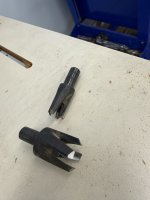
Well definitely ordering a set now...
Spoken like a true Garage Journal member!!!!
seber
Well-known member
This is the way

Engineers pliers will work better. The nose is made specifically for this task.
^^Way too big. 4" needle nose vise grips with serrationsThis is the way
all the way to the tip is what I'd use.

KnurledNut
Well-known member
Could always install the hinge with the other two screws, and use a centering bit to drill the screw out. The countersink on the hinge would keep it from walking.
@PCustoms Glad I could inspire a tool purchase - after all, it's the GJ way!
Haven't been able to try these methods yet (darn life keeps getting in the way!) but I've got just about every suggested option available, from the needle nose vise grips to the plug cutters in the drill press.
Expect results later today!
Haven't been able to try these methods yet (darn life keeps getting in the way!) but I've got just about every suggested option available, from the needle nose vise grips to the plug cutters in the drill press.
Expect results later today!
Not to drift this thread, but this brings to mind a friend of my sister who bought a house that had custom-made, cherry cabinets [gorgeous] in the kitchen. She, the friend, came home from work one day to find her husband finishing up painting the cherry wood off-white. My sister saw the outcome and said to the friend, "So, you plan to remain married to this guy?"Eeeeek, painted mahogany?
Good job! Dowels are the way to go & grain direction doesn't matter since they are under the hinges. My only suggestion is to use vix (self-centering) bits thru the hinge holes. The grain/dowel surfaces may lead a regular bit off center.Christmas EveBoxing DayPost-Boxing Day update:12 successful extractions! E-Z outs weren't working, so we went the chisel + Vise Grips route. New silicon bronze screws acquired, and we'll drill out the chiseled holes for some dowels before re-drilling for the new screws.
Good job! Dowels are the way to go & grain direction doesn't matter since they are under the hinges. My only suggestion is to use vix (self-centering) bits thru the hinge holes. The grain/dowel surfaces may lead a regular bit off center.
Screw retention in end grain usually *****...
KnurledNut
Well-known member
Forget the dowel, just use a longer screw.
Agree, unless you created a large divit with the chisel I wouldn't mess with a dowel. And I wouldn't take out a large core in the original wood.Forget the dowel, just use a longer screw.
KnurledNut
Well-known member
About the most I would do with that is a glued in golf tee if I felt it really needed it. Its a screen door for crying out loud.Agree, unless you created a large divit with the chisel I wouldn't mess with a dowel. And I wouldn't take out a large core in the original wood.
rust in the eye
Well-known member
The screw has been extracted without cutting for a plug then, right?
Stuffing the hole full of hardwood slivers, toothpicks or bamboo chop sticks and wood glue ought to get you back in business.
Sounds the supplied screws were shi t so unless you want a re-run.......
Stuffing the hole full of hardwood slivers, toothpicks or bamboo chop sticks and wood glue ought to get you back in business.
Sounds the supplied screws were shi t so unless you want a re-run.......
cherrybomb
Well-known member
Where do you get your silicon bronze screws from?I like your suggestions. The screws material seemed to be the problem. Unfortunately for the OP,but the rest of us maybe learned some new techniques and some thoughts of new tool purchasesI'd be inclined to drill out and dowel the holes and try again.... if you need salt spray corrosion resistance, use silicon bronze screws with Frearson heads like one does w/ a boat; brass is useless and stainless is dubious over the long haul due to chloride corrosion issues (stainless suffers from crevice corrosion when exposed to chloride ions in the absence of oxygen). With copper at over $5/lb, the temptation to use lots of zinc in the brass is strong. If salt spray isn't an issue, stainless (either 18-8/304 or 316) works well.
Regardless of the material used, don't just drill a pilot hole; use a proper pilot so the shank has clearance so you can drive the screw w/o too much torque.
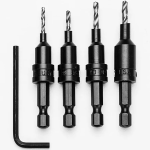
A hardware supplier that has quite the assortment... Bolt Depot. Thankfully they're local to me, so a brief excursion in the family truckster got us some screws in assorted lengths plus a brand-y new Frearson bit, which I had never heard of but works quite well.Where do you get your silicon bronze screws from?
Correct - I chiseled out until I could get some needle-nose Vise-grips locked on, then was able to back the screws out. The supplied screws were definitely not up to the task - still waiting to hear back from the supplier, and we'll bang that drum again next week.The screw has been extracted without cutting for a plug then, right?
Stuffing the hole full of hardwood slivers, toothpicks or bamboo chop sticks and wood glue ought to get you back in business.
Sounds the supplied screws were shi t so unless you want a re-run.......
Agree, unless you created a large divit with the chisel I wouldn't mess with a dowel. And I wouldn't take out a large core in the original wood.
About the most I would do with that is a glued in golf tee if I felt it really needed it. Its a screen door for crying out loud.
I'm curious, why not the dowel method? Or perhaps a better question, why is filling the hole with glue, toothpicks, golf tees, and other such material superior to a dowel and glue that will fill the entire void? I get that it's a screen / storm door, and there are 7 other screws to take much of the force(s), but what am I missing?
rust in the eye
Well-known member
Not saying this is a superior method, it is essentially a crude version of same repair that doesn't require boring a hole for the dowel.
It sounds like most of the wood remains intact so, given that, it is far easier. Behind the hinge so invisible.
It sounds like most of the wood remains intact so, given that, it is far easier. Behind the hinge so invisible.
How much of the screw's shank would not be in solid wood due to the divit? If the majority of the screw could be anchored solidly in hardwood with 2 additional screws in the hinge, I simply wouldn't waste my time coring out and doweling. And unless you cut your own cross grain hardwood dowel it might not be any stronger than the remaing screw hole. It all depends on the condition and holding power of what's left.Correct - I chiseled out until I could get some needle-nose Vise-grips locked on, then was able to back the screws out. The supplied screws were definitely not up to the task - still waiting to hear back from the supplier, and we'll bang that drum again next week.
I'm curious, why not the dowel method? Or perhaps a better question, why is filling the hole with glue, toothpicks, golf tees, and other such material superior to a dowel and glue that will fill the entire void? I get that it's a screen / storm door, and there are 7 other screws to take much of the force(s), but what am I missing?
seber
Well-known member
I have a couple of Frearson bits that came from a boat builder's estate but so far I've never seen a matching screw. Apparently they only come in silicon bronze.
How much of the screw's shank would not be in solid wood due to the divit? If the majority of the screw could be anchored solidly in hardwood with 2 additional screws in the hinge, I simply wouldn't waste my time coring out and doweling. And unless you cut your own cross grain hardwood dowel it might not be any stronger than the remaing screw hole. It all depends on the condition and holding power of what's left.
The longer screws I got will be used in the chiseled-out holes. I think at least half(?) of the screw shank will be in fresh wood. Understood on the coring/doweling time - I would still need to get my drill press set up, find my forstner bits, and get that all set up. Decisions, decisions...
I was shooting a bunch of galvanized sheetrock type screws into treated wood. They tend to break more easily, so I put a coupla drops of 3’n’1 oil near the tip of each, and out of 100’s I drove on that job I broke none. Another time I had to drive many 6“ to 10” lag bolts into treated SYP. That day I had a little plastic medicine bottle with liquid dish soap: worked almost as well as the oil had.
For your situation, I’d find a hollow bit and cut out the screw, quick and painless. Then glue in a dowel. If your attachment screws are tapered, use a tapered bit to pre-drill. Oh, and gt some quality screws! You can paint steel heads brass colored with a permanent ‘chrome’ marker pen.
For your situation, I’d find a hollow bit and cut out the screw, quick and painless. Then glue in a dowel. If your attachment screws are tapered, use a tapered bit to pre-drill. Oh, and gt some quality screws! You can paint steel heads brass colored with a permanent ‘chrome’ marker pen.
I was shooting a bunch of galvanized sheetrock type screws into treated wood. They tend to break more easily, so I put a coupla drops of 3’n’1 oil near the tip of each, and out of 100’s I drove on that job I broke none. Another time I had to drive many 6“ to 10” lag bolts into treated SYP. That day I had a little plastic medicine bottle with liquid dish soap: worked almost as well as the oil had.
For your situation, I’d find a hollow bit and cut out the screw, quick and painless. Then glue in a dowel. If your attachment screws are tapered, use a tapered bit to pre-drill. Oh, and gt some quality screws! You can paint steel heads brass colored with a permanent ‘chrome’ marker pen.
You should probably keep reading
Read what?
You should probably keep reading
The thread. He's removed the screwRead what?
Appreciate the input, but as @PCustoms already pointed out, the screws have been extracted. I even tried the hollow bit you suggest, and broke off all of the teeth on one end and half the teeth on the other end trying to make it work. And quality (silicone bronze) screws have been acquired. Now I just need to find my 'Roundtuit and finish the project!I was shooting a bunch of galvanized sheetrock type screws into treated wood. They tend to break more easily, so I put a coupla drops of 3’n’1 oil near the tip of each, and out of 100’s I drove on that job I broke none. Another time I had to drive many 6“ to 10” lag bolts into treated SYP. That day I had a little plastic medicine bottle with liquid dish soap: worked almost as well as the oil had.
For your situation, I’d find a hollow bit and cut out the screw, quick and painless. Then glue in a dowel. If your attachment screws are tapered, use a tapered bit to pre-drill. Oh, and gt some quality screws! You can paint steel heads brass colored with a permanent ‘chrome’ marker pen.
Meanwhile, I'm off to the store to get some plywood and wire for two other projects...

oldmachinenut
Well-known member
“I love the smell of an expensive mahogany door burning in the morning, it smells like…victory”Have you tried welding a nut to the brass colored steel screw?
“I love the smell of an expensive mahogany door burning in the morning, it smells like…victory”
Left with a pile of ashes, and a screw...seems like a win!