Here is more on the buildings clean out....
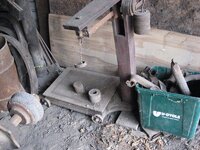

The interesting thing about this scale is that the upright part of it is made of wood (still has it's original paint) and not metal. Don't know much about these but I'd guess it's somewhat old with all those wood parts.


This is what a bench grinder of the day looked like, belt driven. It was a light duty one. To lubricate the shaft you oiled the shaft, just outside the pulley in the center. The upper oil hole is missing its oil cap which kept "junk" out of the oil hole.

This bench grinder used a 2" wide drive belt ( pulley in the center) because it had larger grinding wheels and it needed the larger surface area of the 2" belt so it wouldn't slip. It also was heavier duty than the other grinder so it had grease cups to lubricate the shaft. Here's how grease cups work...
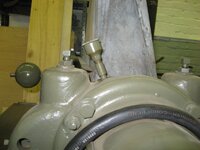
This is a grease cup on my 18" ( about 1/3 meter) Yates American thickness planer from my wood shop. This machine was made in 1944. The grease cup is the part sticking up and angling to the left.

Here's another grease cup on the other end of the planner, this one is installed at a 90 degree angle. The actual cup is to the far left.
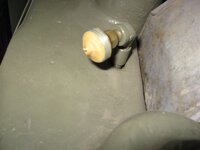
Here part of the the cup has been unscrewed and removed.
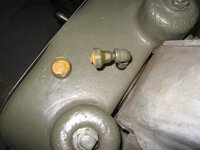
Here you can see the 2 parts that make up a grease cup.The cup is full of grease (grease cup,eh?) Note the swirl pattern of the grease in the cup from unscrewing it. Also note the threads are fine threads to give you better control in the amount of grease dispensed.

Another view.
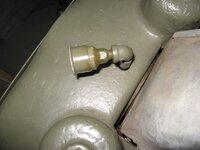
Here the cup is installed but not screwed down yet. Look closely and you'll see the threads still exposed.

Now you just screw the cup down and as you do so.......

...you force grease down the grease line under the cup which will then lubricate the shaft the line is connected to. Also note the cup has serrated edges on it to get a better grip. Older equipment had grease cups instead of grease zirks. Certain bearings responded better to being greased under the low pressure of a cup instead of the much higher pressure generated by a zirk. How much a machine was used determined how often you would "grease" the machine by turning the cup. It is usually turned just a 1/2 turn whenever you "grease it.

This of course is the homemade floor grinder. The best part of this picture is all the space I now have around this floor grinder.

See post #888 on page 45 to see how more space I now have.

In the background is an old cabinet makers work bench with a black smith's vice installed on it ( thank you Kevin54 for identifying that vice (see post #891, page 45

)
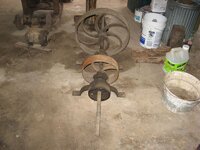
The overhead line shaft for the trip hammer and camelback drill press.

Here the all the grinders and drill press plus numerous other items wait to be picked up by an agricultural museum which will use them in exhibits exemplifying agriculture as it was "back in the day". It is my hope that this equipment will now live on in use as this museum is a hands on one in which the equipment is used and not just as static displays.
Thomas


 If you ever consider selling it I know someone ready to jump.