Continuing with the Barn Bench Build (BBB). I had the corner in the barn nearest the lift established as the place to locate the bench, next was...

...drawing some working plans to work from. The bench would be built for this one specific area. The middle drawing shows the distinctive "L" shape the bench would take. I decided that two benches nested with each other was the best way to approach the "L" requirement. The top drawing shows the front of the the shorter 5 1/2' (1.7 m) bench and the bottom drawing the longer 9.3' (2.8 m) bench. For no particular reason I decided to make the tops out of maple butcher block. It's tight grained, won't mar objects placed on it, heavy-making it stable and, well.... it just looks terrific.

I wanted a strong, hefty look, so 3" (7.6 cm) thick bench tops would be constructed and used. That would also provide extra weight to give stability.
Once that was decided I started to reason that I'd just build the entire bench from hard maple and concluded I would like to enclosed the base as well, just as I had done with the benches in the old shop. It's a neater appearance, provides handy storage and is much easier to keep the area clean, no nooks for spiders to build webs.
Next was to build the base upon which the bench would rest.

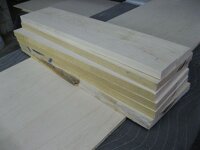
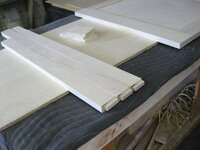
This was done much as the 3 other shop benches were, but this time using solid, hardwood material, primarily maple. Here is some random scrap lumber...

...that was turned into stringers. They are random thickness which doesn't matter at all.

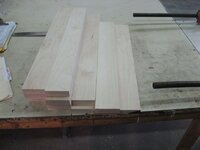
The thinner board on the left is on the front of the bench, and will be the face of the toe kick so...

...that was selected from nice, straight, clear stock.

A better view of that board here.

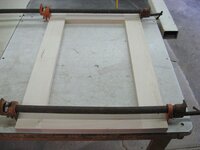
The stringers were all glued and screwed to the outer frame.

The front board had to be screwed from the back side.

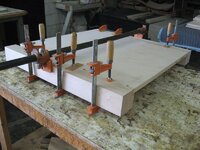
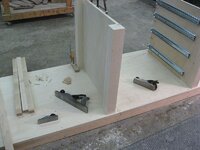
Here the top of the toe kick is being positioned and clamped prior to the actual plywood bottom of the cabinet being secured to the stringers and frame.

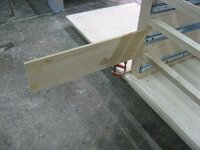
An end view of the top board of the toe kick being clamped in position. Note how it overhangs 2" to the left. It's 3/4" thick so when the plywood floor is installed both pieces will lay flush with each other.

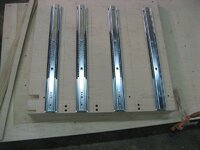
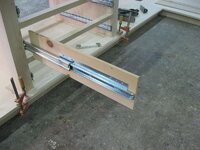
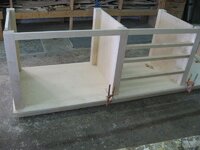
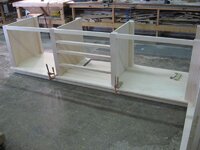
Part of the cabinet bottom installed on the stringers and frame. I used 3/4" maple plywood for the bottoms and interior sides. In fact every part of this bench except for a couple of the bottom stringers (which were poplar) is maple.
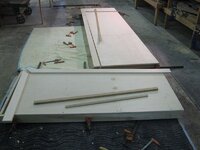
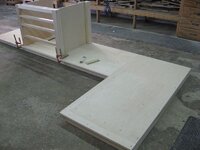
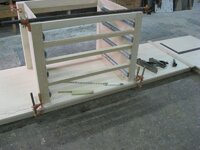
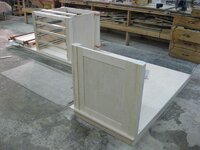
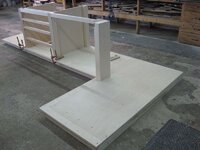
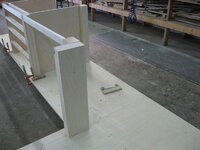
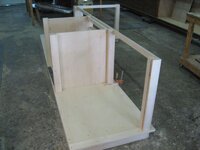
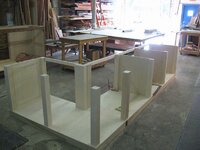
A nice overview of both benches and their relative position to one another. The bottom or floor of the cabinets have been glued and screwed down here to the stringers and outer frame and now the top boards of the toe kicks are being readied for installation. This view is from the back side of the shorter bench.

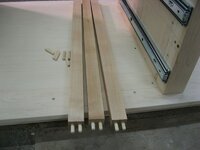
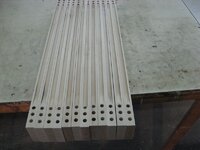
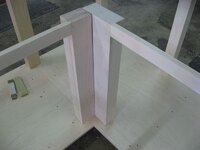
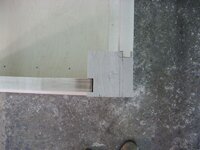
At the end of the base nearest the camera you can see where the top of the toe kick board will be installed. The mitered corner of the toe kick board...
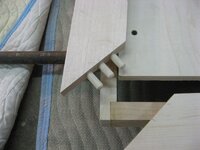
...has dowels installed to help keep the to boards alined with one another and to strengthen the corner.

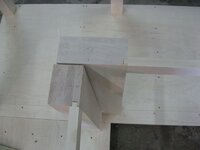
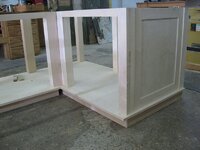
The corner when completed.
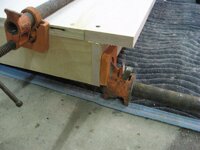
An end view of the toe kick all completed.
More of this exciting bench build is coming this way, stay tuned.
Thomas


 Excellent.... Thank you...
  What a sweet 'farm truck' that would be with the PTO and a mount for the snowplow!











 )
)