hobbitss
Well-known member
Hey hobittss, will these help your tool fix? My belated birthday present from my in laws, my wife's grandfather's old tools!
Score... My Dad has some like those... Good sturdy tools...

Hey hobittss, will these help your tool fix? My belated birthday present from my in laws, my wife's grandfather's old tools!
Score... My Dad has some like those... Good sturdy tools...

Bless your heart Joe, you have the patience of a saint and I'm not kidding.
I just finished my annual simulator training (a multiple day event), where we do emergency, unusual system malfunctions and normal procedures training and evaluations in a simulator. It's stressful at times and preparing for it removes me from circulation for a while until it's all done. I don't even turn on a computer to stay focused. This year with the merger, some of our procedures have changed and that took some extra preparation. Those procedures were implemented about a week before I left for training and so I didn't have much real world practice with them. With good preparation all went very well and I have been blessed for yet another year. As such I'll get back to business here.
To that end I've been trying to contact the Lisle Tool Co. to see what...


... this was used for. I'm completely stymied.
Thomas
Well it's not that old as far as tools but here's one that might make you feel better Joe.
I haven't seen those tools for quite a while, GM carb tools right?

To that end I've been trying to contact the Lisle Tool Co. to see what...
... this was used for. I'm completely stymied.
Thomas
Okay, here's my guess; perhaps these were used to set cylinder sleeves in a block? Are they heavy? Different sizes?
One of 'em looks machined toward the top, the other one, well, it just looks rusty! But seeing the bar in the box makes me realize that it's not that.
Jeez, with all the folks looking at this thread, Shirley, you'd think that someone would have come up with the definitive answer by now?

You'll have to give us more views of it than that. I've seen some ancient grease guns that look like that. Also I've seen some pictures of WWII fire extinguishers (on ships) that looked kinda like that.
Do they have some kind of seal inside to use as a pump maybe?


 If you could have heard those solid lifters and the exhaust echoing in the shop you'd understand completely, honest. After all, tomorrow is another day.
Take a look back at page 134, post #2673 and let us know, will ya?
Thomas
The pics helped a little bit. Does this look familiar? http://www.worthpoint.com/worthopedia/antique-vintage-wooden-lisle-tool-box-114598028. It kinda looks like the box that you have.
The google foo was not that powerful tonight. Gotta go to work tomorrow so I had better sign off and get some rest. I should see my Dad over the holidays. I'll show him a picture and see if he has any idea.
We'll get it in time I'm sure or my name isn't Shirley...my first thought was they were a ballast or standard for the cargo scale you have
 At one time they were finely machined, more than a scale standard would need I'm guessing but who knows, you might still be right. I removed the box from the tool shed and removed everything and then cleaned the box out before I put it in the barn. Thus having spent a bit of time with it I don't have any past experience that would clue me in to it's use.
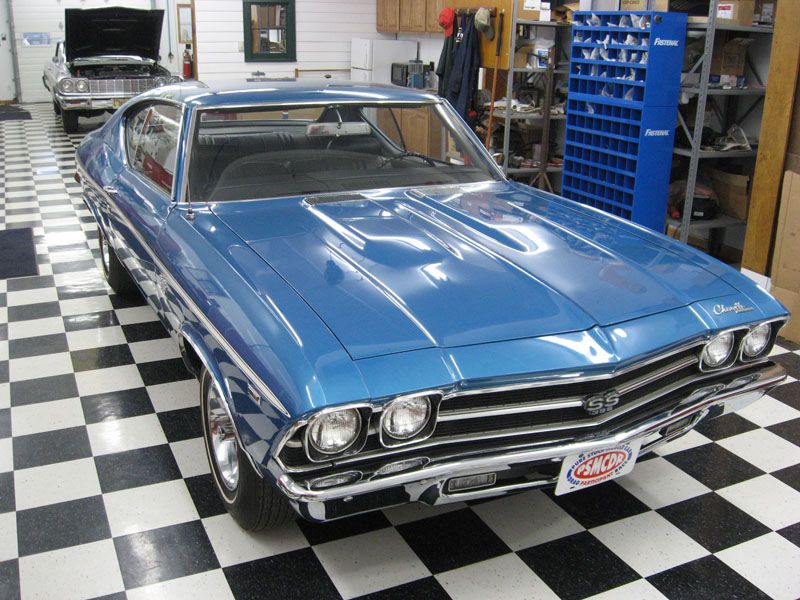
He was having a engine issue that he wanted to have looked into before going to a large national Muscle Car/ Corvette show this weekend. It'll be in the "survivor" area.
oberst idea of using them to install cylinder liners seems plausible enough. The very top has a ridge that would mate with the liner. But I would have thought liners would be pressed in with a press and not with hand pressure, note the handles.
To be continued....
Thomas
snip . . . But I would have thought liners would be pressed in with a press and not with hand pressure, note the handles.
To be continued....
Thomas
Thomas, that Chevelle brings back memories. My wife and I went shopping for our first new car in 1967. The 1968 models were out and I was ready to buy a Chevelle SS396. We wanted bucket seats and a console but they were an extra cost option. The engine was also a big ticket item. Went from the Chevrolet dealer to the Pontiac dealer and the GTO ended up cheaper than the Chevelle. The 400 ci engine was standard, as were the buckets and console (no-cost delete if you wanted the bench seat). With power steering and automatic (with dual gate Hurst shifter) the GTO, at $3,500 was $200 less than the similarly-equipped Chevelle. Not much in today's world but I earned less than $6,000 a year back then. Two week's pay put the Chevelle in second place.
Maybe not hand pressure, but gravity? Sort of 'pile drive' the new sleeve into the block?
I'm picturing a tractor or some such, out in the field, where a duff piston and cylinder could be repaired without taking the engine to a machine shop?
Too bad the bar isn't a slide puller; that might make our scenario more plausible.
Time to call the Hardy Boys. This is a real mystery.
They look similar to a piston pin hole machining gauge for a piston on something big like a diesel truck engine...yeah that would be my guess!
This is very feasable Thomas. The reason I can say this is some of the older engines used a hand pressed liner in them. My uncles old Farmall Super A had liners with o rings on them so you could remove them or replace them with out a machine shop involved. I also helped rebuild an old cotten gin diesel that had hand pressed liners in it.

He's GONNA have an engine issue if he takes that 7000rpm red pointer on that tach as gospel with a stock 396.
The Chevelle really closely matches one that my cousin had in high school, what started as a really decent car got trashed in short order.
He's been pure stock racing it for over 15 years now so who am I to question what works. As I recall when talking with him about that, he was mumbling something about no guts; no glory or words to that effect.
I got this email from Randy Ploeger at Lisle this morning:
Those are Sleeve Drivers to drive in replacement sleeves in Fords from the 30's and 40's. I have been with the company for 26 years and have never seen any. Several months ago a person e-mailed me some pictures of Sleeve Drivers he had found. I had to ask the former President of the company what they were and that's how I found out. Looks like they would make a great door stop.
Randy

This is the shop work truck and I'm pretty sure it's vehicle the Willy's engine sitting on the north room floor came from.....Just might try to find another one and restore it to look like this. I've been know to do such foolish things!!
Thomas
i enlisted the help of a forum member here [steevo]and he received this email ..
looks like oberst hit the nail on the head..
 Some of you machinist out there might enlighten the rest of us. Here's another chance for fame and glory! I expect I'll use a rust dissolver perhaps like Evapo Rust or something that only removes rust but leaves any other finishes intact as these had a satin finish of some sort on them.
 I just got back from Brazil and see oberst got the goods, so to speak, on this one. Nice job!
Well you start looking at the tools left over in a repair shop that operated in the 1940's and yes it does and makes perfect sense to be for engines from the 30's and 40's. I had thought as much at first but completely dismissed it due to the handle on each. I thought that cylinder liners would be a press fit that would have required a mechanical press of some sort. I am aware that interference fits change dramatically with slight temperature changes but still, an engine cylinder liner? Still don't know what...
...the tapered rod would have been used for and why there were two cylinders to install liners? Wouldn't you have installed them one at a time?
Since these were machined to a precise tolerance I guess restoring them with powder coating is out of the question, huh?
Thanks again everyone for all your inputs.
Thomas

Well?
whoa!!! amazing transformation...it seems like im watching Pimp my Garage!
Thomas, aren't the cylinders different sizes? I could believe there were only two bores on 30s/40s Ford motors.
Congrats on your annual, by the way
Once I get home I'll take a closer, more deliberate look to confirm that. Now about the use of that tapered rod.................??I've just read first page.
Incredible work and rebuilt
CONGRATS!
Don't forget to take notes because Chris is slowly refining that thread test of hers. Wouldn't be a bit surprised to see it pop up here one of these days.Tapered rod is to take them out.. I think also if one has a lip on it diff..might be to start them in ? just a SWAG
When I install the sleeves in my old Farmall tractors. Dry sleeves by the way. I match the sleeve to the cylinder so that I can press the sleeve in by hand. Makes removal much easier later in life. A good friend who restores Allis Chalmers tractors does the same thing. Maybe that is what these sleeve installers are for. That handle sure woud make the hand feel alot better when pressing the sleeve in.
I'll have to check that out next time I get the chance. I do a casual search for Willy's pick ups every now and then [...] When the right one comes along I believe I'll do my best to acquire it and then replicate the original shop truck, paint color, lettering and all, probably using the flat head V8-60 in it that was left in the shop as was suggesting by someone here a while back.
What is the bar for? This, is what the bar is for.
