To avoid these ads, REGISTER NOW!

Above 1200 Sq/FT Restored 1930's Auto Shop

Wokspaces above 1200 squarefeet.
To avoid these ads, REGISTER NOW!

Domel

Well-known member
Joined
Aug 8, 2010
Messages
46
Location
Poland in Central Europe
Welcome Domel to the thread. You've got just a BUNCH of reading ahead of you. ;) Don't forget to take notes because Chris is slowly refining that thread test of hers. Wouldn't be a bit surprised to see it pop up here one of these days.

I see you have a fondness for '64's also. Good man! :thumbup:

Thomas

I love '64 ... I'm living far far east in Europe. Maybe some day I will have my own :) This is just a picture to remind me to do not forget about it :)
 
OP
B

BB767

Well-known member
Joined
Dec 24, 2009
Messages
3,724
Location
Philo, IL
Once we do definitively solve this one we're all gonna collectively go "oh ya, I see that now" aren't we? :wtf:

Thomas

Well you know the old saying don't you....one Patent Office drawing is worth a thousand words, so...

SleeveRemovalToolsm.jpg


IMG_4442.jpg


IMG_6541.jpg


IMG_6546.jpg


Many thanks to you ScottS, Vernemotor, omr and everone else.

"Oh ya, I see that now" :bounce:

Thomas
 
OP
B

BB767

Well-known member
Joined
Dec 24, 2009
Messages
3,724
Location
Philo, IL
OK, so I go fly for a few days and when I get home I find everything about the mystery tools gets all explained and tidied up. Nice going everyone on the Sleeve Installation and Extraction tools I D. :thumbup: I've never worked with cylinder sleeves before so I had no point of reference. If I had, one look at those tools and I've had known immediately, they're very unique aren't they?

To do a little more follow up on all this if you can stand it...

IMG_6534sm.jpg


The box that holds those tools is made of oak and measures 31" X 6" x 5" which is precisely the same dimensions of the box mdbeck1 brought to our attention here with the Lisle decal that sold at auction. The description of that box mentions tight dovetails but...

IMG_6540.jpg


...I suspect they meant to say tight finger joints which is what the corner construction of this box is. (that is, finger joints but they far from tight :() As such, since they both came from Lisle I bet the other box was for cylinder tools like this one.

IMG_6536.jpg


When I mentioned the same numbers were on both sleeve drivers I was thinking of the ST 120 shown here cast into the handles. With a little more clean up and closer examination I found...

IMG_6537.jpg


... ST 100 stamped on one and ...

IMG_6538.jpg


...ST 90 stamped on the other. Then with a little quick approximate measurement they are 3 3/8" and 3 1/8" in diameter respectively.

If you look closely at the bottoms of each...

IMG_6549.jpg


...you'll see the edge is chamfered to help guide it into the sleeve that's being installed. On the top end...

IMG_6550.jpg


...you can easily see the ridge left to engage the sleeve during installation. From the top of the cylinder to the bottom they measure about 7 1/4" long and the sleeve extraction bar is about 23" long.

IMG_6539.jpg


I did check my V8-60 and it's cylinders are much smaller than these so I won't be using this when I do that engine build.

With that another mystery has been solved at the Restored 1930's Auto Shop thanks to you. Now lets see what other mischief I can get into around here.......:D

Thomas
 
OP
B

BB767

Well-known member
Joined
Dec 24, 2009
Messages
3,724
Location
Philo, IL
wow those sleeves must have been pretty thin

omr that was my exact, same observation. I would never have guessed you could collapse them like that. Who knew?? :dunno:

Thanks again for your assistance.

Thomas
 
OP
B

BB767

Well-known member
Joined
Dec 24, 2009
Messages
3,724
Location
Philo, IL
This is such a good idea I can't stop smiling just thinking about it. :bounce:


This thread provides more definitive answers than the rest of the internet combined. The mind boggles...

PureSilver about the truck, that was my feeling also. The best part is I clearly remember that truck being out there for many years and it's quite distinctive. To replicate it would just be sooooo right wouldn't it?

As for your other observation and all the information contained in this thread; when it's all said and done I bet it'll be the equivalent of a college degree. :dunno: That way you don't need to feel guilty spending time reading it, you're advancing your education! :D Kind of "One Stop Shopping" you might say.
Thank you for the kind words and encouragement.

Thomas
 
OP
B

BB767

Well-known member
Joined
Dec 24, 2009
Messages
3,724
Location
Philo, IL
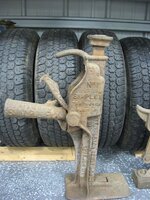
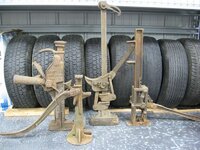
While continuing sorting and relocating items from the tool shed...

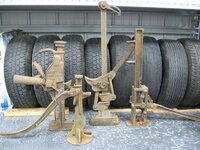
IMG_6552.jpg

...I located some very large, heavy duty mechanical jacks. The tires in the background give some size reference.

IMG_6555.jpg

First up is a Simplex Track Jack No 1, US Patent July 8, 1903.

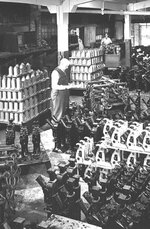
Below are some Simplex jacks at the plant where they were manufactured.

SimplexJacksm.jpg

Note several of the Track Jack No 1's pictured above.

As part of your continuing education, and to give Chris more material for her test, here is a little history of the Templeton, Kenly & Company, manufactures of Simplex Jacks:

In the spring of 1899, Walter B. Templeton, accompanied by his partners, founded Templeton, Kenly & Company in a basement office alongside the Chicago river.
Templeton, a savvy businessman and a skilled engineer, had developed a unique ratchet-lever mechanical jack that offered superior safety in railroad track maintenance applications. He and his partners saw a vast commercial potential for the product and were willing to gamble on it being a success.
That first year, Templeton burned the midnight oil honing his original design, improving efficiency and safety. He knew that the time was right for a new “track jack.” While the ratchet-lever mechanical jack is almost as old as railroading itself, Templeton’s jack was the first to be truly reliable and safe. As testimony to this superior design, the new Simplex® jack — the trade name adopted for this product— quickly became the first choice among the track maintenance men who helped make the railroad a universal transportation system.
Introduced in 1899, the original Simplex® ratchet-lever mechanical jack helped build America’s railroading system. The jack’s contribution to safer railroading would be recognized in 1913 by the American Museum of Safety, which awarded the Simplex jack its coveted Gold Medal — the only jack to ever receive this honor.
Buoyed by high demand, in 1913 Simplex moved its operations from its original facility — where receipts and shipments were still being handled through a ground floor window — to a larger site located on Chicago’s west side, where it would remain for the next forty years.
At the same time, Templeton and his partners were aggressively expanding sales capacity by enlisting a nationwide network of distributors to carry the Simplex line, while also looking beyond railroading to the heavy-construction, maintenance and production markets for future growth.
When World War I broke out, Simplex answered Uncle Sam’s call. Management saw it as part and parcel of Simplex’s corporate citizenship to design products that assisted the military effort. In 1915, for example, a special ratchet lowering jack was developed that pivoted on its base to enable the allied armies to keep equipment moving through rain-soaked battlefields. Then, in World War II, the company produced a greatly- improved track connecting and adjusting tool for light and heavy tanks. These efforts, along with the ongoing manufacture of other quality equipment, earned Simplex the prestigious “Army-Navy E Award”.
Prior to his retirement in 1939, Walter B. Templeton made a final, lasting contribution to the company he founded. In 1937 he assisted in the development of the Simplex Journal Jack, known now in trade circles as the “Super Jack”. This gear actuated jack reduced the friction associated with conventional jacks by 88%. It was an immediate commercial success.

The above was supplied by: Templeton, Kenly & Company - An American Success Story Since 1899.

IMG_6554.jpg

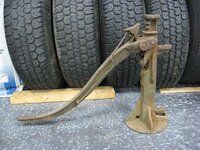
Then there is this...

IMG_6556sm.jpg

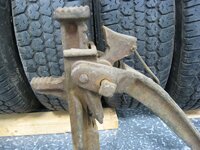
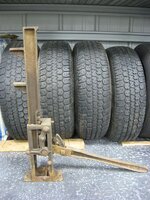
...interesting jack with curved jaws. I suspect the top jaw should be turned around so it would work with the lower one. :headscrat

IMG_6557.jpg

IMG_6559.jpg

Patented June 30-1903.

IMG_6561.jpg

Does it look familar to anyone out there, and why the curved jaws? Was it used to hold logs on the carriage while they were being cut? :dunno: That might explain the small base on it since it would have been bolted to the carriage. I did look at an old 1894 issue of Scientific American for an article on an improved vintage saw mill carriage design but that didn't help. However I did get to see how they made rolling chain from bar stock without welding in that issue...bonus! :thumbup:

IMG_6563.jpg

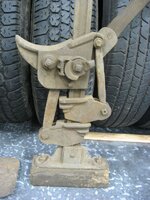
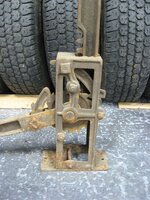
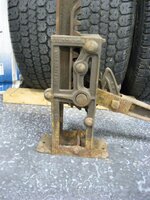
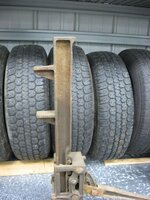
This jack has two fixed jaws....

IMG_6565.jpg

...stacked one on top of the other.

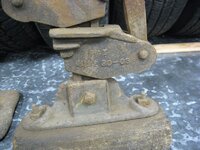
IMG_6566.jpg

IMG_6564.jpg

It's an Amson No 4, manufactured by William E Pratt, MFD, Chicago. I can't readily find any information on this jack or company. The two fixed jaws are very interesting and I bet all of you are looking forward to finding out their purpose also, right? :)

IMG_6567.jpg

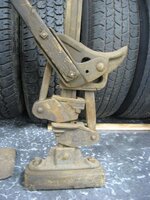
And then there is this very elegant jack that appears to have two jaws stacked one on another also.

IMG_6568.jpg

IMG_6569.jpg

It still had vestiges of green paint remaining. It had a Patent #2185478 cast into the handle but when I did a search of that number I came up with a tubing and casting head design from April 3, 1937. That didn't look like it related to this jack in any manner, so I'll have to do a bit more research.

Thomas
 
Last edited:

gezn2

Well-known member
Joined
Oct 27, 2011
Messages
240
Location
SW WI
<Quote>
Then there is this...

IMG_6556sm.jpg


...interesting jack with curved jaws. I suspect the top jaw should be turned around so it would work with the lower one. :headscrat

IMG_6557.jpg

<Unquote>

We've got some old Hi-Lift style jacks my Dad picked up at a farm sale years ago with a similar jaw setup.
Those small levers with the toothed eccentric on each end are for gripping fence wire, and the curved jaw gives you a good hold on the fencepost when stretching it :)
It's a handyman jack that does double duty, though I've never seen one with that style of ratchet...
 

old salt racer

Active member
Joined
Mar 8, 2011
Messages
26
Location
San Diego
Hey, Thomas ,Ford used what was called "tin sleeves" 37to40 as I remember. common practice was to pull sleeves and use after market pistons .073 oversize after honing block slightly. Happy Thanksgiving to you and yours. we have a lot to be thankful for.----LOU---
 
Last edited:

Nuts

Well-known member
Joined
Jan 31, 2010
Messages
376
Location
Baker City, Or
Jacks.... be still my beating heart. I have a small collection of teens and twenties car jacks, fifty or so. I need to take a pic.

I agree, the second jack looks like a fore runner of a Handyman or Hi-Lift jack.

I've seen the last two used as house jacks, only need a bit of lift to put new shims on sagging floors.


Nuts... Jackaholic
 
OP
B

BB767

Well-known member
Joined
Dec 24, 2009
Messages
3,724
Location
Philo, IL
Hey, Thomas ,Ford used what was called "tin sleeves" 37to40 as I remember. common practice was to pull sleeves and use after market pistons .073 oversize after honing block slightly. Happy Thanksgiving to you and yours. we have a lot to be thankful for.----LOU---

Thanks Lou, you would know how it was done "back in the day"! Are you going to help me bring that V8-60 back to life next year with your annual visit? Just tell "D" that you're going to visit Thomas for a while, bring your rig, plug in and we'll be off and running. You know we'd both be horse the first day from talking and laughing so much. Not sure what we'd get done, but we'd sure have fun. The dynamic duo rides again!!

Chris and I both are very thankful to have you as a dear friend. :beer:

Thomas
 
OP
B

BB767

Well-known member
Joined
Dec 24, 2009
Messages
3,724
Location
Philo, IL
<Quote>
Then there is this...

IMG_6556sm.jpg


...interesting jack with curved jaws. I suspect the top jaw should be turned around so it would work with the lower one. :headscrat

IMG_6557.jpg

<Unquote>

We've got some old Hi-Lift style jacks my Dad picked up at a farm sale years ago with a similar jaw setup.
Those small levers with the toothed eccentric on each end are for gripping fence wire, and the curved jaw gives you a good hold on the fencepost when stretching it :)
It's a handyman jack that does double duty, though I've never seen one with that style of ratchet...

Well score one for you genz2. Once I had the name of the style jack, I found all kinds of information about them. Here's a link to YouTube telling the history and showing some old, vintage ones in use as well as their modern counterparts.


While the one I have is somewhat different, its heredity is readily apparent. Truthfully I haven't tried to jack it up yet so I'm not exactly certain how this jack works. It does look a little Rube Goldbergish though don't you think? :dunno:

Thomas
 

tkbowman

Well-known member
Joined
Jan 19, 2008
Messages
53
Location
Burien, WA
Thomas,

Whew, I finally made it through all the pages after discovering your thread 3 days ago. I don't know how I missed it earlier.

As many have commended you previously, your attention to detail, aesthetics, sense of preservation, honor to the previous owner, craftsmanship and much more is un-paralleled in any web post I've read previously. And it's just a garage! Ya, right! You're an inspiration for many of us. Someday, I hope to ride out to your place for a tour.

Happy Thanksgiving 2011.

Tim
 
Last edited:
To avoid these ads, REGISTER NOW!
OP
B

BB767

Well-known member
Joined
Dec 24, 2009
Messages
3,724
Location
Philo, IL
I love '64 ... I'm living far far east in Europe. Maybe some day I will have my own :) This is just a picture to remind me to do not forget about it :)

Domel, since you have such impeccable taste, here are a few more pictures of a 1964 Impala for your viewing pleasure.

IMG_4230.jpg


IMG_4232.jpg


IMG_4248.jpg


ImpalaSeatssm.jpg


I'll post a few more later. I too love '64 Impalas. :D

Thomas
 
OP
B

BB767

Well-known member
Joined
Dec 24, 2009
Messages
3,724
Location
Philo, IL
Maybe that should be "One Shop Stopping"? Everyone should stop at this thread at least once!:thumbup:

So when are you going to "One Shop Stopping" out here in person with your TR3? If you'er located in Central Illinois you can't be all that far away. We can go to the Philo Tavern for lunch and tell the waitress, "WOW, Nice Jacks" and see where that takes us. Besides I may need some help waxing my anvil. :)

Thomas
 
OP
B

BB767

Well-known member
Joined
Dec 24, 2009
Messages
3,724
Location
Philo, IL
Jacks.... be still my beating heart. I have a small collection of teens and twenties car jacks, fifty or so. I need to take a pic.

I agree, the second jack looks like a fore runner of a Handyman or Hi-Lift jack.

I've seen the last two used as house jacks, only need a bit of lift to put new shims on sagging floors.


Nuts... Jackaholic

I'm curious why the two jaws...

IMG_6565.jpg


an upper and a lower?

IMG_6567.jpg


This one had the same arrangement.

Thomas
 

ihredo4

Well-known member
Joined
Sep 3, 2009
Messages
1,575
Location
100 miles W of Daileyville in Idiotnois
Thomas, That first jack with the two lift points at the top may have been used on old carriage type wagons. Height adjustment is already built in for different wagons. The second I can't come up with the name but I am associating toe with it. Like "Toe Jack" or something. It is used around items that site real close to the ground like a mill or drill press among other things.

On a side note I will kick you in the rear if you ever let the sleeve installer set go. That is unless you give me dibs on them. Those are an awesome find.
 

Nuts

Well-known member
Joined
Jan 31, 2010
Messages
376
Location
Baker City, Or
I'm curious why the two jaws...

IMG_6565.jpg


an upper and a lower?

IMG_6567.jpg


This one had the same arrangement.

Thomas


Thomas, the upper jack actually has three lift points, the two on the side and also the very top of the center shaft. It needs that many as there is only about 8 or 10 notches in the lift mechanism. Obviously what it was designed for didn't need much lifting height.

I still think they are house jacks


Doug
 

BigDaddyUSMC

Well-known member
Joined
Oct 30, 2010
Messages
105
Location
Santee Calif
Y Manifold Gang WISH LIST.......

We have a project in the works & we are looking for parts...I figure I can get the word out with all you great folks.

1932 to 1934 Model B 4 Bander Ford
Quick Change Rear End (looking for a smaller one)
BELLY TANK / DROP TANK ,,, At least 30 inches wide , Lenght 15 to 22 feet long

We are in San Diego , so the closer to SO-CAL the better.

Feel Free to contact me at [email protected]
 
OP
B

BB767

Well-known member
Joined
Dec 24, 2009
Messages
3,724
Location
Philo, IL
Thomas...

The second jack I can't come up with the name but I am associating toe with it. Like "Toe Jack" or something.....

ihredo4 I'm pretty sure your getting the "Toe Jack" mixed up with...

kojak-sucker.jpg


...Kojack. See that was really Telly Savalas and he was real smooth but mean motor scooter. He doesn't have anything to do with mechanical jacks, honest. Hey, it happens all the time "Toe Jack" - "Kojack" ...Ya I can see that. ;)

Thomas
 
OP
B

BB767

Well-known member
Joined
Dec 24, 2009
Messages
3,724
Location
Philo, IL
Thomas,

Whew, I finally made it through all the pages after discovering your thread 3 days ago. I don't know how I missed it earlier.

As many have commended you previously, your attention to detail, aesthetics, sense of preservation, honor to the previous owner, craftsmanship and much more is un-paralleled in any web post I've read previously. And it's just a garage! Ya, right! You're an inspiration for many of us. Someday, I hope to ride out to your place for a tour.

Happy Thanksgiving 2011.

Tim

Greetings to you Tim and welcome to our Growing Group Of Friends (GGOF). Glad you made it through the thread. This isn't the end of course, just an in-between part really. I've got a road trip coming up very shortly that is to retrieve something for the shop that I suspect you and others will find of interest.

Thank you so very much for the kind words and thoughts, it's much appreciated but honest, it really is "just a garage". :) A very "special" garage with a great vibe, but I use it for what I restored it for, working in.

If you happen to be on the Hot Rod Power Tour 2012 next year, they're going to stop, in Champaign, IL on day 2 I believe, for an overnight. The spot they'll be using is only 10 miles or so from the shop. That might be a good time to ride out here for that tour.

BTW Tim, you've never had a problem getting a mechanical jack mixed up with a bald headed fellow who likes suckers have ya? :dunno:

Thomas
 
OP
B

BB767

Well-known member
Joined
Dec 24, 2009
Messages
3,724
Location
Philo, IL
Thomas, the upper jack actually has three lift points, the two on the side and also the very top of the center shaft. It needs that many as there is only about 8 or 10 notches in the lift mechanism. Obviously what it was designed for didn't need much lifting height.

I still think they are house jacks


Doug

Hey Doug, guess what I titled the folder I put all those jack pictures in before I did the post here? Yup, "House Jacks", cause that's what I thought they were the first time I saw them. Something on the order of "great minds think alike" or words to that effect huh?.......:D

Thomas
 
OP
B

BB767

Well-known member
Joined
Dec 24, 2009
Messages
3,724
Location
Philo, IL
Y Manifold Gang WISH LIST.......

We have a project in the works & we are looking for parts...I figure I can get the word out with all you great folks.

1932 to 1934 Model B 4 Bander Ford
Quick Change Rear End (looking for a smaller one)
BELLY TANK / DROP TANK ,,, At least 30 inches wide , Lenght 15 to 22 feet long

We are in San Diego , so the closer to SO-CAL the better.

Feel Free to contact me at [email protected]

Charles, are you absolutely sure Santa can get a drop tank down your chimney? When I was over there I didn't get that close a look at it, but if you're absolutely, positively, cross your heart sure..........:dunno:

Good luck on the new project. Did Jacob ever meet up with and the remnants of Al Jerauld's tanker that we found out about? Wondering if some of those parts will find their way into the new car? Might help to channel the spirit of Al maybe? :thumbup:

Thomas
 

tkbowman

Well-known member
Joined
Jan 19, 2008
Messages
53
Location
Burien, WA
Greetings to you Tim and welcome to our Growing Group Of Friends (GGOF). Glad you made it through the thread. This isn't the end of course, just an in-between part really. I've got a road trip coming up very shortly that is to retrieve something for the shop that I suspect you and others will find of interest.

Thank you so very much for the kind words and thoughts, it's much appreciated but honest, it really is "just a garage". :) A very "special" garage with a great vibe, but I use it for what I restored it for, working in.

If you happen to be on the Hot Rod Power Tour 2012 next year, they're going to stop, in Champaign, IL on day 2 I believe, for an overnight. The spot they'll be using is only 10 miles or so from the shop. That might be a good time to ride out here for that tour.

BTW Tim, you've never had a problem getting a mechanical jack mixed up with a bald headed fellow who likes suckers have ya? :dunno:

Thomas

I've had no problem mixing up mechanical jacks. Jack isn't close to Thomas. :) I did remember I have a Crawford jack (made near you, I believe) that I rescued a number of years ago and needs restoring. I also have an older heavy duty floor jack (not as old as yours) that I don't know the manufacturer. Also, I have the same SB lathe as you. I've had mine for 25 plus years after acquiring it from an older gentleman.

FYI, I built my own shop back in '95 (24x40 Gambrel Roof two story Barn). If I can find my build pictures, I'll start a thread documenting how I built it pretty much by myself. It was done all before GJ was around. It's a working shop also and houses on the lower floor a '63 1/2 Galaxie 500XL driver, '65 Mustang restoration project, and a '56 F100 which I've been street rodding and customizing.

I don't think it will be in 2012 that I can make it to your shop as I already have other plans for my long distance motorcycle rides. The closest I've recently been to your shop was when I picked up my '99 SHO in Ft. Wayne back in 2001.

I'll be looking forward to your next find. BTW, I love airplanes and my garage was originally planned to be able to build a FLYBABY in and has a fully clear span first floor. We also live 1 mile north of the end of the runway under and between 16C and R at SeaTac airport.
 

hobbitss

Well-known member
Joined
May 31, 2010
Messages
341
Location
Southestern Massachusetts
I probably shouldn't do this as it no doubt will slow the archeological dig just beginning in the old Tool Shed, but....

You know there looks like a lot of prep work needed before POWDER COATING those jacks!!!

:bounce:

Joe

While continuing sorting and relocating items from the tool shed...

IMG_6552.jpg


...I located some very large, heavy duty mechanical jacks. The tires in the background give some size reference.

IMG_6555.jpg


First up is a Simplex Track Jack No 1, US Patent July 8, 1903.

Below are some Simplex jacks at the plant where they were manufactured.

SimplexJacksm.jpg


Note several of the Track Jack No 1's pictured above.

As part of your continuing education, and to give Chris more material for her test, here is a little history of the Templeton, Kenly & Company, manufactures of Simplex Jacks:

In the spring of 1899, Walter B. Templeton, accompanied by his partners, founded Templeton, Kenly & Company in a basement office alongside the Chicago river.
Templeton, a savvy businessman and a skilled engineer, had developed a unique ratchet-lever mechanical jack that offered superior safety in railroad track maintenance applications. He and his partners saw a vast commercial potential for the product and were willing to gamble on it being a success.
That first year, Templeton burned the midnight oil honing his original design, improving efficiency and safety. He knew that the time was right for a new “track jack.” While the ratchet-lever mechanical jack is almost as old as railroading itself, Templeton’s jack was the first to be truly reliable and safe. As testimony to this superior design, the new Simplex® jack — the trade name adopted for this product— quickly became the first choice among the track maintenance men who helped make the railroad a universal transportation system.
Introduced in 1899, the original Simplex® ratchet-lever mechanical jack helped build America’s railroading system. The jack’s contribution to safer railroading would be recognized in 1913 by the American Museum of Safety, which awarded the Simplex jack its coveted Gold Medal — the only jack to ever receive this honor.
Buoyed by high demand, in 1913 Simplex moved its operations from its original facility — where receipts and shipments were still being handled through a ground floor window — to a larger site located on Chicago’s west side, where it would remain for the next forty years.
At the same time, Templeton and his partners were aggressively expanding sales capacity by enlisting a nationwide network of distributors to carry the Simplex line, while also looking beyond railroading to the heavy-construction, maintenance and production markets for future growth.
When World War I broke out, Simplex answered Uncle Sam’s call. Management saw it as part and parcel of Simplex’s corporate citizenship to design products that assisted the military effort. In 1915, for example, a special ratchet lowering jack was developed that pivoted on its base to enable the allied armies to keep equipment moving through rain-soaked battlefields. Then, in World War II, the company produced a greatly- improved track connecting and adjusting tool for light and heavy tanks. These efforts, along with the ongoing manufacture of other quality equipment, earned Simplex the prestigious “Army-Navy E Award”.
Prior to his retirement in 1939, Walter B. Templeton made a final, lasting contribution to the company he founded. In 1937 he assisted in the development of the Simplex Journal Jack, known now in trade circles as the “Super Jack”. This gear actuated jack reduced the friction associated with conventional jacks by 88%. It was an immediate commercial success.

The above was supplied by: Templeton, Kenly & Company - An American Success Story Since 1899.

IMG_6554.jpg


Then there is this...

IMG_6556sm.jpg


...interesting jack with curved jaws. I suspect the top jaw should be turned around so it would work with the lower one. :headscrat

IMG_6557.jpg


IMG_6559.jpg


Patented June 30-1903.

IMG_6561.jpg


Does it look familar to anyone out there, and why the curved jaws? Was it used to hold logs on the carriage while they were being cut? :dunno: That might explain the small base on it since it would have been bolted to the carriage. I did look at an old 1894 issue of Scientific American for an article on an improved vintage saw mill carriage design but that didn't help. However I did get to see how they made rolling chain from bar stock without welding in that issue...bonus! :thumbup:

IMG_6563.jpg


This jack has two fixed jaws....

IMG_6565.jpg


...stacked one on top of the other.

IMG_6566.jpg


IMG_6564.jpg


It's an Amson No 4, manufactured by William E Pratt, MFD, Chicago. I can't readily find any information on this jack or company. The two fixed jaws are very interesting and I bet all of you are looking forward to finding out their purpose also, right? :)

IMG_6567.jpg


And then there is this very elegant jack that appears to have two jaws stacked one on another also.

IMG_6568.jpg


IMG_6569.jpg


It still had vestiges of green paint remaining. It had a Patent #2185478 cast into the handle but when I did a search of that number I came up with a tubing and casting head design from April 3, 1937. That didn't look like it related to this jack in any manner, so I'll have to do a bit more research.

Thomas
 

realvc

Well-known member
Joined
Jan 7, 2011
Messages
394
Location
Lake Norrell, AR
Hello Thomas, Chris and everyone

I spotted another Y manifold on a flathead in a recent issue of "The Rodder's Journal" it looks similar to the one you found and gave to the salt flats racers. That makes two that I've seen. I did not check to see if it might be the same picture in two different magazines.

I'm not ready for the test but I do keep up with your "Garage Journey" on "Garage Journal".

Thanks again for all your time spent in keeping this thread going.
 

ihredo4

Well-known member
Joined
Sep 3, 2009
Messages
1,575
Location
100 miles W of Daileyville in Idiotnois
ihredo4 I'm pretty sure your getting the "Toe Jack" mixed up with...

kojak-sucker.jpg


...Kojack. See that was really Telly Savalas and he was real smooth but mean motor scooter. He doesn't have anything to do with mechanical jacks, honest. Hey, it happens all the time "Toe Jack" - "Kojack" ...Ya I can see that. ;)

Thomas

Thomas,

There are times I think I am losing it but dang my friend you don't need to help me. lol I can understand the confusion with no hair on top of the jack or KoJACK. lol As it was I did have it right. Here is a link: http://www.rigging.com/shop/index.php?target=categories&category_id=43

Keep bringing the finds out and the questions. I get lucky once in a while but someone on here will have the answer as we have seen.

ihredo4
 
Last edited:

MisteR Tee

Well-known member
Joined
Nov 8, 2006
Messages
61
Location
England
Hi Thomas, I literally fell over a similar jack, here in the UK just the other day!! It was whilst walking around my friend's workshop where I'm working on a total machanical overhaul of my Model T Doctors coupe. I'll get some pics of it to compare with yours, but from memory it has "HF" embossed on the side. As you might expect from a hot rod repair shop, there is quite a bit of "americana" there & it may have come with a Chevy recovery truck he has parked outside.
 
OP
B

BB767

Well-known member
Joined
Dec 24, 2009
Messages
3,724
Location
Philo, IL
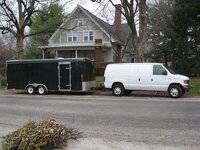
So after getting home from the family gathering on Thanksgiving day, I receive a timely email from a good friend about an ad I might be interested in. It was also strongly suggested I bring a trailer, so after a telephone call...

IMG_6608.jpg

...a road trip was in order. :D

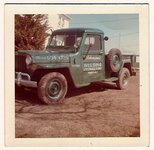
Remember this...

WillysTrucksm.jpg


...the original shop service truck? After 756 miles and a 14 hour drive I got to meet...

IMG_6610.jpg

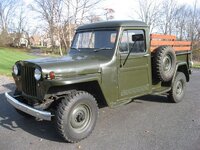
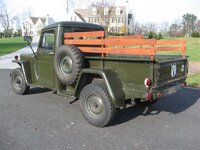
..."Gus" :) as named by the owners 9 year old son. Seemed fitting enough so "Gus" he shall be.
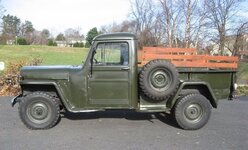
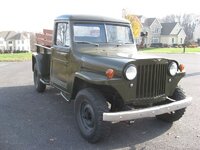
IMG_6613.jpg

Gus is a 1948 Willys Jeep Truck and is very close to the 1949 Johnson Jeep shop truck.

IMG_6618.jpg

The chain of ownership is short. The original owner used Gus on the farm, then passed Gus his to son and in turn, Gus was passed again to his son, grandson of the original owner. Thus Gus stayed in the same family for 51 years from 1948 until 1999. The grandson retired and sold Gus 12 years ago to the gentleman I adopted him from yesterday.

IMG_6614.jpg

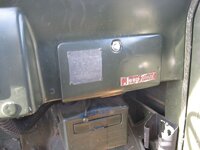
Having stayed within the same family for so long helped keep Gus mostly original and not modified or "hacked-up" like so many seem to be. He still has his original 4 cylinder "Go-Devil" engine and is 4 Wheel Drive - 4WD with everything in nice working order.
IMG_6623.jpg

Gus has only 37,000 miles having stayed on the farm for most of his life.

IMG_6624.jpg

He's never been "stored", just used sparingly and has always led an active life.

IMG_6629.jpg

Once he was loaded up...

IMG_6627.jpg

...well secured for the long drive through the Appellation Mountains...

IMG_6707.jpg

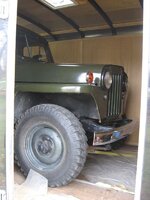
...he's now home.

IMG_6677.jpg

Safe and warm within the confines of the barn, at peace with the knowledge he's now retired in "The Center Of the Universe". ;)

If any of you have words of wisdom regarding a late 40's Willys Jeep truck, I'm all ears. From the firewall forward it seems very close to my 1949 Willys Jeepster except for the 4WD part, but I'm sure I'll have to learn all over again.

I'll update this with more information once I get some rest after that drive. Total time away from base, start to finish, 31 hours 1,576 miles and it was well worth it.

Now where was that sign painters phone number, I had it just a minute ago..........

Thomas
 
To avoid these ads, REGISTER NOW!
Top Bottom