To avoid these ads, REGISTER NOW!

Reusing a double top plate

Powderm0nkey

Member
Joined
Jul 16, 2016
Messages
23
Location
Salem, OR
I'm going to be raising my walls about a foot when I install a new roof, the easiest way I've come about doing this without a total rebuild is to sister 2x4 studs to the existing studs. To do this you cut/notch the existing top plate, sister the studs and redo the top plate. Our garage was built in the 40s, likely from old growth fir or something of the sort. It appears that the sheathing for the roof and the top plate are single 24' long pieces. I'm going to try and save as much of the sheathing as possible, but depending on how it looks when the roof comes off it may not be worth it. My question is, is it possible to remove/reuse the original top plate since it's one continuous board? Would it have to be separated to be reattached to the new studs, or could it be screwed with some of the 5-6" structural screws to get enough fastening depth through the double plate?
 
To avoid these ads, REGISTER NOW!

77Birdman

Well-known member
Joined
Nov 6, 2017
Messages
235
Location
North Eastern MD
If you are talking about the top plate on the stud wall, which I believe you are, technically, structurally I think you would be fine. However, in my experience, you will most likely find the old stuff very dry and prone to splitting with every nail or screw you attempt to put in. I would go ahead and get new for the cost of a couple of 2 x 4"s.
 

Falcon67

Well-known member
Joined
Jun 11, 2009
Messages
18,371
Location
Merkel, TX
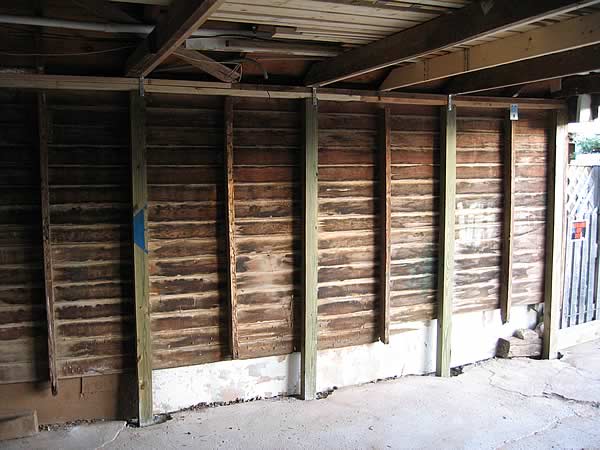
Take the walls up with the roof, knock out the sill plate. I had to cut in some top plate because of rot, but essentially the same.

garageN.jpg


From this thread - https://www.garagejournal.com/forum/showthread.php?t=41042
 

Skiff Builder

Well-known member
Joined
Jun 7, 2016
Messages
1,776
Location
Southern NJ Coast
If you were to reuse it whole, you could toenail it, starting in the seam between the upper and lower pieces, using 16 or 20d nails, one from outside face, one from inside face. Maybe some 8d toenailed from studs into plate.

If you decided to go with a new top plate- I would take both 24' old plates,leave them doubled. Cut them into 6' lengths, giving you (8) 4x4x6'. Face glue or drill and rod all pieces together. Plane down both sides. Now you have a solid 3-1/4 x 24 x 72 workbench top with some history behind it. Plenty of Youtubes on that subject.
I just did the same with a few old doubled fir scaffold poles.

Skiff
 
OP
P

Powderm0nkey

Member
Joined
Jul 16, 2016
Messages
23
Location
Salem, OR
Take the walls up with the roof, knock out the sill plate. I had to cut in some top plate because of rot, but essentially the same.

garageN.jpg


From this thread - https://www.garagejournal.com/forum/showthread.php?t=41042


Interesting. I hadn't thought of doing it this way. The whole roof is coming off for me though. Going from gable to monopitch shed roof. I feel like lifting the entire building would be more difficult than notching the top plate or raising it with new studs. I'll take a look at the thread though, thanks!
 
OP
P

Powderm0nkey

Member
Joined
Jul 16, 2016
Messages
23
Location
Salem, OR
If you were to reuse it whole, you could toenail it, starting in the seam between the upper and lower pieces, using 16 or 20d nails, one from outside face, one from inside face. Maybe some 8d toenailed from studs into plate.

If you decided to go with a new top plate- I would take both 24' old plates,leave them doubled. Cut them into 6' lengths, giving you (8) 4x4x6'. Face glue or drill and rod all pieces together. Plane down both sides. Now you have a solid 3-1/4 x 24 x 72 workbench top with some history behind it. Plenty of Youtubes on that subject.
I just did the same with a few old doubled fir scaffold poles.

Skiff

My thought of using the solid top plate 24' boards was just for stability and strength. Definitely a concern about getting them loose without breaking them though. Who knows how they were originally fastened. To keep the joints spaced appropriately for the top plates, could I use two 12' 2x4s on the bottom and 3 8' 2x4s on the top? Like this?

- - -
_ _

And the first course is toenailed into the studs, the top of the double plate is nailed straight into the one underneath it? Sorry for all the questions, just can't seem to find a good answer anywhere.


.:Edit:.
That idea for a work bench top is excellent! I'll definitely have to do that.
 
Last edited:

driftpin

Well-known member
Joined
Dec 22, 2016
Messages
11,192
Location
Miami-Dade/Broward Co. Florida
I am not a structural engineer. I believe your idea of having a four foot overlap of any splices should give you the strength you need. You could do a 16' & an 8' and just place the top longer pieces over the opposite ends= 16' & 8' and on-top, 8' over the 16' below, then the 16' next-to the 8'. Stagger the screws, and keep them about 1/3 of the width of the board from either side edge. About 6" spacing side-to-side for the screws should work, but you could ask a PE for the exact screw plan.

Unless you're limited by height restrictions, it seems as though you should consider going higher-than a foot-more. Also, 2x6's would allow more insulation, you could rip some 2x4's to 2x2's to widen the lower wall studs for the additional insulation depth.

At what-point is it going to be better to just do a new building? You can get a decent foundation and floor, and have a modern build. I understand price is a concern, and duration of your occupancy there.

My thought of using the solid top plate 24' boards was just for stability and strength. Definitely a concern about getting them loose without breaking them though. Who knows how they were originally fastened. To keep the joints spaced appropriately for the top plates, could I use two 12' 2x4s on the bottom and 3 8' 2x4s on the top? Like this?

- - -
_ _

And the first course is toenailed into the studs, the top of the double plate is nailed straight into the one underneath it? Sorry for all the questions, just can't seem to find a good answer anywhere.


.:Edit:.
That idea for a work bench top is excellent! I'll definitely have to do that.
 

lakeroadster

Well-known member
Joined
Jan 19, 2015
Messages
5,166
Location
Central Colorado
These folks built a new wall on top of the existing... Lifting A Roof 2 Feet

This is a quick way to raise the roof but the issue is this creates a hinge point at the junction of the new stub wall and the old existing wall. That needs to be addressed.

What are you planning to use for external / internal sheathing?

Are you subject to any zoning restrictions and do those require engineering review and sign off for this project?

attachment.php
 

Attachments

  • Powderm0nkey Roof Raise.jpg
    Powderm0nkey Roof Raise.jpg
    91.2 KB · Views: 617
Last edited:
OP
P

Powderm0nkey

Member
Joined
Jul 16, 2016
Messages
23
Location
Salem, OR
These folks built a new wall on top of the existing... Lifting A Roof 2 Feet

This is a quick way to raise the roof but the issue is this creates a hinge point at the junction of the new stub wall and the old existing wall. That needs to be addressed.

What are you planning to use for external / internal sheathing?

Are you subject to any zoning restrictions and do those require engineering review and sign off for this project?

attachment.php

That was my initial idea, however after realizing the issue with the hinge joint I decided against it. That's why I want to just sister the studs with ones that are 12-18" taller and add a new top plate. So just cutting down a 10' 2x4 to length, or go super burly and use 4x4s. That way the studs are unbroken from the top plate down to the sill plate/foundation. Since they will still be on 24" centers, rafters can still go right over the studs. I'm going to use 19/32" or 3/4" OSB outside, whatever I'll need to match the old sheathing. On the inside I'm thinking probably just sheetrock, however I'm also considering some OSB +sheetrock.

I've got plans drawn up that I'm going to take to the local building inspector's office, if they need me to have an engineer sign off I will.
 

matt_i

Well-known member
Joined
Mar 14, 2008
Messages
10,724
Location
SE Michigan
I think you will know if you can reuse it if you can pry it out in 1 piece.

The comment about being dry and crack-y is very possible. I think if you used structural screws or even torx drive screws with a self-drilling point, then they don't split as bad as nails. I'm thinking of GRKs or ABC-Spax screws specifically.
 
To avoid these ads, REGISTER NOW!

OccupantRJ

Well-known member
Joined
May 15, 2009
Messages
10,966
Location
Eastern North Carolina
Since the wall sheathing will also be nailed to the top plate, take a sawsall and cut the wall clean through just below the top plate, which will cut the nails along the way. This will release the top plates as a single unit, and the wall will be ready to go to work on, without a bunch of split wood. The top plates can then be separated and use as desired. Blocking can be added along the sheathing joint where the saw cut was made to attach both old and new wall sheathing to. Extend wall height, then attach the top plates to align the top of the studs, clamping them into alignment as you go. Easier than beating a bunch of older wood apart.
 

kbs2244

Well-known member
Joined
Nov 11, 2006
Messages
14,065
Do not remove the current top plate.
Those nails will never come out clean.

Build a short wall to nail to the top of it.

At that age I would expect the existing sheathing to be 1x6 and 1x8 at a 45 angle.
That makes it easy to remove some short ones at the top and then bridge the joint between with new boards.

That will reinforce the joint against old and new walls and fix the hinge concern.
 
Last edited:

lakeroadster

Well-known member
Joined
Jan 19, 2015
Messages
5,166
Location
Central Colorado
These folks built a new wall on top of the existing... Lifting A Roof 2 Feet

This is a quick way to raise the roof but the issue is this creates a hinge point at the junction of the new stub wall and the old existing wall. That needs to be addressed.

That was my initial idea, however after realizing the issue with the hinge joint I decided against it.

Here is a thread from 2012 with some suggestions on addressing the hinge effect, look at post #9... then run this past an Engineer.https://www.garagejournal.com/forum/showthread.php?t=144479

And here's another forum discussing addressing the hinge effect: http://forums.finehomebuilding.com/breaktime/construction-techniques/increasing-wall-height-one-foot
 
Last edited:

small&rusty

Well-known member
Joined
Jan 28, 2018
Messages
66
Location
Idaho
Couldn't you build a short wall on top of the existing wall then sheet both inside and outside spanning the joint with osb as if it were a sheer wall?
 
OP
P

Powderm0nkey

Member
Joined
Jul 16, 2016
Messages
23
Location
Salem, OR
Since the wall sheathing will also be nailed to the top plate, take a sawsall and cut the wall clean through just below the top plate, which will cut the nails along the way. This will release the top plates as a single unit, and the wall will be ready to go to work on, without a bunch of split wood. The top plates can then be separated and use as desired. Blocking can be added along the sheathing joint where the saw cut was made to attach both old and new wall sheathing to. Extend wall height, then attach the top plates to align the top of the studs, clamping them into alignment as you go. Easier than beating a bunch of older wood apart.

This is how I was thinking of doing it if I end up reusing the top plate.


Do not remove the current top plate.
Those nails will never come out clean.

Build a short wall to nail to the top of it.

At that age I would expect the existing sheathing to be 1x6 and 1x8 at a 45 angle.
That makes it easy to remove some short ones at the top and then bridge the joint between with new boards.

That will reinforce the joint against old and new walls and fix the hinge concern.

This creates a knee wall and a hinge joint. The sheathing can definitely take care of this, but I don't think I want to use OSB or plywood on the interior walls. Sistering the studs and extending the wall with a new top plate is likely what I'm going to do. Definitely extra work, but It's the easiest and safest way in my mind. I still have to clear this with the building inspector here.

Here is a thread from 2012 with some suggestions on addressing the hinge effect, look at post #9... then run this past an Engineer.https://www.garagejournal.com/forum/showthread.php?t=144479

And here's another forum discussing addressing the hinge effect: http://forums.finehomebuilding.com/breaktime/construction-techniques/increasing-wall-height-one-foot

See above.


Couldn't you build a short wall on top of the existing wall then sheet both inside and outside spanning the joint with osb as if it were a sheer wall?

See above. I'm not thrilled about using a knee wall because of the hinge effect. And I don't want to raise the walls, put block in and repour the foundation.
 

kbs2244

Well-known member
Joined
Nov 11, 2006
Messages
14,065
IMHO, the "hinge effect" concern is overblown.
Ask your inspector, he deals with this stuff on a daily basis.
 

small&rusty

Well-known member
Joined
Jan 28, 2018
Messages
66
Location
Idaho
With proper straps or hold downs there would be no hinge effect.

If your set on the sister method I'd suggest new top plates, the time and headache you'll save over trying to remove countless nails would be worth it. Also use 16' boards, that will give you one joint not 3, and three 16 footers will be enough to make both top plates for one side of your garage.
 
OP
P

Powderm0nkey

Member
Joined
Jul 16, 2016
Messages
23
Location
Salem, OR
Thanks for the replies/help. I've decided to hold off on adding height to the walls for now. As I've been able to clear things out and get good measurements, the top of the double plate sits at 8'9". With that and having a tall ridge board and 2x6 rafters, I think I'll just raise the rafter ties up a foot which will give me the ceiling height I need right now. It's 39" from the top of the rafter tie/ceiling joist and the ridge board, so I'll stay in the bottom third, use 2x8s instead of the spiced together 2x4s and also add blocking to help distribute the load down to the walls. When time and funds permit I'll reconsider redoing the roof and adding stem walls.
 

nelstomlinson

Well-known member
Joined
Jul 27, 2009
Messages
649
Location
Interior Alaska
If you chop up the top plate, what keeps your walls straight? I wouldn't do that. Build the little wall on top of the existing wall, use something like 7-111 sheeting on the outside, and some steel straps to keep it from toppling.

You were saying you don't want OSB on your inside walls. Consider putting OSB on then covering with with sheet rock. That gives you solid walls that you can sink a screw into anywhere. I did that on my tool room walls, and I've very happy with it.
 
To avoid these ads, REGISTER NOW!
Top Bottom