To avoid these ads, REGISTER NOW!

rewiring a 110V compressor to 220V

twowheeled

Member
Joined
Jan 21, 2012
Messages
20
Hi All, I need some pointers. I had an electrician install a dryer plug on a 30amp circuit into my garage which I believe is the NEMA 14-30P style outlet.

Sometime later I purchased a dual voltage compressor which is factory wired for 110V. Now I purchased the 4 prong cable and I'm having trouble rewiring the unit to run on 220V.


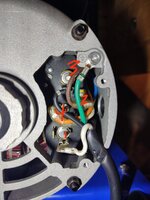
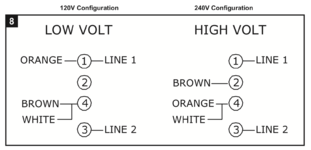
Firstly I have opened up the motor access plate and followed the diagram to switch jumpers from the low to hi voltage configuration. I've tripled checked this.

There is no wiring diagram for the pressure switch. So following some google searching I've hooked up my 4 prong dryer cord as thus:
Red wire - Switch Line
Black wire - Switch Line
Ground - grounded to switch plate/compressor body
White neutral - Capped/not used.

When I turn the compressor on it does not run. I have tried switching the red/black lines and no effect. Measuring between the Red/black wire shows no voltage with multimeter. Measuring past the switch to the motor Line 1 and Line 2 terminals with switch ON shows current with my non contact pen.

Please any advice?
 

Attachments

  • switch.jpg
    switch.jpg
    225.8 KB · Views: 32
  • compressor diagram.png
    compressor diagram.png
    160 KB · Views: 32
  • motor 1.jpg
    motor 1.jpg
    357.6 KB · Views: 31
To avoid these ads, REGISTER NOW!

yatg

Well-known member
Joined
Aug 16, 2019
Messages
2,775
Location
Southern Oregon
Check your receptacle to make sure you have 240V between X and Y.
 

Attachments

  • nema1430.jpg
    nema1430.jpg
    13.3 KB · Views: 28

yatg

Well-known member
Joined
Aug 16, 2019
Messages
2,775
Location
Southern Oregon
Could be beeping because phantom voltage, or one leg is dead.
Make sure your meter is working by testing in a known live receptacle, 120v or 240v.

Check between X and G and Y and G to see if a leg is dead.

Check in the panel that the breaker is actually on.
Check the voltage on the breaker screws to rule out a bad breaker.

Turn off the breaker, pull out the receptacle, and check for correct wiring.
 
OP
T

twowheeled

Member
Joined
Jan 21, 2012
Messages
20
thank you, I am measuring 120V between Y/G and nothing at X/G assuming this is dead. Will be calling electrican back to fix the wiring.
 

Terry D

Well-known member
Joined
Mar 25, 2015
Messages
2,202
Location
St. Louis, MO.
Your non contact voltage detector will drive you crazy on something like this. Using a multimeter is your best choice. As said, measure voltage across breaker. If you dont have 240 volts across the two lugs, the problem is the breaker or the panel. Also check the power coming into the panel. Post a picture of the panel and breaker.
 

u2slow

Well-known member
Joined
Nov 20, 2011
Messages
3,585
Location
BC
The pressure switch wiring won't care if 120v or 240v. It just needs to be rated for the higher voltage. Switch opens/closes the circuit regardless of voltage.
 

sparky 1971

Well-known member
Joined
Oct 9, 2018
Messages
7,967
Location
Central Iowa
The tester leads may not be long enough to make contact in the receptacle. Pull the receptacle out and then check at the screw terminals.

I trimmed the plastic off mine to make them fit.
 

Norcal

Well-known member
Joined
Mar 16, 2008
Messages
13,753
They do have their place, but a Wiggy and or a multimeter are more useful.
 

Terry D

Well-known member
Joined
Mar 25, 2015
Messages
2,202
Location
St. Louis, MO.
They do have their place, but a Wiggy and or a multimeter are more useful.
I agree, when there is lugs, terminals, prongs, etc. A meter is the way to go. But one example, if you have a bunch of nm-b's in a basement and you want to find the one that is hot or the one that is dead, you cant beat a non-contact tester.
 

cannuck

Well-known member
Joined
Nov 30, 2021
Messages
4,609
Location
Rural SK
Most likely when the breaker was installed in the panel it was put on the wrong pair of terminals. to get 220 each leg has to be on a different side of the bus (that alternates all of the way down top to bottom 2 tabs L1 leg and 2 tabs L2 leg).
 

Terry D

Well-known member
Joined
Mar 25, 2015
Messages
2,202
Location
St. Louis, MO.
Most likely when the breaker was installed in the panel it was put on the wrong pair of terminals. to get 220 each leg has to be on a different side of the bus (that alternates all of the way down top to bottom 2 tabs L1 leg and 2 tabs L2 leg).
That is possible on some panels, GE being one. If that was the case, you still would have 120 volts from each hot to ground/neutral, just not 240 volts from hot to hot. The OP claims he has 0 volts from one hot to ground. Most panels, no matter where you plug a 2-pole breaker in, you will get 240 volts
 
Last edited:
To avoid these ads, REGISTER NOW!

u3b3rg33k

Well-known member
Joined
Dec 18, 2017
Messages
4,047
Where I come from a non-contact tester is called a dumbstick. it can help you not be dumb. It can't tell you how dumb you're about to be, or how to do things smart, or if you're doing things smart.

If you need to do smart things, the dumbstick is the wrong tool. but it is a great tool to let you know you you're about to do something really dumb. or that someone else has done something dumb while you weren't looking.
 

klassenl

Well-known member
Joined
Feb 20, 2016
Messages
713
Location
Southern Alberta
Where I come from a non-contact tester is called a dumbstick. it can help you not be dumb. It can't tell you how dumb you're about to be, or how to do things smart, or if you're doing things smart.

If you need to do smart things, the dumbstick is the wrong tool. but it is a great tool to let you know you you're about to do something really dumb. or that someone else has done something dumb while you weren't looking.

In my shop we call them death sticks.
 

Terry D

Well-known member
Joined
Mar 25, 2015
Messages
2,202
Location
St. Louis, MO.
The main thing about a non contact voltage tester is knowing when to use them and when not. And how to use one. They can be a very helpful tool when used correctly. I would not chance my life with one. But I bet most electricians own one
 

Duke74

Well-known member
Joined
May 15, 2021
Messages
249
Location
Pierceland
Yes I own one but I have no idea where it is. Never used it so it’s lost among my stuff somewhere lol.
 

wyliesdiesels

Well-known member
Joined
Aug 14, 2012
Messages
19,995
Location
Modesto, CA
Hi All, I need some pointers. I had an electrician install a dryer plug on a 30amp circuit into my garage which I believe is the NEMA 14-30P style outlet.

Sometime later I purchased a dual voltage compressor which is factory wired for 110V. Now I purchased the 4 prong cable and I'm having trouble rewiring the unit to run on 220V.


Firstly I have opened up the motor access plate and followed the diagram to switch jumpers from the low to hi voltage configuration. I've tripled checked this.

There is no wiring diagram for the pressure switch. So following some google searching I've hooked up my 4 prong dryer cord as thus:
Red wire - Switch Line
Black wire - Switch Line
Ground - grounded to switch plate/compressor body
White neutral - Capped/not used.

When I turn the compressor on it does not run. I have tried switching the red/black lines and no effect. Measuring between the Red/black wire shows no voltage with multimeter. Measuring past the switch to the motor Line 1 and Line 2 terminals with switch ON shows current with my non contact pen.

Please any advice?
a couple of things that are incorrect here

compressor doesn't need a neutral so the 4 prong 14-30 dryer outlet is incorrect

you need a NEMA 6-30

and thus the 4-prong dryer cord is wrong as well.
 

u3b3rg33k

Well-known member
Joined
Dec 18, 2017
Messages
4,047
a couple of things that are incorrect here

compressor doesn't need a neutral so the 4 prong 14-30 dryer outlet is incorrect

you need a NEMA 6-30

and thus the 4-prong dryer cord is wrong as well.
14 series outlets aren't "wrong" they're just the most flexible. don't need the neutral? don't use it in your appliance.
 

Terry D

Well-known member
Joined
Mar 25, 2015
Messages
2,202
Location
St. Louis, MO.
You only need a cord with a 6-20p on it. I'm not a big fan of adaptors, but they do make one. You could change the receptacle to a 6-20r also, but if the 30 amp receptacle you have now is in a 2-gang box, that wouldn't be to easy to do.


u3b3rg33k

Well-known member
Joined
Dec 18, 2017
Messages
4,047
a 14 series outlet is 125/250v and is 4 prong. theyre wrong for a motor that is 240v. using one for a motor screams hack.
disagree. it's exactly what dryers do. neutral is there for a lightbulb/timer. those could be 220v. why do outlets need to lack features? I'd rather have a neutral and an appliance that doesn't need one, than have a 6 series outlet and then have to re-install the wiring just to get a neutral.

it'd be like only installing only 1-15R outlets because you're not planning on using a 5-15P today.

if you hardwired it, sure. then it's strange. but the whole point of outlets is you can plug in something else.

what if your uncle bob comes into town with his RV and wants to plug in? sorry bob. no neutral. better run your generator all night!
 
Last edited:

larry_g

Well-known member
Joined
Apr 28, 2007
Messages
16,874
Location
oregon
To the OP

You show wiring for the switch for proper 240v operation, good. Have you also rewired the MOTOR for 240v operation??

lg
no neat sig line
 

Terry D

Well-known member
Joined
Mar 25, 2015
Messages
2,202
Location
St. Louis, MO.
Not to get off track here, but a RV 30 amp is 120 volt, its a TT-30r. The 240/120 volt RV is a 50 amp, 14-50r, same as a range receptacle. Neither one will plug into that 30 amp receptacle the OP has. He could plug a dryer into it. This is just my opinion, I feel that each piece of equipment should have its own receptacle to plug into, then you don't have to worry about not being able to use something when something else is plugged in
 
Last edited:

Norcal

Well-known member
Joined
Mar 16, 2008
Messages
13,753
disagree. it's exactly what dryers do. neutral is there for a lightbulb/timer. those could be 220v. why do outlets need to lack features? I'd rather have a neutral and an appliance that doesn't need one, than have a 6 series outlet and then have to re-install the wiring just to get a neutral.

it'd be like only installing only 1-15R outlets because you're not planning on using a 5-15P today.

if you hardwired it, sure. then it's strange. but the whole point of outlets is you can plug in something else.

what if your uncle bob comes into town with his RV and wants to plug in? sorry bob. no neutral. better run your generator all night!
It SCREAMS extreme ignorance to supply a neutral for a appliance that does not need it, the only appliances that do require is are clothes driers & ranges.

As to RV's, any self respecting RVer has a adapter from 30A to 15A, and 50A to 15A, if not they can run on battery power, the 50A 125/250V is a dual voltage device, a RV has no 240V loads only 120V.
 

u3b3rg33k

Well-known member
Joined
Dec 18, 2017
Messages
4,047
It SCREAMS extreme ignorance to supply a neutral for a appliance that does not need it, the only appliances that do require is are clothes driers & ranges.

As to RV's, any self respecting RVer has a adapter from 30A to 15A, and 50A to 15A, if not they can run on battery power, the 50A 125/250V is a dual voltage device, a RV has no 240V loads only 120V.
outlets are rarely for a specific appliance. you may put an air compressor there. the next owner may not be a car guy but put an EVSE there. or maybe he wants to plug in the RV. or a welding cart with a mini-sub panel so you can plug in lights and grinders. 14-30/50 are perfect for that. a few RACO boxes bolted to the side of a 2 pole square D box with 2 single pole 20A breakers in it. now I can run my grinders and lights and welder without running cords everywhere.

you know what RVers don't have? 12kVA transformers to make a neutral where one doesn't exist. I've not seen many RVs with enough battery to run an AC.
 

wyliesdiesels

Well-known member
Joined
Aug 14, 2012
Messages
19,995
Location
Modesto, CA
disagree. it's exactly what dryers do. neutral is there for a lightbulb/timer. those could be 220v. why do outlets need to lack features? I'd rather have a neutral and an appliance that doesn't need one, than have a 6 series outlet and then have to re-install the wiring just to get a neutral.

it'd be like only installing only 1-15R outlets because you're not planning on using a 5-15P today.

if you hardwired it, sure. then it's strange. but the whole point of outlets is you can plug in something else.

what if your uncle bob comes into town with his RV and wants to plug in? sorry bob. no neutral. better run your generator all night!
Better go read the schematic for an electric dryer then

Every electric dryer ive owned had a 120v motor. Why? Because the manufacturers want to save money by using one motor for both electric and gas versions.

So while you think theres a 240v motor in that electric dryer, in actuality its most likely a 120v motor and the only thing thats 240v is the heating coil... opppsss
 

u3b3rg33k

Well-known member
Joined
Dec 18, 2017
Messages
4,047
either way. doesn't change my point about having a neutral available being a good thing.

what did @twowheeled 's electrician find?
 

Showkey

"MEMBER EMERITUS"
Joined
Aug 9, 2014
Messages
8,638
Location
Wausau WI
Wow………. it’s Christmas and the electricians are arguing*………..what a surprise ??????


*about nothing
 
To avoid these ads, REGISTER NOW!
Top Bottom