To avoid these ads, REGISTER NOW!

Rewiring the kitchen

Junkman

Well-known member
Joined
Dec 18, 2006
Messages
6,605
Location
Northeastern CT
I am doing some work in a home that was built in the 1960s and it is going to need a complete rewire as I work on the rooms. The kitchen was remodeled about 5 years ago, and that isn't going to be touched, however, the contractor ran the wires across the bottom of the joists diagonally to the electric panel. There are four 14 gauge wires, and I want to run them across the back wall of the cellar, and properly affix them to the header. I know that I am going to need to add additional wire in a junction box because the present wire isn't going to be long enough. Can I join 2 of the wires in a junction box to a 12/3 wire that will be going to the breaker panel? Thanks for the help. I am certain that I am going to have more questions as I go through the process.
 
To avoid these ads, REGISTER NOW!

PCustoms

Well-known member
Joined
Jul 23, 2011
Messages
22,326
Location
VT
Short answer is no.

Long answer is it depends what those wires are for, how they feed the circuit(s) and how you intend to breaker it.
 

mm08822

Well-known member
Joined
Jan 13, 2012
Messages
5,856
Location
NJ
Simplest way is to keep the circuits seperate so any gfcis and arc fault cbs remain working or can easily be added later.

If these are kitchen circuits, I would expect two of those circuits are #12 already. These would be the two small appliance branch circuits for countertop recepts.

Why would you want to use #12 when #14 is used downstream? (Assuming they are all 14s already)

Two 4" square junction boxes is all that is needed to extend.
 

Shiftless

Well-known member
Joined
Mar 9, 2014
Messages
14,474
Location
East Bay SFO
Are the four 14 ga. cables connected to 4 individual 15 amp breakers? Do those 4 supply all the power to the whole kitchen that was remodeled 5 years ago?
 

Chuckster in NJ

Well-known member
Joined
Jan 26, 2010
Messages
2,276
Location
Hunterdon County NJ
sounds like you need some experience with electrical. not dissing you by any means . but you would just extend whats there in proper junction boxes... and any junction has to be accesible ( cannot be buried behind drywall etc.
Best advice is to call a professional…….. Speaking from experience and not being a ****.
I admire folks who like to do their own work, learn and save money but when I see a post like #1 it is very clear that the OP is not qualified and needs professional help.

Wiring is not a hobby…….. Call a professional because your loss may be more than just financial.
 

Shiftless

Well-known member
Joined
Mar 9, 2014
Messages
14,474
Location
East Bay SFO
brain fart, when he said 12/3 I was thinking he wanted to tie 2 circuits into a 20 amp circuit
Can I join 2 of the wires in a junction box to a 12/3 wire that will be going to the breaker panel?
Joining two “wires” to one 12/3 ???
Splicing two 14s onto one 12 and running that back to a single 20 amp breaker? I hope not!
 

Norcal

Well-known member
Joined
Mar 16, 2008
Messages
13,752
Extending any circuit more then 6' that is required to have AFCI "protection" would require AFCI's to be used.
 
OP
J

Junkman

Well-known member
Joined
Dec 18, 2006
Messages
6,605
Location
Northeastern CT
Okay, I made a typo when I referred to them as 14-gauge. All four wires are 12-gauge (yellow Romex). I have no idea what each of them is for, but none of them have GFCI circuit breakers, which I believe were required by code when the kitchen was installed. I will be installing the GFCI breakers where required. My guess is that one is a dedicated circuit for the refrigerator, and possibly the other for the microwave. What the other two are for is anyone's guess, but I will be figuring that out shortly. Another question is whether there is a ceiling light controlled by a switch located just to the side of the sink. Does that need to be GFIC protected? My intuition is that it is yes, because it is close to the faucet. Is it proper for me to install a GFCI receptacle at the first outlet in the kitchen? I know that all the others downstream are protected. I just don't know exactly where a GFCI outlet is acceptable and where it isn't. I wired my entire home in 1983 when I built it, but at the time, the code was a lot easier to understand. I had a small book that covered everything that I needed to know. Thanks
 
Last edited:

mm08822

Well-known member
Joined
Jan 13, 2012
Messages
5,856
Location
NJ
Okay, I made a typo when I referred to them as 14-gauge. All four wires are 12-gauge (yellow Romex). I have no idea what each of them is for, but none have GFCI circuit breakers, which I believe is required by code. I will be installing the GFCI breakers where required. My guess is that one is a dedicated circuit for the refrigerator, and possibly the microwave. What the other two are for is anyone's guess, but I will be figuring that out shortly. Another question is whether there is a ceiling light controlled by a switch located just to the side of the sink. Does that need to be GFIC protected? My intuition is that it is yes, because it is close to the faucet. What say you?
The two small appliance branch circuits probably have gfci recepts at the start of each string of recepts on the countertop. Keeping the reset button accessible is very desirable. If there are none for those 2 circuits, they should be added and hopefully in a convenient countertop location.

The ceiling light switch does not have to be gfci protected. If you want it, then you can add it somewhere in that circuit. Not commonly done, but nothing in the code prevents it. You might be in the dark if it trips.

Start by identifying each circuit and try to determine the connectivity between the outlets on each respective circuit.
 
OP
J

Junkman

Well-known member
Joined
Dec 18, 2006
Messages
6,605
Location
Northeastern CT
I found that one circuit is for the Microwave on a regular circuit breaker, and another is for the refrigerator, which has a single 20-amp receptacle on a standard circuit breaker. The other two have GFCI outlets; one is a standalone unit, and the other has one additional outlet. Probably could have done all three outlets on a single GFCI outlet since they are all in close proximity.
 
OP
J

Junkman

Well-known member
Joined
Dec 18, 2006
Messages
6,605
Location
Northeastern CT
Thanks, that clears up the question of why there are 2 GFCI receptacles. I am always willing to learn more, and that is why I ask questions.
 

mm08822

Well-known member
Joined
Jan 13, 2012
Messages
5,856
Location
NJ
Thanks, that clears up the question of why there are 2 GFCI receptacles. I am always willing to learn more, and that is why I ask questions.
Each of those circuits with the gfci recepts are the small appliance branch circuits.
 

bronc076

Well-known member
Joined
Jul 17, 2023
Messages
190
Location
Ozarks
Does a dedicated fridge circuit need to be GFCI? What code cycle are you working with?
 
To avoid these ads, REGISTER NOW!

theoldwizard1

Well-known member
Joined
Feb 22, 2011
Messages
43,077
Location
SE MI
... but none of them have GFCI circuit breakers, which I believe were required by code when the kitchen was installed.
There is a requirement for 2 circuits 20A each for countertops.
One should be to the left of the sink and one to the right of the sink.

There is no requirement to use GFCI breakers. You can use GFCI outlets instead. You can have more than one countertop outlet on each circuit as long as they are AFTER the GFCI outlet/breaker and on the same side of the counter top as the GFCI protected outlet.

I am pretty certain those circuits are not allowed to power anything else.
 

theoldwizard1

Well-known member
Joined
Feb 22, 2011
Messages
43,077
Location
SE MI
Segue - Skipping "best practice" ...

Does the current NEC require a dedicated circuit for the following kitchen appliances.
  • Refrigerator
  • Microwave (hardwired)
  • Garbage disposer
  • Dishwasher
 

mm08822

Well-known member
Joined
Jan 13, 2012
Messages
5,856
Location
NJ
One should be to the left of the sink and one to the right of the sink.

There is no requirement to use GFCI breakers. You can use GFCI outlets instead. You can have more than one countertop outlet on each circuit as long as they are AFTER the GFCI outlet/breaker and on the same side of the counter top as the GFCI protected outlet.

I am pretty certain those circuits are not allowed to power anything else.
Nooooooooooo, You're making up stuff. As long as there are 2 sabc gfci protected in some manner feeding the countertop recepts, they can be in any order.
 
Last edited:

mm08822

Well-known member
Joined
Jan 13, 2012
Messages
5,856
Location
NJ
Segue - Skipping "best practice" ...

Does the current NEC require a dedicated circuit for the following kitchen appliances.
  • Refrigerator
  • Microwave (hardwired)
  • Garbage disposer
  • Dishwasher
  • Refrigerator - No
  • Microwave (hardwired) - would depend on load - but not on sabc
  • Garbage disposer - would depend on load - but not on sabc
  • Dishwasher - would depend on load - but not on sabc
 

sparky 1971

Well-known member
Joined
Oct 9, 2018
Messages
7,966
Location
Central Iowa
One should be to the left of the sink and one to the right of the sink.
Not if one side of the sink has less than 12" of counter top. (it does happen). Neither one of those have to be a GFCI receptacle, but do have to have GFCI protection.
There is no requirement to use GFCI breakers. You can use GFCI outlets instead. You can have more than one countertop outlet on each circuit as long as they are AFTER the GFCI outlet/breaker and on the same side of the counter top as the GFCI protected outlet.
There is absolutely nothing in the NEC about which side of the counter top the GFCI needs to be. As long as there are two SABC's serving the counter top and the spacing is met, anything goes.
I am pretty certain those circuits are not allowed to power anything else.
Dining room, breakfast room, refrigerator, pantry, clock, gas range... 210.52(B) 1 and 2 including exceptions.
 
OP
J

Junkman

Well-known member
Joined
Dec 18, 2006
Messages
6,605
Location
Northeastern CT
if its in a location that requires GFCI, the answer is yes. the exemptions for no GFCI on a dedicated circuit went away long ago
Does this mean the refrigerator must be on a GFCI outlet? I mentioned this to one of the electrical contractors who is going to quote the job, and he said refrigerators are never on a GFCI; they only have to be on a separate breaker.
What does this acronym stand for, "sabc"?
Thanks
 

mm08822

Well-known member
Joined
Jan 13, 2012
Messages
5,856
Location
NJ
Can we add this to the list of wizardry?
You witnessed it for yourself......Wizardry quote #42,076. 🪞Again the mirror speaks.

Tip:
Apply multiple search tags to each quote. This way you can catalog the meadow muffins :poop: for easy recall at your next party get together.
 

sparky 1971

Well-known member
Joined
Oct 9, 2018
Messages
7,966
Location
Central Iowa
I found that one circuit is for the Microwave on a regular circuit breaker,
If it doesn't sit on the counter top, it isn't supposed to be on one of the small appliance circuits. If it's over the range or a built in, it's more than likely going to exceed 50% of a shared circuit so it would have to be dedicated.
and another is for the refrigerator, which has a single 20-amp receptacle on a standard circuit breaker.
A lot of people (especially here on GJ) think that a fridge should be on a dedicated circuit. What they don't realize is that modern refrigerators are only about five amps. I have a LG french door fridge with a pullout freezer that uses 4.5 amps.
The other two have GFCI outlets; one is a standalone unit, and the other has one additional outlet. Probably could have done all three outlets on a single GFCI outlet since they are all in close proximity.
If those are on the counter top, they would be part of the two 20 amp circuits required by the code.
 

sparky 1971

Well-known member
Joined
Oct 9, 2018
Messages
7,966
Location
Central Iowa
Does this mean the refrigerator must be on a GFCI outlet?
At one time, if the receptacle was within 6' of the sink it had to be GFCI protected. That didn't mean that a GFCI had to be behind it. It could have been fed from a countertop GFCI or a breaker. If you are on the 2023 NEC, everything in the kitchen is supposed to now be GFCI protected.
I mentioned this to one of the electrical contractors who is going to quote the job, and he said refrigerators are never on a GFCI; they only have to be on a separate breaker.
He's wrong. Probably shouldn't use him, he's too stupid. They are now required to be on a GFCI (if the 2023 has been adopted) and they have never been required to be on a dedicated circuit.
What does this acronym stand for, "sabc"?
Small Appliance Branch Circuit. There are supposed to be two of them for a kitchen and can be used for the counter top among a few other things, see the bottom of post #27
 

dave*99

Well-known member
Joined
May 5, 2009
Messages
4,248
Location
Coastal NJ
You witnessed it for yourself......Wizardry quote #42,076. 🪞Again the mirror speaks.

Tip:
Apply multiple search tags to each quote. This way you can catalog the meadow muffins :poop: for easy recall at your next party get together.
My kids bring their dogs to visit. Love the kids and the dogs. Meadow muffins.......... not so much.

Yeah, I couldn't bring my self to address the click bait in Wizardry quote #42,076. If you need specific answers to those items in the list, Google is your friend. NEC is there too. Even Mike Holt can help.

Have we ventured far enough from the OP's question about how to re-route (4) 12 ga. cables that now seem to be adequately supplying his kitchen to close this thread?
 

mm08822

Well-known member
Joined
Jan 13, 2012
Messages
5,856
Location
NJ
Does this mean the refrigerator must be on a GFCI outlet? I mentioned this to one of the electrical contractors who is going to quote the job, and he said refrigerators are never on a GFCI; they only have to be on a separate breaker.
What does this acronym stand for, "sabc"?
Thanks
Fridges are on gfci circuits if within 6' path of sink. They can be on the sabc also. If you want a separate circuit, go for it.
Small appliance branch circuit as mentioned in post 3, 15 19, 27.
 

mm08822

Well-known member
Joined
Jan 13, 2012
Messages
5,856
Location
NJ
My kids bring their dogs to visit. Love the kids and the dogs. Meadow muffins.......... not so much.

Yeah, I couldn't bring my self to address the click bait in Wizardry quote #42,076. If you need specific answers to those items in the list, Google is your friend. NEC is there too. Even Mike Holt can help.

Have we ventured far enough from the OP's question about how to re-route (4) 12 ga. cables that now seem to be adequately supplying his kitchen to close this thread?
If you don't chase the bait, his numbers won't increase. (At least once or twice, since 2011, he has learned how to search Google, NFPA, Mike Holt,.....for electrical code q's.)

Op is on to new q's relevant to his project.
 
OP
J

Junkman

Well-known member
Joined
Dec 18, 2006
Messages
6,605
Location
Northeastern CT
At one time, if the receptacle was within 6' of the sink it had to be GFCI protected. That didn't mean that a GFCI had to be behind it. It could have been fed from a countertop GFCI or a breaker. If you are on the 2023 NEC, everything in the kitchen is supposed to now be GFCI protected.

He's wrong. Probably shouldn't use him, he's too stupid. They are now required to be on a GFCI (if the 2023 has been adopted) and they have never been required to be on a dedicated circuit.

Small Appliance Branch Circuit. There are supposed to be two of them for a kitchen and can be used for the counter top among a few other things, see the bottom of post #27
When you say "everything in the kitchen is supposed to now be GFIC protected", does this include the lighting?
 

sparky 1971

Well-known member
Joined
Oct 9, 2018
Messages
7,966
Location
Central Iowa
When you say "everything in the kitchen is supposed to now be GFIC protected", does this include the lighting?
No, just receptacles and that includes 240 volt so if you have an electric range it would be included but not a hardwired cooktop or oven.
 

mm08822

Well-known member
Joined
Jan 13, 2012
Messages
5,856
Location
NJ
No, just receptacles and that includes 240 volt so if you have an electric range it would be included but not a hardwired cooktop or oven.
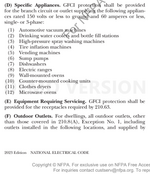
No, it's outlets, not just receptacles. See 210.8(D), 8, 9, 10.
 

sparky 1971

Well-known member
Joined
Oct 9, 2018
Messages
7,966
Location
Central Iowa
No, it's outlets, not just receptacles. See 210.8(D), 8, 9, 10.
I can't. I don't have a 2023 edition yet. We just adopted it last July so I decided to wait until the 26 comes out so I can pick up a NOS 23 cheap. I will admit to being wrong due to not having to worry about it because the state dropped all of the 240 volt GFCI requirements for dwellings when they adopted the 2020 and kept it that way for the 2023. And I only do enough residential work to remind me why I don't do residential work. I wired so many houses from 95 to 98 that I'd much rather go to the dentist. I do some residential service work, but only do a new house when it's far enough in the sticks that nobody else will do it.
 
Last edited:

mm08822

Well-known member
Joined
Jan 13, 2012
Messages
5,856
Location
NJ
I can't. I don't have a 2023 edition yet. We just adopted it last July so I decided to wait until the 26 comes out so I can pick up a NOS 23 cheap. I will admit to being wrong due to not having to worry about it because the state dropped all of the 240 volt GFCI requirements for dwellings when they adopted the 2020 and kept it that way for the 2023. And I only do enough residential work to remind me why I don't do residential work. I wired so many houses from 95 to 98 that I'd much rather go to the dentist. I do some residential service work, but only do a new house when it's far enough in the sticks that nobody else will do it.
1760586858054.png
 
To avoid these ads, REGISTER NOW!
Top Bottom