To avoid these ads, REGISTER NOW!

RPM study on air compressor's

mayday0017

Well-known member
Joined
Oct 20, 2010
Messages
1,715
Location
Houston Texas
There has been so much talk about how 3450rpm motors vs 1725rpm is so much louder, I have been under the belief that this makes no difference in the sound that they are actually geared differently and the pumps spin at close to the same RPM.

Regardless it would be neat to have people take 2 minutes to post up the model of their compressor, the rated CFM (if available), a picture (if available), the drive pulley size, motor RPM, horsepower, and Flywheel size. Lets see what is typical. There are only a hand full of designs out there, lets see what we can learn. :thumbup:

Everyone use this site to calculate the Pump RPM *Enter first 3 fields and press calculate
http://www.temecularodrun.com/ref/rpm_calc.asp
 
To avoid these ads, REGISTER NOW!
OP
M

mayday0017

Well-known member
Joined
Oct 20, 2010
Messages
1,715
Location
Houston Texas
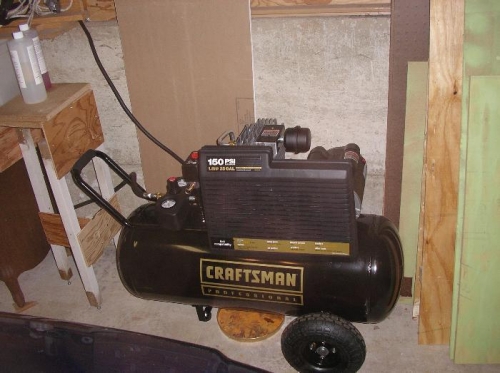
Manufacture: Craftsman (Made by Sanborn)
Model: WV5248069
CFM: 14.1@90psi
Motor RPM: 3450
Motor HP: 5.4 Runnig
Pulley Size: 3.125"
Flywheel Size: 16"
Calculated Pump RPM 673.83

spin_prod_666663601
 
OP
M

mayday0017

Well-known member
Joined
Oct 20, 2010
Messages
1,715
Location
Houston Texas
Manufacture: Kobalt (Made by Sanborn)
Model: LV5248069
CFM: 17.5@100psi
Motor RPM: 3450
Motor HP: 5.2
Pulley Size: 3"
Flywheel Size: 14"
Calculated Pump RPM 739.29

846212001707xl.jpg
 

pipsters

Well-known member
Joined
Sep 1, 2010
Messages
4,899
Location
USA
I just did this calculation yesterday.

Sears Craftsman Pro 25 gal belt driven
Model: 919.195413
1.8 running HP
5.8 CFM @ 90 psi
Motor RPM: 3450
Motor pulley: 2"
Flywheel size: 10"
Calculated pump RPM: 690

FP02082009A0007M.jpg


Seems quiet enough to me but I don't have a frame of reference.
 

PT Doc

Well-known member
Joined
Nov 12, 2010
Messages
3,197
I would recommend computing hp based on amps if accurate data is the goal.
 
OP
M

mayday0017

Well-known member
Joined
Oct 20, 2010
Messages
1,715
Location
Houston Texas
HP doesn't really matter in this, what matters is motor RPM and pulley sizes... Everything else is just extra information. Good suggestion though, and if anyone wants to post that up it will not be frowned upon! :)

Pipsters - Thanks for the quick reply, I am really curious to see what most pumps run at... Prob should also ask people to rate their compressor as Quiet, Tolerable, & OMG LOUD!
 
OP
M

mayday0017

Well-known member
Joined
Oct 20, 2010
Messages
1,715
Location
Houston Texas
Anyone else? This would take 2 or 3 minutes of time to get the information. IF you don't have the time to put in on all of it just send me pully sizes and model number I'll do the rest off manufacture specs.
 

Steevo

Well-known member
Joined
Aug 18, 2009
Messages
8,738
Location
43.49600, -112.04300
Ok, I'll play.

IMG1358-M.jpg


Ingersoll Rand 2475 pump (2-stage)
Baldor 5HP L1410T motor (23A / 230v)

16.8CFM @ 175psi

Motor RPM: 1725
Motor pulley: 6.25""
Flywheel size: 13.9"
Calculated pump RPM: 777
 
Last edited:

boosteddsm92

Well-known member
Joined
Jun 27, 2010
Messages
498
Location
MD
Manufacturer: Jenny
Model: J5A-60
CFM: 23@125psi
Motor RPM: 1735
Motor HP: 5
Pulley Size: 7"
Flywheel Size: 15.5"
Calculated Pump RPM: 780

2012-06-29225437-1.jpg
 
Last edited:

stonesfan68

Well-known member
Joined
Apr 19, 2012
Messages
2,764
Location
Houston, TX
There has been so much talk about how 3450rpm motors vs 1725rpm is so much louder, I have been under the belief that this makes no difference in the sound that they are actually geared differently and the pumps spin at close to the same RPM.

The sound of the reciprocating compressor is a function of the compressor RPM + the motor RPM. The biggest contributor to the sound level is by far the compressor. Most of the sound that you hear is the valves opening and closing and letting the air go in and out. A slower compressor will have a lower sound.

If you want to reduce the sound level you can remote pipe the inlet air filter, or use a heavy-duty filter/silencer like the one's that Solberg makes.

Solberg
 

Stephenw

Well-known member
Joined
Dec 21, 2006
Messages
1,911
Location
Utah
Pull the belt and listen to the electric motor; it makes almost no sound at all.

Pump speed is a result of pulley ratio. The pump makes nearly all of the noise.

The speed of the electric motor makes almost no difference.
 

EOC_Jason

Well-known member
Joined
Jun 25, 2012
Messages
11,388
Location
Bentonville, AR
^^^ Agreed. The speed of the motor is not really a contributing factor to the noise of the compressor. People that try to sell you on the MOTOR RPM is just blowing hot air up your rear. If you are ever replacing a motor, then it is important because you don't want to swap speeds without replacing the pulley size to compensate.

Pump RPM on the other hand does make a difference somewhat in noise level. I was doing a TON of research trying to a best bang-for-the-buck 10-15HP compressor. It is not uncommon for some companies to use one size pump for two model sizes. Example, having a 10HP PUMP but offer both a 7.5HP motor or a 10HP motor models. Running with the 7.5HP motor usually is around 700RPM (on the pump), but with a 10HP motor it runs at 1,000RPM.

Also the amount (and size) of pistons / cylinders a compressor has can have an effect on noise.

Another factor people don't really think about is the air INTAKE. Solberg is probably the best known out there and used on just about every compressor. You can buy them direct off of Amazon.com, along with replacement filter elements. I haven't tried but you might be able to upsize your filter housing and use some reducers to get it to thread in your intake. I don't know if that would reduce the noise anymore than the correctly sized unit. At the very least you wouldn't have to clean / replace the air filter as often.

Solberg (and a few other brands I think) also make intake silencers that look like tube shaped mufflers. I'm attaching a picture so you can see what I'm talking about. Those are supposed to lop off like 10-15dB in noise. (Edit - on their website it says 30dB from high-pitched noise, but I think that is probably a best-case scenario)
 

Attachments

  • 31QoMUYiQNL.jpg
    31QoMUYiQNL.jpg
    8.3 KB · Views: 53
Last edited:

Provincial

Well-known member
Joined
Sep 21, 2011
Messages
6,874
Location
Near Salem, OR
To continue the theme of EOC Jason, the two quietest compressors that I have been around were a 3HP Quincy and my current 7.5HP Ingersoll Rand T30. Both are low RPM compressors.

The Quincy had the big "brick" two-cylinder head that they put on much more powerful compressors, perhaps as large as 15HP. It was hooked to a 1725 rpm Lincoln Electric 3-phase motor that had a tiny pulley. Most of the noise was from the intake, which was simply a small "Riding Lawn Mower" type paper element in a steel cover.

The IR has the same pump as the 10HP models and also runs slower. It has the optional Silencer intake, which seems to be a much larger (taller) paper filter in a larger housing with more intake area. Both the Regular and Silencer air filter housings on the IR compressors have a number of tubes in the fixed housing through which the air is channelled to reach the paper filter. The tubes must help recduce the sound level.

I have sometimes wondered if using a 2-stage air filter from a large construction or farm equipment diesel engine would help silence a compressor. These have a "safety" (or second stage) filter located inside the main paper element. I don't know if the extra element would help dampen the intake pulses, but it would surely dampen any mechanical noise coming back out the intake.

I believe that valve noise is the major issue, at least on the IR compressors. Turn one over by hand with the air filter off to get an idea of what the noise is.
 

JASTECH

Well-known member
Joined
Oct 21, 2009
Messages
2,671
Location
Gering, NE
Other then noise I think the motor RPM does make a difference in quality/life of motor. A slower RPM motor will not wear it's self out as fast as the 3450rpm ones. Most hi quality compressors use 1750rpm motors.
 
To avoid these ads, REGISTER NOW!

larry_g

Well-known member
Joined
Apr 28, 2007
Messages
16,893
Location
oregon
Before arguing motor speed, take the time to study the torque curves of the motor you are selecting. There is a difference. You should study and learn the differences so that you are making an informed selection of the motor for your pump and so you don't make a fool of yourself on some internet forum.

lg
no neat sig line
 

scw1991

Well-known member
Joined
Mar 28, 2010
Messages
506
Inherently, 2-pole motors are louder than 4-pole. The increase in fan speed is proportionate to noise levels generated. Plus you have to take into account whether motor is TEFC or ODP construction.

Same goes for compressor speed since the flywheel also acts as a fan.

I changed out DE motor bearing on my 5HP 1725 RPM WEG motor driving my IR 2475N5 compressor a few months ago because the motor was howling pretty loud. I swear the noise generated dropped 30 decibels. Exaggerated of course, but you get my point.

Steve
 
Last edited:

Motofixxer

Well-known member
Joined
Oct 10, 2009
Messages
681
Manufacture: Ingersoll Rand
Model: T21560V1
CFM: 14@175psi Unknown if FreeAir or Max
Motor RPM: 3450
Motor HP: 5.0
Motor Amps: 22
Pulley Size:
Flywheel Size:
Approved Pump RPM: 1125
Sound level(DB): 84 (Smartphone App-Actually works too)

Looks much better with the $5 dollar rattle can paint job too.
 

Attachments

  • 100_2880.jpg
    100_2880.jpg
    137.2 KB · Views: 235

EOC_Jason

Well-known member
Joined
Jun 25, 2012
Messages
11,388
Location
Bentonville, AR
Is that an actual IR pump? I've seen that model slapped on like the old Coleman Black Max, and I think Northern Tool sells that pump by itself too.
 

NC Fabricator25

Well-known member
Joined
May 28, 2010
Messages
193
Another aspect of this conversation is the ability to transfer power through a V belt and the associated drive pulley size. If the pumps are spinning in the 600 to 700 rpm range, and the flywheel size is somewhat limited, then you'll need a smallish drive pulley in the 3" range, and there is only so much HP you can push through a V belt on a small pulley. The length of the belt wrapped around the pulley becomes a limiting factor.

So once you get up to the true 5hp (not the 5hp just before it burns out rating:eyecrazy:) and larger size motors it becomes necessary to have a larger drive pulley in the 6" range operating off a 1725rpm motor. Other factors at play include the use of multiple V belts to transmit more power and/or larger flywheels to get the pump rpm down.

And, as you get to the larger size motors, especially in 3 phase, it is more common to find them in the 4 pole variant, plus 4 pole motors have more torque than 2 pole motors. And for the big names in compressors (Quincy, IR, Champion, etc.) most of there are compressors are bigger 3ph units, so the pumps, motors, and flywheels are based upon commonly available motor sizes.

I'll go measure my Champion and report back. -David
 
Last edited:

NC Fabricator25

Well-known member
Joined
May 28, 2010
Messages
193
Manufacture: Champion
Model: HR5-8
CFM: 17.3cfm @ 175psi
Motor RPM: 1725
Motor HP: 5
Pulley Size: 6.5" (approx)
Flywheel Size: 16" (approx)
Calculated Pump RPM: 734 rpm (per Mfg.)

I did not take the belt guard off, so my pulley measurements were approximate. Driven by two "B" v-belts off a true 5hp Leeson ODP motor. I purchased this compressor a year ago and cleaned, overhauled (it didn't need much mechanically), and painted it. It is outside the shop on a small concrete slab with a roof over it. Intake air is plumbed from inside the shop because I keep the humidity controlled so there is far less moisture in the air. It's odd only hearing the intake filter from inside the shop when the compressor kicks on....kind of a "whump, whump, whump" noise, not loud at all. I love this compressor, it will outlast me! :D -David

ChampionACoutside.jpg


ChampionACFinished.jpg
 

e-tek

Well-known member
Joined
Dec 19, 2007
Messages
10,690
Location
Saskatoon, SK
Manufacture: Ingersoll Rand

attachment.php


CFM: 14@175psi
Looks much better with the $5 dollar rattle can paint job too.

That thing is a MONSTER for only putting out 14cfm at 175! Once again proving size and performance don't always correlate (lucky for the little guys...) ;)
 

slyfox75

New member
Joined
Jan 5, 2010
Messages
4
I know this is an oldish thread but figured can help people in future.

Manufacturer: Kellogg
Model: 335 TXV
CFM: 15.5@175PSI 17@125PSI ~22 ACFM
Motor RPM: 1725 Baldor 1510
Motor HP: 5
Pulley Size: 5.75"
Flywheel Size: 13.75"
Calculated Pump RPM 721

Low 87-92 Decibels according to Iphone app.
 
Last edited:

Oldbear

Well-known member
Joined
Aug 31, 2011
Messages
620
Location
Linden, Alberta, Canada
My cobbled compressor...

Manufacturer: Emglo - Now Jenny
Model: KU
CFM: 13.1 @ 125PSI ~8 del' air
Motor RPM: 3450 Dayton
Motor HP: 2
Pulley Size: 3.5"
Flywheel Size: 10.25
Calculated Pump RPM: 1178
Tank: 60 gal upright

I have been told by my co-worker that the Jenny's max RPM is 1750... Jenny sells a 2HP with the KU pump that runs at 1140 RPM. I'm waiting to call Jenny on Monday to see if any of the info I have is correct. I upgraded from a 1 HP motor after a garage sale netted us the 2 HP Dayton.

As for noise level - I went from an oil-less screamer to the 1HP with the Emglo... huge change - and now with the 2HP the noise is a bit louder and the compressor is running a few hundred RPM faster - but it nows goes from empty to full in 8.32 mintues rather than 23.8 (I did time it).
 

j.c.whitney

Well-known member
Joined
Mar 26, 2011
Messages
558
Location
Omaha, Ne
Manufacturer: Champion
Model: Porta-Champ 7B7P.
Year: Guessing late 1960's or early 1970's.
Displacement CFM: 4.90@ 50psi - 3.90@ 125psi.
Free air CFM: 3.60@ 50psi@ 783rpm - 2.80@ 125psi@ 625rpm.
Original Pump model B1, later replacement pump known as 2Z203B.
Pump min speed 400rpm, max speed 1000rpm.
Motor: Westinghouse 120v, 3/4hp, 9.5a.
RPM: 3450.
Pulley od: 2 1/8"
Flywheel od: 10 1/8"
Tank: Guessing 7 or 10 gal.
Compressor runs very quiet.
 

Attachments

  • CIMG0166.jpg
    CIMG0166.jpg
    42.8 KB · Views: 44

mmouse

Well-known member
Joined
Sep 4, 2010
Messages
92
My pump:
Kellogg American 331. Leland 3 hp 1725 motor. Calculated pump RPM = 390. Calculated CFM at that RPM = 7.5. db = 79. Motor is squeeky and pump has a vibration / knock. If I solve that problem, it may be quieter, and I need to try to get it up to 500 rpm.
 

bsaint

Well-known member
Joined
Apr 26, 2010
Messages
5,109
Location
Manchester, CT
There has been so much talk about how 3450rpm motors vs 1725rpm is so much louder, I have been under the belief that this makes no difference in the sound that they are actually geared differently and the pumps spin at close to the same RPM.

Regardless it would be neat to have people take 2 minutes to post up the model of their compressor, the rated CFM (if available), a picture (if available), the drive pulley size, motor RPM, horsepower, and Flywheel size. Lets see what is typical. There are only a hand full of designs out there, lets see what we can learn. :thumbup:

Everyone use this site to calculate the Pump RPM *Enter first 3 fields and press calculate
http://www.temecularodrun.com/ref/rpm_calc.asp
You're correct. The pump rpm is what determines noise. Not the motor rpm. You can swap out a 3450 motor for a 1725 motor with a bigger pulley and it'll make the same air and same noise. Some small hp rotary screws are geared to 6000 rpm+
 
To avoid these ads, REGISTER NOW!
Top Bottom