
You are using an out of date browser. It may not display this or other websites correctly.
You should upgrade or use an alternative browser.
You should upgrade or use an alternative browser.
Running service wire in crawl space AND underground
- Thread starter justinae
- Start date
Spudland_Dave
Well-known member
I have the wire in front of me. It says "Compact Stabiloy AL XLPE 600V USE-2 or RHH or RHW-2"
According to the chart you sent RHH and RHW are both fire retardant.
Am I missing something?
So because its fire retardant...does it still need to be in a conduit when run inside?
wyliesdiesels
Well-known member
Oh.. come on now. I've seen lots of these in your area.

LoL! Actually, there's a hippie bus that rolls up across the street sometimes!
pattenp
Well-known member
So because its fire retardant...does it still need to be in a conduit when run inside?
The fire retardant has nothing to do with the requirement to be in conduit. It has to be in conduit inside because it is considered to be individual conductors. It does not have an overall outer sheathing.
Spudland_Dave
Well-known member
The fire retardant has nothing to do with the requirement to be in conduit. It has to be in conduit inside because it is considered to be individual conductors. It does not have an overall outer sheathing.
Gotcha...To give you guys credit...I think you may know more about electricity then some true master electricans around here. You know how many people (all electricians) have told me to just get the 2-2-2-4 THHN from Either HD or Lowes and not worry about it from point to point? Heck I know of 3 garages setup that way (all with 100a breakers too BTW) some are not in code enforced areas, but one of them is and the code guy signed off no issue.
I'm not in a code enforced area...I could use bare conductors in individual Conduits if dumb enough to try such a stunt..

No matter which way I go, It will be run point to point...dunno if its more important to have the sheath on it and a bare Ground in the conduit, or seperate conductors in the house.
wyliesdiesels
Well-known member
So because its fire retardant...does it still need to be in a conduit when run inside?
If it was an SE cable with an outer sheath, then no conduit would be needed!
wyliesdiesels
Well-known member
Does it drive any other electricians nuts like it does me, with how many different types of cables there are out there? Pattenp? Speedy-pete?
Its gotten too complicated with the # of different cables available! Its complicated enough with all the different temp. grades there are! And there's more than just the standard 3 of 60, 75, 90....
Its gotten too complicated with the # of different cables available! Its complicated enough with all the different temp. grades there are! And there's more than just the standard 3 of 60, 75, 90....
pattenp
Well-known member
This doesn't need to be in conduit inside....
SE-R

This does need to be in conduit inside...
MHF

*
SE-R
This does need to be in conduit inside...
MHF
*
Last edited:
pattenp
Well-known member
Does it drive any other electricians nuts like it does me, with how many different types of cables there are out there? Pattenp? Speedy-pete?
Its gotten too complicated with the # of different cables available! Its complicated enough with all the different temp. grades there are! And there's more than just the standard 3 of 60, 75, 90....
It drives me nuts at times trying to explain it to first time electrical DIY'ers in this forum. But I do enjoy trying to help others with basic electrical.
wyliesdiesels
Well-known member
Gotcha...To give you guys credit...I think you may know more about electricity then some true master electricians around here. You know how many people (all electricians) have told me to just get the 2-2-2-4 THHN from Either HD or Lowes and not worry about it from point to point? Heck I know of 3 garages setup that way (all with 100a breakers too BTW) some are not in code enforced areas, but one of them is and the code guy signed off no issue.
I'm not in a code enforced area...I could use bare conductors in individual Conduits if dumb enough to try such a stunt..
No matter which way I go, It will be run point to point...dunno if its more important to have the sheath on it and a bare Ground in the conduit, or separate conductors in the house.
Well, I thought I heard it all! I gotta say I've never heard nor seen someone just run individual THHN conductors loose and not in conduit! #2 THHN is fine for 100a though, depending on the length!
I would not put a bare ground in conduit as it will corrode!
In regards to what method to use, its just as pattenp said- "pick your poison"!
Spudland_Dave
Well-known member
I guess what confuses me the most is why do they not make a 2-2-2-4 cable rated for direct burial AND be able to be run in a house without conduit....IMO From the bazillion threads on here, seems like it would be a pretty good selling item. Like I mentioned before...one of my friends who built his garage last year has SE-R from his house to garage...yes in conduit. Another friend has MHF from point to point. Both of em are on 100a breakers, but thats another story for another thread..ROFL
Junction boxes are just another point of failure and an eye-sore on a house IMO. Right now about as code compliant as I think I can get would be if I used MHF and found a 6' piece of 2" Liquidtight Flex Conduit. Running ridgid conduit between the last Floor Joist and the Rim Joist is gonna be virtually impossible IMO...
IN the end, I can only speak for myself here, I really do appreciate the help here that everybody has given me.
**Edit** Just thinkin...what minimum conduit size is needed for 2-2-2-4? I will run 2" from the garage panel all the way to the side of the house and then at the LB, if I reduce the back side of the LB to 1.5" I MIGHT be able to get a sweep in there and get the conduit down & into the panel....
Junction boxes are just another point of failure and an eye-sore on a house IMO. Right now about as code compliant as I think I can get would be if I used MHF and found a 6' piece of 2" Liquidtight Flex Conduit. Running ridgid conduit between the last Floor Joist and the Rim Joist is gonna be virtually impossible IMO...
IN the end, I can only speak for myself here, I really do appreciate the help here that everybody has given me.
**Edit** Just thinkin...what minimum conduit size is needed for 2-2-2-4? I will run 2" from the garage panel all the way to the side of the house and then at the LB, if I reduce the back side of the LB to 1.5" I MIGHT be able to get a sweep in there and get the conduit down & into the panel....
Last edited:
wyliesdiesels
Well-known member
It drives me nuts at times trying to explain it to first time electrical DIY'ers in this forum. But I do enjoy trying to help others with basic electrical.
You may think I'm a DIYer because I have a lot of questions. But that's because I am not quite a journeyman but definitely way above apprentice! And I have caught and fixed horrible work done previously by "licensed" journeyman electricians! I enjoy doing research and learning. The more I read and question, if needed, the more I can learn and become great @ what I do!
pattenp
Well-known member
I guess what confuses me the most is why do they not make a 2-2-2-4 cable rated for direct burial AND be able to be run in a house without conduit....IMO From the bazillion threads on here, seems like it would be a pretty good selling item. Like I mentioned before...one of my friends who built his garage last year has SE-R from his house to garage...yes in conduit. Another friend has MHF from point to point. Both of em are on 100a breakers, but thats another story for another thread..ROFL
Junction boxes are just another point of failure and an eye-sore on a house IMO. Right now about as code compliant as I think I can get would be if I used MHF and found a 6' piece of 2" Liquidtight Flex Conduit. Running ridgid conduit between the last Floor Joist and the Rim Joist is gonna be virtually impossible IMO...
IN the end, I can only speak for myself here, I really do appreciate the help here that everybody has given me.
**Edit** Just thinkin...what minimum conduit size is needed for 2-2-2-4? I will run 2" from the garage panel all the way to the side of the house and then at the LB, if I reduce the back side of the LB to 1.5" I MIGHT be able to get a sweep in there and get the conduit down & into the panel....
1 1/4" PVC is the smallest. But it would be a pain to pull.
Edit: I need to clarify that 1 1/4" is using compacted conductors. Otherwise it's 1 1/2". Point is wire type makes a difference in the conduit fill. There's a fill difference between THHN/THWN vs. RHH/RHW.
Last edited:
mrobins297aaa
Well-known member
just a note from southwire's web site about conduit and water underground.
Southwire
Technical Support
Power Cable Updates
Buried Conduit? Choose Jackets that Resist Moisture
.
Buried Conduit? Choose Jackets that Resist Moisture
Water is ubiquitous in buried conduit. Cable jackets can help protect insulation.
Putting cable in buried conduit keeps the cable out of sight, and it's protected mechanically. But there is also a downside to underground conduit: water.
"Water from condensation and ground-water leakage at fittings contribute to high moisture conditions inside buried conduit," says Doug Ramsey, Southwire Electrical Division's vice president for industrial products. "In many installations, underground conduit is full of water most of the time."
Southwire
Technical Support
Power Cable Updates
Buried Conduit? Choose Jackets that Resist Moisture
.
Buried Conduit? Choose Jackets that Resist Moisture
Water is ubiquitous in buried conduit. Cable jackets can help protect insulation.
Putting cable in buried conduit keeps the cable out of sight, and it's protected mechanically. But there is also a downside to underground conduit: water.
"Water from condensation and ground-water leakage at fittings contribute to high moisture conditions inside buried conduit," says Doug Ramsey, Southwire Electrical Division's vice president for industrial products. "In many installations, underground conduit is full of water most of the time."
pattenp
Well-known member
just a note from southwire's web site about conduit and water underground.
Southwire
Technical Support
Power Cable Updates
Buried Conduit? Choose Jackets that Resist Moisture
.
Buried Conduit? Choose Jackets that Resist Moisture
Water is ubiquitous in buried conduit. Cable jackets can help protect insulation.
Putting cable in buried conduit keeps the cable out of sight, and it's protected mechanically. But there is also a downside to underground conduit: water.
"Water from condensation and ground-water leakage at fittings contribute to high moisture conditions inside buried conduit," says Doug Ramsey, Southwire Electrical Division's vice president for industrial products. "In many installations, underground conduit is full of water most of the time."
Oh defiantly. In lots of cases the cable is laying in water because the conduit traps it. So there is something to be said for direct bury.
Spudland_Dave
Well-known member
Hmm, so reading that, SE-R is out...
Now you guys have me 2nd guessing myself on running the power in Conduit at all.. My ONLY Hesitation without using one is it will be going under a driveway. Not paved right now, but we've always said we'd pave once the garage is done...
'Nuther thing...what counts as conduit...stupid question I'm thinkin...let me cut to the chase...can I run MHF in some 2" ENT?
http://www-public.tnb.com/ps/fulltilt/index.cgi?part=12011500
Thinkin that would be cheapest & easiest....and might satisfy all necessary codes.
Now you guys have me 2nd guessing myself on running the power in Conduit at all.. My ONLY Hesitation without using one is it will be going under a driveway. Not paved right now, but we've always said we'd pave once the garage is done...
'Nuther thing...what counts as conduit...stupid question I'm thinkin...let me cut to the chase...can I run MHF in some 2" ENT?
http://www-public.tnb.com/ps/fulltilt/index.cgi?part=12011500
Thinkin that would be cheapest & easiest....and might satisfy all necessary codes.
Last edited:
pattenp
Well-known member
Hmm, so reading that, SE-R is out...
Now you guys have me 2nd guessing myself on running the power in Conduit at all.. My ONLY Hesitation without using one is it will be going under a driveway. Not paved right now, but we've always said we'd pave once the garage is done...
'Nuther thing...what counts as conduit...stupid question I'm thinkin...let me cut to the chase...can I run MHF in some 2" ENT?
http://www-public.tnb.com/ps/fulltilt/index.cgi?part=12011500
Thinkin that would be cheapest & easiest....and might satisfy all necessary codes.
SE-R was out for under ground use way back in our discussion. The ENT cannot be used for direct earth burial.
pattenp
Well-known member
Dave, just dig you a nice clean 24" deep trench, lay the MHF, back fill with clean soil, no rocks. I guarantee that wire will out last you by a long ways. And I don't know if you're 20 or 80.
Spudland_Dave
Well-known member
SE-R was out for under ground use way back in our discussion. The ENT cannot be used for direct earth burial.
I would only use ENT inside the house...normal ridgid PVC conduit outside, LB on the house and on the inside of that LB I'd transition to the ENT, come down 4' and be in my main.
Dave, just dig you a nice clean 24" deep trench, lay the MHF, back fill with clean soil, no rocks. I guarantee that wire will out last you by a long ways. And I don't know if you're 20 or 80.
No problem there, we own a Bobcat 325 Mini-Ex, so digging 48" isnt a problem either and my ground is very sandy...VERY Sandy. Easiest thing to describe it would be laying cable in at the beach.

I'm 32....so god willing...I hope it goes at least 30 years...LOL..
pattenp
Well-known member
I would only use ENT inside the house...normal ridgid PVC conduit outside, LB on the house and on the inside of that LB I'd transition to the ENT, come down 4' and be in my main.
No problem there, we own a Bobcat 325 Mini-Ex, so digging 48" isnt a problem either and my ground is very sandy...VERY Sandy. Easiest thing to describe it would be laying cable in at the beach.
I'm 32....so god willing...I hope it goes at least 30 years...LOL..
OH.. sorry. I was thinking you were asking about the ENT the whole way.
32! I wish I was 32 again. Oh the good old days.
Spudland_Dave
Well-known member
LOL, 32...its got perks and pitfalls. What comes to mind is Perk = Young Kids, Pitfall = Young Kids..ROFL... Wouldnt trade em for the world tho. Biggest change I saw in myself in the last few years is the realization that "Dad was/is right". Before that, I knew it all. Its probably why I ask more questions now too...I dont care what other people think anymore, I'd rather have good info and knowledge.
Anywho soo looks like the first electrician I talked to WAYYY back in the day before I even poured the slab was right. He had told me to just Conduit the verticals on both ends and Direct Bury the wire all the way.
JUST IN case, I may bury the wire in open ended 3" Conduit under the driveway so if i ever need to pull it out I wont need to destroy the asphalt above it.
Would you guys put a sweep on each end of the conduit in the ground or just leave it vertical?
Anywho soo looks like the first electrician I talked to WAYYY back in the day before I even poured the slab was right. He had told me to just Conduit the verticals on both ends and Direct Bury the wire all the way.
JUST IN case, I may bury the wire in open ended 3" Conduit under the driveway so if i ever need to pull it out I wont need to destroy the asphalt above it.
Would you guys put a sweep on each end of the conduit in the ground or just leave it vertical?
pattenp
Well-known member
If doing conduit just on the ends, I'd do the sweeps. That's just me.
wyliesdiesels
Well-known member
I would do sweeps too. Makes it a little easier!
Update:
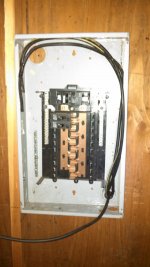
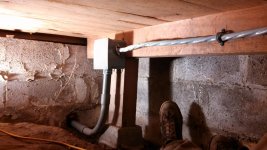
I've run the conduit and I was able to successfully fish the wires through. Here are some photos. I just want to clarify before I hook things up.
1. If I run a continuous ground from the main 200 amp panel to the sub panel, I do NOT have to install ground rods for the garage.
2. If that is wrong and I do have to install ground rods from the garage, is there even any benefit/point to running the ground from the panel to the garage?
3. If there is no benefit/point to running the ground to the garage, do I simply cut off the ends of the bare ground wire from my SER cable and leave it disconnected on both ends?
4. What size wire do I need for the ground rod to panel?
5. Finally, I have not yet fished my ground rod through the conduit. The SER cable has #4 ground, do I have to use #4 or can I use #6?
I'm hoping to have juice tomorrow.
Thanks!
I've run the conduit and I was able to successfully fish the wires through. Here are some photos. I just want to clarify before I hook things up.
1. If I run a continuous ground from the main 200 amp panel to the sub panel, I do NOT have to install ground rods for the garage.
2. If that is wrong and I do have to install ground rods from the garage, is there even any benefit/point to running the ground from the panel to the garage?
3. If there is no benefit/point to running the ground to the garage, do I simply cut off the ends of the bare ground wire from my SER cable and leave it disconnected on both ends?
4. What size wire do I need for the ground rod to panel?
5. Finally, I have not yet fished my ground rod through the conduit. The SER cable has #4 ground, do I have to use #4 or can I use #6?
I'm hoping to have juice tomorrow.
Thanks!
Attachments


Last edited:
pattenp
Well-known member
You need an equipment ground from the main panel to the sub-panel, so use the #4 Al that you have.. You also need ground rods at the garage and use #6 copper to the rods.
Last edited:
OK, thanks Pattenp. Once again, you have very helpful and I appreciate it greatly. What is the minimum spacing on the ground rods?
I have a roto hammer and a drill with hammer function. Do I just get a nut driver that fits over the ground rod and drive it?
Thanks!
I have a roto hammer and a drill with hammer function. Do I just get a nut driver that fits over the ground rod and drive it?
Thanks!
The HD's in Texas probably carry Mobile Home Feeder since Texas is the Mobile Home capital of the US.
Do you know what a Texas twister & a Texas divorce have in common?
Either way someone is fixin' to lose a trailer.

pattenp
Well-known member
OK, thanks Pattenp. Once again, you have very helpful and I appreciate it greatly. What is the minimum spacing on the ground rods?
I have a roto hammer and a drill with hammer function. Do I just get a nut driver that fits over the ground rod and drive it?
Thanks!
The rods can be no closer to each other than 6'. The electrode ground wire needs to be one continuous piece, no splicing. You can use a hammer drill if it will fit and has a setting for just hammering. The small hammer drills aren't going to handle it. Or use a sledge hammer. Be sure to put on the ground acorn nut before you beat the end up.
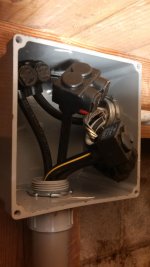
Ok, I think I'm ready to connect. Here are some photos of the splices and junction box.
Also I'm confident I have it right, but want to confirm:
SER all black --> All black conductor
SER black w/ red strip --> All black conductor
SER black w/ white stripe --> All black w/ green stripe
SER bare wire --> All black #6 conductor
Does it matter what side of the subpanel main breaker the two hots go to. For instance, does the black with red strip have to match up with the same bolt on the subpanel? I hope that makes sense.
Also, since I'm running separate ground rods for the garage, do I connect or disconnect the ground and neutral bus?
More photos of the panels to come.
Also I'm confident I have it right, but want to confirm:
SER all black --> All black conductor
SER black w/ red strip --> All black conductor
SER black w/ white stripe --> All black w/ green stripe
SER bare wire --> All black #6 conductor
Does it matter what side of the subpanel main breaker the two hots go to. For instance, does the black with red strip have to match up with the same bolt on the subpanel? I hope that makes sense.
Also, since I'm running separate ground rods for the garage, do I connect or disconnect the ground and neutral bus?
More photos of the panels to come.
Attachments

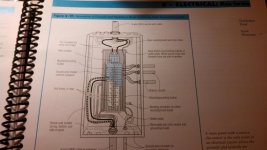
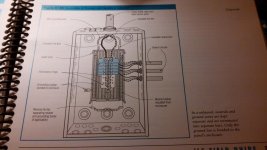
Here are photos of the panels. Reviewing my JLC Field Guide (Volume 2, 2005) it says I connect using the following:
Main panel:
Both the neutral and ground connect to the ground/bus bar that is opposite the bus that is actually grounded. (Photo attached)
Subpanel:
Neutral goes to one bus and ground to the other. Separate the buses. Ground the ground bus to the panel. (photo attached)
I'm generally confident working in the panel, however, please caution me against the absolute DO NOTS. I will turn off all main breakers while working in the panel. Other than that??
Thanks again!
Main panel:
Both the neutral and ground connect to the ground/bus bar that is opposite the bus that is actually grounded. (Photo attached)
Subpanel:
Neutral goes to one bus and ground to the other. Separate the buses. Ground the ground bus to the panel. (photo attached)
I'm generally confident working in the panel, however, please caution me against the absolute DO NOTS. I will turn off all main breakers while working in the panel. Other than that??
Thanks again!
Attachments



pattenp
Well-known member
Looks good. Three minor things. NEC calls for at least 6" of wire in the junction box for splices, looks like you may be a little short (just a fyi, don't worry about it). The open knockouts in the panel need to be closed/filled with knockout caps. The ground on the feed needs to be taped/marked green.
Edit: Forgot to add it doesn't matter which side the hots connect to in the panels. You don't need to match them up. Also did you use aluminum antioxidant on the connections?
Edit: Forgot to add it doesn't matter which side the hots connect to in the panels. You don't need to match them up. Also did you use aluminum antioxidant on the connections?
Last edited:
Thanks! Good to know it's mostly right. I hope the inspector doesn't say anything about the six inches in the box. That would be a huge junction box. Yes I plan to clean up the panel box.
Yes I did use aluminum antioxidant on the connections. The Burndy splices came with some inside and the rest I put on myself. Do I have to do it for the ground wire as well? I don't think I did for the main panel ground connection.
Now to wiring the inside of the garage....
Yes I did use aluminum antioxidant on the connections. The Burndy splices came with some inside and the rest I put on myself. Do I have to do it for the ground wire as well? I don't think I did for the main panel ground connection.
Now to wiring the inside of the garage....
pattenp
Well-known member
You should use the antioxidant on all aluminum wire connections.