To avoid these ads, REGISTER NOW!

Rust removal

David Jackson

Well-known member
Joined
Jul 4, 2014
Messages
471
Location
Magalia, California
This may have been covered, in which case my apologies and I will happily consult whatever thread others know of which covers this topic.

Rust removal; which is kinder to the tool, leaves less residue, leaves whatever traces of paint may be present and so on; Vinegar or electrolysis?

And, if vinegar, what kind is best?
 
To avoid these ads, REGISTER NOW!

Youngguns

Well-known member
Joined
Jul 11, 2014
Messages
643
Location
Mtns of Western Maryland
Electrolysis is kinder to the tool. The process does not affect the base metal at all, whereas vinegar (an acid) will eat its way through the base metal given enough time.
They both seem to leave an equivalent residue for me. I prefer electrolysis' black residue, as it just wipes off, compared to neutralizing any remaining vinegar on the part.
I've never used vinegar on a painted part, but I imagine it won't be to kind to it. Electrolysis well take the paint right off.

I vote electrolysis, but I do use vinegar occasionally for certain rust stages. I use the cheapest, white vinegar I can find.
 

drivesitfar

Well-known member
Joined
Oct 23, 2013
Messages
36,033
Location
Pacific Northwest
David: here's a thread on Electrolysis where most of the questions you have are asked and answered. and if you still have some then post a question or two and you'll probably get an answer fairly quickly.

http://www.garagejournal.com/forum/showthread.php?t=237752&highlight=homemade+electrolysis

some of the guys on here have something in their tanks almost daily so a lot of experience with Electrolysis.

i agree vinegar might be easier, but i'm learning the side effects are not something to ignore.

good luck
 

SASORacing

Well-known member
Joined
Jun 10, 2014
Messages
964
Location
Utah
Id give vinegar a try first, it's less work. Be sure to neutralize it with a baking soda and water rinse after.
 

zcbauer89

Well-known member
Joined
Dec 27, 2011
Messages
598
Location
NW OH
I like white vinegar myself. I put a real roached old wrench in a small tub one time, left it sit for two days and pulled it out, washed off with some lube and it looks perfect. Not a spec of rust left on it.
 

Danglerb

Well-known member
Joined
Sep 6, 2007
Messages
9,736
Location
SoCal
I like Evaporust, others here do as well, but vinegar is cheap, and some prefer electrolysis. Lots of threads using those three keywords.
 

catalytic

Well-known member
Joined
Jul 16, 2011
Messages
636
Location
Boston, Los Angeles, Cleveland
What exactly are you de-rusting? I have used everything from electrolysis to various acids (incl. vinegar), evaporust, mechanical methods (scrapers, wire wheels, etc.). Evaporust is my current favorite, but what you should use really depends on the part...
 

bulletpruf

Well-known member
Joined
Nov 28, 2013
Messages
11,068
Location
San Antonio
Timely thread. I'm not set up for electrolysis here, but can do vinegar with no issues. I'm de-rusting a few c clamps. Have wire wheel, too, but have about 10 clamps to de-rust and can't get to all the nooks and crannies with wire wheel.
 

Joe B.

Well-known member
Joined
Jan 2, 2007
Messages
2,752
I'm also a fan of Evaporust as in my experience it is effective at removing rust while being the most gentle. The stuff is kind of pricey but you can reuse it. You just need to keep it covered so it does not evaporate. They stuff it removed will typically sink to the bottom of a tray over time.
 

BFHtime

Well-known member
Joined
Mar 31, 2012
Messages
983
A better question might be is molasses safer to use for the surface metal?
 

Fretters

Well-known member
Joined
Jan 25, 2014
Messages
4,217
Location
South Yorkshire, England
Rust removal; which is kinder to the tool, leaves less residue, leaves whatever traces of paint may be present and so on; Vinegar or electrolysis?

Simple answer is electrolysis. Paint or plating is something which any process may remove. That's a simple case of cross your fingers and hope, whatever method you use. Regarding effect on the piece however, all acids, no matter how weak, may affect the surface of the piece beyond just removing rust. Even citric, which they say will affect nothing but the rust, (that's bunkum, btw), can leave a less than satisfactory pickled appearance on a piece. That's another cross your fingers and hope affair. Any of the processes leave a residue which needs removing manually, unless you're planning on using industrial type processes.
 

BFBOB

Well-known member
Joined
Sep 20, 2011
Messages
5,073
I've used acid (sulphuric - muriatic) because I'm impatient, Evaporust because of the advertising claims, wire brush/abrasives/blasting when I'm VERY impatient, and electrolysis. Each has its good points and bad points. For what I do mostly now, it's electrolysis. Gets all the rust, pits and all, gets most or all of the paint, doesn't touch the base metal or alter its finish, cheap. What I'm doing now is mostly tools; if I were doing auto body parts, I'd use abrasives/blasting.
All methods mentioned here will work, but differently. Here's my take, based on my experiences:
Acid soak (sulphuric, vinegar, molasses): slow, cheap,minimal equipment/setup, will attack good metal if left in too long. Leaves original finish if not left in too long.
Evaporust & similar: same as above but expensive
Wire brush, other abrasives: medium cost, attacks good metal, leaves deep pits, leaves "paintable" finish.
Blasting: High initial cost, equipment & setup bulky, can be very inconvenient unless you have a lot of space. Digs out pits, leaves paintable finish, attacks good metal if too long on one spot.
Electrolysis: Gets rust, leaves original finish, doesn't attack good metal. Cheap, minimal setup and equipment for small parts. Gets bulky and inconvenient and more expensive initially for large stuff - over about 2-3'.

As in most of life, there are tradeoffs. One consideration is how much rust removal you plan to be doing. If it's an everyday thing, you can afford to devote more space and expense to it. If it's an occasional big object thing, you might be better off hiring it out. Occasional small stuff - wrenches, say, your dip or electro tank can sit in an out of the way corner between uses.

Do your research -- oh, wait, you already are!

edit: as Fretters noted, some handwork is usually necessary no matter what method you use. For tools you're going to leave bare, for instance, electrolysis will often leave a dark residue. This is easily removed with soap and water and a scrub brush, or at worst a hand wire brush, which used lightly doesn't mark the tool steel. For painting, use any surface prep you like.

And with any method, practice on not-so-valuable tools first.
 
Last edited:

BFHtime

Well-known member
Joined
Mar 31, 2012
Messages
983
Great post BFOB, that saved hours of time. That was a great summation, of what I have spent hours on reading.

The next thing I think to ask would be how to set electrolyze up? I have seen several different ways. The most common being old battery chargers which are not easy to find anymore.
 

daveberndt

New member
Joined
Aug 29, 2014
Messages
4
I've been using CLR. I've used in my kitchen and bathroom for years, then I came across another forum that mentioned using CLR for tool rust removal. I've used it several times now and have been pleased. I'll soak the item for several minutes, a little scotchbrite or wire brush(steel or brass) and a water rinse. It will 'stain' the metal if left too long, but seems to clean up with scotchbrite...

Of course, all the precautions mentioned in previous posts apply. I searched these forums for CLR, but didn't get any hits.... Does anybody else have any experience with CLR?
 

drivesitfar

Well-known member
Joined
Oct 23, 2013
Messages
36,033
Location
Pacific Northwest
BFH: there is a great link to a thread about Electrolysis on the #4 post of this thread that i posted. most all the questions are answered there. as far as your battery charger the older ones seem to work better, but the newer ones will work if you put a battery in the circuit. good luck

BFBOB: awesome post :bowdown:

Dave: never heard of CLR. care to share where to buy it and a brand name so i can try it out?

ALL: molasses is a one part molasses to 9 parts water for the dip and not just straight molasses.
 

daveberndt

New member
Joined
Aug 29, 2014
Messages
4
CLR Calcium - Lime - Rust.
Its marketed as a kitchen/bathroom cleaning product. I've used to clean up the shower head and the calcium build around the faucets, etc.

http://www.jelmar.com/CLRbasic.htm

I find it at the grocery store as well as big box hardware stores e.g. Lowes, Home Depot. 1 gallon jug is about $20
 

jakemac

Well-known member
Joined
May 21, 2013
Messages
9,035
Location
New England
Dave: never heard of CLR. care to share where to buy it and a brand name so i can try it out?

Drive - CLR is the brand name. It stands for Calcium, Lime, and Rust. It's marketed for homeowners with hard water issues for cleaning up crusty chrome faucets and rust stains on bathtubs.

It works the same as EvapoRust, but is a little gentler on chrome. It should be available at any hardware store, Box store, The Tractor Supply, and maybe your local grocery store in the cleaning isle. It's available in quart and gallon jugs.


Edit - Oops, Dave beat me to it. :lol:
 
OP
D

David Jackson

Well-known member
Joined
Jul 4, 2014
Messages
471
Location
Magalia, California
A couple of guys have mentioned vinegar attacking metal - is this something which will happen over time even after the part is removed and washed?
I asked about paint; some old wrenches I have are finished in a sort of black paint which I would just as soon leave alone.
I have not tried molasses though I have set up an electrolysis tank; 2 amps or so, 20 hours time, and I have used some vinegar soaking.
 

Fretters

Well-known member
Joined
Jan 25, 2014
Messages
4,217
Location
South Yorkshire, England
Computer power supplies are another option for regulated 12V outputs. It's easy enough to build a power supply if you can drop across a half decent 12V transformer. An enclosure, a full wave bridge rectifier, a smoothing cap and a couple of fuses for protecting input and output and you have a smoothed output, (non regulated, though that's of little concern), DC power supply.


A couple of guys have mentioned vinegar attacking metal - is this something which will happen over time even after the part is removed and washed?

It's fine once you've rinsed the piece thoroughly. Even if there was a tad lurking anywhere, it would have become so diluted via the rinsing that it would be inconsequential.
 
To avoid these ads, REGISTER NOW!

quattroJoe

Well-known member
Joined
Jan 9, 2014
Messages
586
Location
FL
Are you guys submerging the entire tool? Do any of these methods damage standard dipped handles?
 

gilbo

Well-known member
Joined
Feb 1, 2010
Messages
716
Another vote for electrolysis, electrolysis and a quick wire wheel allows you to go from this:

DSC_8047-L.jpg


to this:


DSC_8191-L.jpg


this is the swivel base for my chas parker 973 1/2 vise
 

PCO6

Well-known member
Joined
Dec 25, 2008
Messages
4,573
Location
Newmarket, Ontario
I haven't tried electrolysis or vinegar but they seem to work well. I've been using phosphoric acid for items like the OP asked about for 30 or more years and am happy with it. I also sandblast a lot of items but rarely tools.

View media item 34538
 

catalytic

Well-known member
Joined
Jul 16, 2011
Messages
636
Location
Boston, Los Angeles, Cleveland
A couple of guys have mentioned vinegar attacking metal - is this something which will happen over time even after the part is removed and washed?
I asked about paint; some old wrenches I have are finished in a sort of black paint which I would just as soon leave alone.
I have not tried molasses though I have set up an electrolysis tank; 2 amps or so, 20 hours time, and I have used some vinegar soaking.

First step IMHO is to determine whether they are japanned, black oxidized, or painted.

Electrolysis will loosen paint if you leave it a while (some websites claim otherwise, and they are IMHO wrong. Check how many threads on OWWM.org (rust capital of internet forums) note that electrolysis was used to help with paint removal). Do you have a pic of an item you want to de-rust? Many of us (myself included) have devoted a large section of our lives to de-rusting stuff, and can help more if we know what we're up against.
 

BlackjackNA

Well-known member
Joined
Jul 8, 2012
Messages
166
Location
Newfoundland, CANADA
Hmmm! I was looking for a local supplier of EvapoRust for coating the rusty frame of my trailer.... I just might try CLR instead, (altho' it only comes in qt. sizes from Canadiantire).
 

BJ42LX

Well-known member
Joined
Dec 29, 2010
Messages
2,811
Location
WNY
Hmmm! I was looking for a local supplier of EvapoRust for coating the rusty frame of my trailer....

Blackjack,

Coating isn't a word that's usually associated with EvapoRust.

EvapoRust uses chelation to convert rust. You have to soak the entire part in a bath of the stuff for it to work effectively. If you paint or spray it on there just isn't enough chemical to do the job.
 

tool_scrounge

Well-known member
Joined
Jul 20, 2010
Messages
4,199
Location
Southern California
I like using molasses diluted with water (8:1). It removes rust but not the paint. Usually takes a few days to a week depending on the level of rust. No nasty chemicals or worries about producing hydrogen as with electrolysis (boom). But from what I see of other peoples postings, electrolysis removes paint, so that can be an advantage depending on your situation.
 

BJ42LX

Well-known member
Joined
Dec 29, 2010
Messages
2,811
Location
WNY
Here's what I've tried over the years:

1. Muriatic acid. Works good on heavy rust and scale. Low effort; works quickly. Drop a handful of rusty nuts and bolts in a small container of acid and 20 minutes later they are bare steel. It will attack the base metal if you're not careful. It will also attack everything else it touches including your skin, lungs, eyes, clothes, the driveway, etc. Vapor will rust other stuff in the area. Personal injury is a distinct possibility. Not recommended.

2. Sand/media blasting. Works well on heavy rust and scale. Gets into all corners, hard to reach places and cleans rust craters completely. Requires a decent investment in equipment and PPE. Labor intensive. The bigger the part, the more time and/or equipment required. Not friendly when you're trying to minimize impact on adjacent surfaces such as paint and chrome. Messy. Media and pressure can be adjusted for more delicate surfaces. Equipment can be used to clean and prep other materials as well.

3. Molasses. Inexpensive and low/medium effort but takes days or weeks to have the desired effect. Part size is limited only by the size of the tank you can come up with. It has a distinct odor. If your tank is in your garage you may not be happy with that.

4. Evapo-Rust™ Expensive. Works well on light to medium rust. As with molasses part size is limited to your tub size AND the amount of Evapo-Rust you can afford @ $15 - $25 per gallon. Zero impact on base metal and chrome. Great for hand tools. Fresh Evapo-rust works quickly but the process slows as the chemicals are used up. Turns some metals black.

5. Electrolysis. Same as molasses and Evapo-Rust regarding part and tank size. Requires a small investment in equipment and consumables. Low to medium effort. Quicker than molasses. Comparable to Evapo-Rust for heavier rust. Works well with medium to heavy rust.

6. Wire brush, wire wheel, steel wool. Good for light to medium rust. Produces a burnished/polished appearance which may not be good for paint. Difficult to get into small places. Can't get into the craters and pitting of heavier rust. Usually used in conjunction with the tank processes: Evaporust, molasses, electrolysis.


I tend to use a combination of processes depending on what I'm working on. For instance, I recently scored a bucket of Vise-grips. I used Evapo-rust and a small wire brush to get those looking like new. Last spring when I restored a vise I started with electrolysis to get the heavy rust off then 20 minutes of bead-blasting to get a perfect surface for paint. I could have sand-blasted from the start but it would have taken two or three hours standing at the booth to get the same effect.

I scored a cast-iron pedestal for a grinder at an estate auction. It was too big for me to handle so I took it to a pro and he blasted it in 24 hours for $40.
 
Last edited:

PCO6

Well-known member
Joined
Dec 25, 2008
Messages
4,573
Location
Newmarket, Ontario
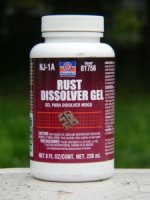
Here's another product that I often use. It's otherwise known as naval jelly. It's great on sheet metal projects that have sat for a bit and have developed surface rust. I keep an old ketchup bottle full of this "pink jelly". Just squirt it on, work it in with steel wool, rinse it off with water and let it dry. It leaves a rust free etched surface.
 

Attachments

  • naval-jelly-225x300.jpg
    naval-jelly-225x300.jpg
    18.8 KB · Views: 19

d.mcfarland

Well-known member
Joined
Jun 18, 2012
Messages
6,573
Location
Western PA
1. Muriatic acid. Works good on heavy rust and scale. Low effort; works quickly. Drop a handful of rusty nuts and bolts in a small container of acid and 20 minutes later they are bare steel. It will attack the base metal if you're not careful. It will also attack everything else it touches including your skin, lungs, eyes, clothes, the driveway, etc. Vapor will rust other stuff in the area. Personal injury is a distinct possibility. Not recommended.

It ate a small metal toolbox that I was trying to restore. In my opinion it's the worst option. It isn't the cheapest, isn't great for the body, tough to work with, and causes more problems if it doesn't completely get removed!
 

tool_scrounge

Well-known member
Joined
Jul 20, 2010
Messages
4,199
Location
Southern California
8:1... Molasses:Water

Molasses (8), Water (1)?

Sounds like my trailer has its answer. Sweet!

8 parts water, 1 part molasses

It smells a bit like molasses to me, but when you are done, dump it down the drain. If you ignore it for a few too many weeks mold forms on the top. I always cover my bucket with a loose fitting cover.

Cheap molasses is available at the animal feed stores for $10-$20 for a 5 gallon pail. They normally feed it to horses I believe. At 8:1 dilution this gives you a lifetime supply.
 

BlackjackNA

Well-known member
Joined
Jul 8, 2012
Messages
166
Location
Newfoundland, CANADA
Excellent - hopping up to the shop tomorrow, (I mean Tuesday). Easy and inexpensive - I like it!

(Will help me with paying all those credit card bills.... "Drill bit Sale"). :shocking:
 

bulletpruf

Well-known member
Joined
Nov 28, 2013
Messages
11,068
Location
San Antonio
6. Wire brush, wire wheel, steel wool. Good for light to medium rust. Produces a burnished/polished appearance which may not be good for paint. Difficult to get into small places. Can't get into the craters and pitting of heavier rust. Usually used in conjunction with the tank processes: Evaporust, molasses, electrolysis.

Kind of what I figured on wire brush not leaving a good surface for painting. Seems too smooth to me. I have a bucket of C-clamps soaking in vinegar now. Will pull them out tomorrow, neutralize, then wire brush them. If I decide to paint 'em, I'll probably sandblast them first. Sandblasting leaves a very nice surface for painting.

Will look for CLR next time I'm at the grocery store. Have some Evapo-Rust on order, but that will take a few weeks to get here.

Thanks

Scott
 

n7tsn

New member
Joined
Oct 29, 2013
Messages
1
I restored a Snap-on taco wagon tool box and the drawer slides were in rough shape. I ordered a gallon of WD40 rust remover for about $25.00 delivered. After removing the slides, I obtained an aluminum turkey pan from the dollar store and poured the rust remover over the slides in the aluminum pan. I actually forgot about them and left them in the solution for 2 days but when I removed them, I was shocked at the result. I washed them with my pressure washer and used air to clean the tracks and they look great and work great.
 

bulletpruf

Well-known member
Joined
Nov 28, 2013
Messages
11,068
Location
San Antonio
Dropped some clamps in straight white vinegar for 24 hours or to. Too long; started to eat away at some of the metal, but nothing serious. When I took a wire wheel to them they came out looking new. Will have to post a few pics.

Used some naval jelly on some others; didn't seem to work terribly well, but I didn't leave it on very long. Only 10 minutes (that's what the instructions recommend).

Picked up some CLR that I need to try out.

Scott
 

BlackjackNA

Well-known member
Joined
Jul 8, 2012
Messages
166
Location
Newfoundland, CANADA
Since I don't own a swimming pool, I had nothing into which I could drop my cargo trailer, with the objective of giving it a molasses bath.

I started brushing the 8:1 solution on the rusty frame... the watery solution ended up on the driveway, for the most part.

Well, my brushing ended with a ratio of 2:1, (water:molasses). Finally, a good portion of the still-watery solution remained on the frame - smells like molasses cookies as one walks up the street now!

Any ya or nays? Should I brush more on? When should it be hosed off? Pressure-washed? I appreciate your comments...
 

Joe B.

Well-known member
Joined
Jan 2, 2007
Messages
2,752
Here's another product that I often use. It's otherwise known as naval jelly. It's great on sheet metal projects that have sat for a bit and have developed surface rust. I keep an old ketchup bottle full of this "pink jelly". Just squirt it on, work it in with steel wool, rinse it off with water and let it dry. It leaves a rust free etched surface.

I used some of this to de-rust some open internal threads on my truck frame. (followed up by a tap.) It worked well because it was the only option that would work in this case. (Could not dip the whole truck frame or get a wire wheel inside the threads.)
 
To avoid these ads, REGISTER NOW!
Top Bottom