To avoid these ads, REGISTER NOW!

Rustoleum Primer/Enamel Failure

To avoid these ads, REGISTER NOW!
OP
S

Skeptic68W

Well-known member
Joined
Jun 18, 2015
Messages
416
Isn't this like "**** happens"? **** happens to me continually, especially on my car projects. Just shrug and try it a different way next time. Only time to obsess is when you just can't get something to run.
When you spent hundreds of tedious hours on a process, doing specifically what you throught would be a good method for removing and preventing rust, only have it rust...and extremely quickly. No, this isn't the sort of thing you just shrug at without understanding why it happened.
 
OP
S

Skeptic68W

Well-known member
Joined
Jun 18, 2015
Messages
416
What did you do the clean the parts after sandblasting? Sandblasting can leave dust on the surface that might keep the paint from adhering. Parts should be cleaned with a wax and grease remover that evaporates slowly so the dirt floats to the surface and is removed with a clean cloth or towel. The process should be repeated until the cloth shown no dirt. Paint adhesion problems are almost always cause by inadequate preparation.
Compressed air and alcohol, which worked fine, there are no adhesion issues.
Just curious, what did Rustoleum say when you asked them about it ?
I contacted them but haven't heard back yet.
 

firebirdparts

Well-known member
Joined
Jun 8, 2016
Messages
10,584
Location
Kingsport, TN
I don't know. I did rustoleum metal primer and then black on my driveway grate over the driveway trench we were discussing in another thread. It's always in the weather and we drive on it, but it looks better than that about like 3 years. I just don't get it.

If I was going to try to beef that up, I would hit that with some phosphoric acid, like "ospho" or something like that. "metal prep" before the rustoleum primer. It may be that rusty metal primer on non-rusty metal is a bad idea, but I don't really know that.
 

gorilla

Well-known member
Joined
Dec 13, 2007
Messages
1,650
If the paint has adhered to the surface how did the surface see enough oxygen to rust? Is the paint porous? In the real world bare metal is converted with phosphoric acid as part of the painting process.
 

niget2002

Well-known member
Joined
Oct 2, 2012
Messages
11,121
Location
Josephine, TX
Do they sell a bare metal primer?

I don't think I've ever seen it
Etching primer is what you use on bare metal. It eats into the metal a little to make a better bond.

When painting bare metal, I've always used etching primer->filler primer->paint->(sometimes clear)
When painting rusty metal, I use rust converter paint->filler primer->paint->(sometimes clear)

Typically always Rustoleum products. I've had good success with both of the above methods.

I'll do a lite sand after the first primer. Then I'll do a heavier sanding and multiple coats of filler depending on how smooth I want the final surface.

For a really strong finish, you could look at using implementation paint from tractor supply. I think it's a 2-part and has a really good hard finish when cured.
 

finn

Well-known member
Joined
Mar 27, 2005
Messages
16,189
Location
The UP, God's country
I’ve seen rust like shown in the picture of that bracket propagate through Rustolium before. It happens when the metal was heavily rusted and scaling. Sandblasting helps, but often can’t get to the bottom of the pits in the metal. Notice how it’s at its worst in the through hole where the bolt goes. That’s an area where the sand can’t be directed perpendicular to the thin section.

I’m pretty sure what looked like shiny metal wasn’t….there were still blotchy areas where the bottom of the microscopic pits were rusty.

People use rust encapsulation products, although I have no experience with them. Epoxy etching primers seem to work a little better. I usually grind the surface after sandblasting, but that’s not always enough, as it’s hard to get into the corners of stamped parts with concave surfaces that have tight pockets. Phosphoric acid etch is a good idea, too.
 
OP
S

Skeptic68W

Well-known member
Joined
Jun 18, 2015
Messages
416
Had a couple exchanges with Rustoleum's tech support and we found the problem, it was a mistake on my part.

When I began this project a few years ago, I think I was mixing it at a 2:1 ratio of primer/paint to acetone based on what I had seen others do online (Rustoleum doesn't provide official thinning instructions on the can or tds for spraying). Sometime more recently, for whatever reason, I got it in my head it was a 1:1 ratio. So parts near the rear of the truck were painted at 2:1, and parts near the front (far fewer thankfully) got 1:1. This explains why parts near the rear appear to be fine, but parts in the front are failing. Turns out even 2:1 is well over the recommended limit of 15% thinner.

So essentially, I took a primer that is 77% solids, and an enamel that is 51% solids, and reduced them to 38% and 25% respectively. I then just shot enough until I had good looking coverage, which usually was 1 coat of primer and 1-2 heavy coats of enamel. That translates to very thin dry mil thickness, and poor protection.

This is a pretty big relief in multiple ways, because I understand why it failed, and can take proper steps to correct it now. It's not catastrophically failing, it just needs the trouble spots to be treated and then all of it to be built up to the recommended thickness.
 

tehach

Well-known member
Joined
Mar 7, 2010
Messages
211
Most likely the substrate was contaminated by chlorides, sulfates, or nitrates, resulting in under-film corrosion. Could try washing with a product such as chlor-rid before before and after blast.
 

thammel

Well-known member
Joined
Oct 3, 2005
Messages
2,237
Location
Maryland
This is an interesting thread. I have always been using the rusty metal primer on blasted parts followed by gloss black (usually) enamel. For me it works well, but my parts don't sit out in the elements. I think I'm going to buy some clean metal primer also. One thing I notice on the rusty part of yours is that the rust seems to be starting at an edge. This is where the paint is thinnest by far. Perhaps you didn't get perfect coverage at the edges?
 
OP
S

Skeptic68W

Well-known member
Joined
Jun 18, 2015
Messages
416
This is an interesting thread. I have always been using the rusty metal primer on blasted parts followed by gloss black (usually) enamel. For me it works well, but my parts don't sit out in the elements. I think I'm going to buy some clean metal primer also. One thing I notice on the rusty part of yours is that the rust seems to be starting at an edge. This is where the paint is thinnest by far. Perhaps you didn't get perfect coverage at the edges?
Right. As pointed out in post 49, the issue ended up being too little mil thickness due to overthinning. The edges would get the worst of that, and the heavily pitted parts would need extra build, which they obviously didn't get, and that's why they're showing fast.
 

2ndTry

Member
Joined
May 16, 2023
Messages
15
Location
New Hampshire
I’ve been reading this thread and there was LOTS of bad advise and erroneous information presented to Skeptic68W. I bet you more than half of you self-appointed “experts” didn’t even know that Rustoleum had a technical data sheet because if you did, you would of advised him to follow it to the letter. The product technical data sheet tells you EVERYTHING you need to know in order to apply that product successfully. Skeptic68W knew the information existed (a good thing!) but the lesson he learned was that he relied on Internet foolishness in lieu of following the manufacturer’s written instructions to the letter. People, don’t rely on the Internet for paint advise. Companies like Rustoleum spent millions getting their paint application instructions correct. Every paint product from every paint manufacturer comes with its on unique instruction sheet and they’re all posted online. Take the time to read it. You just may learn something.
 

PCustoms

Well-known member
Joined
Jul 23, 2011
Messages
22,350
Location
VT
Skeptic68W knew the information existed (a good thing!) but the lesson he learned was that he relied on Internet foolishness in lieu of following the manufacturer’s written instructions to the letter.

Really?

I thought he just screwed up his mix/thinner ratio...
 

WildBill

ALLIANCE MEMBER
Joined
Aug 20, 2021
Messages
1,984
Location
PNW
I’ve been reading this thread and there was LOTS of bad advise and erroneous information presented to Skeptic68W. I bet you more than half of you self-appointed “experts” didn’t even know that Rustoleum had a technical data sheet because if you did, you would of advised him to follow it to the letter. The product technical data sheet tells you EVERYTHING you need to know in order to apply that product successfully. Skeptic68W knew the information existed (a good thing!) but the lesson he learned was that he relied on Internet foolishness in lieu of following the manufacturer’s written instructions to the letter. People, don’t rely on the Internet for paint advise. Companies like Rustoleum spent millions getting their paint application instructions correct. Every paint product from every paint manufacturer comes with its on unique instruction sheet and they’re all posted online. Take the time to read it. You just may learn something.
He said he read it and followed it, we all assumed that was true. This had nothing to do with "internet experts". But thank you for your condescending and unhelpful post after he already figured out the issue, you seem like a real blast.
 

Jazz1

Well-known member
Joined
Jan 3, 2016
Messages
4,184
Location
Thunder Bay On.
Right. As pointed out in post 49, the issue ended up being too little mil thickness due to overthinning. The edges would get the worst of that, and the heavily pitted parts would need extra build, which they obviously didn't get, and that's why they're showing fast.
Im currently on my 4th frame off restoration. I always prime with epoxy primer, yes its time consuming mixing and cleaning spray gun but i have to revisit enough of my other errors.
I have always avoided Rustoleum as ive read numerous threads about how it is not compatible with other paints for top coating. Epoxy primer also seals, Utech ( high end)epoxy is resistant to brake fluid. Kirker is a decent brand, i shot a cab with Kirker epoxy and left it outside for 6 years with no sign of rusting.
 

Attachments

  • IMG_3406.jpeg
    IMG_3406.jpeg
    716.9 KB · Views: 22
OP
S

Skeptic68W

Well-known member
Joined
Jun 18, 2015
Messages
416
He said he read it and followed it, we all assumed that was true. This had nothing to do with "internet experts". But thank you for your condescending and unhelpful post after he already figured out the issue, you seem like a real blast.
He's half right. Rustoleum doesn't give you ratios to spray, presumably because they expect anyone spraying the product will buy spray cans, not shoot it from an HVLP gun. I took my initial ratio from folks on the web who claimed to have success with a 2:1 ratio. It does lay out well if you do that, just doesn't build enough.

Rustoleum informed me that 15% is the max amount of thinner you want to add while spraying, but that was during the conversation we had trying to diagnose this failure.

This is my first "restoration", so the goal was to learn, and I'm doing that. Rustoleum seems like a workable solution because of it's cost, ease of use, etc. But in reality brushing it on, even on suspension parts, doesn't go well. It takes way longer than cleaning a gun, and produces a much less even finish. Additionally, if you don't use a hardener, that stuff takes days and days to dry up, making it unrealistic for use on a lot of parts you're trying to handle and re-install. Using hardner means mixing and throwing out anything you don't use, just like a urethane product.

At the end of the day, rustoleum has a lot of uses, but unless you're really short on cash or just putting lipstick on a pig, automotive isn't a great one. In the future I'm just going to bite the bullet and use a combination of epoxy and urethane chassis topcoat.
 
To avoid these ads, REGISTER NOW!

2ndTry

Member
Joined
May 16, 2023
Messages
15
Location
New Hampshire
Rustoleum-like paints that you buy at the hardware store are typically linseed oil based alkyd enamels that don't cure per se but dry by way of solvent evaporation. The reason some of you experienced a slower dry time with the Rustoleum primer for rusty surfaces was that primer has a higher filler loading than Rustoleum's primer for clean metal surfaces. The higher filler loading just slows the solvent package from evaporating. These alkyd enamels provide a reasonable level of corrosion and weather resistance but also provide a high level of user-friendliness with application. The main goal of this type of paint is to beautify not protect. A coating on the other hand is designed to protect. An epoxy is a type of protective coating that is designed to protect the underlying substrate and to provide a solid base for a subsequent topcoat. An epoxy coating cures by way of a catalytic chemical reaction between two components (part A and part B). Part A is typically the resin portion and the part B is the chemical reactant. Once combined, they react to form a large, long and dense polymer chain which gives the cured coating outstanding adhesion, solvent resistance, hardness and abrasion durability. Epoxies are mostly used as primers because they do not offer good fade resistance. Modern era automotive basecoat/ clearcoat paint systems consist of catalyzed epoxies (primer) and catalyzed polyurethanes (topcoat). The two component urethanes provide a level of color and gloss retention that a Rustoleum-like paint could never achieve. There will however, always be a need for Rustoleum-like paint products because they are quick, easy and inexpensive. And that has tremendous value. One downside of a Rustoleum-like paint is that the darker colors will fade rather quickly in the bright sun. Don't paint your car with a hardware store paint. Water-based acrylic coatings have a much higher resistance to fading in bright sunlight than the oil based alkyd enamels paints. For this reason, you should stop using the old school oil based paints on your house. On your next metal-painting project, consider using the Rustoleum as the primer and an acrylic paint as the topcoat. An epoxy primer will provide a higher level of performance but comes at a much higher cost and with a higher complexity regarding application.

 

PCustoms

Well-known member
Joined
Jul 23, 2011
Messages
22,350
Location
VT
Rustoleum-like paints that you buy at the hardware store are typically linseed oil based alkyd enamels that don't cure per se but dry by way of solvent evaporation. The reason some of you experienced a slower dry time with the Rustoleum primer for rusty surfaces was that primer has a higher filler loading than Rustoleum's primer for clean metal surfaces. The higher filler loading just slows the solvent package from evaporating. These alkyd enamels provide a reasonable level of corrosion and weather resistance but also provide a high level of user-friendliness with application. The main goal of this type of paint is to beautify not protect. A coating on the other hand is designed to protect. An epoxy is a type of protective coating that is designed to protect the underlying substrate and to provide a solid base for a subsequent topcoat. An epoxy coating cures by way of a catalytic chemical reaction between two components (part A and part B). Part A is typically the resin portion and the part B is the chemical reactant. Once combined, they react to form a large, long and dense polymer chain which gives the cured coating outstanding adhesion, solvent resistance, hardness and abrasion durability. Epoxies are mostly used as primers because they do not offer good fade resistance. Modern era automotive basecoat/ clearcoat paint systems consist of catalyzed epoxies (primer) and catalyzed polyurethanes (topcoat). The two component urethanes provide a level of color and gloss retention that a Rustoleum-like paint could never achieve. There will however, always be a need for Rustoleum-like paint products because they are quick, easy and inexpensive. And that has tremendous value. One downside of a Rustoleum-like paint is that the darker colors will fade rather quickly in the bright sun. Don't paint your car with a hardware store paint. Water-based acrylic coatings have a much higher resistance to fading in bright sunlight than the oil based alkyd enamels paints. For this reason, you should stop using the old school oil based paints on your house. On your next metal-painting project, consider using the Rustoleum as the primer and an acrylic paint as the topcoat. An epoxy primer will provide a higher level of performance but comes at a much higher cost and with a higher complexity regarding application.
1745245252626.jpeg
 

nadogail

Well-known member
Joined
Jan 23, 2009
Messages
31,909
Location
Coronado, CA
I first used Rustoleum primer on my ‘48 Chevrolet pickup in the late’50’s and was very pleased with how it seemed to arrest the rust and adhere to the sheet metal of the cab.
I am of the opinion that the formulation has changed and like many other things, including myself, it just isn’t what it used to be.
My memory tells me that original product used a Fish Oil vehicle. Can anyone confirm that?

At the time I was still a teenager and was concerned about the holes that had rusted through the cab and rain and mud was coming into the cab. I used a wire brush to knock off the loose rust and then sprayed the area with Rustoleum. I then carefully cut some patches from inner tube and with contact cement covered the holes. Those patches were still doing their job when the pickup was sold a few years later.
 

VTX1800

Member
Joined
Nov 14, 2010
Messages
24
Location
Near Council Bluffs Iowa
I am at a total loss to figure what your issue is, if I understood you followed about the same steps as I did, I've done two frames/suspension pieces etc by first sandblasting, then rusty metal primer and finally top coat (the next day) with satin black. I hope the formulas haven't changed as I am going to be doing a frame/under body on a truck I am working on now.

Sorry that I am unable to point to anything you may have done wrong.
 

Jim greengo

Well-known member
Joined
Sep 3, 2018
Messages
7,415
Location
Behind my house
Over the last few years I've been embarking on my first automotive restortation project. First time doing body work/paint, so I'm trying to learn everything as I go along.

For the outer body panels I'm using professional 2k stuff from Tamco, but for the chassis parts I decided to use good old rustoleum. It's gonna be a daily driver, not a high end deal.

The process for all of the parts has been as follows:

For smaller parts:
Sandblast totally clean
Prime with Rustoleum Rusty Metal Primer
Topcoat with Rustoleum Stops Rust Gloss Enamel

For large parts:
Descale/clean with wire wheels
Treat with phosphoric acid to convert any remaining rust
Clean very well to remove acid residue
Prime with Rusty Metal Primer
Topcoat with Enamel


I've done a great deal of the truck with this process, the back half of the frame, the rear axle, leaf springs, and much more. However, I noticed the other day that I'm already starting to get rust staining/bleed through in some areas. The truck hasn't been used, just sitting outside. Most of the parts aren't even in direct sun or getting hit by rain. Somehow just the moisture in the air is sufficient to cause this issue.

Being somewhat new to this, I really don't understand what's happening. The primer/paint is stuck on just fine, no flaking or anything like that. The parts are super clean when they get primed. I truly don't get it. I'm hoping someone can explain to me what's going on, in a more informative fashion than "that's what you get for using cheapo box store paint". People online seem to use this combination of primer/paint frequently on outdoor projects like tractors and everything else with success, so I'm a bit baffled.

Here are some photos of the same part, 1 year apart. I sprayed this upper shock mount in may of last year, and it's just been sitting out there under the hood for 11 months and this is the result. It was sandblasted completely clean in the cabinet before priming.

1744935110609.png1744935127693.png1744935142011.png
You didn't get all the rust out of there.
Did you use the rusty metal primer or regular?
 

Jim greengo

Well-known member
Joined
Sep 3, 2018
Messages
7,415
Location
Behind my house
I wonder if heating up the material with a torch after sand blasting it would help pull the moisture out of the material?
Then primer it after it after it cools down.
 

racecougar

Well-known member
Joined
Jan 26, 2021
Messages
4,981
Location
Missouri
I am at a total loss to figure what your issue is, if I understood you followed about the same steps as I did, I've done two frames/suspension pieces etc by first sandblasting, then rusty metal primer and finally top coat (the next day) with satin black. I hope the formulas haven't changed as I am going to be doing a frame/under body on a truck I am working on now.

Sorry that I am unable to point to anything you may have done wrong.
Is it within the realm of possibility that your compressed air had water in it?
You didn't get all the rust out of there.
Did you use the rusty metal primer or regular?
I wonder if heating up the material with a torch after sand blasting it would help pull the moisture out of the material?
Then primer it after it after it cools down.
You guys should probably take a look at post #49.
 

mike93lx

ALLIANCE MEMBER
Joined
Dec 9, 2013
Messages
37,403
Location
Richmond, VA
I've had really good luck with rustoleum pro and some really ****** luck with regular rustoleum. Which did you use here?

Either way, glad you found the cause of this issue
 

andypress

Member
Joined
Jan 26, 2015
Messages
14
You guys should probably take a look at post #49.
I already had prior to asking. Moisture pre-primer, and/or during paint application would have compounded the corrosion issue, they’re not mutually exclusive.
 
Last edited:

Snip's

Well-known member
Joined
Apr 29, 2017
Messages
1,849
Location
Ohio
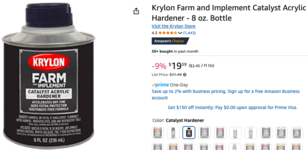
I just picked up some Krylon Acrylic hardener to use with some Rust Oleum along with a new HF purple cheapo spray gun...
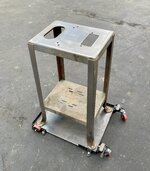
This will be my first attempt at this type of painting... I have a vintage Delta machine stand that I will be refinishing...
IMG_4809.JPG

Screen Shot 2025-05-15 at 2.29.33 PM.png

IMG_4764 2.jpg
 
To avoid these ads, REGISTER NOW!
Top Bottom