To avoid these ads, REGISTER NOW!

RV Converter Question

JuncleJohn

Well-known member
Joined
Dec 27, 2025
Messages
197
Location
Omaha, Nebraska
Getting our camper ready for the summer and the power awning quit working. The fuse checks good but I only get 9.9 volts when checking the output with a volt meter. The other fuses are checking even lower in 8.5 range. The camper is plugged in so I would think that I should be getting 12-13 volts at all the fuses.

At first I thought it was the awning motor, but after checking the voltage I’m suspecting an issue with the converter. The battery is 5 years old but I don’t think that should matter if it’s plugged in to 120v 30 amp AC.

I’ve owned campers for close to 30 years and never had trouble with a converter.

It’s a 2021 Grand Design Imagine TT.

Thoughts?

John
 
To avoid these ads, REGISTER NOW!

Steve from Socal

Well-known member
Joined
Jan 27, 2009
Messages
3,491
Location
Hutchinson Ks.
RV converter/chargers are throw aways. Also, did you check the battery for water? The chargers are supose to 'float charge' but batteries in RV's need to be checked for water at least monthly.
 

duneslider

Well-known member
Joined
Jan 20, 2013
Messages
2,247
Location
Riverton, Utah
It sounds like the converter is bad to me. I haven't checked voltage but on mine the awning and slide move faster when running off the converter vs just the battery so I have to assume the converter is putting out more volts than the battery. If yours is only showing 8.5 to 9.9 then something is wrong.
 

dcg9381

Well-known member
Joined
Jun 20, 2018
Messages
11,660
Location
Austin, TX
At first I thought it was the awning motor, but after checking the voltage I’m suspecting an issue with the converter. The battery is 5 years old but I don’t think that should matter if it’s plugged in to 120v 30 amp AC.
5 years old could be dead. And if the converter is dead and the RV was stored the battery is likely dead. OEM battery disconnects almost always leave the smoke/c02 detectors on and they're really a "disconnect most things". I always carry a 12V charger in my RVs just in case the converter takes a ****.

If you get a new one, make sure it has decent float and I'd pick one that does different battery chemistry. I had one in a Jayco that was just junk, it'd hard charge to 14.7V and hold all day long, batteries would boil out if not watched carefully.
 

mm08822

Well-known member
Joined
Jan 13, 2012
Messages
5,875
Location
NJ
Any schematic you can take a picture of?

Are all dc connections free of corrosion and tight?
 

dcg9381

Well-known member
Joined
Jun 20, 2018
Messages
11,660
Location
Austin, TX
If the OP is plugged in to 120vac source, would battery voltage matter?
Yes, because the converter should be putting out "charge voltage" even if the battery were dead. Battery would likely read 13V or so, give or take if the converter is working. If it's not, something is wrong with the converter or perhaps a fuse in the charge circuit.

OP can always unplug the RV from 120V and measure the battery voltage for sane battery health reading (voltage only).
 

pbon

Well-known member
Joined
May 14, 2017
Messages
3,498
If the OP is plugged in to 120vac source, would battery voltage matter?
It may not on some vehicles and it may on others. Theoretically you would think plugging in bypasses the battery system. Apparently it does not completely do so on some vehicles.

I am not an RVer but my father in law is and I helped drive him to his RV in Florida this winter. The batteries were 5 or 6 years old but we figured it would not matter since we were plugged in, but he tried using the heating system during a cold spell and it would not work. I do not fully understand how the converter and 12V and 120V system works but working batteries were still needed so he had to buy new Duracell 6V golf cart batteries at about $200 each. Fixed the problem.
 

mm08822

Well-known member
Joined
Jan 13, 2012
Messages
5,875
Location
NJ
Yes, because the converter should be putting out "charge voltage" even if the battery were dead. Battery would likely read 13V or so, give or take if the converter is working. If it's not, something is wrong with the converter or perhaps a fuse in the charge circuit.

OP can always unplug the RV from 120V and measure the battery voltage for sane battery health reading (voltage only).

It may not on some vehicles and it may on others. Theoretically you would think plugging in bypasses the battery system. Apparently it does not completely do so on some vehicles.

I am not an RVer but my father in law is and I helped drive him to his RV in Florida this winter. The batteries were 5 or 6 years old but we figured it would not matter since we were plugged in, but he tried using the heating system during a cold spell and it would not work. I do not fully understand how the converter and 12V and 120V system works but working batteries were still needed so he had to buy new Duracell 6V golf cart batteries at about $200 each. Fixed the problem.
I'm not familiar with these either, but I would have assumed the battery charge/float circuit runs separately from the DC output circuit.

IMO, why should I need a battery if I'm plugged into an ac source and that energy is the one getting stepped down/rectified/filtered. Info (beyond the sales specs) was non-existent for me to find on these converters.
 

duneslider

Well-known member
Joined
Jan 20, 2013
Messages
2,247
Location
Riverton, Utah
I have had multiple RV's and never had a problem operating anything with dead batteries/no batteries when plugged into 120v.

If output is not over 12v from the converter than I can't see how the converter would be good. When you check voltage are you checking directly at the converter after the fuses when the wires are connected?

If the converter is bad and has been for a bit I suspect the batteries will also be low since they wouldn't be charging. Probably worth checking the batteries too.

There should be a model number on the converter and with that you can find the manual for it online. There aren't really that many different models of converters and they are all pretty similar.
 
To avoid these ads, REGISTER NOW!

dcg9381

Well-known member
Joined
Jun 20, 2018
Messages
11,660
Location
Austin, TX
I'm not familiar with these either, but I would have assumed the battery charge/float circuit runs separately from the DC output circuit.
The output wires may be separate (due to higher amps) but because the battery is tied to the 12V box one way or another, there is no isolation.
IMO, why should I need a battery if I'm plugged into an ac source and that energy is the one getting stepped down/rectified/filtered. Info (beyond the sales specs) was non-existent for me to find on these converters.
30A is 30A... Some things pull pretty good AC current. Modern RVs might have a 12V fridge, 2 slides, a leveling system... But for simple one off operation, you'd think 30A of 12V is enough.

An awning won't pull much power.. maybe 10A or so.
 
OP
J

JuncleJohn

Well-known member
Joined
Dec 27, 2025
Messages
197
Location
Omaha, Nebraska
Checked voltage again tonight at the converter and was getting a little higher readings 10-11 volts at all of the 15 amp fuses. Unplugged the camper for an hour and the battery still tested at 12.4 volts. Plugged the camper back in and was getting 13 volts at the converter.

Going to replace the 5 year old battery to eliminate that possibility.

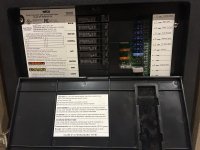
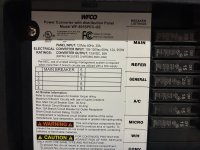
See the pics of the converter/panel combo unit.
 

Attachments

  • IMG_3382.jpeg
    IMG_3382.jpeg
    757.8 KB · Views: 16
  • IMG_3383.jpeg
    IMG_3383.jpeg
    663.8 KB · Views: 16

Codyboy

Well-known member
Joined
Jan 31, 2019
Messages
1,638
Location
S.E. TEXAS
Checked voltage again tonight at the converter and was getting a little higher readings 10-11 volts at all of the 15 amp fuses. Unplugged the camper for an hour and the battery still tested at 12.4 volts. Plugged the camper back in and was getting 13 volts at the converter.

Going to replace the 5 year old battery to eliminate that possibility.

See the pics of the converter/panel combo unit.
Where is the controller? Mine is in the bathroom under the linen closet. Check voltage there.
 

mikedodge

Well-known member
Joined
Jun 27, 2017
Messages
2,764
Checked voltage again tonight at the converter and was getting a little higher readings 10-11 volts at all of the 15 amp fuses. Unplugged the camper for an hour and the battery still tested at 12.4 volts. Plugged the camper back in and was getting 13 volts at the converter.

Going to replace the 5 year old battery to eliminate that possibility.

See the pics of the converter/panel combo unit.

As per the manual for your unit :

"The WF-8900 Series Power Centers will charge the 12-volt House battery if installed. A battery DOES NOT have to be installed for WF-8900 Series Power Center converter operation."

So there's no point in replacing the battery. If that makes a difference there's something wrong with the coverter.

It also says "Electronic Current Limiting In the event that the output current exceeds the maximum rating for the WF-8900 Series Power Center converter, the output current will remain constant but the output voltage will begin to drop. If this occurs, the unit will recover once loads are reduced."

Sounds like maybe that's whats going on? Which might lead to either the awning is taking more amperage then it's supposed to causing the problem or again something wrong with the converter that it can't maintain the load?

Did you try anything after you unplugged it and voltage went back to 13V?
 
Last edited:
OP
J

JuncleJohn

Well-known member
Joined
Dec 27, 2025
Messages
197
Location
Omaha, Nebraska
Everything works except the awning. Checked power to the awning motor today and it’s getting 12.2 volts. New motor is on order.

No idea why I’m getting erratic volt readings. But, the main goal is get the awning working. I’ll get that motor switched out and if it works as intended, along with everything else, this matter will be closed. I’m not wanting to open a can of worms. Evidently, different scenario’s can result in various voltage readings.

I just want everything to work.

Thanks to all of you for your input. If the new motor fails to solve the problem, I’ll be back.😀

John
 

Innovate1

Well-known member
Joined
Jul 28, 2014
Messages
4,284
Location
Illinois near St. Louis, Missouri
The output wires may be separate (due to higher amps) but because the battery is tied to the 12V box one way or another, there is no isolation.

30A is 30A... Some things pull pretty good AC current. Modern RVs might have a 12V fridge, 2 slides, a leveling system... But for simple one off operation, you'd think 30A of 12V is enough.

An awning won't pull much power.. maybe 10A or so.
The 30A mentioned was the 120V utility connection not 12V. Sounds like the battery may be ok.

Not that familiar with RV electrical and the charger/converter. I figured the charger just charged the 12V battery and all the 12V loads just ran off the battery. Apparently the converter controls power to some loads also? I got an RV trailer about a year ago and it sounds like I need to read up a bit on things...I bought our trailer used and when not plugged in to shore power I had no battery voltage but things worked when plugged in. Had to replace the battery. Haven't had any other trouble (yet).
 

dcg9381

Well-known member
Joined
Jun 20, 2018
Messages
11,660
Location
Austin, TX
The 30A mentioned was the 120V utility connection not 12V. Sounds like the battery may be ok.
Correct, that's the standard "30A" 120V RV connector. I'd "guess" that the converter puts out about 30A for battery charge, but depends on mode.
Not that familiar with RV electrical and the charger/converter. I figured the charger just charged the 12V battery and all the 12V loads just ran off the battery. Apparently the converter controls power to some loads also? I got an RV trailer about a year ago and it sounds like I need to read up a bit on things...I bought our trailer used and when not plugged in to shore power I had no battery voltage but things worked when plugged in. Had to replace the battery. Haven't had any other trouble (yet).
Just think about it like a car. The converter is essentially the "alternator", only it would supply load even if the battery was missing/dead.
The because the converter is connected to both the battery and the load center (directly or indirectly) it's all the same circuit.
 

Innovate1

Well-known member
Joined
Jul 28, 2014
Messages
4,284
Location
Illinois near St. Louis, Missouri
Correct, that's the standard "30A" 120V RV connector. I'd "guess" that the converter puts out about 30A for battery charge, but depends on mode.

Just think about it like a car. The converter is essentially the "alternator", only it would supply load even if the battery was missing/dead.
The because the converter is connected to both the battery and the load center (directly or indirectly) it's all the same circuit.
The 30A output at 12 V isn't related to the 30A input circuit - seemed like you were saying they were. Assuming 100% efficiency 30A at 120V would be 300A at 12V. It's obviously not 100% but even at 60% it would be a huge current at 12V. The 30A includes several other loads besides the charger, the main one being the AC. You don't have to guess. The units have ratings for output. Google says 45, 55, and 80A are common. Only a small part of that 30A input goes to the circuit that charges the battery.

My only question is if the output of the charger is simply connected to the battery and 12V loads (which I think is the case for most if not all of them) or if the power from the battery to the loads goes through additional circuitry to control voltage and limit current (which I seriously doubt is the case but some of the responses seemed to suggest that).
 

mm08822

Well-known member
Joined
Jan 13, 2012
Messages
5,875
Location
NJ
The 30A output at 12 V isn't related to the 30A input circuit - seemed like you were saying they were. Assuming 100% efficiency 30A at 120V would be 300A at 12V. It's obviously not 100% but even at 60% it would be a huge current at 12V. The 30A includes several other loads besides the charger, the main one being the AC. You don't have to guess. The units have ratings for output. Google says 45, 55, and 80A are common. Only a small part of that 30A input goes to the circuit that charges the battery.

My only question is if the output of the charger is simply connected to the battery and 12V loads (which I think is the case for most if not all of them) or if the power from the battery to the loads goes through additional circuitry to control voltage and limit current (which I seriously doubt is the case but some of the responses seemed to suggest that).
From the manual.................
"STORAGE MODE
The third mode of charging is what is called the “float” charge. This mode is designed to provide a “trickle charge” to the battery after the system observes no significant variations in current draw over a long period of time. When in Storage Mode, the voltage will reduce from 13.6V to 13.2V and supply the “trickle charge” which helps to preserve the life of the battery while keeping it charged and ready for use. A change in DC current will cause the converter to exit the mode and return to the Absorption mode and then to Bulk mode if required.

LITHIUM TWO-STAGE SMART CHARGING The two-stage “smart” charger continuously measures the battery voltage output and regulates the amount of charge using two modes of operation: Charge and Power mode - TWO-STAGE CONVERTER VOLTAGE OUTPUT MODES:

CHARGE MODE
This mode is designed with two purposes in mind. First, to quickly restore the energy back into the battery. Second, to ensure the lithium cells inside the battery remain balanced. This is accomplished by boosting the output voltage to 14.6 VDC and allowing the maximum current to flow as required by the loads. The charge mode stage could last anywhere from one to four hours based on the battery and load current which is being used. For a full battery, the charge stage has a minimum time requirement of one hour, which allows the lithium cells inside the battery the time required to “balance”. For an empty battery, the charge stage has a maximum time requirement of four hours. If your application requires longer than four hours (such as a larger battery bank > 200 Ahr), a simple cycling of power will reset the timers. As the energy is restored into the battery, the DC system voltage will climb and the current from the converter will decrease. If the total amperage-draw from the converter reaches a preset point (within the one-to-four-hour timer), the converter is designed to drop out of charge mode.

POWER MODE
This mode is designed with 1 purpose in mind. This purpose is to provide a safe operating voltage for all loads in the RV. This is accomplished by reducing (from charge mode) the output voltage to 13.6 VDC and remaining at this voltage until the power is cycled to the converter. The power mode stage is the default or normal mode of operation, which has no timer associated with it. In this mode an output of 13.6 VDC is provided to the DC circuits in the RV. This voltage has a long-term history as the acceptable voltage for all loads in the RV, and should not place undue stress (nor reduce the longevity) of the lights and appliances in the RV. This is not to say that all loads will have an issue with a constant higher voltage; however, some loads may have an issue. Please refer to the individual manufacturer’s specifications for acceptable operating voltage range of the connected load."
 

dcg9381

Well-known member
Joined
Jun 20, 2018
Messages
11,660
Location
Austin, TX
The 30A output at 12 V isn't related to the 30A input circuit - seemed like you were saying they were. Assuming 100% efficiency 30A at 120V would be 300A at 12V. It's obviously not 100% but even at 60% it would be a huge current at 12V. The 30A includes several other loads besides the charger, the main one being the AC. You don't have to guess. The units have ratings for output. Google says 45, 55, and 80A are common. Only a small part of that 30A input goes to the circuit that charges the battery.
You're right. My designation of 30A was confusing (I meant DC side). 45-55-80A are common ratings at 12V for converter output.


My only question is if the output of the charger is simply connected to the battery and 12V loads (which I think is the case for most if not all of them) or if the power from the battery to the loads goes through additional circuitry to control voltage and limit current (which I seriously doubt is the case but some of the responses seemed to suggest that).
The converter does not limit current from the battery and loads in most cases, if it did, that wouldn't work for many RVs that can pull more than 45/55/80A on a 12V circuit when doing things like leveling, slides, Fridge, whatever.

A good part of this is not on how the converter is wired, but how the RV is wired. I'll bet if your converter is dead and you apply a direct 12V 20-30A "charge current" to the battery, things will come back to life.

Here are a couple of diagrams that I've found that might explain it better, but in the end it's how they hack together the RV electrical. In my experience, you can totally remove the converter and you'll still have power to the 12V load panel.


1780338551280.png


1780338802914.png
1780338740617.png
 
Last edited:
To avoid these ads, REGISTER NOW!
Top Bottom