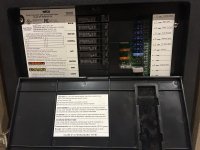
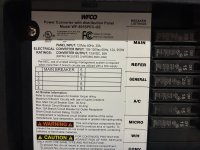
The 30A output at 12 V isn't related to the 30A input circuit - seemed like you were saying they were. Assuming 100% efficiency 30A at 120V would be 300A at 12V. It's obviously not 100% but even at 60% it would be a huge current at 12V. The 30A includes several other loads besides the charger, the main one being the AC. You don't have to guess. The units have ratings for output. Google says 45, 55, and 80A are common. Only a small part of that 30A input goes to the circuit that charges the battery.
My only question is if the output of the charger is simply connected to the battery and 12V loads (which I think is the case for most if not all of them) or if the power from the battery to the loads goes through additional circuitry to control voltage and limit current (which I seriously doubt is the case but some of the responses seemed to suggest that).
From the manual.................
"STORAGE MODE
The third mode of charging is what is called the “float” charge. This mode is designed to provide a “trickle charge” to the battery after the system observes no significant variations in current draw over a long period of time. When in Storage Mode, the voltage will reduce from 13.6V to 13.2V and supply the “trickle charge” which helps to preserve the life of the battery while keeping it charged and ready for use. A change in DC current will cause the converter to exit the mode and return to the Absorption mode and then to Bulk mode if required.
LITHIUM TWO-STAGE SMART CHARGING The two-stage “smart” charger continuously measures the battery voltage output and regulates the amount of charge using two modes of operation: Charge and Power mode - TWO-STAGE CONVERTER VOLTAGE OUTPUT MODES:
CHARGE MODE
This mode is designed with two purposes in mind. First, to quickly restore the energy back into the battery. Second, to ensure the lithium cells inside the battery remain balanced. This is accomplished by boosting the output voltage to 14.6 VDC and allowing the maximum current to flow as required by the loads. The charge mode stage could last anywhere from one to four hours based on the battery and load current which is being used. For a full battery, the charge stage has a minimum time requirement of one hour, which allows the lithium cells inside the battery the time required to “balance”. For an empty battery, the charge stage has a maximum time requirement of four hours. If your application requires longer than four hours (such as a larger battery bank > 200 Ahr), a simple cycling of power will reset the timers. As the energy is restored into the battery, the DC system voltage will climb and the current from the converter will decrease. If the total amperage-draw from the converter reaches a preset point (within the one-to-four-hour timer), the converter is designed to drop out of charge mode.
POWER MODE
This mode is designed with 1 purpose in mind. This purpose is to provide a safe operating voltage for all loads in the RV. This is accomplished by reducing (from charge mode) the output voltage to 13.6 VDC and remaining at this voltage until the power is cycled to the converter. The power mode stage is the default or normal mode of operation, which has no timer associated with it. In this mode an output of 13.6 VDC is provided to the DC circuits in the RV. This voltage has a long-term history as the acceptable voltage for all loads in the RV, and should not place undue stress (nor reduce the longevity) of the lights and appliances in the RV. This is not to say that all loads will have an issue with a constant higher voltage; however, some loads may have an issue. Please refer to the individual manufacturer’s specifications for acceptable operating voltage range of the connected load."