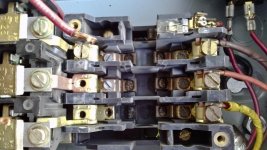
You are correct it is not rated for single phase but it can handle the current. NEMA is conservative already and it can handle 27 continuous Amps on NEMA 1. I couldn't find how much it can handle peak or any rating for that but considering it is conservative already it should have no problem taking my continuous load of 16 Amps and 32 Amps at peak startup current.
I'm not sure where you got those numbers but they are WAY off! Your single phase 7.5 hp motor is going to pull close 30 amps running and the locked rotor amps are going to be over 200! The start up will not lock the rotor but I wouldn't be at all surprised to see OVER 100 amps at start up. Most motors I have seen that are TRUE 7.5 hp single phase have a peak RUNNING amps about 32 or so on the tag, NEC says you have to use 40 amps for one @7.5hp 230v. So either way you look at it the NEMA 1 starter is not big enough to meet the code requirements.
As for the plug if I thought I was going to pull 100 amps I would not use a 50 Amp plug. The only reason I would use a 50 Amp plug is because my peak is only 32 Amps. If something went wrong and I pulled more then 50 Amps my breaker would kick in before my wire melted as it is designed.
Nothing has to go wrong, every time you start the thing your going to pull more than 50 amps! And when you do it's unlikely the breaker will trip and I’m sure the wire will not melt either. The starting amperage is a short duration event, its over in a few seconds at most.
I already have a 30 Amp outlet where I wanted the compressor but I won't use it. The start-up current would exceed the rating of the breaker and trip every time the compressor kicks in. If I change the breaker the #10 wire is not rated for that and it would be unsafe. So I am going to make a new run of #6 wire and 50 Amp breakers.
I think that we have a fundamental misunderstanding as to how things are setup with a motor control circuit.
1st the motor controller ( starter ) is the over current protection device. The overload part of the starter (sized to the tag running amps) protects the wire from over current ( the wire sized at 125% of 40 amps here)
2nd the breaker/fuse is there to clear faults/shorts and can in my opinion be sized excessively large. Depending on the device many times the running load, in this case 40 amps X 800% for an instantaneous trip breaker! Note this is the MAXIMUM amount and it does NOT say you HAVE to use that large of breaker.
I would probably start with a 40 amp breaker for your application, as I like to think that it would also then function as an additional protection of the wire beyond what is required in the code. In your case if you had an occasional nuisance trip it would not be a big deal ( and might even be a good deal if say you tried to start the compressor with the wrong weight oil in cold weather!). Also the replacement cost of the beaker is low, if you have to change it, to a 50 or larger at some point.
William......