To avoid these ads, REGISTER NOW!

scope testing 2ndary

To avoid these ads, REGISTER NOW!

Racr350

Well-known member
Joined
Aug 24, 2010
Messages
216
Location
Rochester, NY
Watch for the digital signal generated by the rotor. I'm not sure what vehicle youre working on, etc. But it should be a certain height (voltage). Too big of a spike and the gap is too small, too small and the gap is too large. It should be healthy medium. Just out of curiosity, what are you using for a scope?

Example of the Digital Signal. (Sorry its not Perfect)

_l-l_l-l_l-l_
 

Stick

Well-known member
Joined
Dec 12, 2007
Messages
2,302
Location
Alaska
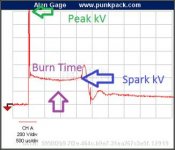
I'm not really a secondary ignition guru, but hopefully I can help. When you look at secondary ignition, the three biggest things are Peak kV (also called firing kV), spark kV, and the burn line/burn time. I couldn't find a good capture of secondary ignition in my library, so I grabbed a random one from iATN and marked it up.

Peak kV is how much voltage it takes to get the ignition to start to fire. Peak kV is directly affected by cylinder compression. It should be about 8-12kV at idle (depending on type of ignition), and up to 15-18kV in a snap test. If peak kV is low, it indicates low cylinder compression.

Spark kV is how much voltage it takes to sustain ignition in the cylinder. Typically spark kV should be 1-2kV, a higher value means that the resistance in the secondary ignition path is high. Causes of this include worn out plug wires, or an excessive gap in the system.

Burn time is how long the spark is sustained during the ignition event. The burn line can tell you what is happening in the cylinder. As an example, the burn line will move upwards at the end of the burn time in a lean cylinder. This is because it takes more voltage to sustain the spark as the cylinder goes lean.

You asked specifically about rotor gap, but there isn't a significant difference between rotor gap and plug gap. An easy way to tell if the problem is rotor gap is that spark kV will be constant across all the cylinders.

Obviously secondary analysis is more complicated than what I've tried to explain, but hopefully this will give you what you are looking for.
 

Attachments

  • secondary.jpg
    secondary.jpg
    17.3 KB · Views: 9
Last edited:

Stick

Well-known member
Joined
Dec 12, 2007
Messages
2,302
Location
Alaska
I can tell ya how Elroy would do it at the drag strip with a timing light.

Another cryptic answer from Elroy. I'm not sure how you would check rotor gap with a timing light, but if you would care to enlighten us...

Unless you are compensating for excessive gap by adjusting the timing. Lots of guys at the drag strip advance the timing until you get spark knock, then back it off a couple of degrees. I don't think that's the best way to set timing, but plenty of guys do it.
 
To avoid these ads, REGISTER NOW!
OP
R

rdaleyj

Well-known member
Joined
Oct 12, 2010
Messages
126
Location
Jacksonville fla
Wow that was a definitely quick answer thnx. Im using a Fluke 199c with a 10,000:1attenuation ignition pickup, and while the firing lines are kinda high, the spark kv stays around 2kv and burntime is 1.6ms to 2ms. The vehical is a 1990 Ford e150 van 5.8 liter.
 
OP
R

rdaleyj

Well-known member
Joined
Oct 12, 2010
Messages
126
Location
Jacksonville fla
What got me started on this ignition adventure was fixing a 0.6 voltage drop from the relay to the inertia switch. Before the fix the fuel pump rotational speed was 17 Ms as seen with a low amp current probe. Also the van ran consistently lean. After repairing the voltage drop fp rotational speed dropped to 14 Ms and spark line leveled out when i get home I'll tap into the 02 sensor to see what it's sensing.
 

Stick

Well-known member
Joined
Dec 12, 2007
Messages
2,302
Location
Alaska
Wow that was a definitely quick answer thnx. Im using a Fluke 199c with a 10,000:1attenuation ignition pickup, and while the firing lines are kinda high, the spark kv stays around 2kv and burntime is 1.6ms to 2ms. The vehical is a 1990 Ford e150 van 5.8 liter.
Sounds like a fairly normal pattern. Burn time should be between 1.5 and 2ms, so you might be a little on the short end of things, but that is because of the high firing kV.

You might still be a bit off on the fuel pump. 60,000ms / 14ms = 4285rpm which is a bit on the slow side. I'd check the amp draw of the pump, and if it's higher than 7.5A or so, you probably have a plugged fuel filter. That could be part of the reason for the high peak kV. If you have a low amp probe, check that pattern as well.
 
OP
R

rdaleyj

Well-known member
Joined
Oct 12, 2010
Messages
126
Location
Jacksonville fla
Sounds like a fairly normal pattern. Burn time should be between 1.5 and 2ms, so you might be a little on the short end of things, but that is because of the high firing kV.

You might still be a bit off on the fuel pump. 60,000ms / 14ms = 4285rpm which is a bit on the slow side. I'd check the amp draw of the pump, and if it's higher than 7.5A or so, you probably have a plugged fuel filter. That could be part of the reason for the high peak kV. If you have a low amp probe, check that pattern as well.
got an amp draw of 5.2 amps.
 
To avoid these ads, REGISTER NOW!
Top Bottom