To avoid these ads, REGISTER NOW!

Selecting the Correct Size Pilot Drill Bit

Wamsutta

Well-known member
Joined
Jan 8, 2014
Messages
10,852
Location
Amarillo, Texas
School me on selecting the correct size pilot bit for a 3/16 hole in mild steel 10 Gauge.

I center punched the location of the hole and went straight to a 3/16 drill bit. Final hole drifted off center.

Apparently, a center punch dimple is not enough.

The drill bit was a brand new black Milwaukee 135 degree split point.
 
To avoid these ads, REGISTER NOW!

Beerhippie

Well-known member
Joined
Oct 13, 2023
Messages
9,606
Location
Far NE Oregon
My usual go-to is a 1/8".

For sheet metal, a step bit works much better than a twist drill. Less tendency to wander off the punch and leaves a much cleaner and rounder hole. Also no tendency to "lift" the metal when it goes through.
 

MJD1

Well-known member
Joined
Dec 28, 2014
Messages
604
I prefer screw machine length ( stubby) bits for situations where a deep hole isnt necessary.
 

mikey03

Well-known member
Joined
May 17, 2024
Messages
2,030
I honestly don’t know when I’m supposed to drill a pilot hole and when I’m not.

material
size of hole
type of fastener

i think those three things are what decides but idk which are supposed to and which not
 

alfadan

Well-known member
Joined
Mar 9, 2007
Messages
2,103
Location
Augusta, ks
For that small of a bit in sheet metal, a pilot is unnecessary. I only use a pilot in stock at least 1/2 inch thick and bits 1/2 and up.
For sheet metal, a step bit is the best option, and safer.
 

alfadan

Well-known member
Joined
Mar 9, 2007
Messages
2,103
Location
Augusta, ks
Also, choosing a too big pilot size is usually worse than no pilot at all. It lets the drill wobble around, making odd shaped oversize holes and even damge the cutting edge.
 

PCustoms

Well-known member
Joined
Jul 23, 2011
Messages
22,186
Location
VT
Yeah, they don't walk like drill bits do sometimes. So quick a pop a self tapper through, pull it back out, then run the drill bit through. Works pretty good in my experience.

I guess. Personally of find them to be one of the more frustrating fasteners.

Not going to work well on thicker steel, So I always grab a punch...
 
To avoid these ads, REGISTER NOW!

Willie Makeit

Well-known member
Joined
Dec 30, 2013
Messages
906
I've always used the rule of thumb of: 1/2 the size of the finished hole ... in your case, finish hole size is 3/16 ... pilot hole size would be 3/32
 

PoorUB

Well-known member
Joined
Mar 29, 2021
Messages
11,615
Location
Fargo, ND
I honestly don’t know when I’m supposed to drill a pilot hole and when I’m not.

material
size of hole
type of fastener

i think those three things are what decides but idk which are supposed to and which not
You forgot type of machine and HP. I worked at a machine shop and we would drill 2" holes in plate steel with a HSS bit and no pilot hole, but then a super rigid machine and 15 HP you can do it!

A pilot hole is necessary with lower HP tools, perhaps a hand drill. I usually would drill a pilot hole roughly the same size as the web of the finished drill bit size.
 

dnschmidt

Well-known member
Joined
Oct 3, 2014
Messages
7,260
Location
Phoenix, AZ
The answer are Turbo bits (ASTRO) or what Norseman call Vortex bits. Both are basically miniature step drill bits. Problem solved. You can get individual Vortex bits from Epstein and the price is right.
 

dr_clyde

Well-known member
Joined
Jan 7, 2009
Messages
6,421
Location
Holland, MI
You forgot type of machine and HP. I worked at a machine shop and we would drill 2" holes in plate steel with a HSS bit and no pilot hole, but then a super rigid machine and 15 HP you can do it!

A pilot hole is necessary with lower HP tools, perhaps a hand drill. I usually would drill a pilot hole roughly the same size as the web of the finished drill bit size.
This right here.
 

AEAdam

Well-known member
Joined
May 27, 2023
Messages
2,703
Location
SE PA
The answer you seek is called "step up". Some materials are ok with your making multiple steps, some will want to work harden. Materials like Titanium need you to take a pretty big bite (big step up). Split point bits are good, better than not, but don't center cut amazingly well.

My answer would be a #40 pilot then I think you could step up to 3/16".

The better answer is it doesn't matter as much if your bits are sharp, and you've got the right cutting fluid, speeds and feeds.

I think 10 ga is like .13? That's sheet metal. Final hole may not be round and may be undersized. If you want a clearance hole, you may be better off with a #10 drill. Or drill 3/16" and ream 3/16"
 

tarbellb

Well-known member
Joined
Apr 17, 2011
Messages
5,725
Location
Oregon
I'm convinced 90% of the people on this forum have never actually fabricated anything or turned a wrench in their life.

The theoretical scenarios in the thread are fantastic

Yup

At least we aren't seeing the copy paste from Ai..... yet
 

Lorydr

Well-known member
Joined
Sep 10, 2015
Messages
637
Location
Piqua, oHIo
I tend to start with a 1/8" or close bit, for a pilot. Then I step up 2 or 3X to almost the final size, then punch through with the final size, then the final size hole seems to be cleaner.

I need to start using my step bits more.

Then a quick de-burring, with a much larger bit, at low speed & feed, for a half a second.

I think the proper step-bit (broad interval) can fairly de-burr most common holes quickly.
 

Nick Rivers

Well-known member
Joined
Mar 19, 2024
Messages
261
Location
USA
Since your drill drifted, use a center punch then use a 142 degree Spot Drill. This will be a larger drill bit angle for your 135 split point and give you a nice dimple. You can use that single spot drill for most of your pilot holes if you have a set of 135 degree drill bits.

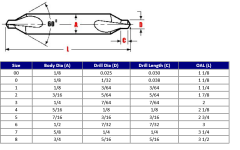
Avoid center drills. Center drills are ground at 60 degrees to drill turning stock for lathe centers.
 

The Cobbler

Super Moderator
Staff member
Joined
Oct 24, 2013
Messages
25,802
Location
Niagara Region, Ontario, Canada
for a hole that small, I would center punch & then center drill or use a 1/16 bit to get a better divot . make sure your 3/16 is sharp ( and properly sharpened) slow rpms until it has seated
 

AEAdam

Well-known member
Joined
May 27, 2023
Messages
2,703
Location
SE PA
where I work we drill millions of holes. Many millions are 3/16”. We typically pilot #40. We’ve done a lot of testing and a lot of studies on drill bit wear, & how to get the most life and on hole quality.

There is absolutely science to the choice/step up. We test all that stuff. But it could very well be that #40 bits are cheap and 3/16” are not as. So the industrial use of pilots and their specific sizes could be more about cost than quality.
 
To avoid these ads, REGISTER NOW!
Top Bottom