To avoid these ads, REGISTER NOW!

Service Upgrade Adventure

Rusty Bolt

Well-known member
Joined
Nov 12, 2017
Messages
87
Location
Carson City, NV
This tale of woe is shared in the hope that it might save someone out there some pain. Those of you planning a service upgrade might find the steps interesting. Those of you into schadenfreude will enjoy it also
:lol_hitti

A few months ago, I posted a question on upgrading my meter main to 400A (really 320A). https://www.garagejournal.com/forum/showthread.php?t=401572 The strong consensus was to replace my pedestal.

So, I decided to replace my pedestal. I know that dealing with the power company, any power company, can be a real PITA until you learn how do deal with them and I'm not going to ever do another panel upgrade, so my plan was to hire an electrician then I'd just write a check, take a nap, and when I woke up, my service would be upgraded.

Yeah, right, maybe in my dreams :shocking:

The electric utility here is NV Energy. They subscribe to Euserc (Electic Utility Service Equipment Requirements Committee) though NV Energy isn't listed as a member on Euserc.org. The cheapskates must not pay their membership dues. It turns out that there are a lot of panels available that don't meet Euserrc requirements.

The electrician that I hired is licensed, insured, and experienced. He has recently done several new panels. Those jobs went smoothly.

The first issue was to find a pedestal. It's easy to spend $3K - $4K on a 400A pedestal. My electrician found a Milbank pedestal; 400A, meter socket, and 2x200A circuit breakers. It sounded perfect. I don't remember the cost but it was somewhere in the $1,500 range. That matched what one of the electricians that I talked to along the way said it would cost.

OK, with a new pedestal in hand, the next step was to schedule an AM-PM for NV Energy to come out in the morning, cut my power, pull out their old wire, then come back in the afternoon to pull new wire and connect to my new pedestal. I called because I have the permit and the electrician doesn't. I was expecting that to take about 6 weeks from the time I called to schedule it. When it was only about 4 weeks out, I thought had gotten lucky. Well maybe, I had gotten lucky, but it wasn't good luck. :lol_hitti

Before the AM-PM, NV Energy comes out two or three times to look the job over, find their pull box in the junipers, verify their conduit size, and etc. One guy even asked to see the new pedestal. He looked at it but only checked to see that it was a 400A pedestal.

OK, the big day rolls around, I've got the electrician scheduled, the AM-PM scheduled, and the new equipment on hand. In the morning, NV Energy calls me and tells me the city needs to inspect the new pedestal before they connect to it. That normally wouldn't be a problem but I scheduled the AM-PM on Nevada Day. That explains why the date was open. It's a city holiday, so the building inspectors are off. I really didn't want to wait another 6 weeks for an AM-PM, so I managed to talk NV Energy into connecting my new service anyway, though as penance they reminded me about every 5 minutes that they weren't supposed to do that.

NV Energy comes over, drops my power, pulls the old wire and leaves a pull cord in the conduit. My electrician comes over, spends most of the day removing my old pedestal, putting the new pedestal in place, and doing the wiring on my side. We call NV Energy to pull the new wire and turn my electricity back on.

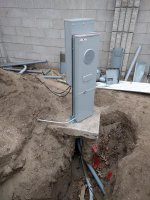
The NV Energy guys come out, take one look at the new pedestal (while reminding me that they're breaking the rules by reconnecting my power) and say "Oh Sh!t! We won't touch that with a 10 foot disconnect stick"! The pedestal didn't meet NV Energy's requirements for a bunch of things; meter too low (40 inches instead of 48 - the old pedestal was 36), no meter locking ring, insufficient isolation between the metered and unmetered wires, and maybe a couple of other things.

After some discussion and calling headquarters, they decide they can do a temporary connection with the understanding that my electrician would get an suitable panel real soon. So, NV Energy runs about 100 feet of wire across the ground(!) from their pull box to my pedestal. Essentially, my house is running on an extension cord. :shocking:

It turns out that my electrician had mixed up the Milbank product number and gotten a non-Euserc approved panel, which he admits.

NV Energy comes out several times, to check on things; once with 3 people. They call me several times, I give them the electrician's phone number and I bug the electrician too..

My electrician spends a month or so researching alternatives. He finally comes up with a plan and finds suitable equipment. His plan is to get an approved meter socket on a new pedestal, mount that next to the pedestal he just put in (back to back) then drill holes in the back of the meter socket and run wires from the sealed NV Energy pull compartment to the pedestal that he already had. He'll use Unistrut to tie both pedestals to the concrete pad my original pedestal mounted to. Once the electricity gets onto my side it's my problem and not an NV Energy issue.

Being chagrined by the previous fiasco, my electrician sends the cut sheet of his chosen meter main, a Milbank U3548-X, to the inspector's supervisor at NV Energy. The supervisor approves the meter main. Some sellers list this as a Euserc approved panel (like Home Depot) but it's not.

OK, my electrician buys the meter main and spends most of a day to install the new meter main, makes a good looking install, connects the power, and calls the city for an inspection. My general contractor happens to be at the building department when the electrician calls. The city asks my contractor what's going on, so he call me. I tell him that the electrician finally has the new pedestal resolved. He's surprised that it's taken so long (~2 months) and convinces a building inspector to come out with him immediately. The building inspector likes the installation and gives me a blue tag.

Alright, we're on the home stretch, right? The electrician calls NV Energy to finish the service upgrade. The NV Energy inspector takes one look at the new pedestal and says he's not approving it.

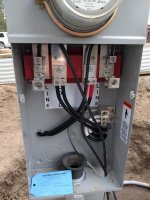
Why not? Now would be a good time to look at the pictures and see if you can spot the problems.

attachment.php


attachment.php


attachment.php


One problem that becomes apparent is that the NV Energy inspector is unable to communicate. He seems like he's speaking clearly but it turns out he's a sloppy speaker and is misleading. Rumor has it that he has a reputation in the building department a being a jerk. I wonder how he got that? :confused:

So what didn't he like?
  • My neutral landing on their side. IIRC, Euserc just says it has to be easy to isolate my neutral from the power company neutral. Dual lugs look pretty easy to me but it's a trivial change
  • Holes drilled in the back of their pull section to allow metered wires to make their way to my side
  • Knockout removed in the bottom to connect temporary power.- Connecting the power is a big no-no. I wonder how many panel replacements NV Energy even learns about?
  • My wire on their side. Q: How does electricity get from your side to mine, if there's no wire? A: You can't have any equipment on the NV Energy side. Q: OK, so how does the electricity get from your side to my side if I can't run a wire? Here's an approved panel passed by other NV Energy inspectors that has wire running from the NV Energy compartment to my side. What's different about my installation. And so on, and so on.
  • Somebody could get into the NV Energy sealed compartment and steal power. Q: But if I break the seal and open the compartment, I can do whatever I want anyway. A: Somebody could steal power. Q: But don't those new smartmeters detect that? A: They're supposed to but we don't want anyone to be able to steal power. And so on, and so on.

After at least two meetings with the inspector, spending hours reading the Euserc Diagram 301(?) I think I have a glimmer of what he was trying to say.

If you look at the panel busing, line and load are both at the bottom. The inspector refers to the bottom part of what I'd call a single sealed compartment as the "pull section" or "pull compartment" and refers to it as the NV Energy compartment. The top, above the meter he regards as a separate compartment. So, what he's demanding is that the unmetered wires enter at the bottom and land on the bottom of the meter socket. The metered wires have to land at the top of the metered socket and exit above the meter socket. IIRC, the Euserc requirement is that there be an "appropriate barrier" between the metered and unmetered wires. Evidently, the meter socket is an "appropriate barrier". Who knew? :confused:

I think the concern the inspector has is that someone could push, say an insulated screwdriver through one of the bottom knockouts in their pull section and effectively place a jumper between the metered and unmetered wires to steal power. That would be stupid and and dangerous but if they electrocuted themselves in the process, NV Energy would probably have a lawsuit on their hands.

If that's what their concerns really are, and I'm not sure that it is, a great deal of hassle could have been avoided if they'd only said so clearly.

NV Energy keeps encouraging me to get rid of the pedestal, dig up their conduit, make a right angle bend to my shop and mount a panel on my shop and then feed the house off of the shop. I don't want to do that because it seems less logical than a central pedestal feeding both buildings.

On his last visit, the inspector gave me a 7 day disconnect notice and said that as long as I could at least show an approved panel on order, they wouldn't disconnect me because they view me as an innocent homeowner.

As you might guess, the local NV Energy folks and my electrician don't think much of each other.

So, what's happening now? My electrician has identified an approved panel and the inspector agrees that it's OK. He's also doing an informal escalation via a high school buddy who is "fairly high up in NV Energy" whatever that means. Plan C, I'll buy a panel and replace it myself. Plan D would be to get a prescription for oxygen - that means they can't disconnect my power.
:beer: I need to tell my tenants about that so they quit transferring the electricity bill to me. :bounce:
 

Attachments

  • IMG_20190105_152807.jpg
    IMG_20190105_152807.jpg
    142.3 KB · Views: 878
  • IMG_20190105_152821.jpg
    IMG_20190105_152821.jpg
    146.8 KB · Views: 881
  • IMG_20190105_153016.jpg
    IMG_20190105_153016.jpg
    99.4 KB · Views: 897
To avoid these ads, REGISTER NOW!

mike93lx

ALLIANCE MEMBER
Joined
Dec 9, 2013
Messages
37,407
Location
Richmond, VA
Wow. I made it through...can't imagine. I think I would be going the route of a main at the shop and feeding from there. I wouldn't have the patience for this ****
 

steve p

Member
Joined
Jan 12, 2011
Messages
7
rusty bolt, sorry for you bad experience. I am a licensed master electrican, not in NV but I feel your electrician may not be familiar with 2017 NEC code change 408.3(A)(2). This lists the requirement for a barrier. I cant post a link , however you can google for your own info. Your electrical inspector is just enforcing the new NEC.
 

mm08822

Well-known member
Joined
Jan 13, 2012
Messages
5,871
Location
NJ
You like the OP's induction heater? :shocking:

Not just one but three! It fails for that alone.

This guy made his job harder than doing it right - one ko vs. six. Any bonding between enclosures?

I also like the sheetmetal self tappers going into the other panel.

OP, Poco is right. Your sparky's fix isn't cutting it.
Tell him to buy the correct meter/main enclosure and install one enclosure as the finished product. I would be pissed looking at that setup for the next umptteen years.

Any pics of the other enclosure opened?
 

alfredeneuman

Well-known member
Joined
Mar 3, 2011
Messages
4,580
Location
Fullerton, CA
Rusty Bolt,
What we're referring to is the chase ******* contain the different phases. All are supposed to go through the same conduit.
It causes inductive heating on the metal between them.
Depending on the load, it can heat the sheet metal up to the point it burns through.
Your electrician may be licensed and insured, but his experience is lacking
 

Bert_

Well-known member
Joined
Dec 24, 2016
Messages
9,701
Location
NW Iowa
As I was reading I kept thinking, it's going to be ugly but I guess functional. Then comes the pictures. Facepalm...


As usually this is the result of a lack of communication. If the EC wasn't familiar with their rules or equipment requirements why didn't he ask?

When I've done work with a utility I'm not familiar with or a service that I am not familiar with communication is absolutely necessary. Get a hold of a their field guy and talk about your plans and the equipment you want to use. Give brands and part numbers, then you can figure out if they are going to hook it up before you get it installed...

If you ask for it the utility will give you tons of information that spells out exactly what they require for a service.
 

Norcal

Well-known member
Joined
Mar 16, 2008
Messages
13,752
If a meter can is ringless, it is very unlikely to comply with EUSERC requirements, with the mess above the only way to fix it is to remove everything and start over.

EUSERC, Electric Utility Service Equipment Requirements Committee. Mostly comprised of west coast utilities.


EUSERC is an acronym for Electric Utility Service Equipment Requirements Committee. Formed in 1983, the purpose of the organization is to promote uniform electric service requirements among the member utilities, publish existing utility service requirements for electric service equipment and provide direction for development of future metering technology. There are approximately 80 utilities involved in EUSERC from 12 states. Not all EUSERC member utilities accept all metering devices that meet EUSERC specifications. So, although a device may meet EUSERC specifications, it may not be accepted for use by a specific utility company. Always check with the utility company for approval before using any metering device.

information above from link at the Schneider Electric website.
 

Terry D

Well-known member
Joined
Mar 25, 2015
Messages
2,202
Location
St. Louis, MO.
As I was reading I kept thinking, it's going to be ugly but I guess functional. Then comes the pictures. Facepalm...


As usually this is the result of a lack of communication. If the EC wasn't familiar with their rules or equipment requirements why didn't he ask?

When I've done work with a utility I'm not familiar with or a service that I am not familiar with communication is absolutely necessary. Get a hold of a their field guy and talk about your plans and the equipment you want to use. Give brands and part numbers, then you can figure out if they are going to hook it up before you get it installed...

If you ask for it the utility will give you tons of information that spells out exactly what they require for a service.

I totally agree, I am a master electrician in St. Louis. Our electrical utility is Ameren. They provide us with a hand book on their requirements. It is up to us, the contractor, to check for updates on their website. The handbook lists all the approved meter enclosures. On top of that, we also meet with a estimator before the work has started to go over everything. They also give us a meter location where to mount the equipment. Sounds like the electrician should have bought the proper equipment from the start. If the right equipment costs thousands of dollars, then that is what it costs. Sounds like he may have under bided the job and tried to cut costs. And any master electrician should know not to run the hots and neutrals through separate *******
 
OP
R

Rusty Bolt

Well-known member
Joined
Nov 12, 2017
Messages
87
Location
Carson City, NV
Thanks for the interesting info.

I'm surprised that you can get inductive heating in that situation. Isn't the induced current parallel to the wire and therefore in the thin direction of the sheet metal of the enclosure so that it can't flow?

The NV Energy info tends to be not very clear and subject to interpretation. NV Energy hasn't updated their approved panels list since 2014 and I think there were only two panels on it. My electrician did ask about the acceptability of the second panel and got bad info from a supervisor who is now retired.

I did come across some Milbank info about the panel my electrician used. I couldn't find it just now but it showed two panels. The bullet points said Euserc approved but in the detailed spec table there was an asterisk on the other panel the said Euserc approved. Very misleading, the bullet points give and the asterisk takes away. It's possible that that might have misled the NV Energy supervisor, assuming that's what my electrician sent to him.

@mm0822 here is a picture of the other panel. And good catch on the self-tapping screws. I'll point that out to my electrician. You can see the panels are bonded via the white wire though the NV Energy inspector wants the white wire removed. I wonder if we removed the white and called it a bonding wire he'd be happy? Don't the through chases count as bonding too?

attachment.php


An approved 400A panel is "only" about $750 at Home Depot. So, it's cheaper than the original panel my electrician got. NV Energy says to mount it on 4x4 pressure treated posts. My experience in this area is that Home Depot quality pressure treated post rot off in about 5 years around here. For fences, I've gone to using the $30 steel posts with a top hat cross-section because of that.

I think this job turned out to be outside the expertise of my electrician. It wasn't obvious that this job was outside his ability at the outset. Now, I think he's educated enough to handle similar jobs. :thumbup: Thankfully, it's mostly on his dime. :thumbup: :thumbup:

Both NV Energy's and my electrician's communication skills weren't up to the task.
 

Attachments

  • IMG_20190106_124259.jpg
    IMG_20190106_124259.jpg
    82.1 KB · Views: 617

Terry D

Well-known member
Joined
Mar 25, 2015
Messages
2,202
Location
St. Louis, MO.
All the phase wires and the neutral need to be in the same conduit. Even if he did 2 separate ******* to connect the two panels, there would have to a conductor from A Phase, B Phase and a neutral in each ****** to cancel each other out, or a heating effect will occur. I know this isn't 3 phase, I just used the word phase
 

Norcal

Well-known member
Joined
Mar 16, 2008
Messages
13,752
Thanks for the interesting info.

I'm surprised that you can get inductive heating in that situation. Isn't the induced current parallel to the wire and therefore in the thin direction of the sheet metal of the enclosure so that it can't flow?

The NV Energy info tends to be not very clear and subject to interpretation. NV Energy hasn't updated their approved panels list since 2014 and I think there were only two panels on it. My electrician did ask about the acceptability of the second panel and got bad info from a supervisor who is now retired.

I did come across some Milbank info about the panel my electrician used. I couldn't find it just now but it showed two panels. The bullet points said Euserc approved but in the detailed spec table there was an asterisk on the other panel the said Euserc approved. Very misleading, the bullet points give and the asterisk takes away. It's possible that that might have misled the NV Energy supervisor, assuming that's what my electrician sent to him.

@mm0822 here is a picture of the other panel. And good catch on the self-tapping screws. I'll point that out to my electrician. You can see the panels are bonded via the white wire though the NV Energy inspector wants the white wire removed. I wonder if we removed the white and called it a bonding wire he'd be happy? Don't the through chases count as bonding too?

attachment.php


An approved 400A panel is "only" about $750 at Home Depot. So, it's cheaper than the original panel my electrician got. NV Energy says to mount it on 4x4 pressure treated posts. My experience in this area is that Home Depot quality pressure treated post rot off in about 5 years around here. For fences, I've gone to using the $30 steel posts with a top hat cross-section because of that.

I think this job turned out to be outside the expertise of my electrician. It wasn't obvious that this job was outside his ability at the outset. Now, I think he's educated enough to handle similar jobs. :thumbup: Thankfully, it's mostly on his dime. :thumbup: :thumbup:

Both NV Energy's and my electrician's communication skills weren't up to the task.

If you lose that Milbank pedestal you get the additional benefit getting rid of those Zinsco clone breakers too. Those breakers are the one reason I don't like Milbank.
 

mm08822

Well-known member
Joined
Jan 13, 2012
Messages
5,871
Location
NJ
Thanks for the interesting info.

I'm surprised that you can get inductive heating in that situation. Isn't the induced current parallel to the wire and therefore in the thin direction of the sheet metal of the enclosure so that it can't flow?

The NV Energy info tends to be not very clear and subject to interpretation. NV Energy hasn't updated their approved panels list since 2014 and I think there were only two panels on it. My electrician did ask about the acceptability of the second panel and got bad info from a supervisor who is now retired.

I did come across some Milbank info about the panel my electrician used. I couldn't find it just now but it showed two panels. The bullet points said Euserc approved but in the detailed spec table there was an asterisk on the other panel the said Euserc approved. Very misleading, the bullet points give and the asterisk takes away. It's possible that that might have misled the NV Energy supervisor, assuming that's what my electrician sent to him.

@mm0822 here is a picture of the other panel. And good catch on the self-tapping screws. I'll point that out to my electrician. You can see the panels are bonded via the white wire though the NV Energy inspector wants the white wire removed. I wonder if we removed the white and called it a bonding wire he'd be happy? Don't the through chases count as bonding too?

attachment.php


An approved 400A panel is "only" about $750 at Home Depot. So, it's cheaper than the original panel my electrician got. NV Energy says to mount it on 4x4 pressure treated posts. My experience in this area is that Home Depot quality pressure treated post rot off in about 5 years around here. For fences, I've gone to using the $30 steel posts with a top hat cross-section because of that.

I think this job turned out to be outside the expertise of my electrician. It wasn't obvious that this job was outside his ability at the outset. Now, I think he's educated enough to handle similar jobs. :thumbup: Thankfully, it's mostly on his dime. :thumbup: :thumbup:

Both NV Energy's and my electrician's communication skills weren't up to the task.

This link provides an explanation with good illustrations regarding induction.
http://www.electrical-engineering-assignment.com/magnetic-field-due-to-current-carrying-conductor
Replace the cardboard in the explanation with your steel enclosure walls. The magnetic flux induced into the enclosure wall is flip-flopping the iron molecules and causing heat to be generated in the process. The greater the current in the conductor and the more severe is the inductive current and the resulting heating. Eventually the heat becomes very destructive – thermal expansion, insulation breakdown, etc.

I was partially wrong on the self-tappers. After zooming in on your pics, I see he screwed them into the unistrut and not through the back of the other enclosure. Still not the way unistrut was designed to be used but better than into an enclosure. I’ve never seen unistrut used in that manner either.

Maybe the second meter enclosure was ok'd by the POCO, but they way it was installed is not.
At a minimum the 6 chase ******* have to be removed and either 2 – 2” ******* used or 1 – 2.5” ****** used to properly route the conductors between enclosures. When any metallic enclosures and metallic conduits are part of the service entrance equipment, it all needs to be bonded together. Your sparky should have used metal close ******* to join the enclosures with back-back locknuts and bonding locknuts within the enclosures or bonding bushings. This is a moot point as your hopefully going to have these 2 enclosures removed and one single meter/main pedestal installed.

I only see 2 ground wires. Does one go to the ground rod and the other to the new garage service? The house has none?

I only see one ground rod. Is there a second rod driven? I would be required to add another if modifying the service today in my area..

Your sparky lost his shirt on this job. I am sure he learned what q's to ask and to seek approvals/review before acting. It's always cheaper to fix when the job is still in the paper stage!
 

mm08822

Well-known member
Joined
Jan 13, 2012
Messages
5,871
Location
NJ
If you lose that Milbank pedestal you get the additional benefit getting rid of those Zinsco clone breakers too. Those breakers are the one reason I don't like Milbank.

Who makes those?
 

wyliesdiesels

Well-known member
Joined
Aug 14, 2012
Messages
19,994
Location
Modesto, CA
Not just one but three! It fails for that alone.

This guy made his job harder than doing it right - one ko vs. six. Any bonding between enclosures?

I also like the sheetmetal self tappers going into the other panel.

OP, Poco is right. Your sparky's fix isn't cutting it.
Tell him to buy the correct meter/main enclosure and install one enclosure as the finished product. I would be pissed looking at that setup for the next umptteen years.

Any pics of the other enclosure opened?

you mean 4? its parallel conductors each in their own hole...

As I was reading I kept thinking, it's going to be ugly but I guess functional. Then comes the pictures. Facepalm...


As usually this is the result of a lack of communication. If the EC wasn't familiar with their rules or equipment requirements why didn't he ask?

When I've done work with a utility I'm not familiar with or a service that I am not familiar with communication is absolutely necessary. Get a hold of a their field guy and talk about your plans and the equipment you want to use. Give brands and part numbers, then you can figure out if they are going to hook it up before you get it installed...

If you ask for it the utility will give you tons of information that spells out exactly what they require for a service.

:+1: exactly

If a meter can is ringless, it is very unlikely to comply with EUSERC requirements, with the mess above the only way to fix it is to remove everything and start over.

EUSERC, Electric Utility Service Equipment Requirements Committee. Mostly comprised of west coast utilities.


EUSERC is an acronym for Electric Utility Service Equipment Requirements Committee. Formed in 1983, the purpose of the organization is to promote uniform electric service requirements among the member utilities, publish existing utility service requirements for electric service equipment and provide direction for development of future metering technology. There are approximately 80 utilities involved in EUSERC from 12 states. Not all EUSERC member utilities accept all metering devices that meet EUSERC specifications. So, although a device may meet EUSERC specifications, it may not be accepted for use by a specific utility company. Always check with the utility company for approval before using any metering device.

information above from link at the Schneider Electric website.

agreed. need to scrap it all and start over
 
To avoid these ads, REGISTER NOW!
OP
R

Rusty Bolt

Well-known member
Joined
Nov 12, 2017
Messages
87
Location
Carson City, NV
I called my electrician this morning at 10:30 and left a message that this situation needed to be resolved by Close of Business tomorrow. I had an internal deadline of 1:00 for a response before I fired him and installed a new panel myself. I was actually at Home Depot looking at 400 amp panels - they didn't have any that are acceptable - when he called 15 minutes before I was going to fire him.

The latest is that NV Energy will accept the panel with some, yet to be specified, revisions. My electrician's friend on the inside argued that since NV Energy had approved the panel, they couldn't just change their minds after it was installed.

The NV Energy inspector is busy with outages today, so presumably tomorrow he'll call my electrician and go over the required changes.

@mm0822. I understand electric induction. 40 years ago I could have calculated the power involved. I was a physics major all those years ago.

My understanding, which might be completely wrong, and if it is, I'd like to be corrected, is that a wire carrying 60 Hz current, running perpendicularly through a thin metal plate shouldn't get noticeable inductive heating.

Imagine a wire carrying alternate current passing through a thin, conductive, metal plate. The electric current creates circular magnetic field around the wire that's changing. Use the right hand rule to figure out the direction of the magnetic field. The changing magnetic field pushes electrons around in the metal plate. Moving electrons are an electric current. Use the right hand rule on the magnetic field to see the direction the electrons get pushed in.

What happens is that the induced current is in the opposite direction to the current in the wire. That is, the induced current tries to cancel the main current. That means the induced current in the metal plate is running front to back then back to front. i.e. electrons pile up on on side then the other side. With such a short distance (what ~ 0.050 inches? there isn't much current flowing to generate heat.

A wire in a conduit or running parallel to a metal panel is a different story. In that case, the induced current runs along the length of the conduit. All the pictures that I could find using Google of electrical equipment with induced current problems were either conduit or a wire running parallel to a metal plate.

Now a wire running in a metal through chase could be a problem because it looks like a short conduit.

Given that, I can see the sense in a rule that says no unbalanced conductors.

Here's a link from an inductive heater manufacturer. There is a table that shows the minimum size of something made from steel to be heated efficiently. For cold steel, i.e. below the Curie Point, at 1 KHz, you need something around 3/8 inch diameter. at 3KHz it can be about 1/5 (0.2) inches. At 60 Hz it would have to be much bigger. https://www.azom.com/article.aspx?
ArticleID=11659


Here's a paper done for inspections on the CANDU reactor. The paper does a finite element analysis of inductive heating in an aluminum plate with flaws and validates it experimentally. If you look at the first picture in section 4, you'll see that their experimental setup has the axis of the heating coil perpendicular to the plate. IOW, the wire runs parallel to the plate.
https://www.researchgate.net/publication/326689590_Three-Dimensional_Numerical_Modelling_of_Induction_Thermography_on_Metallic_Panels
 

alfredeneuman

Well-known member
Joined
Mar 3, 2011
Messages
4,580
Location
Fullerton, CA
The panel isn't aluminum, it's steel, so the CANDU reactor paper is irrelevant.

The Code doesn't agree with you.

300.6 Conductors of the Same Circuit. (I) All conductors of the same circuit and, where used, the grounded conductor and all equipment grounding conductors shall be installed in the same raceway or cable or shall be installed in close proximity in the same trench

300.20 Induced Currents in Ferrous Metal Enclosures or Ferrous Metal Raceways.
(A) Conductors Grouped Together. Where conductors carrying alternating current are installed in ferrous metal enclosures or ferrous metal raceways, they shall be arranged so as to avoid heating the surrounding ferrous metal by induction. To accomplish this, all phase conductors and, where used, the grounded conductor and all equipment grounding conductors shall be grouped together.

images
 
Last edited:
OP
R

Rusty Bolt

Well-known member
Joined
Nov 12, 2017
Messages
87
Location
Carson City, NV
It's resolved!

I'm waiting for NV Energy to pull new wire and officially take my house off of their "extension cord" instead of looking for an MD to give me a prescription for oxygen to prevent them from turning off my electricity. :thumbup:

The Carson City Area Manager came out with the inspector and looked at the panel install again. The inspector said it just couldn't pass as is.

My electrician kept escalating his issue at NV Energy. He ended up sending the whole email thread that he had with the previous area manager to the new area manager. The new area manager decided to see what it would take to make the install acceptable.

The Carson City Area Manager called in the Yerington Area Manager, who has a lot of experience in designing installations. We pulled the covers off both sides and they guy from Yerington asked me if I was getting 400 amp service or 320 amp service. I told him 320, he took one look and said it was fine and they OKed the installation on the spot with one change: The panels had 2 ground rods, each fed by #4 copper. NV Energy wanted it upgraded to #2 copper. My electrician did that and called the upgrade in. Now I'm waiting for NV Energy to come out and pull the new wire and connect my panel.

The area managers spent a long time talking to the inspector when they went out to their trucks. I wonder what the talked about? :headscrat

It turns out that part of the problem was an inexperienced inspector with a little too much ego and not quite enough methodicalness. He thought that I was getting real 400 amp service, instead of "residential 400 amp service", i.e. 320 amp service which he should have known by looking at the conduit - they won't go over 320 amp service in a 3 inch conduit. Though it is an easy mistake to make, since everyone seems to call 320 amp service 400 amp service. Evidently, there are different rules for real 400 amp service.

The most shocking thing is that my electrician says he got a call from the Carson City Area Manager to apologize for the way this situation went down and that they've put some new procedures in place to hopefully avoid messes like this in the future.

My electrician is losing money on this job. So I told him that a good education is always expensive. :lol_hitti

The fact that none of the inspectors had noticed the #4 copper where #2 is required is a testament to the rule of thumb that 100% inspection is 80% effective.
 
OP
R

Rusty Bolt

Well-known member
Joined
Nov 12, 2017
Messages
87
Location
Carson City, NV
So theyre gonna pass it with the wires going through different holes?

That's what they said ... but I'm still waiting for the actual upgrade to take place. It's supposed to be scheduled by the inspector who got overruled. I wonder if that has anything to do with it or maybe they have a backlog due to winter storms.
 
OP
R

Rusty Bolt

Well-known member
Joined
Nov 12, 2017
Messages
87
Location
Carson City, NV
Resolved? Did I say resolved? Silly me! :lol_hitti

It's been a week since my new panel was approved for hookup. My electrician has called it in several times to the reconnect hotline and nothing has happened.

So, I encouraged my electrician to call the area manager at NV Energy to see if there was something else we need to do.

It turns out that Scott the NV Energy inspector, who has been the problem all along, has been out again and failed the panel. Then didn't tell anyone effectively preventing the service connection. I do not know why he failed the panel.

The area manager got the head inspector for the area to look at the panel (actually, I think he looked at pictures of the panel) and said it was OK, as long was we put some protection around the NV Energy conduit where it comes out of the ground to where it enters the panel. My electrician did the fix and sent before and after pictures to the area manager.

At this point, I'm amazed that Scott still has a job and I'm still waiting for a real hookup.
 

mm08822

Well-known member
Joined
Jan 13, 2012
Messages
5,871
Location
NJ
Sorry, but I agree with Scotty!!!

You have 2 code violations there. Maybe 3 - are there 1 or two ground rods?
 
OP
R

Rusty Bolt

Well-known member
Joined
Nov 12, 2017
Messages
87
Location
Carson City, NV
Sorry, but I agree with Scotty!!!

You have 2 code violations there. Maybe 3 - are there 1 or two ground rods?

So, do I understand correctly that you think it's appropriate for a junior inspector to (a) quietly ignore his bosses including the local head inspector (b) not say what his problems are and (c) do the passive-aggressive thing to piss off a customer? He could have raised any issues he had when we all met. Instead he quietly deep-sixed the connection. If anyone working for me did half of that I'd fire him in a heart beat and ****** him off of company property but maybe you work differently.

No one at NV Energy (2 inspectors and 2 big bosses, so far) nor the city building department has mentioned the things you think are code violations. I don't see it in the code sections you quoted either but then the NEC often only makes sense if you already know what it means and often what it means is up the the AHJ anyway which is NV Energy in this case - their side of the meter, their rules.

There are 2 ground rods - one from the old pedestal and a new one.
 

mm08822

Well-known member
Joined
Jan 13, 2012
Messages
5,871
Location
NJ
Im only looking at the pics of the job. What and how the inspector communicated to others is another soap opera for another channel.

NEC article 250.92 and 300.20 A/B are not met.
 

mm08822

Well-known member
Joined
Jan 13, 2012
Messages
5,871
Location
NJ
Are you saying the hole ITSELF - joining two enclosures- is actually a 'raceway'?

Nothing to do with a hole. It’s the chase ******* (all 6 of them).

I consider the two enclosures separate as there is no direct mechanical or electrical connection between them other than the 6(!) chase *******. The chase ******* are acting as the raceway(s) between the two enclosures.

Any raceway upstream of the ocp must be bonded to the enclosures to provide lowest impedance possible to trip utility ocp upstream. Since the “phase conductors’ are passing thru un-bushed chase *******, there is a chance that one of the service conductor’s insulation could be compromised at the threaded end of the chase ****** and energe it.

Conductors over #4 must pass thru bushed fittings entering a cabinet to minimize insulation damage at these points - NEC 300.4G. (OK, now here’s the 3rd unmet requirement.)

Since no paint was removed from either side of the punched ko’s, there is a good chance that a high impedance to neutral connection exists and the chase ****** just stays energized brewing away.

Think about it – chase ****** passed thru enclosure 1, no paint removed from interior contact region, no locknut on exterior side of enclosure 1 or paint removed, no locknut on enclosure 2 exterior or paint removed, no paint removed from interior contact region in enclosure 2, locknut driven home. How good is that connection today, 5,10, 25 years from now??

This provides the perfect need for a bonding locknut on each chase ******. 250.92(B)(4).

I don't see any point in arguing whether a chase ****** is a raceway or fitting. The above issues don't go away.
 

wyliesdiesels

Well-known member
Joined
Aug 14, 2012
Messages
19,994
Location
Modesto, CA
So, do I understand correctly that you think it's appropriate for a junior inspector to (a) quietly ignore his bosses including the local head inspector (b) not say what his problems are and (c) do the passive-aggressive thing to piss off a customer? He could have raised any issues he had when we all met. Instead he quietly deep-sixed the connection. If anyone working for me did half of that I'd fire him in a heart beat and ****** him off of company property but maybe you work differently.

No one at NV Energy (2 inspectors and 2 big bosses, so far) nor the city building department has mentioned the things you think are code violations. I don't see it in the code sections you quoted either but then the NEC often only makes sense if you already know what it means and often what it means is up the the AHJ anyway which is NV Energy in this case - their side of the meter, their rules.

There are 2 ground rods - one from the old pedestal and a new one.

I agree with scotty and mm here.

The other inspectors obviously need some continued education.

The NEC is pretty clear in this area and mm laid it out well.

Those 6 holes that were drilled are a major issue.

If it were my project Id demand everything be ripped out and redone. What a cluster f*ck.

And FYI, PoCos arent bound by NEC rules. They have their own set of rules. But you are. And that install has numerous violations.
 
To avoid these ads, REGISTER NOW!
Top Bottom