To avoid these ads, REGISTER NOW!

Sewing machine recommendation?

Shopmaster

Active member
Joined
Mar 21, 2013
Messages
28
I want a sewing machine to make my own sand / gravel bags. Having not touched a sewing machine since the ripe old age of about 6 or 7 (while mom wasn't looking) I have no idea what's necessary to sew say, 8 oz non woven polypropylene. Anyone have a suggestion?
 
To avoid these ads, REGISTER NOW!

cgrutt

Well-known member
Joined
Mar 4, 2016
Messages
8,169
Whats your budget and how many are you looking to do? I would think any industrial straight stitch walking foot machine would be great for that application. Such as a Sailrite but there are less expensive offbrand options that are pretty much the same machine. I'm still waiting for a Juki 1541 to do my boat's interior but that is a fairly expensive option and I don't think needed for your application unless you're doing a ton of these.
 

Beerhippie

Well-known member
Joined
Oct 13, 2023
Messages
9,642
Location
Far NE Oregon
If you use double-face tape in the seams before stitching, you can get away with a regular, heavy-duty sewing machine. Walking-foot adds considerably to the cost. We used to stitch sails using an old Dressmaker machine with the D-F tape trick.

You'll probably want to invest in some ball-point needles.
 

SwissMetric

Well-known member
Joined
Dec 28, 2024
Messages
186
Location
Switzerland
Maybe getting a used industrial Singer. The Swiss army sold some a couple of years ago via RUAG. Unfortunately I can't sew but the machines seemed heavy and robust, the special table was included.
Well, more exactly, as child I tried once to sew somehing thicker using my mom's machine but IIRC it just break a few needles and that ended my short-lived tailor (is not rich) career. :)
 

Shadowdog500

Well-known member
Joined
Dec 7, 2009
Messages
9,829
Location
Down the shore
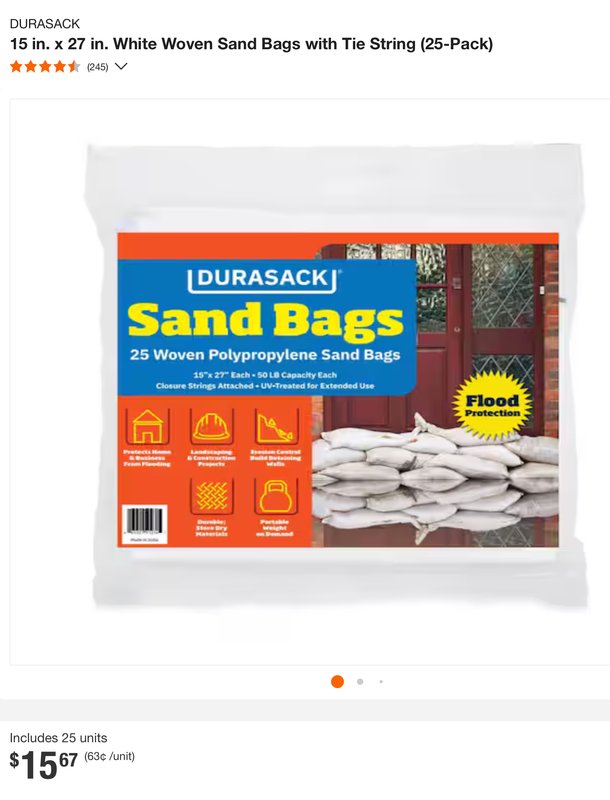
It looks like those bags are fifteen buck for 25 bags at Home Depot. Is it worth your time to make them?

8oz is on the low end of heavy fabric. You may want to get a heavy duty sewing machine. My wife used to have an old Singer Dressmaker sewing machine from the 70s. I used to sew seat cushions and canvas for my boat on that machine. If you have access to an older sewing machine like that, give it a try.

IMG-3435.jpg
 
Last edited:
OP
S

Shopmaster

Active member
Joined
Mar 21, 2013
Messages
28
It looks like those bags are fifteen buck for 25 bags at Home Depot. Is it worth your time to make them?
Those are woven. They don't let water permiate through and they deteriorate quickly from UV exposure. A good quality nonvoven bag is about $4 each. I'm not using these for a typical water stopping structure. I want water to be able to slowly soak through. Plus, I have access to cheap / free material to make them from.
 

dwasifar

Well-known member
Joined
May 28, 2017
Messages
2,083
Antique black iron Singer is your best bet, frankly. Model 201 was a great machine, marketed to consumers but robust enough to sew leather in commercial use. Tough as nails and designed to last generations. Will run rings around modern machines for your use case.

Just keep an eye on estate sales, thrift stores, or Goodwill around your area. They're always popping up for a pittance as their elderly former owners die and the heirs don't sew. Look for one from the late 1940s through late 1950s. You might have to clean/oil the works, maybe replace a belt (still widely available) or a power cord, but that's usually all they need.
 

dwasifar

Well-known member
Joined
May 28, 2017
Messages
2,083
Good hunting!

A tip: the motors require periodic greasing. The official Singer grease is no longer available, but Vaseline works just fine. Use a plastic drinking straw to squeeze it into the grease cups.
 
OP
S

Shopmaster

Active member
Joined
Mar 21, 2013
Messages
28
Mechanically all the 201s are pretty similar. My wife has a collection of old machines, but for production use in her teddy bear business she uses a 1957 201-2.
Ok, thanks for your help. If / when I find one I may have some more questions. Hate to admit it here on an open forum, but I'm sort of excited about a sewing machine 🤣. How this usually works for me is I get a goofy idea, someone encourages me, the next day I get {whatever}.
 

dwasifar

Well-known member
Joined
May 28, 2017
Messages
2,083
Once you get one and see the engineering quality, you'll feel better about it. I can't think of any consumer product today built to such high standards, except maybe firearms and high-end watches.
 

GeoBruin

Well-known member
Joined
May 5, 2018
Messages
3,733
Lots of industrial machines for sale on the second hand market. Singer, Pfaff, Juki, etc. Find one you can see working before you buy. If you don't know what you're looking for, you might get it home and find out the timing is off or similar.

The only real problem is space. These machines are going to be belt driven by a big clutch motor mounted to the table. They're heavy and they take up a ton of room.

Sailrite LS/LSZ is a cool option if you're not willing to dedicate all that space. They have a little servo motor mounted to them and they pack up nicely into a little case that can be put away. Just check how much room you're going to need under the presser foot as they won't give you quite as much work envelope as a true industrial machine. Also they're limited to a #22 needle and about Tex 92 thread.
 

jar944

Well-known member
Joined
Jul 26, 2010
Messages
5,897
Location
Northern VA
Whats your budget and how many are you looking to do? I would think any industrial straight stitch walking foot machine would be great for that application. Such as a Sailrite but there are less expensive offbrand options that are pretty much the same machine. I'm still waiting for a Juki 1541 to do my boat's interior but that is a fairly expensive option and I don't think needed for your application unless you're doing a ton of these.

A Used singer, consew, juki, Pfaff walking foot can be cheap, really cheap.


Juki 563-3 was $145 (needed a bit of work)
Singer 111g156 I paid $50 + shipping (head only)
Consew 226r was $100
20140706_123307.jpg20140720_225206.jpg20140820_205441.jpg
 

cgrutt

Well-known member
Joined
Mar 4, 2016
Messages
8,169
A Used singer, consew, juki, Pfaff walking foot can be cheap, really cheap.


Juki 563-3 was $145 (needed a bit of work)
Singer 111g156 I paid $50 + shipping (head only)
Consew 226r was $100
20140706_123307.jpg20140720_225206.jpg20140820_205441.jpg
Thanks! I wasn't aware of Juki 563 looks exactly what I'm after. Pretty good video on 563 specific but really most industrial walking foot in general here.


ETA is 563-3 no reverse? May be good option for OP but I'd want reverse (model 563) personally.
 

jar944

Well-known member
Joined
Jul 26, 2010
Messages
5,897
Location
Northern VA
Thanks! I wasn't aware of Juki 563 looks exactly what I'm after. Pretty good video on 563 specific but really most industrial walking foot in general here.


ETA is 563-3 no reverse? May be good option for OP but I'd want reverse (model 563) personally.

Yes, there are 2 versions of the 563, one with reverse and one without. Both are large bobbin unlike the 562.
 
To avoid these ads, REGISTER NOW!

Firebrick43

Well-known member
Joined
May 12, 2015
Messages
13,980
Location
West central Indiana
The singer 401/402/403 are excellent HD machines as well. The 501/502/503 are basically the same machine but worth more due to their rock space age styling. Quality dropped significantly after the 501 series.

My 401 has no issues with 4 layers of heavy denim or corner reinforcements on Dacron sails which is a very tight/tough material to sew
 

cgrutt

Well-known member
Joined
Mar 4, 2016
Messages
8,169
Yes, there are 2 versions of the 563, one with reverse and one without. Both are large bobbin unlike the 562.
Where did you find one for $145? There are several current listing's all $950 - $1200 (which is pretty much what I would have expected). The 1541 has come down a bit but is now available new for about $1,800 I think I'd still go with that over taking a gamble on used machine for about $1000. I'd definitely consider it at the price you paid though. Great deal.
 

jar944

Well-known member
Joined
Jul 26, 2010
Messages
5,897
Location
Northern VA
Where did you find one for $145? There are several current listing's all $950 - $1200 (which is pretty much what I would have expected). The 1541 has come down a bit but is now available new for about $1,800 I think I'd still go with that over taking a gamble on used machine for about $1000. I'd definitely consider it at the price you paid though. Great deal.

Craigslist.

Imho the consew for $100 was the better deal.
 

Skiff Builder

Well-known member
Joined
Jun 7, 2016
Messages
1,776
Location
Southern NJ Coast
I got this Rex Sew Strong for my marine canvas fabricating. It is the same as a Sailrite model with less bells and whistles. You can hop it up if so inclined.
Paid less than $400 new, shipped in 2 days.

Works like a champ, heavy duty. Goes through 10 layers 12oz duck with a #20 needle.

IMG_3267.jpeg
 

Attachments

  • IMG_3275.jpeg
    IMG_3275.jpeg
    854.8 KB · Views: 25
  • IMG_2641.jpeg
    IMG_2641.jpeg
    998 KB · Views: 16
  • IMG_2642.jpeg
    IMG_2642.jpeg
    591.8 KB · Views: 16
  • IMG_2652.jpeg
    IMG_2652.jpeg
    671.6 KB · Views: 16
  • IMG_2655.jpeg
    IMG_2655.jpeg
    729.5 KB · Views: 43

DG930

Well-known member
Joined
Nov 19, 2020
Messages
99
Location
Maine
I did a ton of research a couple of years ago and bought a new Juki 1541 after shopping around.

I had never sewn anything more than a button but was determined to learn after getting stupid quotes for boat cushions and a new zipper for my dry suit. I also want to use it to do some car seat covers.

One thing that hasn't been mentioned in detail yet is the motor. Newer machines have the option of a digital servo motor that allows you to precisely control the sewing speed with the foot pedal. Something that has allowed me to climb the learning curve a lot faster. The old analog motor machines are on or off which make it a lot harder to control and learn with.

If all you want to do is make bags it's probably not that big a deal but if you want to try doing other things the ability to control the stitching speed was invaluable.

You can probably retrofit an older machine but that adds cost and complexity.

I made this as my third project. No way I could have done it with my skills on an analog machine.
 

Attachments

  • IMG_3136.JPG
    IMG_3136.JPG
    807.1 KB · Views: 57
Last edited:

dscheidt

Well-known member
Joined
Apr 26, 2017
Messages
2,880
I did a ton of research a couple of years ago and bought a new Juki 541 after shopping around.

I had never sewn anything more than a button but was determined to learn after getting stupid quotes for boat cushions and a new zipper for my dry suit. I also want to use it to do some car seat covers.

One thing that hasn't been mentioned in detail yet is the motor. Newer machines have the option of a digital servo motor that allows you to precisely control the sewing speed with the foot pedal. Something that has allowed me to climb the learning curve a lot faster. The old analog motor machines are on or off which make it a lot harder to control and learn with.

In the dim mists of history, factory sewing machines were driven by a line shaft, and power to the machine was taken by belt connected to the machine's pulley that traveled through a cork conical clutch, controlled by the foot treadle. As electric motors came in, the first step was to gang machines together in sets of 6 or 8, and use a single motor to power all of them, with an under table lineshaft. That was followed by the individual motor per machine, an induction motor, running at constant speed, and using the same sort of clutch. These clutches require careful use and maintenance, and in good nick, are surprisingly easy to control, over the whole range of speed available. The problem is they're never in good nick, because no one does anything to them, and they become sticky on/off switches. They're frustrating to use, and very hard to actually control speed, and to make the needle stop where you want it.

Servo motors are much better in this respect. But there are some things to consider. The basic servo setup just replaces the undertable induction motor and its clutch, with a servo. They have a speed control dial (or buttons, whatever) to set max speed and a speed display. This is pretty much a plug and play conversion, you probably need a different belt, sometimes the treadle operating rods have to be changed or modified, and the table electrics may require some fiddling, but it's an afternoon job for anyone reasonably mechanical, even if they've never seen a sewing machine before. Slightly fancier kit has a sensor mounted on the handwheel, so they can do basic needle positioning (always stop with the needle up or down, do a commanded half stitch. Basic stuff, but useful). These motors suffer from a couple problems. One thing common to all of them is low low-speed torque, which can be a disaster for some machines and operations. A whole bunch of them also have totally worthless speed control, because they're all clones of the same controller, and they didn't understand how it worked (it's got an optical sensor that uses a plastic piece that has graduated opacity in IR to tell how far you pressed the treadle. The clone makers didn't get that.). I think that has been sorted out, and they're generally okay. If you have, or get, an older industrial machine, this is a worthwhile modification.

Sewing macines that are factory designed for a servo have better motors, and the last ~10 years or so, have direct drive motors, not belt driven. These are typically 3-phase motors driven by a VFD, which gives superior speed control. A big bonus for the manufacturer is it makes a single machine that works on wall voltage anywhere. ( My Juki can run on 100 to 250V AC, 0 to 60 hz, 1 or three phase, with the only change being wiring in a new plug.) factory designed servo machines typically have a bunch of very useful automations (electric foot lift, automatic thread cutter, and single touch reverse with a button near the needle being the basics. From there you can get simple pattern sewing (sew a programmable number of back stitches at the start and end of each seam, bar tacks,) and then more complicated features.)
 

rlitman

Well-known member
Joined
Oct 18, 2010
Messages
24,579
Location
Long Island
I want a sewing machine to make my own sand / gravel bags. Having not touched a sewing machine since the ripe old age of about 6 or 7 (while mom wasn't looking) I have no idea what's necessary to sew say, 8 oz non woven polypropylene. Anyone have a suggestion?
8oz non woven poly is within the reach of pretty much any sewing machine. Even the kiddie toy hand crank machines. You then mention UV exposure. THAT is going to be a big problem! Most sewing threads are not UV stable, and are going to fall apart in a matter of months with direct sun exposure. There are two ways to make a thread last longer in the sun. Use a truly UV stable thread (these are VERY expensive, and are also not friendly to non-commercial machines), or use thicker thread (this just buys you more time before it fails; ideally you want the thread to last as long as the fabric). Thicker thread requires a thicker needle, which takes more punching force, and THAT's what pushes you into commercial machine territory.

edit: I have a cone of #69 T70 210D/3 "uv resistant" thread. It sews well with 120/19 needles. This is both the absolute heaviest thread and thickest needle you can reliably run through a decent (not plastic framed) home sewing machine. Most commercial machines have similar limitations, since most commercial machines were designed for garment production. Anyway, this super heavy thread should reliably get you a year or two in the sun in my area (where regular thread may only get 6 months).

If you use double-face tape in the seams before stitching, you can get away with a regular, heavy-duty sewing machine. Walking-foot adds considerably to the cost. We used to stitch sails using an old Dressmaker machine with the D-F tape trick.

You'll probably want to invest in some ball-point needles.
I sew onto 8oz non-woven poly all the time with my Brother machine. No tape, no walking foot. Just a teflon foot (that I use for almost everything). Ball point needles have their place. I can't say I've found them to be better with this stuff. They're a godsend on elastic...

Anyway, the OP wants to close bags. And do so in a UV stable way. The best answer I can think of is to buy a Bag Closer They're dedicated to this EXACT task, are inexpensive, run very heavyweight threads, and use a chain stitch, so there are no bobbins to waste time on.
 
Last edited:

IndyGarage

Well-known member
Joined
Apr 29, 2010
Messages
9,669
Location
Indy
If you want to just sew some bags shut, almost any machine will do. A new cheap brother or Singer home model or even an older singer home model will do that fine. I have a 1930's old Singer 66 that is a great sewing machine and I would say it's pretty close to industrial level.

I also have a newer Brother with dozens of stitches that sews great. It's not as heavy as the singer and I doubt it will work in 80 years, but it would sew bags just fine.

If you want to sew heavier stuff - leather or vinyl seats or heavy canvas then I would recommend a triple feed walking foot machine. Almost all of them are copies of the Singer 111 - I've bought them for as little as $100. Juki, Consew, Pfaff Adler, same design concept. Juki seems to be the most popular workhorse commercial machine right now. A new one is $1500 or so.

I use a Pfaff 1245 and it will sew most anything.
 
OP
S

Shopmaster

Active member
Joined
Mar 21, 2013
Messages
28
8oz non woven poly is within the reach of pretty much any sewing machine. Even the kiddie toy hand crank machines. You then mention UV exposure. THAT is going to be a big problem! Most sewing threads are not UV stable, and are going to fall apart in a matter of months with direct sun exposure. There are two ways to make a thread last longer in the sun. Use a truly UV stable thread (these are VERY expensive, and are also not friendly to non-commercial machines), or use thicker thread (this just buys you more time before it fails; ideally you want the thread to last as long as the fabric). Thicker thread requires a thicker needle, which takes more punching force, and THAT's what pushes you into commercial machine territory.

edit: I have a cone of #69 T70 210D/3 "uv resistant" thread. It sews well with 120/19 needles. This is both the absolute heaviest thread and thickest needle you can reliably run through a decent (not plastic framed) home sewing machine. Most commercial machines have similar limitations, since most commercial machines were designed for garment production. Anyway, this super heavy thread should reliably get you a year or two in the sun in my area (where regular thread may only get 6 months).


I sew onto 8oz non-woven poly all the time with my Brother machine. No tape, no walking foot. Just a teflon foot (that I use for almost everything). Ball point needles have their place. I can't say I've found them to be better with this stuff. They're a godsend on elastic...

Anyway, the OP wants to close bags. And do so in a UV stable way. The best answer I can think of is to buy a Bag Closer They're dedicated to this EXACT task, are inexpensive, run very heavyweight threads, and use a chain stitch, so there are no bobbins to waste time on.
Never knew these types of things existed. Wealth of info on this board.
 

WILD-BILL

Well-known member
Joined
Dec 10, 2011
Messages
872
Location
Brook Park Oh
Polyester thread is UV resistant and what I use for doing boat upholstery. If you do look for industrial machines, keep an ey out for the Consew 255RB series. I have 2. The first one I got was a 255RB 2 with a sailrite servo motor for around $700. The second is a 255 RB 3 with a consew servo that has a needle posintioner that I paid $750

I looked at a JUKI 563 and IMHO, I find the Consew to be a little more user friendly especially when it comes to adjusting stitch length.
 

WILD-BILL

Well-known member
Joined
Dec 10, 2011
Messages
872
Location
Brook Park Oh
My third machine is a Janomie HD 9 BE. A heady duty domestic but will only handle thread sizes up to about Tex 60 or so.

It would definatly do the job but unlikely to find one used and new they can be pricey.
 

rlitman

Well-known member
Joined
Oct 18, 2010
Messages
24,579
Location
Long Island
Never knew these types of things existed. Wealth of info on this board.
Bag closers are the tool you use to sew the tops on bags of rice, sugar, or even sand. The chain stitch uses only one spool of thread (no bobbin), which is why if you choose the correct end, you can pull the string and unravel the entire end of the bag. That's often a feature, but if not, you can secure that end with some knot creativity or glue.

Any sewing machine can close off one end of a tube to make a bag, but you'll want something you can lift and run across the bag to close up a filled bag.
 

dscheidt

Well-known member
Joined
Apr 26, 2017
Messages
2,880
Polyester thread is UV resistant and what I use for doing boat upholstery. If you do look for industrial machines, keep an ey out for the Consew 255RB series. I have 2. The first one I got was a 255RB 2 with a sailrite servo motor for around $700. The second is a 255 RB 3 with a consew servo that has a needle posintioner that I paid $750

Regular polyester thread is not particularly UV resistant. Polyester has modest resistance to UV, which may be good enough for some uses. It's very common for things sewn with ordinary weight (tex 40 or less) polyester garment sewing thread to fall apart because the thread fails from UV exposure, when left exposed to sunlight for long periods. This is more of a problem in the tropics, or at altitude, where UV exposure is higher than some where like Ohio.


Thicker thread will have a longer life, and some colors may be more resistant than others (dyes absorb it before it hits the polyester), and there are all sorts of thread treated for UV resistance. Lots of upholstery thread is uv resistant, even when that isn't explicitly listed as a selling point.
 

Beerhippie

Well-known member
Joined
Oct 13, 2023
Messages
9,642
Location
Far NE Oregon
Regular polyester thread is not particularly UV resistant. Polyester has modest resistance to UV, which may be good enough for some uses. It's very common for things sewn with ordinary weight (tex 40 or less) polyester garment sewing thread to fall apart because the thread fails from UV exposure, when left exposed to sunlight for long periods. This is more of a problem in the tropics, or at altitude, where UV exposure is higher than some where like Ohio.


Thicker thread will have a longer life, and some colors may be more resistant than others (dyes absorb it before it hits the polyester), and there are all sorts of thread treated for UV resistance. Lots of upholstery thread is uv resistant, even when that isn't explicitly listed as a selling point.
Grain sacks seem to be sewn with cotton thread.
 

tiredoldironworker

Well-known member
Joined
Jun 14, 2024
Messages
243
I wouldn't worry too much about the timing being off. The local "pro" sewing machine shop quoted my mother $200 to re-time her old Singer. I watched a couple of YouTube videos and did it myself in about a half hour. No unusual tools needed.
 

csp

Well-known member
Joined
Mar 23, 2010
Messages
5,719
Location
Franktown, CO
I found a Singer 111W155 at an estate sale for $200 and it included LOTS of different thread sizes/types, lots of bobbins, needles and other accessories including two pairs of very expensive shears. I swapped the clutch motor for an inductive one to be able to go slow.

The only drawback to this old machine is it doesn't have reverse.
 

DGersic

Well-known member
Joined
Mar 12, 2017
Messages
6,266
Location
DeKalb, IL
I have the Consew clone of the Sailrite clone of the old Singer design. It works well enough for my limited skill level and minimal experience. It is straight stitch only, with reverse, and a walking foot. Those are all good to have, but it would be nice to have the zig zag stitch option, and other feet for things like piping.
 

drmarkr

ALLIANCE MEMBER
Joined
Feb 5, 2006
Messages
4,202
Location
Tucson
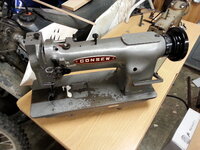
Pfaff or Consew. Quick pic of my Consew, which I acquired with a bundle of other leather shop supplies about 12 years ago. I use it for upholstery and leather mainly, or any heavy materials that I need to fabricate/repair. Looks like they can be had for $4-600 on Marketplace.
 

Attachments

  • image (2).jpg
    image (2).jpg
    512.4 KB · Views: 43
To avoid these ads, REGISTER NOW!
Top Bottom