I did a ton of research a couple of years ago and bought a new Juki 541 after shopping around.
I had never sewn anything more than a button but was determined to learn after getting stupid quotes for boat cushions and a new zipper for my dry suit. I also want to use it to do some car seat covers.
One thing that hasn't been mentioned in detail yet is the motor. Newer machines have the option of a digital servo motor that allows you to precisely control the sewing speed with the foot pedal. Something that has allowed me to climb the learning curve a lot faster. The old analog motor machines are on or off which make it a lot harder to control and learn with.
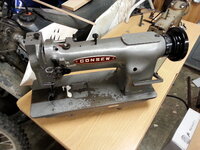
In the dim mists of history, factory sewing machines were driven by a line shaft, and power to the machine was taken by belt connected to the machine's pulley that traveled through a cork conical clutch, controlled by the foot treadle. As electric motors came in, the first step was to gang machines together in sets of 6 or 8, and use a single motor to power all of them, with an under table lineshaft. That was followed by the individual motor per machine, an induction motor, running at constant speed, and using the same sort of clutch. These clutches require careful use and maintenance, and in good nick, are surprisingly easy to control, over the whole range of speed available. The problem is they're never in good nick, because no one does anything to them, and they become sticky on/off switches. They're frustrating to use, and very hard to actually control speed, and to make the needle stop where you want it.
Servo motors are much better in this respect. But there are some things to consider. The basic servo setup just replaces the undertable induction motor and its clutch, with a servo. They have a speed control dial (or buttons, whatever) to set max speed and a speed display. This is pretty much a plug and play conversion, you probably need a different belt, sometimes the treadle operating rods have to be changed or modified, and the table electrics may require some fiddling, but it's an afternoon job for anyone reasonably mechanical, even if they've never seen a sewing machine before. Slightly fancier kit has a sensor mounted on the handwheel, so they can do basic needle positioning (always stop with the needle up or down, do a commanded half stitch. Basic stuff, but useful). These motors suffer from a couple problems. One thing common to all of them is low low-speed torque, which can be a disaster for some machines and operations. A whole bunch of them also have totally worthless speed control, because they're all clones of the same controller, and they didn't understand how it worked (it's got an optical sensor that uses a plastic piece that has graduated opacity in IR to tell how far you pressed the treadle. The clone makers didn't get that.). I think that has been sorted out, and they're generally okay. If you have, or get, an older industrial machine, this is a worthwhile modification.
Sewing macines that are factory designed for a servo have better motors, and the last ~10 years or so, have direct drive motors, not belt driven. These are typically 3-phase motors driven by a VFD, which gives superior speed control. A big bonus for the manufacturer is it makes a single machine that works on wall voltage anywhere. ( My Juki can run on 100 to 250V AC, 0 to 60 hz, 1 or three phase, with the only change being wiring in a new plug.) factory designed servo machines typically have a bunch of very useful automations (electric foot lift, automatic thread cutter, and single touch reverse with a button near the needle being the basics. From there you can get simple pattern sewing (sew a programmable number of back stitches at the start and end of each seam, bar tacks,) and then more complicated features.)




 . How this usually works for me is I get a goofy idea, someone encourages me, the next day I get {whatever}.