To avoid these ads, REGISTER NOW!

Shared Neutrals in the panel - how to find identify

Carterton

Member
Joined
Aug 13, 2022
Messages
8
I unfortunately hired an electrician that turned out to be hard to work with. Anyway, I thought he mentioned having shared some neutrals in the panel, but then he claimed that he didn't. Initially he had a couple of 20 amp breakers with handle ties, then he rearranged the breakers very quickly and none of the have the ties anymore. Basically, what is the easiest way to check to see if there are shared neutrals in the panel. Is there a way to do it using a multi-meter?

One note, the lines are fed in though the top and I can't peak in that part of the panel without taking off the meter, which I don't want to do.
 
To avoid these ads, REGISTER NOW!

sparky 1971

Well-known member
Joined
Oct 9, 2018
Messages
8,118
Location
Central Iowa
If it's romex, it's easy. There will be a cable(s) with black and red wires. Conduit will be a little more difficult. Count how many hot wires in a pipe vs. how many neutrals, excluding 240 volt loads. Post a good picture of the interior. It might require more than one photo.
 

nadogail

Well-known member
Joined
Jan 23, 2009
Messages
32,239
Location
Coronado, CA
A clamp on amp meter will be your friend. You can measure any Neutral Current and see how the measurements responds to the changes made by opening a circuit breaker.
 
OP
C

Carterton

Member
Joined
Aug 13, 2022
Messages
8
If it's romex, it's easy. There will be a cable(s) with black and red wires. Conduit will be a little more difficult. Count how many hot wires in a pipe vs. how many neutrals, excluding 240 volt loads. Post a good picture of the interior. It might require more than one photo.
Why would I exclude 240 volt loads? 2 hots and 1 neutral, right?
 

sparky 1971

Well-known member
Joined
Oct 9, 2018
Messages
8,118
Location
Central Iowa
Why would I exclude 240 volt loads? 2 hots and 1 neutral, right?
Yes, as well as a ground but in that case it would be 120/240 and should be on a two pole breaker. Ranges and dryers fall into 120/240 territory. Straight 240 will be two hots and a ground, no neutral. If you count four hot wires and two neutrals in a conduit and two of those wire are for an AC, they don't count. You then have two hots and two neutrals and no shared neutral.
 
OP
C

Carterton

Member
Joined
Aug 13, 2022
Messages
8
Makes sense. We have 2 double pole breakers. One for the AC, which was installed years ago, so I will assume 2 hots and a ground. What about an electric wall oven on a 30 amp breaker? The hots going in the breaker look like a #10 to me.
 

sparky 1971

Well-known member
Joined
Oct 9, 2018
Messages
8,118
Location
Central Iowa
Makes sense. We have 2 double pole breakers. One for the AC, which was installed years ago, so I will assume 2 hots and a ground. What about an electric wall oven on a 30 amp breaker? The hots going in the breaker look like a #10 to me.
The oven may or may not be 120/240, it could be 240, but either way won't count. The 30 amp breaker should be a two pole. If you're concerned about shared neutrals, you have to look at 120 volt circuits. Two hots on single pole breakers but one neutral for the two circuits. They should either have a handle tie or be on a two pole. I prefer the handle tie to eliminate the common trip.
 
OP
C

Carterton

Member
Joined
Aug 13, 2022
Messages
8
I wish I could just look for the common trip ties, but I think the electrician messed it up. (See original message.)
I'm asking about the 30 amp breaker because I want to count up the hots vs the neutrals in the panel. The double pole 50 amp for the AC should only have 2 hots and a ground, right? The double 30 amp breaker should be the same? Thanks for your help, Sparky.
 

sparky 1971

Well-known member
Joined
Oct 9, 2018
Messages
8,118
Location
Central Iowa
I wish I could just look for the common trip ties, but I think the electrician messed it up. (See original message.)
I'm asking about the 30 amp breaker because I want to count up the hots vs the neutrals in the panel. The double pole 50 amp for the AC should only have 2 hots and a ground, right? The double 30 amp breaker should be the same? Thanks for your help, Sparky.
Follow the wires from the 30 amp bteaker to where it comes into the panel to see if it has a neutral. Or, look for a #10 neutral on the neutral bar. The AC doesn't need a neutral, but I've seen a lot of air conditioners that had a 10/3 romex pulled to them and the white wire not used but still on the neutral bar in the panel.

Does your wiring consist of romex cable only or a combination of romex and conduit?
 

sparky 1971

Well-known member
Joined
Oct 9, 2018
Messages
8,118
Location
Central Iowa
It's a combination of both romex and conduit.
Then look at my first post. Shared neutrals with romex will be a black and a red wire, both on single pole breakers. The same concept with conduit, but there isn't necessarily going to be any consistency with colors. If there are more hot wires than neutrals going into a conduit, but not counting the oven or AC, you have shared neutrals.

I read your 1st post again. What do you mean the lines are fed in through the top and can't be accessed without getting into the meter? The circuits and the meter should be separated. Post a picture or four.
 
Last edited:

Norcal

Well-known member
Joined
Mar 16, 2008
Messages
13,791
Then look at my first post. Shared neutrals with romex will be a black and a red wire, both on single pole breakers. The same concept with conduit, but there isn't necessarily going to be any consistency with colors. If there are more hot wires than neutrals going into a conduit, but not counting the oven or AC, you have shared neutrals.

I read your 1st post again. What do you mean the lines are fed in through the top and can't be accessed without getting into the meter? The circuits and the meter should be separated. Post a picture or four.
There are some semi-flush meter/main panels that the cover over the meter concealed the top entry of the branch circuit wiring, there is a barrier between the metered & unmetered conductors, this was mostly w/ OH service. Semi-flush panels are great in new construction, but can be a real PITA later, and amplified when stucco was used.
 

sparky 1971

Well-known member
Joined
Oct 9, 2018
Messages
8,118
Location
Central Iowa
There are some semi-flush meter/main panels that the cover over the meter concealed the top entry of the branch circuit wiring, there is a barrier between the metered & unmetered conductors, this was mostly w/ OH service. Semi-flush panels are great in new construction, but can be a real PITA later, and amplified when stucco was used.
I always forget about things like that. I'm so used to panels in the basement or garage and the meter outside that I expect it to be the norm everywhere.
 

dcg9381

Well-known member
Joined
Jun 20, 2018
Messages
11,989
Location
Austin, TX
Then look at my first post. Shared neutrals with romex will be a black and a red wire, both on single pole breakers. The same concept with conduit, but there isn't necessarily going to be any consistency with colors. If there are more hot wires than neutrals going into a conduit, but not counting the oven or AC, you have shared neutrals.
Saying this another way - we're assuming these are 20A (maybe 15A) circuit wired with 12/3 romex, which will be red/white/black. You're indicating that it's cut back and you can't see it. Do you have any 15/20A circuits on a red wire? There are other ways to make this hard, of course..

And it is my understanding that shared neutral 120V circuits need to be on breakers that are double pole or tied - he's removed the ties.

20A shared neutral isn't common here.

I think we can "narrow it down" if you have red wires, but to find the particular neutral, I dunno how to do that other than disconnect 'em one at a time and tone them out (with the main off, of course).
 

alfredeneuman

Well-known member
Joined
Mar 3, 2011
Messages
4,596
Location
Fullerton, CA
There are some semi-flush meter/main panels that the cover over the meter concealed the top entry of the branch circuit wiring,
I carried a non conductive, lighted around the rim, mirror in my toolbox for this reason. It came in handy for other uses too.
 
OP
C

Carterton

Member
Joined
Aug 13, 2022
Messages
8
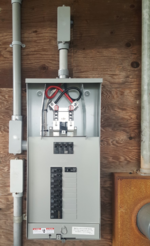
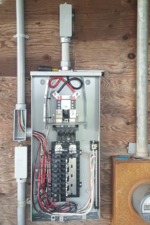
Here is our panel and you can see how you cannot get in without removing the meter. The wires and conduit come in from above.20230619_185030.jpg
 
To avoid these ads, REGISTER NOW!

sparky 1971

Well-known member
Joined
Oct 9, 2018
Messages
8,118
Location
Central Iowa
It has come to the point where you need to help yourself. Take the cover off and take some pictures. Count the hot wires and count the neutrals.
 

mm08822

Well-known member
Joined
Jan 13, 2012
Messages
6,238
Location
NJ
Here is the same panel you have:
Remove the lift up cover over the cb's and the dead face surrounding the cb's. You can look up on either side of the meter channel and figure it out. If all NM-B 2 conductor = no shared neutrals, if conduit count number of hots and compare to number neutrals in each conduit.

1687293417726.png1687293246786.png
 
OP
C

Carterton

Member
Joined
Aug 13, 2022
Messages
8
Guys, thanks for all the help, but I guess it is time to bite the bullet and get a pro in here. I was hoping there was an easy solution. Thanks again.
 

alfredeneuman

Well-known member
Joined
Mar 3, 2011
Messages
4,596
Location
Fullerton, CA
There is an easy solution. Take the cover off and look. Not as easy as a crystal ball, but easy nonetheless.
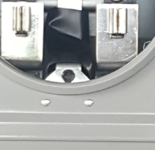
The top pair of meter clips will still be hot with thousands of amps driving them, even if the main breaker is off. (The meter doesn't appear to have a ring in the photo)
 

sparky 1971

Well-known member
Joined
Oct 9, 2018
Messages
8,118
Location
Central Iowa
The top pair of meter clips will still be hot with thousands of amps driving them, even if the main breaker is off. (The meter doesn't appear to have a ring in the photo)
Can't the bottom be opened without exposing the meter? How would one go about changing a breaker? I've never seen that meter main before but mine, and every one I've ever installed can be opened up without exposing the meter.
 

mm08822

Well-known member
Joined
Jan 13, 2012
Messages
6,238
Location
NJ
The top pair of meter clips will still be hot with thousands of amps driving them, even if the main breaker is off. (The meter doesn't appear to have a ring in the photo)
He won't have access to either set of jaws. I put an old style 100A Westinghouse meter in this panel and it has a ring that seals the meter to the cover. You can see the ring lip in the pic.
Can't the bottom be opened without exposing the meter? YES How would one go about changing a breaker? I've never seen that meter main before but mine, and every one I've ever installed can be opened up without exposing the meter. That is correct.
The top cover can not come off without pulling the meter and taking off the screw behind it.
1687301933745.png
 

sparky 1971

Well-known member
Joined
Oct 9, 2018
Messages
8,118
Location
Central Iowa

The top cover can not come off without pulling the meter and taking off the screw behind it.
I knew there had to be a way. I will never understand why the panels go outside though. The meter mains popular here are the Millbank 200 amp, eight space, with feed through lugs. It's been a while, but I think the 100 amp versions are six spaces.
 

Norcal

Well-known member
Joined
Mar 16, 2008
Messages
13,791
Here is the same panel you have:
Remove the lift up cover over the cb's and the dead face surrounding the cb's. You can look up on either side of the meter channel and figure it out. If all NM-B 2 conductor = no shared neutrals, if conduit count number of hots and compare to number neutrals in each conduit.

1687293417726.png1687293246786.png
The LB is a prime example of how not to do it, that side entry is over live parts & the entry needs to be sealed, that is the reason that factory KO's are at the bottom & below live parts.
 

mm08822

Well-known member
Joined
Jan 13, 2012
Messages
6,238
Location
NJ
The LB is a prime example of how not to do it, that side entry is over live parts & the entry needs to be sealed, that is the reason that factory KO's are at the bottom & below live parts.
The LR was brought in as low as existing obstacles permitted.
The panel is at least 12' from any overhead opening
It is at best considered a damp location, certainly not wet
The LR was sealed with duct seal at panel entry
The LR had a weep hole added.
Conductors were tied back from cb's.

It would be a different story if located on a wall fully exposed to the elements.
(Plywood is 40 years old if that helps to gauge the existing protection.)
 

Norcal

Well-known member
Joined
Mar 16, 2008
Messages
13,791
The LR was brought in as low as existing obstacles permitted.
The panel is at least 12' from any overhead opening
It is at best considered a damp location, certainly not wet
The LR was sealed with duct seal at panel entry
The LR had a weep hole added.
Conductors were tied back from cb's.

It would be a different story if located on a wall fully exposed to the elements.
(Plywood is 40 years old if that helps to gauge the existing protection.)
You missed my point entirely, the entry to the panel when it is above live parts must be sealed, not the interior of the LB.
 

mm08822

Well-known member
Joined
Jan 13, 2012
Messages
6,238
Location
NJ
You missed my point entirely, the entry to the panel when it is above live parts must be sealed, not the interior of the LB.
Point not missed at all. That requirement only applies for wet locations - read the last sentance of 312.2. My point, I don't even consider it in a damp location based on the specifics of its location. It wasn't going to get a Meyers hub. Again this is not some panel hanging off the wall exposed to all sorts of weather completely unprotected.

And while not an approved method, I did also silicone the mating areas of the 2 fittings and enclosure interface areas during glue up.
 

mm08822

Well-known member
Joined
Jan 13, 2012
Messages
6,238
Location
NJ
How do you explain the rust on the meter socket beside it?
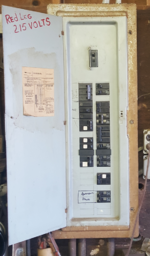
It's 40 years old. I've seen panels in garages not too far off from that meter pan cover and no one would have considered those areas wet or damp. All NEMA 1 hardware used. Very common.
Outside of the enclosure is not necessarily the same as inside.
1687400950537.png
Regardless, it is not a wet location and that is where 312.2 applies.
 
To avoid these ads, REGISTER NOW!
Top Bottom