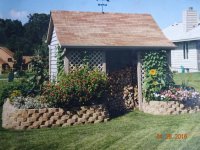
It must be the season of shed planning. Here is another thread on the subject.
http://www.garagejournal.com/forum/showthread.php?p=5234465#post5234465
Here is some information:
Make a list of exactly what you need to store. Then do a layout of how to access everything. Decide if you want future space available. Then wrap that with a structure. Now you have the design.
Once you know exactly what you want to store, you can size the shed.
Next step is to check your zoning, and zoning rules. This will tell you what you can build without a permit, and where you can put it on your lot.
Then you need to decide if it will be a temporary or permanent floor/foundation. Tax rules and building rules for foundations will give you your options here. I prefer a permanent concrete slab, but sometimes that is taxed differently and requires a foundation. Check your requirements. Another consideration for the floor type, is how steep the ramp will be to access the shed.
Once you have all this info, and have made decisions on floor/foundation, then style is the next question. Do you want to match, complement or contrast with the house design?
Now you are ready to make a thumbnail sketch of what you are going to build.
Some design tips.
Make it a module of your building material size, IE 4x8 sheets of OSB or plywood sheathing. And make that sheathing module work vertically as well.
I also prefer steep slope roofs. 12/12 is easy to stick frame. It sheds snow and rain very well too. Where are you located?
And an overhang all around helps protect the walls. I sheathe with OSB and cover with vinyl siding, but there are cheaper methods where the finished siding is the sheathing. I like full 2x4 framing with a double top plate but you can use a single top plate if the wall framing matches the joist spacing. And 24"o.c. wall studs are fine for a shed.
Prepare the site so that all organic material is removed and a pad, or base is installed that keeps water away from the shed and gives a stable base for it.
I like to frame the ceiling with at least a 4x4 opening for access into the attic. And another way to access the attic is from an outside door in the gable end. For more attic volume you can use a Gambrel roof, but consider how the style of that works for you and the fact that is is more difficult to frame.
Use sill seal, treated lumber for the sill plate and everything below the sill plate if you use a wood floor system.
Consider a window, glazing in the door, or a skylight for natural light.
Make the door bigger than you think you need.
I like 3 tab shingles and use aluminum edge metal and #30 felt. There are more advanced roof sheathing materials than OSB available as well as other options than felt.
The style of a shed is not just in the configuration of the masses, but also in the details of how you trim it out. All buildings are just boxes, with different detailing. Choose and size and locate your door and window(s) to reflect the style you are using.
To find out exactly what it will cost, do a spreadsheet. List every item needed.
Excavation and site prep. (Pad).
Foundation and footings (Or skids) Don't forget concrete formwork and anchor bolts.
Framing materials
Trim lumber
Metal brackets and connectors
Sheathing materials and siding (If included)
Roofing materials
Windows (Or skylights) and doors
Nails (Rough and finish) and staples
Caulk and paint
Sill seal
House wrap
Electrical?
Floor framing.
Floor elevation is always a balance. You want to keep your wood framing and sheathing of the walls above surrounding grade by at least 6 or 8 inches. On the other hand, you want to keep the finished floor level as close to grade as practical, so the ramp for access is as low as possible.
This is true for a concrete slab, and even more so for a wood framed floor.
Because of this, I really dislike the two most used methods of floor framing. The first is one where you use concrete support blocks and run beams from block to block. Now, you can minimize the height of this method by burying the blocks almost completely and running the floor joists from beam to beam with joist hangers rather than putting the floor joists on top of the beams.
Some people lay down skids and then build a floor framework on top of them. This adds height that is unnecessary as well. If you start with the floor sheathing, and determine what it will span, then you have the spacing for the members needed to support it. Most sheds have OSB or plywood floors. I prefer treated 3/4" T&G plywood. This will easily span 16" o.c. joists, or a 14 1/2" space. If we carefully prepare a gravel pad for the shed, compacted and level, there is no reason we can't use the skids for those members. Using 6x6 treated lumber, spaced at 20"o.c. we have the same span for the floor sheathing. Run a treated 2x6 across the ends of all these members on either end and you have a floor frame that is also skids, without adding to the height. And frankly, you could do the same thing with 2x6 joists at 16"o.c. Joists OR skids on gravel, it's all the same. No reason to have 2 layers.
Now, to your specific foundation questions.
There are 2 ways to take care of frost.
One is to provide a foundation that goes deep enough to be beyond the frost level. Where you are, that is going to be pretty deep.
It may be a requirement that you do it that way. Check and find out. Call anonymously.
The other way is to provide good drainage, so there is no freezing and thawing below the slab, and build a floating slab. This takes careful excavation and placement and compaction of the building pad, and choice of pad material. I like angular limestone with fines compacted in lifts to above surrounding grade. Plus grading around the pad, for positive drainage. Having a sloping site, you need to cut and fill and grade as needed.
Bill