Outlawmws
Well-known member
Been thinking about doing this for a while, and another thread got me part way there. Maybe this will be worthy of a spot in the sticky thread 
What makes a good tin snip? And what type is used for what?
Once upon a time Wiss made outstanding snips, and were pretty much the industry standard for tin benders. There were other good snips, (Malco, Pexto, etc) but Wiss had an edge.
The deal was that you have two requirements: Hard blade edges and a tough handle that would neither break or bend.
Wiss inlaid a hardened steel insert into their handle so the edge stayed sharp longer, and was less likely to chip, flake or otherwise degrade.
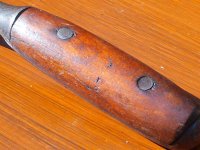
The handles were tough and unlikely to break.
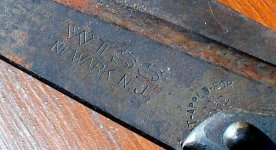
If you pick up an older set of Wiss bench snips, you can actually see the inlay (look for the dark straight line shadow on the flat side):

Regular Bench snips are for straight cutting generally (any curved cutting is difficult and usually less than optimal)
The sizes sometimes marked are for the handle length, not the overall length, so a "9" has 9" handles. (Unlike how Pliers are sized)
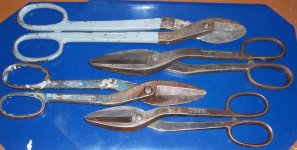
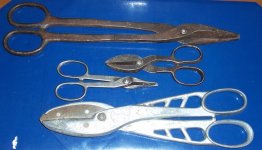
Bench snips show from bottom to top: 9" inlaid, 10" inlaid, 10" inlaid long blade, and a set of 14" "Specials" for "Alloy" metals and SS.

Lighter snips are made using aluminum alloy with bolted in inlaid blades. Malco makes these in at least 2 sizes, the larger "Andy" is show below with 12" handles. (Not sure Malco uses the handle length for size..)
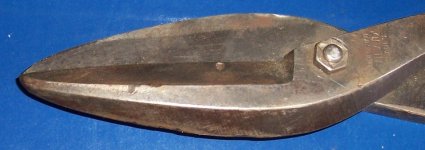
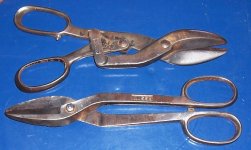
Duckbill snips (Two sizes shown) allow for some curved cutting but not a real tight curve.
Generally the smaller the snips the lighter the materials they will cut.

For cutting tighter curves Aviation snips are used. these are smaller and have smaller jaws, and by using a compound action in the grips, can cut heavier materials for their size. The compound action is so good that someone with strong hands can spring the jaws if cutting too heavy or tough of material is attempted.
I believe MetalMaster was one of, if not the first maker of aviation snips, and was later bought by Wiss. (I have an old pair of MM (Pre plastic grips) without the Wiss label)
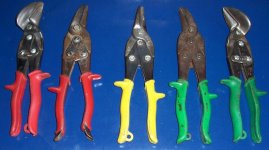
These snips are very popular, and now can be bought in more than the standard straight, right and left cutting models. including pairs that keep the handles out of the way of the materials (Shown) and pairs that cut nearly vertically so clear in tight quarters.
Std
M1 - Red = left
M2 - Green = right
M3 - Yellow = straight
M6 Red offset = Left
M7 - Green offset = Right

Again special snips are made for heavy/tough materials, as well as double cuts good for staring at a small holes and cutting patterns, very handy for making an opening in a sheet of metal.
Special
M1/M2 - Blue L/R for Stainless Steel
M5 - Red = Straight mini Bulldogs. (For heavier material - Pre SS Blue, but still sold I think)
Yellow Double cuts = Straight

I know the quality of Wiss has dropped as the company was sold into diversity, but watch for the better snips used, including Wiss (inlaid), Pexto Malco, Metal Master.
Bench snips are very easy to resharpen, (best on a lower speed grinder) and even aviation snips can be resharpened, however you need a special checkering file to renew the gripping teeth on the blade.
If anyone has things to add (Or if you see something that needs correcting), feel free to comment.
What makes a good tin snip? And what type is used for what?
Once upon a time Wiss made outstanding snips, and were pretty much the industry standard for tin benders. There were other good snips, (Malco, Pexto, etc) but Wiss had an edge.
The deal was that you have two requirements: Hard blade edges and a tough handle that would neither break or bend.
Wiss inlaid a hardened steel insert into their handle so the edge stayed sharp longer, and was less likely to chip, flake or otherwise degrade.
The handles were tough and unlikely to break.
If you pick up an older set of Wiss bench snips, you can actually see the inlay (look for the dark straight line shadow on the flat side):
Regular Bench snips are for straight cutting generally (any curved cutting is difficult and usually less than optimal)
The sizes sometimes marked are for the handle length, not the overall length, so a "9" has 9" handles. (Unlike how Pliers are sized)
Bench snips show from bottom to top: 9" inlaid, 10" inlaid, 10" inlaid long blade, and a set of 14" "Specials" for "Alloy" metals and SS.
Lighter snips are made using aluminum alloy with bolted in inlaid blades. Malco makes these in at least 2 sizes, the larger "Andy" is show below with 12" handles. (Not sure Malco uses the handle length for size..)
Duckbill snips (Two sizes shown) allow for some curved cutting but not a real tight curve.
Generally the smaller the snips the lighter the materials they will cut.
For cutting tighter curves Aviation snips are used. these are smaller and have smaller jaws, and by using a compound action in the grips, can cut heavier materials for their size. The compound action is so good that someone with strong hands can spring the jaws if cutting too heavy or tough of material is attempted.
I believe MetalMaster was one of, if not the first maker of aviation snips, and was later bought by Wiss. (I have an old pair of MM (Pre plastic grips) without the Wiss label)
These snips are very popular, and now can be bought in more than the standard straight, right and left cutting models. including pairs that keep the handles out of the way of the materials (Shown) and pairs that cut nearly vertically so clear in tight quarters.
Std
M1 - Red = left
M2 - Green = right
M3 - Yellow = straight
M6 Red offset = Left
M7 - Green offset = Right
Again special snips are made for heavy/tough materials, as well as double cuts good for staring at a small holes and cutting patterns, very handy for making an opening in a sheet of metal.
Special
M1/M2 - Blue L/R for Stainless Steel
M5 - Red = Straight mini Bulldogs. (For heavier material - Pre SS Blue, but still sold I think)
Yellow Double cuts = Straight
I know the quality of Wiss has dropped as the company was sold into diversity, but watch for the better snips used, including Wiss (inlaid), Pexto Malco, Metal Master.
Bench snips are very easy to resharpen, (best on a lower speed grinder) and even aviation snips can be resharpened, however you need a special checkering file to renew the gripping teeth on the blade.
If anyone has things to add (Or if you see something that needs correcting), feel free to comment.
Attachments

Last edited:
 ) on ground machine tool ways to remove high spots from "dings")

 sticky very nice write up