To avoid these ads, REGISTER NOW!

shop lighting plan

NakeDiesel

Well-known member
Joined
Sep 6, 2007
Messages
2,727
Location
oklahoma
Been building the shop as I have time since last Feb. I'm getting to the point where I need to make some decisions on the main shop lights. I've layed them out in my drawing below. It would have 18 8' T5ho lights in the main shop and the kitchen would have 2 8' T8's, storage room would have 1 4' T8 and the bathroom would have a regular light fixture.

Any thoughts? Too many or too few lights? Walls and Ceiling are all covered in White steel Farm Panels. You can see pictures of the shop in my build thread linked in my signature.

10210668374_6b0ffc22c4_b.jpg
 
To avoid these ads, REGISTER NOW!

2ManyProjects

Well-known member
Joined
Jul 18, 2013
Messages
757
Been building the shop as I have time since last Feb. I'm getting to the point where I need to make some decisions on the main shop lights. I've layed them out in my drawing below. It would have 18 8' T5ho lights in the main shop

Each of which, per your drawing, would have four tubes. That adds up to about 3,900 watts (+/-, depending on the ballasts), and about 360,000 total lumens.

You're in the ballpark (maybe a little high) on total lighting intensity; but having all that load on only two switch banks is problematic for several reasons. You REALLY need to break that up into at least four (perhaps 6-8) switch banks.

I also question the wisdom/desirability of using T5HOs (especially four of them per fixture), given your stated ceiling height of only 13'6". If these are open-tube (or simple diffuser) fixtures, and you make a point of mounting them smack up against the ceiling, you MIGHT get away with it; but you are still concentrating a LOT of light at each fixture location, yet leaving large-ish spaces between those fixtures. That is generally a prescription for "spotty" uneven lighting. You would near-certainly be better off with a greater number of twin-tube T8 or T5 (NOT T5HO) fixtures, arranged to provide much more even lighting AND granular control over both overall brightness and "zoning".

and the kitchen would have 2 8' T8's, storage room would have 1 4' T8 and the bathroom would have a regular light fixture.

The same principle applies here. The single twin-tube T8 fixture is probably OK for the storage room. But the Kitchen again suffers from too much light concentrated into too few places. And at about 92.5 lumens/ft.^2, it's also more than a bit bright in general, at least presuming that you also have proper task lighting (such as under-counter LED strips, or similar) in the prep areas. Exactly what lights you'll want where will depend in large part on the exact layout of that room. But even if you were to take the same total number of F32T8 tubes, but split them up into four-foot twin-tube fixtures, you could then arrange those fixtures to provide MUCH more even illumination. And again, I would suggest multiple switch banks, so that you don't HAVE TO make the area super bright if/when you don't need to.


Charles (in GA)

Well-known member
Joined
Jan 11, 2006
Messages
12,489
Location
50 mi south of Atlanta
I'm going to disagree with 2ManyProjects on the T5HO choice. I think that mounting them to the ceiling (why would you do otherwise?) is high enough to not be an issue. I have two of these "8ft" (they are actually about 92 inches) 4 tube open fixtures over 16 ft of workbench at about 7 ft and do not find them objectionable.

I would suggest mounting them to the ceiling with ½ inch or so spacers at the ends to keep the heat somewhat away from the ceiling itself.

Here is my IR temp gauge (upside down) measuring the top of my T5HO fixture in the area of the ballast after it had been on for an hour or so, 156°F, and also on the top of the ballast in an area away from the ballast, 105°F. Imagine what the temps would climb to if the fixture was up hard on sheetrock or a metal surface.

attachment.php


attachment.php
 
To avoid these ads, REGISTER NOW!
OP
N

NakeDiesel

Well-known member
Joined
Sep 6, 2007
Messages
2,727
Location
oklahoma
I've done some further thinking and planning on the lighting and crunched some numbers and think I'm going to end up going with 8' T8 fixtures with 4 - 4' bulbs instead of the T5HO's. I've laid out the lights how I want them, and also left open the area I'm putting in my paint bay as there isn't a reason to light up the top of it. I also broke it down into 3 circuits, which I don't want more than that anyway. If I'm in there, I'm working and want light.

10237650984_973eebe844_b.jpg
 

2ManyProjects

Well-known member
Joined
Jul 18, 2013
Messages
757
I've done some further thinking and planning on the lighting and crunched some numbers and think I'm going to end up going with 8' T8 fixtures with 4 - 4' bulbs instead of the T5HO's.

I'd call this an incremental improvement over your original plan; but it still has some issues...

Overall brightness levels in the main shop area are still a bit on the high side (about 120 lumens/ft^2) ; but that's only a minor concern, so long as you set up the switching correctly.

What, specifically, will the undefined areas between the storeroom and the paint booth, and to the right of the garage bays, be used for? (I'm guessing workbenches, tool storage, stationary machines, and general fabrication areas; but that's only a guess, and a more specific breakdown would be useful to determine the real lighting requirements.)

I don't see the point of doubling-up the fixtures near the front entry door.

The kitchen area is still WAY over the top. By my abacus, it works out to about 140 lumens/ft^2, before you even factor in the task lighting! Are you perhaps doing open-heart surgery in there?

I've laid out the lights how I want them, and also left open the area I'm putting in my paint bay as there isn't a reason to light up the top of it.

Do you never paint the roofs or hoods/trunklids of cars?

My understanding is that THE key lighting issue in paint booths is to avoid shadows at all costs. And to that end, you want have every part of the vehicle illuminated from as many different angles as possible -- INCLUDING overhead.

I also broke it down into 3 circuits, which I don't want more than that anyway. If I'm in there, I'm working and want light.

How many people will normally be working in that shop? If you have several employees, each of which will presumably be working in different areas at any given moment, your approach makes some sense (tho' personally, I'd still want at least SOME additional flexibility). But if, as I suspect, this is (at least mostly) a "one man show", then it is horridly wasteful. That is a BIG shop (at least as compared to typical home "garages"). You really don't need -- or want, if you really think about it -- to light ALL of it to full "fine detail work" brightness all the time.

Your general lighting should be arranged to provide first a minimal amount (perhaps 20 lumens/ft^2 or so) of "walk through" lighting throughout the entire space, controlled by switches at EVERY entry point. This will be the first button you push upon entering the building, and will provide sufficient light to safely navigate your way to wherever you need to go.

Beyond that, the rest of the general area lighting should be set up in at least two "stages" for each major work area. The first stage brings the overall lighting level up to maybe 40-50 lumens/ft^2, which will be more than adequate to keep it from feeling dim & dingy or "cave-like" when you're not actually working in those areas; it will probably even be adequate for general "work lighting" when you don't need to see fine detail (or have task lighting to augment it). The third and final stage would only be used in those areas you are actively working in, and would bring those areas ONLY up to full brightness. Given the number of separate work areas you apparently have, this COULD all add up to as many as 16-20 separately switched banks, en toto; you MIGHT get away with 10-12, but three just ISN'T going to cut it.

Now, I fully understand that you may not want to have to deal with flipping even 10-12 switches on and off to control all this. But that's where a semi-automated lighting control system, such as Insteon, comes in. With such a system, a single keypad can be programmed to provide several (typically 6-8) different lighting "scenes", as needed at that moment. Notably, each of these scenes can "overlap" other scenes, in the sense that the same fixture can be a member of multiple scenes, as needed. Conversely, there is effectively no limit on how many keypads can be set up to control any given light or scene; and they can be placed ANYWHERE, as convenient. So in practice, your switching effectively becomes task oriented -- you push a particular button to set the lighting up for whatever you're planning to do that day/hour/moment, and the system automatically makes it so. Further, because the load/switch assignments are all made via "virtual links" (i.e., in software), you retain your ability to change your mind about how to arrange/organize things a few weeks/months/years later; so in essence, it "mistake-proofs" you. And finally, if you know going in that you're going to use Insteon (or similar) to control the lighting, the required wiring actually becomes simpler. Given the size/complexity of the lighting system in play here, that COULD mean it winds up being less expensive than attempting to use conventional wiring/switching methods to provide similar (actually, much less) flexibility; at worst, it won't be all that much more expensive.

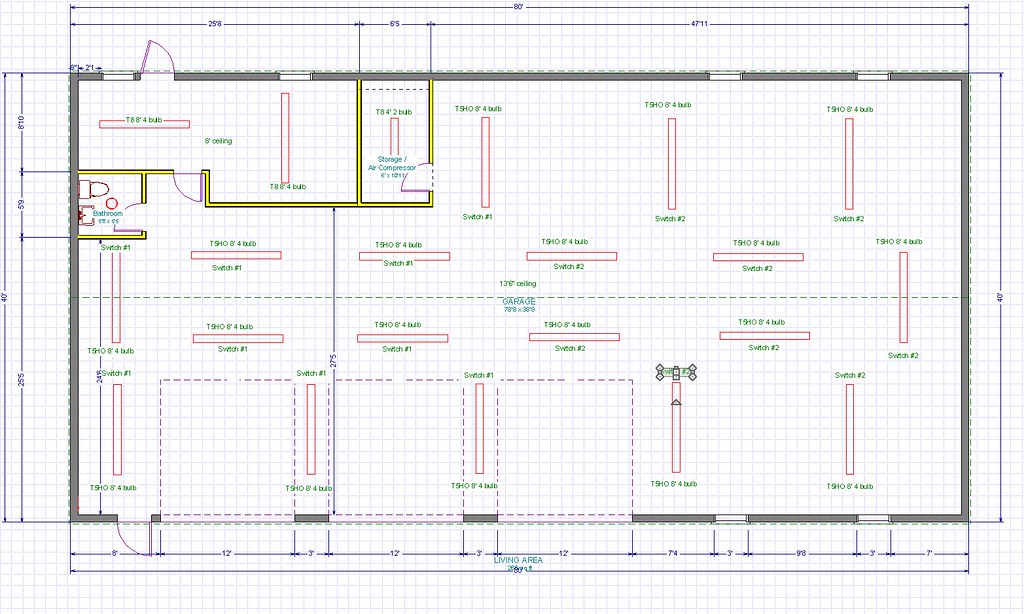
 
Last edited:
OP
N

NakeDiesel

Well-known member
Joined
Sep 6, 2007
Messages
2,727
Location
oklahoma
90% of the work will be done in the 3 bays where the doors are. I currently have 2 4' T8 dual bulb plug in fixtures hanging there. It's still a little dim and where my welding and cutting equipment will be located. along the indented wall of the kitchen/storage room, there is a 2' overhang on the room and I will be hanging additional switched lighting under that. I will be building around a 2' wide bench along the length of this wall for my drill press, chop and cutoff saws, bench grinder, etc... Underneath the bench will be tool boxes and other storage for items infrequently used. Along the entry way side, will be my mig welder, plasma torch, oxy/acetylene bottles, welding table, and upright tool boxes.

The area between the storage room and paint bay will probably get a tire machine, and where I work over the bull hides I tan and the skulls that I'll be finishing out.

I didn't put any lights in the paint bay because it will have a sub roof over it when it's built most likely and I will design the light for it separately and they will have their own switches there. The paint bay will have lights on the walls, at an angle along the ceiling and on the ceiling to ensure it's fully light up.

The big area to the right of the last door will primarily be used for part/car storage of our projects we aren't working on, as well as storage of big tools not being used like the cherry picker, engine stands, rotisserie, etc...

As to the number of people out there working at any one time, it is just me and my 17 year old son and we are generally working on either my project or his depending on what we have parts wise or time wise.

Based on my calculations of 2600 avg lumens per 4' T8 32 watt bulb, I'm right at 100 lumens per sq ft in the shop part. 3200 total square feet - 300 sq ft for paint bay, - 468 sq ft for the kitchen, bathroom and storage room which is 2432 sq ft * 100 lumens per sq ft / 2600 avg lumens per bulb / 4 bulbs per fixture = 23.38 fixtures and I have mine designed with 24 fixtures.

As for switching, I'm good with 3 for the main shop lighting, I don't want to mess with a bunch of electronics/programmable lighting. I deal with computers and software at work and don't want to deal with it in my shop, that's where I go to get away from it.

My brother's shop has 1 switch for his lighting contactor that controls all of his lights and compressor in his 40x60 shop. I think his shop is under lighted.

I agree that I'm probably over killing the kitchen and will probably only use 4 4' lights in there on a single switch. It's going to be a while before I finish out the kitchen and will address that when I actually get around to building the kitchen out.

Thanks for the insights and pointing out my screw ups on the different area.
 
To avoid these ads, REGISTER NOW!
Top Bottom