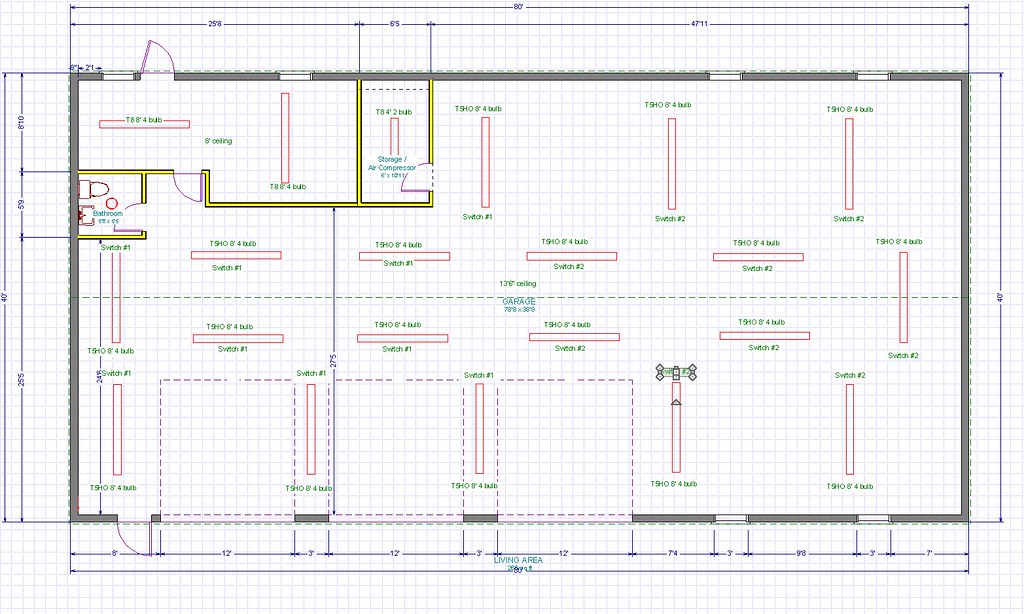
I've done some further thinking and planning on the lighting and crunched some numbers and think I'm going to end up going with 8' T8 fixtures with 4 - 4' bulbs instead of the T5HO's.
I'd call this an incremental improvement over your original plan; but it still has some issues...
Overall brightness levels in the main shop area are still a bit on the high side (about 120 lumens/ft^2) ; but that's only a minor concern, so long as you set up the switching correctly.
What, specifically, will the undefined areas between the storeroom and the paint booth, and to the right of the garage bays, be used for? (I'm guessing workbenches, tool storage, stationary machines, and general fabrication areas; but that's only a guess, and a more specific breakdown would be useful to determine the real lighting requirements.)
I don't see the point of doubling-up the fixtures near the front entry door.
The kitchen area is still WAY over the top. By my abacus, it works out to about 140 lumens/ft^2, before you even factor in the task lighting! Are you perhaps doing open-heart surgery in there?
I've laid out the lights how I want them, and also left open the area I'm putting in my paint bay as there isn't a reason to light up the top of it.
Do you never paint the roofs or hoods/trunklids of cars?
My understanding is that
THE key lighting issue in paint booths is to avoid shadows at all costs. And to that end, you want have every part of the vehicle illuminated from as many different angles as possible -- INCLUDING overhead.
I also broke it down into 3 circuits, which I don't want more than that anyway. If I'm in there, I'm working and want light.
How many people will normally be working in that shop? If you have several employees, each of which will presumably be working in different areas at any given moment, your approach makes some sense (tho' personally, I'd still want at least SOME additional flexibility). But if, as I suspect, this is (at least mostly) a "one man show", then it is horridly wasteful. That is a BIG shop (at least as compared to typical home "garages"). You really don't need -- or want, if you really think about it -- to light ALL of it to full "fine detail work" brightness all the time.
Your general lighting should be arranged to provide first a minimal amount (perhaps 20 lumens/ft^2 or so) of "walk through" lighting throughout the entire space, controlled by switches at EVERY entry point. This will be the first button you push upon entering the building, and will provide sufficient light to safely navigate your way to wherever you need to go.
Beyond that, the rest of the general area lighting should be set up in at least two "stages" for each major work area. The first stage brings the overall lighting level up to maybe 40-50 lumens/ft^2, which will be more than adequate to keep it from feeling dim & dingy or "cave-like" when you're not actually working in those areas; it will probably even be adequate for general "work lighting" when you don't need to see fine detail (or have task lighting to augment it). The third and final stage would only be used in those areas you are actively working in, and would bring those areas ONLY up to full brightness. Given the number of separate work areas you apparently have, this COULD all add up to as many as 16-20 separately switched banks, en toto; you MIGHT get away with 10-12, but three just
ISN'T going to cut it.
Now, I fully understand that you may not want to have to deal with flipping even 10-12 switches on and off to control all this. But that's where a semi-automated lighting control system, such as Insteon, comes in. With such a system, a single keypad can be programmed to provide several (typically 6-8) different lighting "scenes", as needed at that moment. Notably, each of these scenes can "overlap" other scenes, in the sense that the same fixture can be a member of multiple scenes, as needed. Conversely, there is effectively no limit on how many keypads can be set up to control any given light or scene; and they can be placed ANYWHERE, as convenient. So in practice, your switching effectively becomes task oriented -- you push a particular button to set the lighting up for whatever you're planning to do that day/hour/moment, and the system automatically makes it so. Further, because the load/switch assignments are all made via "virtual links" (i.e., in software), you retain your ability to change your mind about how to arrange/organize things a few weeks/months/years later; so in essence, it "mistake-proofs" you. And finally, if you know going in that you're going to use Insteon (or similar) to control the lighting, the required wiring actually becomes simpler. Given the size/complexity of the lighting system in play here, that COULD mean it winds up being less expensive than attempting to use conventional wiring/switching methods to provide similar (actually, much less) flexibility; at worst, it won't be all that much more expensive.