To avoid these ads, REGISTER NOW!

Should manufacturers standardize?

celticbhoy

Well-known member
Joined
Apr 10, 2013
Messages
540
It's funny. Although i'm all for automotives going to metric, i'm canadian but am always mixing up sae/metric measurements. I never say i'm 181cm, always 6'3", I always measure things in inches.... i confuse myself at times.
 
To avoid these ads, REGISTER NOW!

Dimitri

Well-known member
Joined
Feb 28, 2013
Messages
250
Location
Toronto
Chrysler wasn't the only manufacturer to do that, but they did it for a lot longer than everyone else did.

Ah okay, I've heard of that back in high school shop. I've never actually see it myself.

Thanks!

Dimitri
 

60766244

Active member
Joined
Mar 27, 2013
Messages
40
Location
Kalamunda/Boyup Brook, Western Australia
I have always wondered about that and Europe...do carpenters buy wood sized differently?

Aussie here. It's wonderful here because sometimes you get things in millimeter widths, or, sometimes you get things in inches. It varies a lot.

In reality, I prefer working in millimeters - much cleaner and more precise imho.

If only there was true standardization! ;)
 

MikeF2316

Well-known member
Joined
Dec 29, 2012
Messages
9,605
Location
Thornhill, ON
It's funny. Although i'm all for automotives going to metric, i'm canadian but am always mixing up sae/metric measurements. I never say i'm 181cm, always 6'3", I always measure things in inches.... i confuse myself at times.

Yes, since 181 cm = 5' 11 1/4" :lol_hitti
 

richfinn

Well-known member
Joined
Jan 29, 2011
Messages
4,814
Location
Leeds, Yorkshire, England
Although Britain went metric decades ago, there are still many things that are measured in the old imperial system.

Speedos are all mph not kph

Bridges all have the max vehicle height in feet and inches

Milk/beer is still dispensed in pints

God forbid they ever try and make us order beer in litres, it would probably start the 3rd world war :)
 

LAROKE

Banned
Joined
Jul 30, 2010
Messages
1,790
Location
Boca Raton, Florida
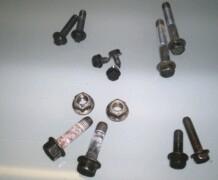
I'm a shadetree mech. The first time I pulled my '91 Jeep Wrangler apart, I had to remove all these to get the bellhousing away from the engine.

jp061006bt.jpg


The top (2) bellhousing bolts were reversed (external) torx E-12 capscrews
The intermediary (2) bellhousing bolts were 16mm
The bottom (2) bellhousing bolts were 18mm thru bolts
There were three 13mm short capscrews holding various sheetmetal components to the bellhousing
Finally, the starter motor was attached to the bellhousing with a 15mm bolt on the backside and a 14mm bolt on the front side.

There were copious amounts of profanity issuing from underneath the Jeep before I was finished with this job.
 

Heavy Metal Doctor

Well-known member
Joined
May 26, 2010
Messages
5,417
Location
Mason Dixon Line
Industry standardization as a concept in itself is great. More than just nuts and bolts. Many other components have become standardized which I think some pros who work with the items never even think about it. I run into hydraulic issues on machinery sometimes where even experienced guys don't think of the fact that an item like a DO3 valve is the same between 3 different manufacturers of machinery - just read the circuit diagram on the valve - if they match, they are interchangeable - doesn't matter one came from brand "x" and your working on "z".


The only reason there are metric fasteners on U.S. products is because the crappy outsourced fasteners are a few cents cheaper than inch ones! And if you have to spend hundreds of dollars on new tools they don't care!

Rant over - back to wrenching' !

We recently began selling machine built entirely in Europe. One of the first things I noticed is the condition of the hardware. Doing PDI / prep / assembly right out of the shipping container they rode over the pond in, I notice all the hardware seems like crappy plating and corrosion building in the threads to the point if look like they could gall up - zero hours on this stuff, not even delivered. They seem to be using top notch components for everything on the machine (they better for twice the cost of the US made comparable version), but the hardware looks like ****....also playing hell figuring out which items are 19MM over 18MM, and is 24MM close to 1 1/8", I forget? I dunno....


I don't care.

Metric is simpler, but simpler does not always mean better.

If you are challenged by fractional math, I really don't want you working on my machines.


:beer:


FWIW
i dont have any issues telling the difference between metric & std hardware.:eyecrazy:

maybe it's a trained eye, machinist backround, or just pulling wrenches "professionally" for 30 years....:dunno:

:beer:

Same here - easy to spot the grade markings that tell you standard or metric - one of the first things I was taught as a mechanic - we spent days on all those basic materials / concepts / practices stuff. I wonder, though, do they still teach these basics? Because I see many machines I get in for service from customers equipment / fleet shops that arrive with mixed up hardware. IE: metric bolts crammed in standard bolt holes. WTF?
 

bimmerZ5

Well-known member
Joined
Aug 16, 2008
Messages
1,790
yes, we should standardize. there's a very real cost to the confusion or mishaps due to metric/SAE mistakes. it cost US tax payers over $300 million because someone screwed up metric/SAE with the Mars orbiter mission (http://en.wikipedia.org/wiki/Mars_Climate_Orbiter). that's just one of the more dramatic mistakes due to metric/SAE confusion. stuff like that probably happen frequently at a smaller cost scale, but it all adds up.

plus, SAE system is based on division of units into 12 parts is a really, really old system derived from Mesopotamian merchants that used the digits on their fingers of each hand to count. (4 fingers,excluding thumb x 3 digits per finger = 12 count per hand, thumb was used to hold your place as you counted) it doesn't make sense anymore to use it today other than for "legacy" reasons.

metric system tend to define their units against natural phenomenon, although which natural measure they use have evolved over time. either way, i tend to like that principal.

but, the most important point, regardless of "which system to use", is that folks all use the same system so we're speaking the same language when it comes to measuring things. since the vast majority of the world uses metric, i see no reason why we shouldn't adopt it as the primary "standard". we can always keep the SAE system for legacy, but it shouldn't be our primary system. just as much as i believe that foreign immigrants to the USA should learn and adopt American English as their primary language and not try to get our schools to educate in another language, i have no problems that other languages are taught as secondary languages.
 

racingtadpole

Well-known member
Joined
Dec 3, 2011
Messages
2,029
Location
The far side of crazy.. but sometimes Australia
I have always wondered about that and Europe...do carpenters buy wood sized differently?

Cant speak for Europe but timber here is "metric" as is steel.

Standard framing pine is 90mm x 45mm, although some hardwoods do come in 100 x 50, and for some reason laminated beams seem to be common in 63mm thicknesses (but I think thats got more to do with the number of layers than anything else).
 

bimmerZ5

Well-known member
Joined
Aug 16, 2008
Messages
1,790
Wasnt it Prez .Nixon that tried to put the USA on metric system. I wish it had worked.

it was Pres Ford actually, but the effort was repealed by the Reagan administration. I doubt a conversion so painful, even if necessary would succeed driven by our pandering political system. It would really have to come from industry leaders/elite, they are the ones who control this country and its peoples.
 
To avoid these ads, REGISTER NOW!

wafrederick

Well-known member
Joined
Jul 3, 2010
Messages
6,048
Location
Holton,Mi
No.I don't like metric bolts,5 thread pitches vs 2 thread pitches for sae.GM,Chrysler and Ford need to go back to cubic inch displacement for engine sizes instead of this liters ****.Same with the stabalizer bars,turbo chargers and thottle bodies,use milimeters and should be in inches.
 

byoungblood

Well-known member
Joined
Apr 6, 2011
Messages
2,590
Location
Berryville, VA
I have no issues with fractional math, but adding 15mm + 14mm is a hell of a lot easier than having to do the extra math in my head to add together 103 3/8" + 5 3/16" quickly.

As already mentioned, metric system makes better sense because the units scale much easier, and scale in a logical fashion. Basis of how the units were derived really isn't important to most unless you are a scientist, but there's none of the nonsense of having to remember how many cups are to a pint, or how many ounces to quart, etc. That is why scientists embraced metric volume measurements almost immediately, you don't have to worry about someone mixing different measurements for liquid volume since 1000mL always equals 1L.

Most folks are OK with distance measurement simply because they use it every day, but the standard system still is pretty arbitrary with 5,280' to a mile, 3 feet to a yard, 12 inches to a foot, etc.

Like anything, it is one of those things that as it creeps into society more and more, people will become more accustomed to using it, and the old measurements will find themselves falling into disuse in the US. I foresee this country becoming like the UK in adaptation, where some popular units like the gallon and mile stick around for measuring gas and measuring distance on roads, but once the older generations (and rednecks ;)) that oppose the metric system "just because" fall by the wayside, I think you'll see metric units become more or less the defacto standard.
 
Last edited:

Dave455

Well-known member
Joined
Mar 19, 2013
Messages
5,806
Location
Sussex, England
I have always wondered about that and Europe...do carpenters buy wood sized differently?

I went to buy a sheet of 3/4 inch chipboard recently. Timber merchant said he only had metric, so it would have to be 19mm. "Fine", I said "What size sheets do you have?" "standard 8 foot by 4 foot of course"!!!
 

wmartin

Well-known member
Joined
Jun 16, 2011
Messages
1,645
We should start by rationalizing the alphabet.

Getting rid of either 'C' (which is always pronounced like a 'K' in Latin) or 'K' would be a good start.

With 25 letters, things would evenly divide into 100 (4x25) and you could build a 5x5 grid of the alphabet. 100 is important since, of course, we (mostly) have 10 fingers and that anthropomorphic bit of news is the foundation of the metric system.
 

bran1har

Well-known member
Joined
Jun 12, 2012
Messages
118
Location
CT
the harbor freight sae bolt sets have sae threads and metric heads, i don't think I could be more pissed.
 

MikeF2316

Well-known member
Joined
Dec 29, 2012
Messages
9,605
Location
Thornhill, ON
I'm a shadetree mech. The first time I pulled my '91 Jeep Wrangler apart, I had to remove all these to get the bellhousing away from the engine.

jp061006bt.jpg


The top (2) bellhousing bolts were reversed (external) torx E-12 capscrews
The intermediary (2) bellhousing bolts were 16mm
The bottom (2) bellhousing bolts were 18mm thru bolts
There were three 13mm short capscrews holding various sheetmetal components to the bellhousing
Finally, the starter motor was attached to the bellhousing with a 15mm bolt on the backside and a 14mm bolt on the front side.

There were copious amounts of profanity issuing from underneath the Jeep before I was finished with this job.


This is a pet peeve of mine too. Why do you need 8 different tools to take off 9 fasteners on one part?

We have these finger tip laser scanners at work. To replace the scanner guts, you need to loosen a lock screw with a Phillips 0 to remove the switch assembly. The 2 screws at the front of the body halves go into a metal ring that also holds the red lens, they're removed with a Torx 7. The 2 screws holding the back of the of the body halves together screw directly into the plastic (so they have wood screw type thread) are removed with a Torx 6.
5 tiny screws, 3 screwdriver bits needed.

:dunno:
 

Milton Shaw

Well-known member
Joined
Feb 11, 2011
Messages
4,838
I have never seen metric sockets. All I have ever seen are 1/4, 3/8, 1/2, 3/4 etc. The other end can fit metric bolts/nut but all the sockets are SAE on one end.
 

neophyte

Well-known member
Joined
Apr 23, 2012
Messages
9,648
Location
Pennsylvannia
We should start by rationalizing the alphabet.

Getting rid of either 'C' (which is always pronounced like a 'K' in Latin) or 'K' would be a good start.

With 25 letters, things would evenly divide into 100 (4x25) and you could build a 5x5 grid of the alphabet. 100 is important since, of course, we (mostly) have 10 fingers and that anthropomorphic bit of news is the foundation of the metric system.

Melvil Dewey, http://en.wikipedia.org/wiki/Melvil_Dewey of the Dewey Decimal System actually tried to simplify and rationalize American spelling. Some of his changes stuck but others didn't. It's one of the reasons English and American versions of the same words aren't spelled the same. English and American also borrow a huge # of words from other languages that the western alphabet isn't actually capable of spelling.


I have never seen metric sockets. All I have ever seen are 1/4, 3/8, 1/2, 3/4 etc. The other end can fit metric bolts/nut but all the sockets are SAE on one end.

European sockets only look like they use fractional standards for the square drive. They standard is actually 6.3mm, 9.5mm, 12.7mm, and 19mm. At least that's how I've seen some European toolmakers list it.
 

Steinmetz

Well-known member
Joined
Oct 11, 2012
Messages
2,274
Location
Washington State
teh US of A are already "metric": you already use SI to weight your psychoactive street powdery stuff... :D

The U.S. didn't adopt the British monetary system at the outset of our Republic. We conveniently chose a monetary system that involves denominations of ten, like the metric system.
 

Big-Foot

Well-known member
Joined
Jan 30, 2005
Messages
1,951
Location
Midlothian, TX
Wasnt it Prez .Nixon that tried to put the USA on metric system. I wish it had worked.

No - he was the dip-stick that spent all his time over in China and opened up the borders for trade with them....:scared:


Even God doesn't like the metric system. If He did, you'd be standing on meters instead of feet, there would have been 10 disciples instead of 12, and so on... :lol_hitti

As much as I hate having two standards, I have to admit that metric measurements are easier.. But there are so many things that would need to change. Not just simple measurements.. For instance, if we were totally on the metric system, you'd not be measuring torque in ft lbs or inch pounds. Your car would not be measured in Horsepower or foot pounds of torque, etc...
 

mattv97

Member
Joined
Apr 18, 2013
Messages
9
Location
Michigan
I am a diesel mechanic and prefer standard because manufacturers tended to use less sizes when everything was standard. Not to offend anybody but America isn't a great country to live in because we followed the lead of everybody else.
 

diesel research

Well-known member
Joined
Sep 12, 2010
Messages
5,440
Location
gulf coast, TEXAS
it's because we learned fractions by the fourth grade, and do not wonder silly things like "what is the next 16th above 1/2?"

we also have no problems decimalizing for the simpletons. A task literally taught in high school.
.0625
.125
.250
.3125
.375
.4375
.500
.5625
.625
.6875
.75
.8125
.875
.9375
1


It's not jingoistic either, as many capable-minded individuals travel the globe to study and work the engineering system here. They too, are capable in either system.
 

cryan

Well-known member
Joined
Mar 13, 2013
Messages
158
Location
Kirkcaldy, Fife
I prefer working in metric but Whitworth is the best thread. The reason for that is very simple. When Joseph Whitworth decided that a standard thread was needed to speed up the industrial processes he spent years experimenting with hundreds of different thread pitches and angles until he decided upon the best ones to put his name to. Every other thread pitch etc has been designed to be different to Whitworth and therefore they are inferior.
 

gagreen

Well-known member
Joined
Mar 22, 2013
Messages
779
Location
Colorado
I'm pretty much an sae fan, but I work on airplanes so lol. Euro manufactured airplanes use sae as well. This is due in a large part to keeping the number of tools required to a minimum reducing the possibility of FOD (an afterthought) Airplanes also use MS and AN hardware and fittings. The hardware numbering system for an and ms is something every airplane mechanic is supposed to understand and is based around fractional sizings making it much quicker and easier to order a new bolt based on length diameter thread and whether or not its drilled for safety wire. I hope to not see a switch in mass or at all in aviation, but I'm not opposed to seeing a change in automotive especially with the buy a metric set get an sae free which usually leads a set of sae wrenches or sockets going on the market for cheap :D
 
To avoid these ads, REGISTER NOW!
Top Bottom