Outlawmws
Well-known member
come on... srsly?
you found a Peter Wright anvil for $25 bucks?
were you using a gun?

 Except I paid $20...

come on... srsly?
you found a Peter Wright anvil for $25 bucks?
were you using a gun?
Except I paid $20...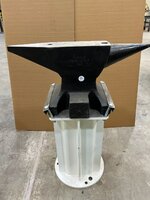


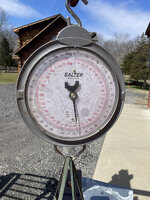
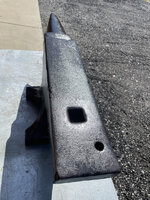

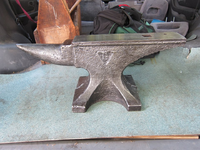
Yes sir. It’s a 120 pound AnyangWow, that a big'un!
Is that a power hammer behind it?


Yes; yes you do.Farmer you sure post up some amazing wood items.
Of course there are. Remember Sherwood Forrest where Robin Hood hung out?In my head I always thought Europe didn’t have any trees. Ha ha.
Or the woods in many of Grimms' Fairy Tales? The Black Forest?Yes; yes you do.
Of course there are. Remember Sherwood Forrest where Robin Hood hung out?

Can't ID the maker, but, generically, it is a bridge anvil.Can anybody identify this? Located at an upcoming auction from a foundry.
ANVIL, RECTANGULAR, W/ STAND, 30" X 7" TOP TABLE, 35" X 14" BASE PORTION OF ANVIL, OVERALL HEIGHT OF ANVIL 15-1/2", TOP FACE IS 31" FROM GROUND WHILE ON STAND
This is a personal preference kind of thing. I would flatten completely, then do varying degrees of rounding of the edges to allow for shaping forged pieces. I would also leave a small amount of crisp edge...this just gives flexibility of the ASO.On the subject of ASO's (anvil shaped objects), is it advisable or not advisable to mill the top flat after doing the rest of the shaping?
If yes should you go all the way to the edge or leave the edge somewhat rounded?
I've got a piece of track about 30" long that I've had for many years and my father had for many years before that. It's about time I shaped it to be more useful.
On the subject of ASO's (anvil shaped objects), is it advisable or not advisable to mill the top flat after doing the rest of the shaping?
If yes should you go all the way to the edge or leave the edge somewhat rounded?
This is a personal preference kind of thing. I would flatten completely, then do varying degrees of rounding of the edges to allow for shaping forged pieces. I would also leave a small amount of crisp edge...this just gives flexibility of the ASO.


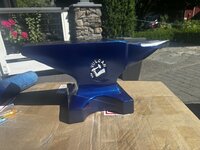
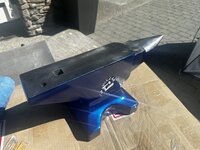
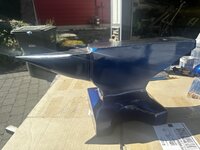
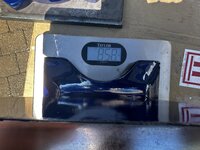
I only took 0.030” off to clean it up. So it’s still intact. From what I could tell from the side of the casting it was at least 0.500” thick, but hard to know for sure without machining down the sides.Looks GREAT!!!
Your Vulcan should have a steel top plate...do you know how much of it you were able to leave intact?
Great job! what did you use to get the sides that nice?
Fully restored this old Vulcan
I machined the top dead flat then applied a 3k automotive polyurethane.
I used short strand fiberglass filler to even put the casting. Same as I’ve done on my Bridgeport and lathe to smooth out the sand castings. I’m n this case it should face the added benefit of damping the anvil too. Luckily the top was fairly square and overhung the base so little chance of chipping it in use.Great job! what did you use to get the sides that nice?
Couldn't stay with that. Why can't people use foam on the camera mic? Nothing worse than wind noise on a recording.Ever heard of Anvil Heaven? This is it- ANVIL HEAVEN
Warning - it's a youtube video therefor amateur quality. I had to use the youtube speed controls to play it at 1/2 speed to keep from getting dizzy BUT IT'S WELL WORTH THE EFFORT.
What I hate is all the swish pans, in+out, back+forth, real cameramen know enough to hold a shot and keep the camera stable. After 75 years of professionally shot TV enter youtube where they have to provide controls so you can speed through or slow down to follow action. Anyone can post content but only a few know how to present moving imagery.Couldn't stay with that. Why can't people use foam on the camera mic? Nothing worse than wind noise on a recording.
Lot's of anvils, that's for sure.
Sheesh, I have to turn off the laptop camera, I guess.I think we just assumed from the number of times we have caught you beating it.

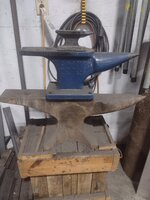

At first I thought the same, it looks like an arc welded plate, but after further reading I found that they are in fact solid cast steel with a heat treated, hardened face at some depth. The line we see is a casting line, much more discernable in this photo I found of a 100lb Columbian:Your Columbian has a inlaid face; not clear if it was cast in place as Columbian did on many early vise jaws, or forged in place. but you can see the dividing line right at the top surface of the horn.
This thread is a good read for more information:

