
You are using an out of date browser. It may not display this or other websites correctly.
You should upgrade or use an alternative browser.
You should upgrade or use an alternative browser.
Show us your cool, "old" drill press
- Thread starter rickairmedic
- Start date
tombell572
Well-known member
Timm--thats a fine looking drill, nice highlighting on the letters. I love the shape of that belt guard casting.
Tom B.
Tom B.
Wall-E0852
New member
- Joined
- Nov 10, 2024
- Messages
- 2
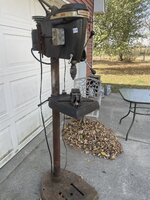
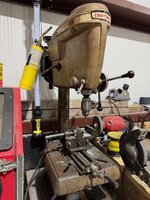
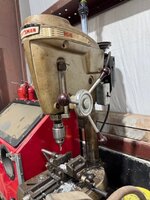
I picked this up from a local online auction a few weeks ago. I have been trying to do research and, near as I can figure, it seems to be around 1964. It has the shallow pockets on the base and the hole for the chuck on the table. What I have issues with is identifying if it is a King Seeley or Emerson build. The motor tag is not legible at all and looks like it was a bench grinder motor as there is a shaft out both ends, but that seems common on these. The tag for the drill press is also missing from the base. Are there any other identifying marks that may still be on it? I looked at the post showing all of the Craftsman Drill Presses chronologically. This one has two holes drilled on the left side, when facing it, like the pic of the ‘63, but it does not have the adjusting knob so that and the base led me to believe 64. But King Seeley or Emerson? That is my question.
When they loaded it into my truck they broke one of the handle tips, so looking for a replacement one of those, or all three. It looks dark gray or black in color.
Also trying to ID the vise it came with. Similar to the one shown in the 64 Craftsman catalog on the site, but not quite the same.
Working on taming the rust. I live in MN and it will only get worse if I do nothing with it.
When they loaded it into my truck they broke one of the handle tips, so looking for a replacement one of those, or all three. It looks dark gray or black in color.
Also trying to ID the vise it came with. Similar to the one shown in the 64 Craftsman catalog on the site, but not quite the same.
Working on taming the rust. I live in MN and it will only get worse if I do nothing with it.
Attachments


Last edited:
Outlawmws
Well-known member
Also trying to ID the vice it came with. Similar to the one shown in the 64 Craftsman catalog on the site, but not quite the same.
Working on taming the rust.
The Vise is likely Palmgren.
For rust inhibition generally, paste wax or BLO is your friend, depending on the use surface and parts tolerance for mating parts.
Wall-E0852
New member
- Joined
- Nov 10, 2024
- Messages
- 2
Awesome! Thank you
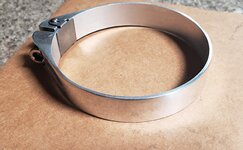
I'm pretty sure I just finished my last step in my Craftsman 150 rebuild. I wanted to find a safety stop collar to mount below the head to prevent an expensive whoops. I wanted something nicer than a muffler clamp, and something subtle that wouldn't look too far out of place. I like what I found. When I ordered this polished aluminum clamp it said it was 2 3/4" but I was left with a 1/8" gap all around. Fortunately, I can't bring myself to throw away used serpentine belts and my day finally came. I cut a small trip of the belt and epoxied it inside the clamp. Now the fit is perfect, it's insulating the aluminum from the steel, and I think it will provide more grip on the column. And, it was only about $10.
It actually looks better than the pictures, the reflections make it look beat-up.

It actually looks better than the pictures, the reflections make it look beat-up.
Delta and Delta/Rockwell collars are 2 3/4 as well. They make a fancy cast one and a cheaper one of 1/8 thick x 1/2 wide (if memory serves) sheet metal one. Neither are an eyesore, you might consider looking at them if you lose confidence in the one you made. bill s
tombell572
Well-known member
Additional alternatives from McMaster might also be suitable, especially if the shaft is an oddball size:

 www.mcmaster.com
Tom B.
McMaster-Carr
McMaster-Carr is the complete source for your plant with over 595,000 products. 98% of products ordered ship from stock and deliver same or next day.
Tom B.
Beerhippie
Well-known member
Ever have that "This doesn't look right" feeling?

I was doing some drilling on a project with the old Darra James. I'd just finished my last hole and lifted the quill... but not the spindle!
An hour-and-a-half and it's back together. Lots of LocTite this time.
I was doing some drilling on a project with the old Darra James. I'd just finished my last hole and lifted the quill... but not the spindle!
An hour-and-a-half and it's back together. Lots of LocTite this time.
Provincial
Well-known member
That's a lot of "quill drop."
Beerhippie
Well-known member
Quill's where it should be--that's the spindle.That's a lot of "quill drop."
The spindle is retained by a single set-screw--or was. It now has three.
dutchgray
Well-known member
Bought this high speed sensitive drill, Webo Rapid (German), pretty old I guess 1,900 to 19,000 rpm over six speeds though I only have the motor pulley for the lower 3 (you have to swap out a 3 step flat belt pulley). Stands 5' tall, has 2/3rd hp 3 phase motor
It was cheap and local, I don't really need it but couldn't resist.

It was cheap and local, I don't really need it but couldn't resist.
OK, I'm pretty sure that this is the last modification to my 150 restoration. The little toggle switch on the bottom of the motor was slightly better than no switch at all. And I refuse to drill the first unnecessary hole in this 63 year old drill press, so I scratched my head and came up with a solution that works well for me.
I had to break my rule of not buying a cheap imported product over an American-made product. This very-foreign, $14.00 switch has me impressed so far. I don't know what the internal contacts look like, but from the outside this things seems to be pretty solid, much better than I expected from the picture. And the good news is I was able to use 2 of the motor mount bolts to secure it.
Following Jeff's unwritten rule of "if it's not polished, it's gold or brown", I think I made it appear that it was an option that Craftsman forgot to include.

I had to break my rule of not buying a cheap imported product over an American-made product. This very-foreign, $14.00 switch has me impressed so far. I don't know what the internal contacts look like, but from the outside this things seems to be pretty solid, much better than I expected from the picture. And the good news is I was able to use 2 of the motor mount bolts to secure it.
Following Jeff's unwritten rule of "if it's not polished, it's gold or brown", I think I made it appear that it was an option that Craftsman forgot to include.
tool_scrounge
Well-known member
Nice drill press. I always like the table adjustment on that style drill.Bought this high speed sensitive drill, Webo Rapid (German), pretty old I guess 1,900 to 19,000 rpm over six speeds though I only have the motor pulley for the lower 3 (you have to swap out a 3 step flat belt pulley). Stands 5' tall, has 2/3rd hp 3 phase motor
It was cheap and local, I don't really need it but couldn't resist.
OK, I'm pretty sure that this is the last modification to my 150 restoration. The little toggle switch on the bottom of the motor was slightly better than no switch at all. And I refuse to drill the first unnecessary hole in this 63 year old drill press, so I scratched my head and came up with a solution that works well for me.
I had to break my rule of not buying a cheap imported product over an American-made product. This very-foreign, $14.00 switch has me impressed so far. I don't know what the internal contacts look like, but from the outside this things seems to be pretty solid, much better than I expected from the picture. And the good news is I was able to use 2 of the motor mount bolts to secure it.
Following Jeff's unwritten rule of "if it's not polished, it's gold or brown", I think I made it appear that it was an option that Craftsman forgot to include.
Wow. We need a LOT more pics of that beauty!
Mike
dutchgray
Well-known member
I do too, the only problem is if they haven't been lowered in a very long time it can be very difficult to get the lifting screw to run down, one like that isn't so bad with a single screw but I had a 4 spindle production press for a couple years which had a two part screw, I never got the lower larger dia section to free up and turn, it obviously hadn't moved in a long time and was very stuck in the nut.Nice drill press. I always like the table adjustment on that style drill.
Beerhippie
Well-known member
My old Darra James 350 got a heart transplant!
The treadmill motor I used, 'though it claimed 2 1/2 hp, didn't cut it. It would bog down very easily at the speeds I need for drilling metal--especially stainless--using the largest spindle and smallest drive sheaves I could get away with.
So I hit the 'Bay and found this:

Rated at 1/2 hp and 1,800 rpm.
It set me back $85, but new price is between ~$600 and $1,500, so I didn't do too badly.
It took some creativity to fab a mount for it, as it's a face-mount motor.

What we call a C-face mount around here. It was probably mounted to a gear box in its previous life.
Some scrap, some cutting and drilling (with an underpowered DP), some booger welds and...


My limit for down-pressure is now flex in the 1 5/8" column. At 300 rpm, I can't bog the motor down, even two-******* a 1/2" bit in stainless!
It's still variable-speed using the same MC60 controller, but my speeds are now limited to about 100-660 rpm. I'd like to bump that up to 250-~1,200, so I'll be playing with the sheaves when my shorter AX belt arrives.
The treadmill motor I used, 'though it claimed 2 1/2 hp, didn't cut it. It would bog down very easily at the speeds I need for drilling metal--especially stainless--using the largest spindle and smallest drive sheaves I could get away with.
So I hit the 'Bay and found this:
Rated at 1/2 hp and 1,800 rpm.
It set me back $85, but new price is between ~$600 and $1,500, so I didn't do too badly.
It took some creativity to fab a mount for it, as it's a face-mount motor.
What we call a C-face mount around here. It was probably mounted to a gear box in its previous life.
Some scrap, some cutting and drilling (with an underpowered DP), some booger welds and...
My limit for down-pressure is now flex in the 1 5/8" column. At 300 rpm, I can't bog the motor down, even two-******* a 1/2" bit in stainless!
It's still variable-speed using the same MC60 controller, but my speeds are now limited to about 100-660 rpm. I'd like to bump that up to 250-~1,200, so I'll be playing with the sheaves when my shorter AX belt arrives.
Beautiful DP!!!OK, I'm pretty sure that this is the last modification to my 150 restoration. The little toggle switch on the bottom of the motor was slightly better than no switch at all. And I refuse to drill the first unnecessary hole in this 63 year old drill press, so I scratched my head and came up with a solution that works well for me.
I had to break my rule of not buying a cheap imported product over an American-made product. This very-foreign, $14.00 switch has me impressed so far. I don't know what the internal contacts look like, but from the outside this things seems to be pretty solid, much better than I expected from the picture. And the good news is I was able to use 2 of the motor mount bolts to secure it.
Following Jeff's unwritten rule of "if it's not polished, it's gold or brown", I think I made it appear that it was an option that Craftsman forgot to include.
Guys, if you want quality/high end USA switches, pilot lights, enclosures, etc go to Ebay and search "Allen Bradley 800T". There's a glut of industrial grade USA controls and they go for pennies on the dollar.
I think this switch was around $15, pilot light was $10 and enclosure was around $30.

Beerhippie
Well-known member
I finally got the new, shorter AX belt in (the mounting of this motor is closer to the spindle than the old one) and now everything fits.
I still wanted to speed things up and was thinking about using the original sheave stack for the spindle instead of the 5" sheave I have on it currently. Then I remembered that I'd added a resistor in series with the pot to slow the old motor down. I got to thinking, I'm only getting 70V at the highest speed with that resistor in line and the motor is rated for 90V. Speeding it up by using a smaller spindle sheave would cost torque, when the motor isn't operating at full speed anyhow.
I removed the resistor and now the usable range is about 60-1,100 rpm on the spindle--just about exactly where I wanted it! Still can't bog it down above about 150 rpm.
I still wanted to speed things up and was thinking about using the original sheave stack for the spindle instead of the 5" sheave I have on it currently. Then I remembered that I'd added a resistor in series with the pot to slow the old motor down. I got to thinking, I'm only getting 70V at the highest speed with that resistor in line and the motor is rated for 90V. Speeding it up by using a smaller spindle sheave would cost torque, when the motor isn't operating at full speed anyhow.
I removed the resistor and now the usable range is about 60-1,100 rpm on the spindle--just about exactly where I wanted it! Still can't bog it down above about 150 rpm.
crguy
Well-known member
Friction Drive U. S. Electrical Tool Co. drill press. Just acquired this and haven't been able to find much online. Vintage machinery has some company information, but only one 1906 ad for the drill press. Seems to be pretty original except for the repaint. Going to check/lube things before I plug it in. Anybody have any info on this one? I've owned 3 other friction drill press and saved pics of everything I have found online for years, but haven't seen this one before. 

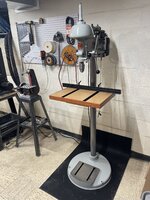
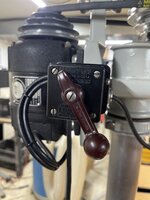
1941 Walker Turner 900 series. Bought this one from the family of the original owner. I did a full restoration and made a custom table for it. It came complete with slo-speed pulley and a reverse switch.
Attachments

Last edited:
Thanks Mike, I have a more to share, I’ve restored quite a few. The 900 is a keeper!
ScepterToad
Well-known member
- Joined
- Nov 9, 2023
- Messages
- 353
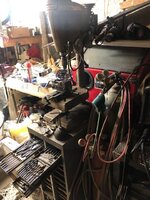
Really crappy picture of my old Craftsman. I'll get a better one later.
And next up is a sneak peek at an old (mid 1890s to my best guess) Lodge and Davis. This is currently in my dad's barn, but will be moving to the shop soon (hopefully). It's not all original. Motor is different, but it retains the flat belt and pulleys. Really excited to get this one in and cleaned up. I don't plan on doing a full restoration.
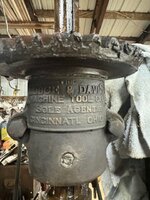
And next up is a sneak peek at an old (mid 1890s to my best guess) Lodge and Davis. This is currently in my dad's barn, but will be moving to the shop soon (hopefully). It's not all original. Motor is different, but it retains the flat belt and pulleys. Really excited to get this one in and cleaned up. I don't plan on doing a full restoration.
That is one of the strangest things I've ever seen. I'm not sure I understand it. Does the upper round "table" serve any other purpose other than transferring power from the motor?Friction Drive U. S. Electrical Tool Co. drill press. Just acquired this and haven't been able to find much online. Vintage machinery has some company information, but only one 1906 ad for the drill press. Seems to be pretty original except for the repaint. Going to check/lube things before I plug it in. Anybody have any info on this one? I've owned 3 other friction drill press and saved pics of everything I have found online for years, but haven't seen this one before.
I would guess infinitely variable speed control.That is one of the strangest things I've ever seen. I'm not sure I understand it. Does the upper round "table" serve any other purpose other than transferring power from the motor?
Beerhippie
Well-known member
It's the oldest (that I know of) form of CVT. There were some early cars that used that sort of drive, with the driven wheel actually made of (highly compressed) cardboard!That is one of the strangest things I've ever seen. I'm not sure I understand it. Does the upper round "table" serve any other purpose other than transferring power from the motor?

Friction drive - Wikipedia
O
OK, NOW I get it!
Friction drives are still used in most snowblowers, according to my dealer.
Mike
It's the oldest (that I know of) form of CVT. There were some early cars that used that sort of drive, with the driven wheel actually made of (highly compressed) cardboard!
Friction drive - Wikipedia
en.wikipedia.org
OK, NOW I get it!
Friction drives are still used in most snowblowers, according to my dealer.
Mike
Really crappy picture of my old Craftsman. I'll get a better one later.
And next up is a sneak peek at an old (mid 1890s to my best guess) Lodge and Davis. This is currently in my dad's barn, but will be moving to the shop soon (hopefully). It's not all original. Motor is different, but it retains the flat belt and pulleys. Really excited to get this one in and cleaned up. I don't plan on doing a full restoration.
I really like that cabinet under the Craftsman, what is it?
Wow, definitely save that old Lodge & Davis! I occasionally find random, REALLY old stuff for sale around here, but nothing I have a family history with. That's very special.
Mike
Outlawmws
Well-known member
I really like that cabinet under the Craftsman, what is it?
Looks to be an old card file to me - Good re-purpouse if so!
crguy
Well-known member
Correct.I would guess infinitely variable speed control.
crguy
Well-known member
It gives you variable speed by moving the drive wheel on top.That is one of the strangest things I've ever seen. I'm not sure I understand it. Does the upper round "table" serve any other purpose other than transferring power from the motor?
PowerWagonBuilder
Well-known member
So I HAD a cool old drill press, that I replaced with another cool old drill press, but not quite as old. And, the replacement is actually a RAD so does that still make it a press?
So, for scale of things... what I was previously using was a 1939 Barnes All Gear drive 24" MT3 drill press.
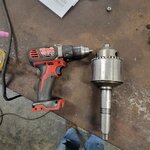
Here is the chuck out of the thing compared to a M18 drill. Now compare that to the chuck installed in the drill in the next photo. The drill weighed around 3,000 lbs. Its a beautiful machine and I enjoyed using it and looking at it but I ran into some spots where it wouldn't do the job due to limitations on column height and gear speed. It was self feeding with 8 power feed speeds too.
Now with the same chuck installed.

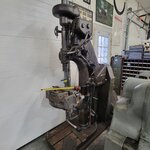
So I sold that one to a guy who is enjoying it and using it for drilling out and resizing head bolts on diesel marine engines for whatever his rebuild application is.
The replacement - instead of 3k lbs, I went with a 5200 lb unit. Has a removable swivel table and an 8" Kurt machine vise. Power feeds, and is rated to a 5" drill... but all I have up to is a 3"
Its a 1954 Cinci Bickford 9x4 Radial arm drill. 5 hp 3 phase.
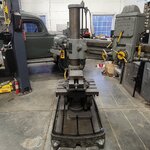
The arm climbs and lowers on the column under its own power and the arm swinging away makes loading of weird heavy parts rather easy.

^ If I recall, that was a 1-5/16" diameter drill there that I was working with.
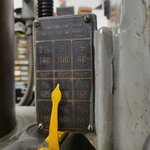
Running on a VFD to convert to 3 PH and give me further speed control of the motor, including DC braking for power tapping and reversing.
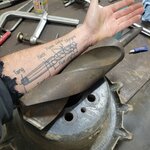
And this is what a 3" diameter twist drill looks like. I can't believe this thing has such a tiny shank too. The RAD is an MT4 quill with 14" of travel.
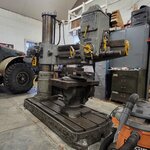
Oh, and yes. This is my garage space. I live in this building with these machines and this is all side hobby, a little bit of side work for friends, but just an obsession with big old heavy machinery that is above normal homeowner size but typically a little too small for big industrial shops. I have a CInci No 2 High Speed Mill and a Bridgeport that sometimes get used as drills as well.
So, for scale of things... what I was previously using was a 1939 Barnes All Gear drive 24" MT3 drill press.
Here is the chuck out of the thing compared to a M18 drill. Now compare that to the chuck installed in the drill in the next photo. The drill weighed around 3,000 lbs. Its a beautiful machine and I enjoyed using it and looking at it but I ran into some spots where it wouldn't do the job due to limitations on column height and gear speed. It was self feeding with 8 power feed speeds too.
Now with the same chuck installed.
So I sold that one to a guy who is enjoying it and using it for drilling out and resizing head bolts on diesel marine engines for whatever his rebuild application is.
The replacement - instead of 3k lbs, I went with a 5200 lb unit. Has a removable swivel table and an 8" Kurt machine vise. Power feeds, and is rated to a 5" drill... but all I have up to is a 3"
Its a 1954 Cinci Bickford 9x4 Radial arm drill. 5 hp 3 phase.
The arm climbs and lowers on the column under its own power and the arm swinging away makes loading of weird heavy parts rather easy.
^ If I recall, that was a 1-5/16" diameter drill there that I was working with.
Running on a VFD to convert to 3 PH and give me further speed control of the motor, including DC braking for power tapping and reversing.
And this is what a 3" diameter twist drill looks like. I can't believe this thing has such a tiny shank too. The RAD is an MT4 quill with 14" of travel.
Oh, and yes. This is my garage space. I live in this building with these machines and this is all side hobby, a little bit of side work for friends, but just an obsession with big old heavy machinery that is above normal homeowner size but typically a little too small for big industrial shops. I have a CInci No 2 High Speed Mill and a Bridgeport that sometimes get used as drills as well.
Attachments
That makes sense now that you explained it. ThanksIt gives you variable speed by moving the drive wheel on top.
ScepterToad
Well-known member
- Joined
- Nov 9, 2023
- Messages
- 353
Looks to be an old card file to me - Good re-purpouse if so!
I really love that cabinet as well. I got this drill press from the son of an old guy who used the drill press to machine parts for old tractors. He used it mostly like a mill. The drill press was sitting on top of that cabinet in his garage, so I was able to snag that before his grandson (who doesn't actually work on anything) came in and pulled the family card. I guess I really can't blame him for that. I did miss out on all of the tooling he had as a result though.
In any case, the cabinet doesn't really have many markings on it, aside from the numbers associated with the shelf supports. The shelves themselves are open on the back end (not a tray) and some have old stickers on them, mostly to do with banks. The "trays" are 23.5x6.5. I wish I had more trays, but that's all that came with it.


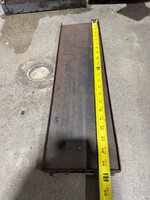
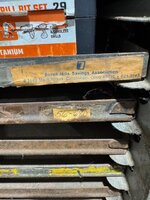
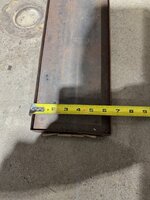
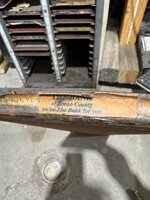
That number actually looks like an old account number or routing number. Wish I knew the actual history.
Just realized that my Mapp gas has fallen over.
All in, the drill press is in pretty good shape. Motor is not original, and it has the switch installed as well. I'm thankful I was able to pick it up.
EDIT: @mikeinri I tried to quoted your post as well. Apparently I haven't had enough coffee yet today.
crguy
Well-known member
That cabinet is for letterpress printers to store galleys in. The galley is the steel tray that holds a group of "type" that is assembled for a specific printing job. These are for repeat jobs so you don't have to assemble the type each time that job comes up.I really love that cabinet as well. I got this drill press from the son of an old guy who used the drill press to machine parts for old tractors. He used it mostly like a mill. The drill press was sitting on top of that cabinet in his garage, so I was able to snag that before his grandson (who doesn't actually work on anything) came in and pulled the family card. I guess I really can't blame him for that. I did miss out on all of the tooling he had as a result though.
In any case, the cabinet doesn't really have many markings on it, aside from the numbers associated with the shelf supports. The shelves themselves are open on the back end (not a tray) and some have old stickers on them, mostly to do with banks. The "trays" are 23.5x6.5. I wish I had more trays, but that's all that came with it.
That number actually looks like an old account number or routing number. Wish I knew the actual history.
Just realized that my Mapp gas has fallen over.
All in, the drill press is in pretty good shape. Motor is not original, and it has the switch installed as well. I'm thankful I was able to pick it up.
EDIT: @mikeinri I tried to quoted your post as well. Apparently I haven't had enough coffee yet today.
ScepterToad
Well-known member
- Joined
- Nov 9, 2023
- Messages
- 353
So, that might explain the banks. May have been printing checks for each bank with the routing numbers and the setup for each. Cool stuff, thanks!That cabinet is for letterpress printers to store galleys in. The galley is the steel tray that holds a group of "type" that is assembled for a specific printing job. These are for repeat jobs so you don't have to assemble the type each time that job comes up.
Back to the drill presses....
Thanks, @ScepterToad!
Interesting history on the DP, that's a great testament to the strength and durability that it was able to hold up well to the side loading of machining!
Mike
Interesting history on the DP, that's a great testament to the strength and durability that it was able to hold up well to the side loading of machining!
Mike

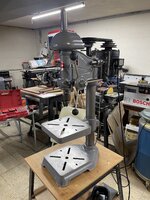

Looks great. Is the custom table for woodworking?Atlas model 63 Cregs list find, added slow/high speed pulley and finished it off with custom table, head badge and switch plate decals.