To avoid these ads, REGISTER NOW!

Show us your handplanes

bobemmerich

Well-known member
Joined
Aug 23, 2009
Messages
1,611
Location
Middletown, Ct.
There's some awesome looking hand planes here! WOW!
I recently (within the last year or so) started buying the old school wooden planes. My home was built in 1734, so I wanted to get a sense of what they used in the old days. As soon as I can get my garage/shop straightened out, I'll be using them and learning. I'm at work, so I don't have pics, but I'll try and get some tomorrow.
 
To avoid these ads, REGISTER NOW!

Prichman38

Well-known member
Joined
Sep 10, 2016
Messages
81
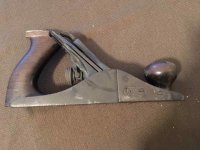
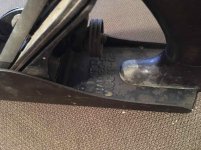
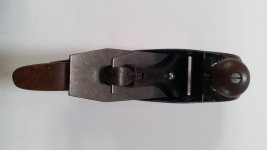
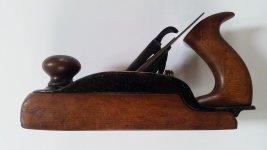
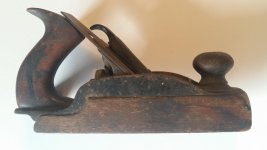
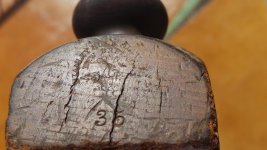
I like the old repair on this Type 9 Bailey 1902 number 4. But I assume it dramatically effects the value. But I only paid $1 for it.

IMG_0208.jpgIMG_0207.jpgIMG_0206.jpg


Sent from my iPad using Tapatalk
 

CRSINMICH

Well-known member
Joined
Aug 15, 2015
Messages
2,396
Location
Southeastern Michigan
I own some nice old handplanes, I know nothing about how to adjust them or what planes do what. Please direct me to a video or articles that explain this so I can use them with minimal frustration.

jon: That's quite a tall order. The amount of information on hand planes can, and will, make your head spin. There is probably no one site or video that will answer all your questions. Here are two sites that can get you started or at least get you pointed in the right direction. If you could post pictures of some of your planes, your questions might be able to addressed more specifically.

What Are The Different Types of Woodworking Hand Planes:
https://www.wonkeedonkeetools.co.uk...he-different-types-of-woodworking-hand-plane/

Choosing Hand Planes:
https://www.popularwoodworking.com/projects/choosing-hand-planes/
 
Last edited:

Jim C.

Well-known member
Joined
Jan 8, 2010
Messages
2,598
I own some nice old handplanes, I know nothing about how to adjust them or what planes do what. Please direct me to a video or articles that explain this so I can use them with minimal frustration.


There’s some pretty good low tech conversation about old hand planes here:
Several types and patterns are covered, including a little history, their use, and availability. Lots of pictures too.

http://www.papawswrench.com/vboard/index.php?topic=9443.msg59439#msg59439

The index associated with the link above can be found here:

http://www.papawswrench.com/vboard/index.php?topic=10243.msg65624#msg65624

Both threads link to each other.
 
Last edited:

Provincial

Well-known member
Joined
Sep 21, 2011
Messages
6,855
Location
Near Salem, OR
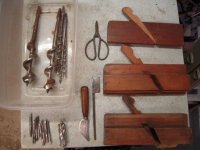
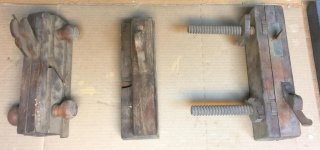
I picked up three old wooden hand planes last weekend. They are molding planes, and have interesting shapes. The seller was moving to town and this was the last day of the sale. He lowered the price to where it was easy to decide to buy them.

The main reason I bought them is because my wife inherited her grandfather's planes. He was a carpenter who immigrated to the US from Austria just before WWI. The planes were stored in a barn after he retired, and remained there after his death. They stayed there for forty years before my wife got them, and the irons are rusty and the wood has no finish left.

I bought these to show the original finish. I understand that refinishing old planes is discouraged, so showing these with the family relics allows the viewer to imagine what the family planes looked like when they were being used.
 

Attachments

  • Saturday 1b.comp.jpg
    Saturday 1b.comp.jpg
    35.1 KB · Views: 40

jonshonda

Well-known member
Joined
Jul 17, 2017
Messages
4,733
Location
Wisconsin
Thanks CRSINMICH and Jim C, I will have to do some reading after the kids go to bed a few nights in the future.
 

hsvtoolfool

Well-known member
Joined
Jul 29, 2015
Messages
185
Location
Rocket City USA
They stayed there for forty years before my wife got them, and the irons are rusty and the wood has no finish left.

Since your planes are from Austria, probably from the 1900s era but maybe older, I'd love to know the maker's brand.

The only "finish" most wooden body plane got was some type of wipe-on oil (like 50/50 boiled linseed oil and turpentine). I've never seen a varnish or laquer used on any antique wooden plane.

I would just lighty scrub the bodies with steel wool, maybe use a tiny bit of warm soapy water if needed to clean off grime, wipe and dry them off well, then wipe on some danish oil or 50/50 boiled linseed oil and turpentine. Done. You can let it dry for a couple weeks then wipe on another coat of oil like with furniture, by I woudn't bother. These are tools after all.

The bigger problem is: how rusty are the irons? Are they so rusty near the edge that you don't think someone can lap the backs flat to sharpen them properly?
 

Provincial

Well-known member
Joined
Sep 21, 2011
Messages
6,855
Location
Near Salem, OR
Pretty rusty, but I haven't tried to work them over. I think they have been used for the last time. My wife just wants to put them on display.

There are some iron planes, too. I'll have to take an inventory and some photos.
 

CRSINMICH

Well-known member
Joined
Aug 15, 2015
Messages
2,396
Location
Southeastern Michigan
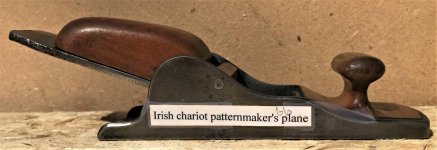
It has been some time since the last post on this thread so I'll throw this one in. It came from an estate sale of a collector. The dearly departed had 176 planes all of which were tagged with identifying information. As you can see, he thought this was Irish but I'm not sure why. The iron is stamped I Sorby, an English maker. There are no other names or marks anywhere. I had never heard of a chariot plane but it turns out to be a real thing. I think of it as a low-angle infill plane.
 

Attachments

  • Low Angle Infill  (4).jpg
    Low Angle Infill (4).jpg
    100.3 KB · Views: 45
  • Low Angle Infill  (5).jpg
    Low Angle Infill (5).jpg
    87.3 KB · Views: 40

crguy

Well-known member
Joined
Jan 24, 2016
Messages
2,646
Location
SW Washington
It has been some time since the last post on this thread so I'll throw this one in. It came from an estate sale of a collector. The dearly departed had 176 planes all of which were tagged with identifying information. As you can see, he thought this was Irish but I'm not sure why. The iron is stamped I Sorby, an English maker. There are no other names or marks anywhere. I had never heard of a chariot plane but it turns out to be a real thing. I think of it as a low-angle infill plane.

Neat plane, no matter what you call it. :thumbup:
 

Old Radar

Well-known member
Joined
Apr 17, 2019
Messages
2,754
Location
San Antonio, TX
I just finished putting the final touches on my Stanley No. 35 Transitional Plane:
I posted this on another thread but this one seems to be the appropriate place.

Basically I just threw the knife, backer plate and the hardware in vinegar overnight. The jappaning is still mostly there on the main body and frog so they just got scrubbed. I did sand and re-stain the wood parts.


Stanley#35Before1.jpgStanley#35Final1.jpg

Stanley#35Before2.jpgStanley#35Final2.jpg

Stanley#35Before3.jpgStanley#35Final3.jpg

Stanley#35Before4.jpg

According to TimeTestedTools, the marks on mine indicate it is a No. 35 Type 6 (1874-1884) except mine still has a knob with a bead around the base. I expect they used up their old supply of beaded knobs before going to the non-beaded type. For that reason, I theorize mine to be a very early Type 6 which should put the manufacture date sometime in 1874.
 

txlonghorn1989

Well-known member
Joined
Feb 27, 2017
Messages
2,786
It has been some time since the last post on this thread so I'll throw this one in. It came from an estate sale of a collector. The dearly departed had 176 planes all of which were tagged with identifying information. As you can see, he thought this was Irish but I'm not sure why. The iron is stamped I Sorby, an English maker. There are no other names or marks anywhere. I had never heard of a chariot plane but it turns out to be a real thing. I think of it as a low-angle infill plane.

Really nice looking plane CRS!
 

CRSINMICH

Well-known member
Joined
Aug 15, 2015
Messages
2,396
Location
Southeastern Michigan
Old Radar: Yes this is the right thread for posting plane pictures. Feel free to post as many as you'd like. Transitionals don't get much respect. I bought one (okay I bought several) recently so that I could judge for myself.

If your plane is an early model, the frog should be held to the wood body by round headed wood screws. If it's a little later model, the frog will be held down by machine screws in threaded inserts. I have one of each. Whenever I get them sharpened, I'll give my opinion.
 
Last edited:

CRSINMICH

Well-known member
Joined
Aug 15, 2015
Messages
2,396
Location
Southeastern Michigan
EVERYONE: Thanks for the compliments on the chariot plane. All I had to do was get to the estate sale by 2:00 a.m. to get number 4, wait 8 hours for the sale to start, beat everyone else to the planes, and then pay way more than I usually do.

Here's another unusual plane. I'm a little hesitant to post it because I wouldn't want this thread to be thought of as only for posting uncommon planes.

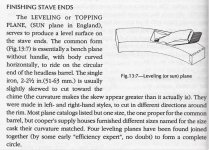
Anyway, this is a coopers' leveler plane. It is used to level the tops of staves when making barrels. I saw one of these in a display of vintage coopers' tools at a winery. I decided that if I ever saw one I'd get it. Much to my surprise, exactly a week later I found this one at a tool sale. It was well used and will be put on display as a conversation piece.

When I cleaned the iron a bit this morning, I discovered that it was made by D.R. Barton of Rochester, New York

p.s. The information about levelers came from a book called "The Wooden Plane" written by John M. Whelan
 

Attachments

  • Leveler plane.jpg
    Leveler plane.jpg
    161.1 KB · Views: 15
  • Leveling plane (7).jpg
    Leveling plane (7).jpg
    146.2 KB · Views: 16
  • Leveling plane (3).jpg
    Leveling plane (3).jpg
    92.6 KB · Views: 15
Last edited:

txlonghorn1989

Well-known member
Joined
Feb 27, 2017
Messages
2,786
tx: BLO is wonderful stuff. One quirk about it is that it is not boiled. Go figure. Yes, 3-in-1 is light machine oil. Sewing machine oil would probably work too. Wooden planes are great to work with but if you think you fell into a rabbit hole with metal planes you aint seen nothing yet. Here's some pictures of my latest wooden plane. It's a chamfer plane. I've been looking for one, metal or wood, for a long time. I haven't done anything to clean it up yet. I may decide to leave it alone. It's in good shape.

CRS, just saw your camfer plane post. I would LOVE to find a camfer plane! You are finding some cool planes!
 

txlonghorn1989

Well-known member
Joined
Feb 27, 2017
Messages
2,786
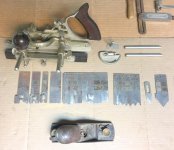
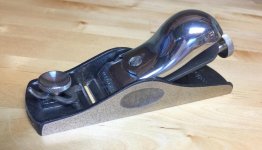
I'd forgotten about this hand planes thread. Will definitely subscribe to it so that doesn't happen again. Picked up some planes since posting back in June. In early Aug I got the chance to hit an estate sale prior to it starting. In fact, the woman called me on the first day she and her crew were going through stuff in preparation for the sale. I picked up my first wooden planes, 13 molding planes and 3 other combo (?) planes. Also, came home with a great condition Stanley No 45 and a Stanley No 18 block plane with the first pronged-fork version of the lever cap. Eight of the molding planes were made by a M. Crannell of Albany, one other by Bensen & Crannell of Albany, and can't tell on the rest. The Stanley No 45 has a standard set of cutters and I've been told it is complete with no missing parts. I believe the Stanley No 18 is a type 2 based on pics in the Stanley Tools book by J Walter. Really not a good design. If anyone knows anything about M Crannell or the plane makers in and around Albany and a timeframe when these were being made I would love to know more. Also, an idea of value would be appreciated.
 

Attachments

  • IMG_9083.jpg
    IMG_9083.jpg
    106.2 KB · Views: 28
  • IMG_9080.jpg
    IMG_9080.jpg
    111 KB · Views: 25
  • IMG_9121.jpg
    IMG_9121.jpg
    134.7 KB · Views: 28
  • IMG_9127.jpg
    IMG_9127.jpg
    76 KB · Views: 23

txlonghorn1989

Well-known member
Joined
Feb 27, 2017
Messages
2,786
Also, in the last month I picked up a WoodRiver No 4-1/2 and a WoodRiver standard block plane at an estate sale. They both had a bit of surface rust but I've gotten rid of that but the discoloration remains. The surface is smooth but what do you guys recommend in terms of maintaining flatness and removing the discoloration? Thanks!
 

Attachments

  • IMG_9457.jpg
    IMG_9457.jpg
    130.9 KB · Views: 14
  • IMG_9447.jpg
    IMG_9447.jpg
    120.4 KB · Views: 15
To avoid these ads, REGISTER NOW!

txlonghorn1989

Well-known member
Joined
Feb 27, 2017
Messages
2,786
Oh, one more hand plane, a week after I got all the molding planes and others I picked up a Stanley No 92 shoulder plane with some other goodies. It's been a good year for me and hand planes. :0)
 

Attachments

  • IMG_9222.jpg
    IMG_9222.jpg
    151.2 KB · Views: 64

Old Radar

Well-known member
Joined
Apr 17, 2019
Messages
2,754
Location
San Antonio, TX
Old Radar: Yes this is the right thread for posting plane pictures. Feel free to post as many as you'd like. Transitionals don't get much respect. I bought one (okay I bought several) recently so that I could judge for myself.

If your plane is an early model, the frog should be held to the wood body by round headed wood screws. If it's a little later model, the frog will be held down by machine screws in threaded inserts. I have one of each. Whenever I get them sharpened, I'll give my opinion.

Yep. Two original round headed slotted wood screws driven straight into the wood. The #35 also has a tail screw holding the cast body to the wood but mine was not original and had stripped out the hole. Had to shim the block and use a more appropriate sized screw.

I understand transitionals don't get much respect but I like them for the warm feel of the wood in my hands vs. the cold steel of the later planes.
 

hsvtoolfool

Well-known member
Joined
Jul 29, 2015
Messages
185
Location
Rocket City USA
I picked up my first wooden planes, 13 molding planes and 3 other combo (?) planes.

In your 13 lineup shot, the first molding plane on the left is the most interesting, but we'd need to see the bottom/sides to tell you what it does. The screw on top looks like it allows the throat to be adjusted, but it may perform some other duty.

You have a few "hollows" and "rounds" in that same lineup. They're a generic moulding plane which come in matched sets. Unlike other molding planes which take their names from the profile they leave behind (bead, ogee, astragal, etc.), the hollow and round planes are named for their bottom profile. A hollow is concave while the round is convex. In other words, the round cuts a recessed cove into the molding.

For example, the second plane of the left is a large "round". Somewhere out there is a "hollow" of the same diameter but it's concave instead of convex. The fourth plane from the left is an example of a" hollow". In fact, it may be the match to the round. If so, the same number will be stamped on the ends of each plane. It also appears there are a few small diameter rounds on the far right end of your lineup, but they may be some other type of moulding plane. It's hard to tell from that angle.

Most hollow/round sets were specified in 1/16" diameter increments. So a #8 hollow (or round) is a 1/2" diameter profile. So the two hollow/round planes on the left end will have larger numbers, while those on the far right will have small numbers. But standardization wasn't a priority back before the civil war. So you may have a set which is numbered backwards or has a unique system.

Also, an idea of value would be appreciated.

The block plane is in very poor condition and is common. The mounding planes are also dime a dozen. I don't see anything special there, although they are very useful tools. If you clean up and conserve the sash and fillister planes nicely, they may have some value in good condition. If you ever find an old wooden planes made of rosewood, boxwood, ebony, mahogany, or ironwood then get it appraised. It's probably was something special. Most wooden planes were beech or rock maple.

The #45 appears to be a later model and not especially valuable, though very useful. The main value in that #45 plane is all the blades. It would have more value as a whole with the original paper box, wooden blade box, and the cute little Stanley screwdriver that came with it.

For all of these planes, you can shop around on Ebay and Craigslist to get ballpark estimates of value. There's lots of lazy flippers trying to make easy money, so prices tend to be higher than the actual market. But if you find these tools interesting, I recommend you attend local flea markets and meet some tool dealers. They tend to be avid hobbyists and know their stuff. They can tell you what you have and what it's going for now.
 

CRSINMICH

Well-known member
Joined
Aug 15, 2015
Messages
2,396
Location
Southeastern Michigan
tx: The information that toolfool gave you is correct, if a bit bluntly stated. It sounds like he spoke from experience. From my perspective, those wooden planes are a gold mine. They might not be collectors items (they might be) but if you take a good look at them you could gain a lot of valuable knowledge about wooden planes. For instance in the group shot of molding planes the plane eighth from the left is boxed. Look along the bottom edge and you'll see what looks like an insert of a lighter wood. That's exactly what it is. A strip of boxwood was added because it is hard and wears well. It was relatively expensive and added extra time to insert it into the plane. It can be a mark of something more than ordinary. You'll have to look even closer at the fifth plane from the left. There is an etched line running slightly diagonally from the sole toward the top of the plane. That is a spring line. Imagine you're going to use that plane to cut a molded profile on a piece of wood. You'd have to look down the toe (front) and tilt the plane until that line was vertical. That would orient the plane correctly to cut the profile. I apologize if you already knew that. It's hard to know.

While we're on the subject of plane toes, the names stamped into the wood are owners' names and makers' names. It looks like you raided a good portion of P. Kroll's planes. The smaller words, which I can't make out, will be the maker's name. Take a little time and google the names. You'll probably be surprised at what you find. I haven't even touched on the 3 wooden planes in their own picture. Find out what you can about what kind of planes they are and what they were used for.

One last thing, toolfool was right about the #45 too. It is very useful. It looks like yours is complete but there is one piece that you might want to add. It's called a long foot. It looks like the piece to the right of the tote in your photo except that the flat section is, well, longer. It will allow you to cut a bead right up to the edge of the wood. You may not ever want to do that but if you do they are readily available on Ebay.
 
Last edited:

txlonghorn1989

Well-known member
Joined
Feb 27, 2017
Messages
2,786
toolfoot & CRS, Thanks for the info! Not knowing anything about wooden planes (molding or otherwise) just didn't know. I'd heard molding planes weren't worth a lot. I didn't have to pay much for them. So no big loss. Didn't buy them because I thought they'd be worth money. Just interested in them and first time I've had an opportunity to buy any. For me it's always cool to come across any old Stanley plane I don't have like the #45 and the #18. Won't ever use the #18 but will add it to my small but slowly growing collection of Stanley hand planes. I definitely plan on using the #45.

I had previously googled M Crannell trying to find info on the maker. This time I added a bit more info and at least found an Albany City Directory entry from 1863. See the pic below. Kind of cool to think that this could be the guy who made these molding planes.

CRS, I included a pic take of some #45 parts. Is that the long foot you're referring to?

Good stuff guys! Thank you!!
 

Attachments

  • M Crannell Albany City Directory 1863.JPG
    M Crannell Albany City Directory 1863.JPG
    89.8 KB · Views: 19
  • Stanley #45 long foot.JPG
    Stanley #45 long foot.JPG
    17.3 KB · Views: 21

txlonghorn1989

Well-known member
Joined
Feb 27, 2017
Messages
2,786
Guys, I'm hoping someone has recommendations on decent sandpaper rolls to purchase and possibly even where I might buy said sandpaper rolls most economically. I suspect in sandpaper cheaper isn't always better. I'm going to use these for some hand plane restorations. I'm thinking to get a couple of rolls maybe 120 & 240 or 320.

I've seen the video where Paul Sellers does a quick rehab on a vintage Stanley hand plane. He used sandpaper off a roll to remove surface rust and to "flatten" the plane. I'd typically prefer other methods for rust removal like Evaporust or electrolysis but there are instances where I can see wanting/needing to use a sandpaper roll to help "flattening" a plane bottom or clean up some discoloration due to rust. I've got a couple of 2" thick granite surface blocks I use for smaller planes and a much larger piece of granite counter top I plan to use for these larger planes.

Thoughts and recommendations much appreciated!

Mike
 

Old Radar

Well-known member
Joined
Apr 17, 2019
Messages
2,754
Location
San Antonio, TX
Guys, I'm hoping someone has recommendations on decent sandpaper rolls to purchase and possibly even where I might buy said sandpaper rolls most economically. Mike

Mike--

I must have missed why you are looking specifically for sandpaper rolls, but for those of us who haunt estate sales cruising for vintage tools, inexpensive packages of sandpaper are a literally a dime a dozen. I haven't bought sandpaper at a box store in years and have several year's supply on hand (from 45 grit to 600) that I picked up here and there for pennies on the dollar. Steel wool is even cheaper.
 

txlonghorn1989

Well-known member
Joined
Feb 27, 2017
Messages
2,786
Mike--

I must have missed why you are looking specifically for sandpaper rolls, but for those of us who haunt estate sales cruising for vintage tools, inexpensive packages of sandpaper are a literally a dime a dozen. I haven't bought sandpaper at a box store in years and have several year's supply on hand (from 45 grit to 600) that I picked up here and there for pennies on the dollar. Steel wool is even cheaper.

OR: I've also picked up a LOT of sandpaper and steel wool (lifetime supply by now) at estate sales. I guess I wanted to get rolls so I could have one contiguous piece down that would be the length of the plane and then some. Help ensure I didn't hit one area too much. Wrong way of thinking? I'm certainly no expert on rehabbing old planes.
 

Old Radar

Well-known member
Joined
Apr 17, 2019
Messages
2,754
Location
San Antonio, TX
I guess it depends on your sanding technique.

Technically, I see your concern--if you place a sheet of sandpaper on your flat granite block and slide the plane back and forth over it you will invariably drive the toe and heel beyond the surface of the paper resulting in the mid section of the plane being sanded more than the ends.

Taken to the extreme, this would seem to result in a concave surface, but practically, this is self-correcting. If more material is sanded away from the center of the plane on a full back-and-forth stroke, on the next full stroke, the "extra" material on the toe and heel will prevent the center section from fully contacting the sanding surface. If constant pressure is applied throughout both strokes, equilibrium should be regained and you should wind up with a smooth flat surface.

I suppose if you only let the toe constantly overshoot the sandpaper and you sanded like a maniac for an hour, you could wear down the heel area.
 
Last edited:

Old Radar

Well-known member
Joined
Apr 17, 2019
Messages
2,754
Location
San Antonio, TX
Just finished the minor rehab of another dis-respectable transitional plane. This time it's a Stanley No.23 Smooth Plane. The number two is a little difficult to see. It's 9" long with a 1-3/4" wide iron.

According to Time Tested Tools, the markings indicate it is a Type 12 (1905-1908)--but because the underside of main cast body has a ""B" casting mark that was indicative of some Type 11s, I have to assume this is a very early Type 12, i.e. 1905. The "B" apparently is a code letter for a sub-contracted foundry, but the name is unknown.
https://www.timetestedtools.net/2019/02/19/roger-k-smiths-stanley-transitional-type-study/

Before:
Stanley#23Before.jpg

After:
Stanley#23After1.jpgStanley#23After2.jpg

Stanley#23After3.jpgStanley#23After4.jpgStanley#23After6.jpg
 

CRSINMICH

Well-known member
Joined
Aug 15, 2015
Messages
2,396
Location
Southeastern Michigan
tx: When I flattened the sole of a #7 last year I went to HF and bought a package of 6" X 42" sanding belts. (They were cheap). I cut out the overlapping seam and glued the rest to the table of my table saw. That gave plenty of room for back and forth movement without going off the sandpaper. Have a brush handy to remove the dust that will clog the grit. A crepe eraser will help too.

Old Radar: Another nice rehab. I'm going to have to get sharpening to try out the transitional planes I already have.
 
Last edited:

454ragtop

Well-known member
Joined
Mar 24, 2008
Messages
5,011
Location
Carver, MA
Picked up this little plane at a yard sale this AM, along with the cute little universal bevel. What is this type of plane called, and what is it commonly used for? Any idea who made the bevel? Seem to be finding lots of them lately, though usually not as small and detailed as this one.
 

Attachments

  • 20191026_160737.jpg
    20191026_160737.jpg
    147.2 KB · Views: 24
  • 20191026_160117.jpg
    20191026_160117.jpg
    155.3 KB · Views: 26
  • 20191026_160702.jpg
    20191026_160702.jpg
    148 KB · Views: 23
  • 20191026_160104.jpg
    20191026_160104.jpg
    125.3 KB · Views: 29
  • 20191026_160636.jpg
    20191026_160636.jpg
    149.2 KB · Views: 26

454ragtop

Well-known member
Joined
Mar 24, 2008
Messages
5,011
Location
Carver, MA
While I have your attention, I have this little spokeshave I found a year or so ago, doesn't seem to have any marking, anybody recognize it? Just threw it in Evaporust, see if any markings turn up.
 

Attachments

  • 20191026_161028.jpg
    20191026_161028.jpg
    143.3 KB · Views: 18
  • 20191026_161041.jpg
    20191026_161041.jpg
    78.9 KB · Views: 17
  • 20191026_161056.jpg
    20191026_161056.jpg
    90 KB · Views: 14

Old Radar

Well-known member
Joined
Apr 17, 2019
Messages
2,754
Location
San Antonio, TX
Picked up this little plane at a yard sale this AM, along with the cute little universal bevel. What is this type of plane called, and what is it commonly used for? Any idea who made the bevel? Seem to be finding lots of them lately, though usually not as small and detailed as this one.

It's a rabbet plane, used for, you guessed it, making rabbets in cabinet work.
 

CRSINMICH

Well-known member
Joined
Aug 15, 2015
Messages
2,396
Location
Southeastern Michigan
ragtop: Your plane is an English Bull Nosed rabbet plane. If you can find "Norris" on it somewhere, it could be valuable. Marples, who made the cutting iron, was an old established English firm.

The shave is a cobbler's shave, sometimes called a heel shave. It might also be English.
 

Attachments

  • Bull Nose Norris plane.jpg
    Bull Nose Norris plane.jpg
    122.8 KB · Views: 25

txlonghorn1989

Well-known member
Joined
Feb 27, 2017
Messages
2,786
ragtop: Your plane is an English Bull Nosed rabbet plane. If you can find "Norris" on it somewhere, it could be valuable. Marples, who made the cutting iron, was an old established English firm.

The shave is a cobbler's shave, sometimes called a heel shave. It might also be English.

When I saw ragtop's plane yesterday my first thought was "is that a Norris plane?". Wouldn't that be a nice surprise?!!!

Nice find ragtop!
 

Oldpine

Well-known member
Joined
Feb 3, 2011
Messages
73
Location
Central Alabama
This is not mine, but I thought it was pretty unusual. Bought by a friend at the local dirt market for $15. It is about 6 inches long.
Tom
 

Attachments

  • IMG_0049.jpg
    IMG_0049.jpg
    149.6 KB · Views: 38
To avoid these ads, REGISTER NOW!
Top Bottom