I picked up my first wooden planes, 13 molding planes and 3 other combo (?) planes.
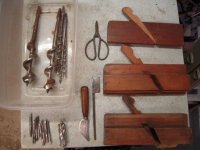
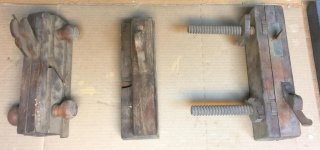
In your 13 lineup shot, the first molding plane on the left is the most interesting, but we'd need to see the bottom/sides to tell you what it does. The screw on top looks like it allows the throat to be adjusted, but it may perform some other duty.
You have a few "hollows" and "rounds" in that same lineup. They're a generic moulding plane which come in matched sets. Unlike other molding planes which take their names from the profile they leave behind (bead, ogee, astragal, etc.), the hollow and round planes are named for their bottom profile. A hollow is concave while the round is convex. In other words, the round cuts a recessed cove into the molding.
For example, the second plane of the left is a large "round". Somewhere out there is a "hollow" of the same diameter but it's concave instead of convex. The fourth plane from the left is an example of a" hollow". In fact, it may be the match to the round. If so, the same number will be stamped on the ends of each plane. It also appears there are a few small diameter rounds on the far right end of your lineup, but they may be some other type of moulding plane. It's hard to tell from that angle.
Most hollow/round sets were specified in 1/16" diameter increments. So a #8 hollow (or round) is a 1/2" diameter profile. So the two hollow/round planes on the left end will have larger numbers, while those on the far right will have small numbers. But standardization wasn't a priority back before the civil war. So you may have a set which is numbered backwards or has a unique system.
Also, an idea of value would be appreciated.
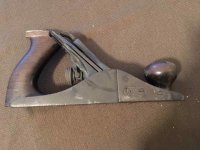
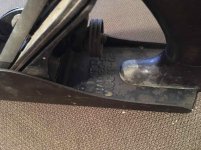
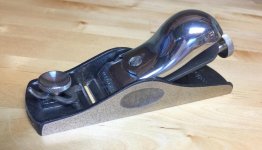
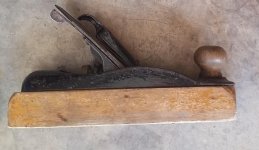
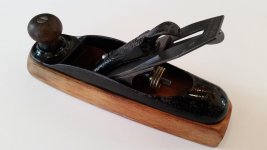
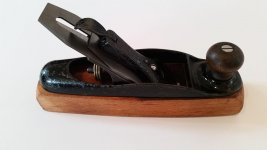
The block plane is in very poor condition and is common. The mounding planes are also dime a dozen. I don't see anything special there, although they are very useful tools. If you clean up and conserve the sash and fillister planes nicely, they may have some value in good condition. If you ever find an old wooden planes made of rosewood, boxwood, ebony, mahogany, or ironwood then get it appraised. It's probably was something special. Most wooden planes were beech or rock maple.
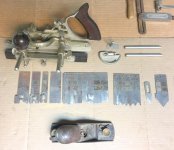
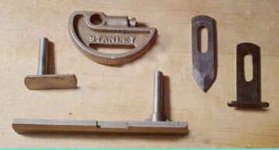
The #45 appears to be a later model and not especially valuable, though very useful. The main value in that #45 plane is all the blades. It would have more value as a whole with the original paper box, wooden blade box, and the cute little Stanley screwdriver that came with it.
For all of these planes, you can shop around on Ebay and Craigslist to get ballpark estimates of value. There's lots of lazy flippers trying to make easy money, so prices tend to be higher than the actual market. But if you find these tools interesting, I recommend you attend local flea markets and meet some tool dealers. They tend to be avid hobbyists and know their stuff. They can tell you what you have and what it's going for now.