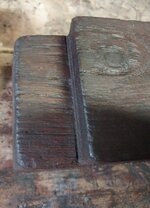
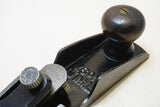
Looks pretty old. I would say "user made" it did enough work to wear the body down enough to need the mouth to need closing. From the pictures it looks like rosewood to me. I would say the handle is maybe not the original. For the stuck wedge, try tapping the heel with a wooden mallet to back it out.Here is my most recent acquisition, a razee jack plane that seems really heavy like its made of some tropical exotic hardwood, making me think its user made. Change my mind.
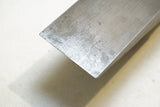
Found this guy at the Alameda Antique Flea Market, sitting on a table with 3 other planes, I think the only tools in the booth. My high estimate of where I'd go was right what he offered, so away we went. Stuck it in my bag, set it aside 'til today when I had a few minutes over lunch to attack it. Getting the wedge out was a bit difficult, as my normal method of grabbing is in a handscrew wouldn't work as the exposed portion of the wedge was tapered, so the screw just slide up as I tightened it. Took a wooden mallet, knocked the wedge side to side, and it slowly backed out. Made sure everything came apart while my hands were dirty, and grabbed some pics. Nice beefy tapered iron (3/16") inside. There is a bevel on the mouth side of the brass closure plate, but the pix don't show it. I suspect the closure plate would be a user added thing whether factory made or not.
Things that make me think its homemade 1) exotic hardwood 2) weirdly angled small handle 3) coarse strike button 4) mouth escapement has lots of tool marks left 5) the wedge looks like he chewed the front edge & the screw is tearing into the slot cut for it 6) seems to be a lower than normal cutting angle at 42° (vs 45)
No makers marks or user IDs on it. May find something on the blade or chipbreaker when I derust them a bit.
Some pics after a quick brush off and wipe down. Will give it a mineral spirits wipe later.
BTW, that full handled stubby screwdriver is a fantastic thing for stuck blade screws
More pix here. Will add more here when I get it up and working. May make a new mouth closure plate if it tears out too much.

You are using an out of date browser. It may not display this or other websites correctly.
You should upgrade or use an alternative browser.
You should upgrade or use an alternative browser.
Show us your handplanes
- Thread starter trainman1385
- Start date


RTM
Well-known member
Thanks. I was guessing rosewood, but I'm never confident on those guesses.Looks pretty old. I would say "user made" it did enough work to wear the body down enough to need the mouth to need closing. From the pictures it looks like rosewood to me. I would say the handle is maybe not the original. For the stuck wedge, try tapping the heel with a wooden mallet to back it out.
I was in mixed emotions on the handle being original to the build or not. Shaping rosewood might be a bit dicey. I tried to make a saw handle out of madrone, and while beautiful, my buddies were questioning my logic for starting to learn on such a tough wood. Will see how it holds up to the cleaning process. IF it falls out, may change it to something that fits my hands better.
I started out whacking the back end with a wooden mallet, but once I was hitting so hard I was afraid of denting my mallet on the rosewood, I switched to plan B.


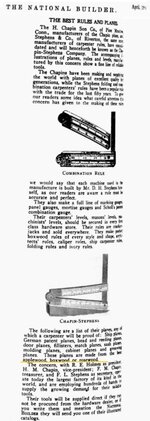
Here's some Ship Planes from 1914 Chapin Stephens catalog. The razee style was popular in ship building. I have a French version I'll try to get some pictures posted. I made a toothing plane out of black locust so I understand starting out with tough wood. I've seen a lot of planes with different wood than the body, so you might not have to replace it if it is still solid.Thanks. I was guessing rosewood, but I'm never confident on those guesses.
I was in mixed emotions on the handle being original to the build or not. Shaping rosewood might be a bit dicey. I tried to make a saw handle out of madrone, and while beautiful, my buddies were questioning my logic for starting to learn on such a tough wood. Will see how it holds up to the cleaning process. IF it falls out, may change it to something that fits my hands better.
I started out whacking the back end with a wooden mallet, but once I was hitting so hard I was afraid of denting my mallet on the rosewood, I switched to plan B.
Attachments

crguy
Well-known member
Most shipwright planes were rosewood as far as I've seen, and owner made also. Some of the big planemakers offered rosewood planes made to order and a couple smaller companies made rosewood planes all the time. Stilley, in Oakland, CA made some.Thanks. I was guessing rosewood, but I'm never confident on those guesses.
I was in mixed emotions on the handle being original to the build or not. Shaping rosewood might be a bit dicey. I tried to make a saw handle out of madrone, and while beautiful, my buddies were questioning my logic for starting to learn on such a tough wood. Will see how it holds up to the cleaning process. IF it falls out, may change it to something that fits my hands better.
I started out whacking the back end with a wooden mallet, but once I was hitting so hard I was afraid of denting my mallet on the rosewood, I switched to plan B.
RTM
Well-known member
Hmm, local boy, never heard of him before. Here is what DAT says.a couple smaller companies made rosewood planes all the time. Stilley, in Oakland, CA made some
Thanks
| 1860 - 94 | |
| Tools | WOOD PLANES |
| Text Info | Henry (born 20 Nov. 1827; died 12 May 1913) was a brother of John Stilley of Cincinnati. He left OH ca. 1850 and moved from San Francisco to Oakland in 1876. He primarily worked as a carpenter and ship joiner and was never listed as a tool maker in directories. |
| Marks | (1) H.G.STILLEY/MAKER/S.F (sometimes without "S.F" and sometimes with it on the second line) (2) H.G.STILLEY/MAKER/OAKLAND CAL. (sometimes without "CAL.") |
CRSINMICH
Well-known member
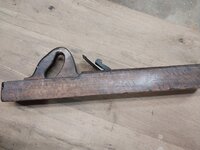
Here's my razee plane. Not sure what type of wood it is. Maybe Applewood like mentioned above. The home plate shaped mouth closer was missing so I made an oak replacement. Peugeot freres iron. I like to think it was used building a tall sailing ship. It's really fun to make shavings with.
Attachments



paulm12
Well-known member
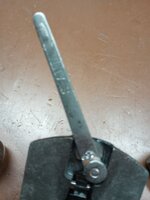
anyone want these parts free? just pay shipping, thanks. Send me PM.


d42jeep
Well-known member
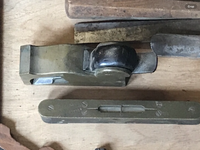
Here is an unusual plane I found on Saturday at a Tahoe garage sale. According to the seller, it belonged to his grandfather and had been stored on a shelf in his garage for 30 years. It came with quite a few very old woodworking tools. 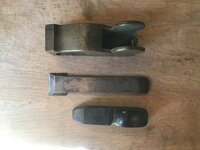


 -Don
-Don
-Don
Last edited:
Nice little plane. A lot of those were cast by Slater and you would find an iron and make your own wedge. Preston made those as well and didn't always mark them. My guess is that one is Slater though. Is the spirit level marked?Here is an unusual plane I found on Saturday at a Tahoe garage sale. According to the seller, it belonged to his grandfather and had been stored on a shelf in his garage for 30 years. It came with quite a few very old woodworking tools.
RTM
Well-known member
Commonly known as a bull-nosed rabbet plane. I agree with ararat's thought of them being unmarked, build your own type planes. Seen lots, similar body, different wedge, some embellishments to the casting. I've got one around here where the infill shrank, or was made too small, and the blade chatters something fierce in use, making it pretty useless.Here is an unusual plane I found on Saturday at a Tahoe garage sale. According to the seller, it belonged to his grandfather and had been stored on a shelf in his garage for 30 years. It came with quite a few very old woodworking tools.
-Don


crguy
Well-known member
That compass plane is unusual. The other brass bodied ones are fairly common.Here's a compass bullnose plane that is similar. Plus a few more bullnose planes that live in the old Jennings machinist box.
Yeah, the compass plane is pretty rare. I was lucky to get it and the 3/8" Preston with the logo and the small brass shoulder plane in the picture all in a lot on ebay several years ago. The rest of the lot was junk. Wood body compass bullnose planes are much easier to find.That compass plane is unusual. The other brass bodied ones are fairly common.
d42jeep
Well-known member
It has some markings but I don’t know who made it. I didn’t want to post it on the Stanley thread.Nice little plane. A lot of those were cast by Slater and you would find an iron and make your own wedge. Preston made those as well and didn't always mark them. My guess is that one is Slater though. Is the spirit level marked?


Another picture of the plane.

-Don
crguy
Well-known member
That level is European, clearly not Stanley.It has some markings but I don’t know who made it. I didn’t want to post it on the Stanley thread.
Another picture of the plane.
-Don
Great finds for a garage sale. Sometimes the levels are stamped on the wood and can be pretty light from wear. I would say it is probably British. Preston, Rabone, Hockney Abbey, Mathieson would have made similar levels. Looks like ebony from the picture. The plane would also be mid to late 1800's British. Maybe very early 1900's.It has some markings but I don’t know who made it. I didn’t want to post it on the Stanley thr
Another picture of the plane.
-Don
Last edited:
Miss the Pontiacs
Well-known member
@CRSINMICH Sorry buddy I haven’t been on this thread since my post you were querying me on. Use the quote next time and it will help trigger the poster.Miss the Pontiacs: The Stanley transitional planes in your post look pretty good as do the spoke shaves and wood bodied planes. The racks are very interesting. Were they meant for the transitional Stanleys?
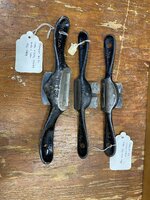


The spoke shaves and wooden planes were all bought at a local on line auction. The racks were a separate auction lot but very likely a part of the original sellers items. The racks do work well for planes I bought. It was kind of a shame as there were many additional planes and related articles which probably saturated what he could have got for them if they would have broken up the items into a few auctions about a week or so later.
I have a couple of new planes to add but no pictures at this time but just wanted to see what is new on the thread.
Last edited:
d42jeep
Well-known member
These were part of the garage sale lot as well.
-Don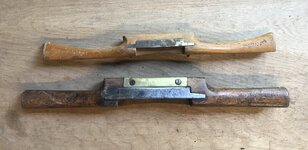

-Don
Wood body spokeshaves. Very cool type of hand plane. The curved handled one is giving off continental vibes but could be British. I can't make out the markings from the picture. Nice find.These were part of the garage sale lot as well.
-Don
Miss the Pontiacs
Well-known member

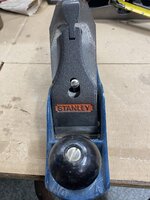 The Stanley #4 was given to me as a Xmas gift from my FIL probably 40 years ago. You can tell I havent used it much. I have an electric planer but don’t use it much either.
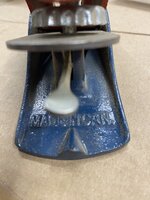
i bought this little fella with a couple of other items on a online auction. All it says is made in Can. It might be handy sure has a good feel to it. Any ideas of its pedigree/builder


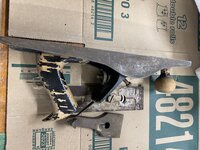
The #5 likely also a Stanley, I have no idea where I got it. Likely found it when I tore down 2 garden sheds at the lake. I have it on my refurb list but fairly low on the list. So crossing my fingers that it will get done.

Miss the Pontiacs
Well-known member

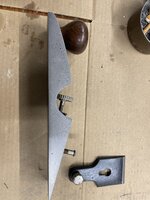 I thought this one deserved its own entry. It was given to me by an old school mate, it was his Grandfathers and he thought it would be cool to put it on display in my garage than sitting in a box in his basement. I have cleaned it up and put his name on it and put it on display.
It is a Stanley #97, bit of an odd duck. Blade comes out the front as there is no hole in the base. Can anyone tell me anything about this hand plane? Where would I look for the proper blade or anything else it may require. Not even sure the the blade clamp is correct. I haven’t checked out the net for info yet as I never even thought about it till this thread showed up. So just wanted to share this strange piece of equipment.
RTM
Well-known member
The 97 is known as a chisel plane, very rare and expensive when I started collecting 20+ years ago. Now that I am out and about in the Internet more, I've seen many, and the prices are less stupid high. But your friend must like you a lot to let that go. Think of it as a guided chisel for working into corners and narrow spaces. Read more about it, and see the blade, here.
It is a Stanley #97, bit of an odd duck. Blade comes out the front as there is no hole in the base. Can anyone tell me anything about this hand plane? .
Miss the Pontiacs
Well-known member
@RTM Thanks for the info had no idea.
#97 Cabinet makers' edge plane, 10"L, 2 1/4"W, 3 3/4lbs, 1905-1943. *
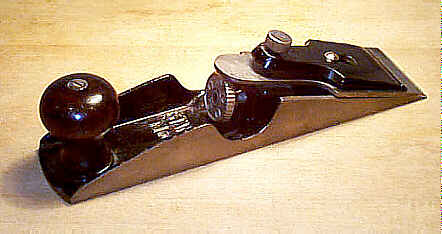
There is no mouth on this plane - it has no bearing surface ahead of the cutter making the plane really nothing but a chisel held at a constant pitch and regulated by the sole to prevent it from digging into the wood too deeply.
The plane carries a cutter that is as wide as the plane is with it bedded bevel side up. The cutter is pitched at about 20 degrees, and it rests on the sides of the bottom casting, which are machined to form an inclined plane. If you were to use this plane, and forget its value as a collectible, you'd want to make sure that the machining was true with both sides in the same plane. The entire length of the backside of the cutter does not rest on the side rails; only the leading edge of the cutter makes direct contact with the side rails and the bed proper.
The cutter is held in place by a thumb screw-activated lever cap that is entirely japanned. The cutter is adjusted by the familiar screw mechanism found on the common block planes. The sides of the plane each have a U-shaped cutout on them to allow better access to the adjusting screw. The sides are also machined at right angles to the sole.
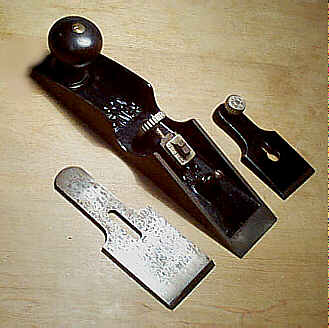
Like the #62, these planes have a tendency for chipping at the leading edge of the bottom casting, directly below the cutter, due to the thinness of the casting there. The left and right corners of the leading edge on some examples of these planes are not finished at a right angle, but are instead slightly angled in an attempt to reduce chipping.
Chipping doesn't harm the plane's use, as long as the chipping isn't too severe, but it really kills the plane's value to your average Stanley collector. If yours is chipped, and you can't sell it to a collector, you can always use it as a doorstop - its wedge-shape makes it perfect for that role.
Check that the tool hasn't been reworked, where an example, with a minor chip, was machined to eliminate the defects. Sight down the machined side rails, on which the cutter rests, to make sure they are straight and true. Any deviance from a straight edge on these means that a portion of the side rails has been machined so that the leading edge can be cut back a bit to eliminate the chip. The underside of the cutter clears the back end of the machined side rails by about 1/16"; if it's less than that amount, chances are that the plane was chipped and remachined. One of the tell-tale signs of a re-work is the machining marks at the very end of the casting, where the chipping occurs; original machining leaves curved milling marks concentric with each other a la the layers of an onion. The marks are very fine, but they are there.
The earlier castings, down along the U-shaped 'cut-outs' of the side rails, do not have the quarter-sphere bumps that the later castings do. These 'bumps' were likely added to the casting to give it strength and to make the pattern pop free of the sand easier during the casting of the tool.
Miss the Pontiacs
Well-known member



Good grief. Now I need to find a proper blade.
Home › FINE TYPE 2 STANLEY NO. 97 CABINETMAKERS' EDGE PLANE
FINE TYPE 2 STANLEY NO. 97 CABINETMAKERS' EDGE PLANE
Regular price$475.00 USD
Default Title - $475.00 USD
I need friends like this
It is a Stanley #97, bit of an odd duck. Blade comes out the front as there is no hole in the base. Can anyone tell me anything about this hand plane? Where would I look for the proper blade or anything else it may require. Not even sure the the blade clamp is correct. I haven’t checked out the net for info yet as I never even thought about it till this thread showed up. So just wanted to share this strange piece of equipment.

That's one I don't have. Not sure how to get a date range for this model, but short front knob would put it pre 1919 if it were one of the bench planes. The mark on the blade would have helped. Very cool.
The number 4 is probably 1970s or later. The little block plane is probably Stanley Canada maybe as early as the 1960s. The number 5 is probably in the same age range.
i bought this little fella with a couple of other items on a online auction. All it says is made in Can. It might be handy sure has a good feel to it. Any ideas of its pedigree/builder
The #5 likely also a Stanley, I have no idea where I got it. Likely found it when I tore down 2 garden sheds at the lake. I have it on my refurb list but fairly low on the list. So crossing my fingers that it will get done.
RTM
Well-known member
Patent date plus 17 years should limit the new side of the equation, and the old.Not sure how to get a date range for this model,
I read where it always had the low knob, so that didn't help. Your plane has the bumps beside the adjuster, it said those weren't on the early models. My guess would be 1910-1920 somewhere, those years are some of the most collectable of the bench planes. People love type 11. It looks to be in great shape. Finding an original blade will probably not be cheap though.Patent date plus 17 years should limit the new side of the equation, and the old.
Miss the Pontiacs
Well-known member
I found the following video interesting on the #97.
Miss the Pontiacs
Well-known member

crguy
Well-known member
Cutters for those do turn up. Set up a serch on Ebay and they will let you know when one is listed. There are tool collector groups on Facebook that can help find one.Good grief. Now I need to find a proper blade.
Home › FINE TYPE 2 STANLEY NO. 97 CABINETMAKERS' EDGE PLANE
FINE TYPE 2 STANLEY NO. 97 CABINETMAKERS' EDGE PLANE
Regular price$475.00 USD
Default Title - $475.00 USD
crguy
Well-known member
Those are all too new to be considered high quality.
i bought this little fella with a couple of other items on a online auction. All it says is made in Can. It might be handy sure has a good feel to it. Any ideas of its pedigree/builder
The #5 likely also a Stanley, I have no idea where I got it. Likely found it when I tore down 2 garden sheds at the lake. I have it on my refurb list but fairly low on the list. So crossing my fingers that it will get done.
Miss the Pontiacs
Well-known member


RTM
Well-known member
I've heard good things about this guy.

 nhplaneparts.com
NH Plane Parts
Large selection of antique and vintage plane parts with fast free USA shipping and easy secure ordering.
nhplaneparts.com
Old Radar
Well-known member
According to the guy in the video, it looks like you have a Type 2 plane with a Type 4 lever cap.Not even sure the the blade clamp is correct.
RTM
Well-known member
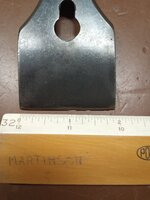
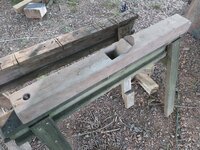
Geez, 3" blade? Guessing coopers plane. Nice get.
Yes, three inch blade width. I knocked of the loose rust and gave it some boiled linseed oil. Then gave the plane and wedge some BLO. It wasn't as thirsty as I was expecting though. Can't decide what the wood type is. I need to research what the back should look like, it has a notch taken out of back. Then I need to decide on the front button. I plan to glue down the delaminations on the top instead of leaving them sticking up or sanding them down.Geez, 3" blade? Guessing coopers plane. Nice get.