Eric Brown
ALLIANCE MEMBER
- Joined
- Jun 14, 2024
- Messages
- 723
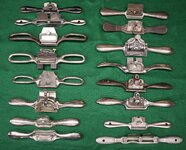
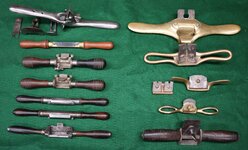
As requested, some more pictures of my brass shaves. The big one is using a regular plane blade, 2 1/8" wide, bevel up.


5 and 6 from the right on the first picture look like A. A. WoodSome of my spokeshaves. I have more and some of these have been sold.
That's awesome. How the cap fits is really cool.As requested, some more pictures of my brass shaves. The big one is using a regular plane blade, 2 1/8" wide, bevel up.
Looks like someone else has the Spokeshave book!!5 and 6 from the right on the first picture look like A. A. Wood
Another good spokeshave book is "Iron Spokeshaves and Related Tools Manufactured by Edward Preston & Sons" by Joe Stankus.It's a great book.
Has anyone here got the 'Planecraft' book?Looks like someone else has the Spokeshave book!!
Looks interesting. It is on archive.org, but you have to log in to "borrow" it to view. https://archive.org/details/planecrafthandpl0000mode/page/7/mode/1upHas anyone here got the 'Planecraft' book?
I used to have a copy of it when I was a kid but that was stolen, and I see there's plenty for sale secondhand and wondered if it was worth getting another copy?
I found this info about it on 'UK Workshop' forum:
The original book, "Planecraft, Hand Planing by Modern Methods" was written in 1934 by CW Hampton, who was a director of C&J Hampton, who traded as Record Tools, and E Clifford who was later described as 'one of the most knowledgeable plane men of his time.'
It was published and distributed by C&J Hampton, rather than through the book trade. It was revised and enlarged in 1950 and 1959. It was a hardback, 8 1/2" x 5 3/4", of up to 250 pages.
In the US, Woodcraft Supply Corp published a softcover facsimile reprint of the 1959 edition in 1980.
in 1984 John Sainsbury published another, more radical revision under the title "Planecraft, A Woodworker's Handbook." Published by Sterling Publishing in New York, this had a larger page size of 10" x 7 3/4" and ran to 192 pages. In the UK it was distributed by Blandford Press.
I have the 1972 reprint of the 1959 version. Have not read it. It started really slow. I need to pull it out and try it as a reference book.Has anyone here got the 'Planecraft' book

That could be interesting, I wonder what it says about that. It's over 50 years since i read it, so I can't remember exactly what it said! A professional traditional joiner friend of mine does work backwards with short strokes when cutting rebates and grooves etc, it's only the last few passes he does a fine cut full length of the work.Will look at the combo plane section, see if it speaks of working backwards.
That's exactly how I was taught, maybe 15 years ago. That's why I figured it was a good place to look, a miracle worker of process improvement for me.That could be interesting, I wonder what it says about that. It's over 50 years since i read it, so I can't remember exactly what it said! A professional traditional joiner friend of mine does work backwards with short strokes when cutting rebates and grooves etc, it's only the last few passes he does a fine cut full length of the work.
Nice !Here's my Cincinnati Tool Co spokeshave collection plus a little Seymour Smith that I really like.

That's a nice one. Here it is in the 1923 catalog.Nice !
I have only one Cincinnati spokeshave. Large 2-1/4" blade

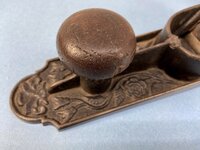


That's awesome.Victorian tool art. Morris plane, 1870 patent.
I haven't seen one like that before. That color is similar to Tyzack, you might check their catalog. I feel like maybe it was user made by a patternmaker. It's definitely a cool design. I have this little guy that is a similar color. Mine is unmarked as well.Carriage or Coach Makers' Router
I've had this one for a time also. I thought it was a weird kind of spokeshave. Looking at the catalog for the DR Barton shave (above) I saw the router. This one is NOT the Barton router. It's cast iron. I still don't know the maker. It seems to be a fairly rare type of shave/router hybrid and it's heavy duty. Anyone have more information?
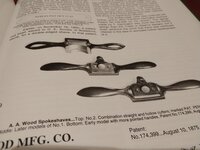
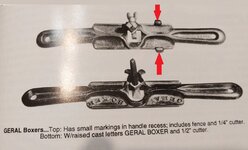
Looks like a Geral or look-alike. Based on the Spokeshave book that @ararat showed above, probably a boxing cutter. Without stealing too much text out of the book here's a couple of illustrations. Edit: Dang, he caught me while editingCarriage or Coach Makers' Router
I've had this one for a time also. I thought it was a weird kind of spokeshave. Looking at the catalog for the DR Barton shave (above) I saw the router. This one is NOT the Barton router. It's cast iron. I still don't know the maker. It seems to be a fairly rare type of shave/router hybrid and it's heavy duty. Anyone have more information?


You are correct.Looks like a Geral or look-alike. Based on the book, probably a boxing cutter. Without stealing too much text out of the book here's a couple of illustrations.
These got my attentionLooks like a Geral or look-alike. Based on the Spokeshave book that @ararat showed above, probably a boxing cutter. Without stealing too much text out of the book here's a couple of illustrations.
My two bit understanding, Carriage or Coachmaker's routers were designed to do the intricate decoration that early carriage users demanded for city life (the pinstriping of the day). Do lots of tools for cutting spaces for inlays, fat and thin, and following the curves of the carriages.
Here is one I picked up from auction in the UK that arrived a few weeks ago. Very thin cutter, almost stringing level decorations.- No detailed pics, no name, nothing. I just took the arrival shot, and stashed it away for a few weeks. You can see the fence anchor point on the left, the hidden face is curved toward the cutting edge, and the cutter is between 1/16" - 1/8", at a guess. More here later in a few weeks. Those other two in the front left will make an appearance too.
I think it would have been for cleaning up already existing grooves squaring up the bottom, so the fence wouldn't necessarily be needed if it was initially cut with another tool. I wish I knew more about carriage/coach building though. I have a coach makers vise that I couldn't find much on how it was actually used.RTM and ararat: Thanks for the information! The catalog photo was especially helpful. It was hard to imagine how this tool would have been used without a fence and I didn't see any indication of one. The photo shows tabs on the top and bottom edge of the router. Those must be the fence mentioned in the text. There's no indication of how the fence would have been held in position but I think I can imagine how it was done. BTW, the cutting iron on mine is made from 10mm square stock and the cutting edge is 15mm wide or, roughly 13/32" square stock with a cutting edge of 18/32".
It also would have been handy for tenons with that long registration area. No fence needed.I think it would have been for cleaning up already existing grooves squaring up the bottom, so the fence wouldn't necessarily be needed if it was initially cut with another tool. I wish I knew more about carriage/coach building though. I have a coach makers vise that I couldn't find much on how it was actually used.
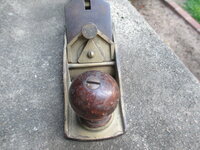
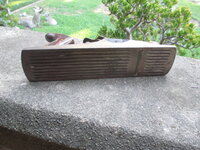
Pretty cool I think it is one of the post 1915 planes with the high knob 1915 patent date cast in the bed. The cap is the single setting type that appeared in the patent application and was used in regular production after 1915. I recently got a very early " pre patent" 710C with a low knob, no patent date on the bed, and the triangular 1-2-3 cap. Attached are pictures. Apparently, this early type was made only in the 710 size and the 2 or 3 other examples I have found pictures of are smooth bottoms. The Auto Set planes hit the market years before the Stanley metallic Gage planes. The Sargent auto set planes are much less common the Stanley Gage planesI won 2 boxes of miscellaneous old tools at a local auction. This Sargent 710C in the bottom was my goal.

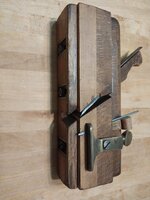
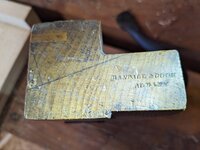
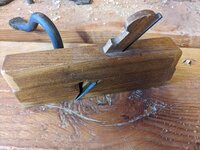
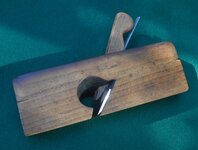
Is that a 2"? Nice n beefy lookingThe second is my oldest known tool - Randall and Cook, Auburn NY Rabbet Plane
2-1/4" wide iron.Is that a 2"? Nice n beefy looking
The plane has a narrow strip of boxing and also a spring line.Cleave: Those are both nice planes. Curiously, the Randall and Cook looks like it has a spring line and some boxing. I'd expect to see both on molding planes not rabbet planes. I guess they made things a little differently 190 years ago.
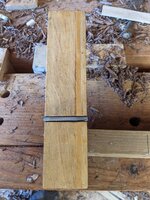
Could be "work in progress". It looks like maybe it was going to be a molding plane, but was never finished. Would add more cool factor to me if so. A pic of the bottom of the plane would be interesting. Nice planes.Cleave: Those are both nice planes. Curiously, the Randall and Cook looks like it has a spring line and some boxing. I'd expect to see both on molding planes not rabbet planes. I guess they made things a little differently 190 years ago.
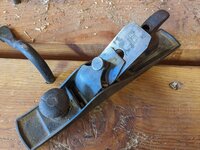
Almost looks like a bedrock---I think this one is a stanley S5. It's made of steel and rivited together.
go to patrick Leach's Blood and Gore--all things Stanley, plus moreTrainman: any chance you might have before, during and after restoration of one or two of your planes? i know i for one would really enjoy watching a pro do one. i think i saw one on GJ last year, but not sure where to find it. if you know and can provide links on this thread i bet a lot more members will grab them and save them from the scrap yards.
i know one guy that has a cabinet full of nicer planes than my union and i think he had a couple of them on like new condition. i'd also be surprised if there isn't a web site or a forum on these good old tools.
thanks again for starting this thread
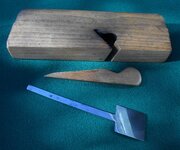
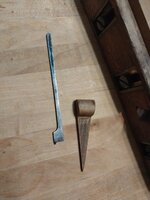
What is this tool?Here's a compass bullnose plane that is similar. Plus a few more bullnose planes that live in the old Jennings machinist box.