Yup #40 scrub.Is that a no 40 in the middle? Nice clamps too.
I love those old clamps. Have 8 of them now.

Yup #40 scrub.Is that a no 40 in the middle? Nice clamps too.
Stanley 81. Nickle plated.The silver No.81 … what brand is that?


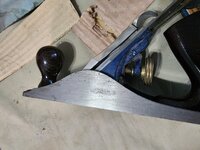

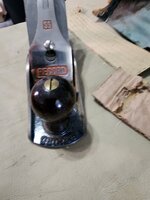


Nuked a negative comment over there for you!Tripped across this Record 04 Stay Set a couple weeks ago.
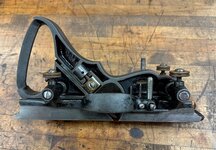
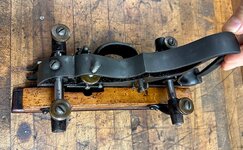
You should know good and well that plane had a wood handle. If there were some that didn't, Heckel would have mentioned them in his book. You should also realize your plane had the earlier style handle, and shown in PTAMPIA that didn't have that screw down thru the casting to hold it on.Here is my Siegley No. 2 Combination Plane. Based on the type study by David Heckel and descriptions from PTMPA Vol. 1, this would be the Type 3 (1884) one. It has the brass block cutter adjuster with teeth that engage the cutter, advanced/retracted by a capstan “head” with wing nut to clamp. It has some Type 2 (1883-1884) qualities too, so it may have been a transitional or hybrid one. Independently, I also have a Type 4 (1885-1886) model.
The fence is a beautiful bird's eye maple with an adjustable rosewood filletster strip. There is no evidence of a wooden handle ever being positioned on this tool, as there are no screw hole recessions on the upper handle, or side screw holes (type 1), either of which would inevitably have been marked on the cast handle. All of previous ones I owned, and photos from the Siegley study, PTMPA, other on-line sources, show the screw attachment method. I attached a photo of the normal screw attachment (different plane). In any case, I am keeping this one as-is!


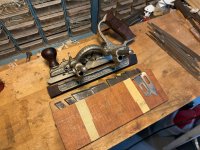

I’ll send you my address.Way too nice for my meager collection.
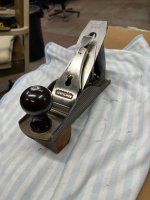
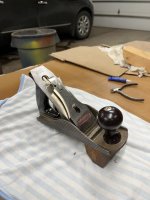
The one with the racing stripes. I don’t recall if I still have one. I donated my first one to a woodworking program for kids.My early 1960's model #4 Craftsman hand plane.
Was there a practical reason for the stripes? And you knew this … the 619 in the part number is for Sargent tools.The one with the racing stripes. I don’t recall if I still have one. I donated my first one to a woodworking program for kids.
Not that I know of. Hard to imagine corrugated sides for shooting board use.Was there a practical reason for the stripes? And you knew this … the 619 in the part number is for Sargent tools.

 kirkhmb.smugmug.com
Was there a practical reason for the stripes?
The part num is visible on the blade, i assume that’s the num for the whole tool.I don't think I ever looked up the part number, not sure if mine had one.
Craftsman planes were definitely lower quality than Stanley planes.Not that I know of. Hard to imagine corrugated sides for shooting board use.
I don't think I ever looked up the part number, not sure if mine had one.
Many years ago I did a study on early Craftsman planes, because all the big name Fanboys were saying they were lightweight, poorly made etc etc. so this study compares early Craftsman to Sergeant and Millers Falls made planes. Don't think I had any that were Stanley made. You can see it here.
Craftsman Connection - KirkHMB
Some Craftsman tools, and their ties and similarities to other tools by Millers Falls and Sargent

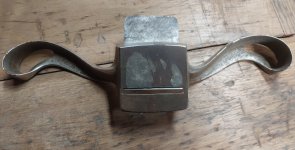
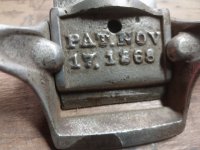
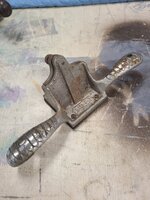
DATAMP says combo of lugs, screw and cap holds the blade.Not sure what the hole is for, but it's supposed to be there. Maybe to hold it while plating?
It's not threaded. I believe the later models had a screw, but not the early models.DATAMP says combo of lugs, screw and cap holds the blade.
Is it threaded?
US Patent: 84,140 - Improvement in Shoemaker's Shaves
US patent 84,140 Improvement in Shoemaker's Shaves was issued to James Y. Simons of Troy, NY. It was granted on 11/17/1868. Blade is secured by combination of a cap, screw, and lugs from the handles. The design of the handles is also claimed as for them giving space for thdatamp.org
That was possibly how Tom found his example. Try it both ways, and pick your favorite.The spokeshave book claims they were bevel down, but this one was found bevel up. With the low angle, it seems like it would be better as bevel up.
From patent 84140:It's not threaded. I believe the later models had a screw, but not the early models.

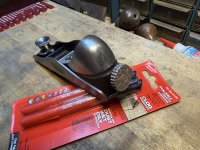
 My buddy snagged this 60 for me. I don’t have a before picture but it really cleaned up with some wd40 and steel wool, and autosol on the shiny bits. I love the “V” logo era tools so this is going to be a shelf queen. The fit and finish on this era is really fine. The ramp to the rear mouth is almost sharp enough to cut. Run it over one finishing nail and it’s toast. It’s also so pretty it makes my other block planes look like junk.
It really looks good. It's great when all tool cleans up that well.
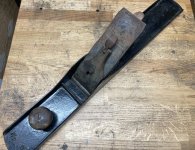


I would say it is an Ohio Tool Co. plane. O8 on the toe is probably letter"o" not numeral "0", and the markings on the iron are Ohio. Is the iron tapered (thinner at the top, thicker towards the cutting edge)? I like the few Ohio iron planes that I have. I think that any No 8 size jointer plane in decent condition is a great find.Who made me?

 www.timetestedtools.net

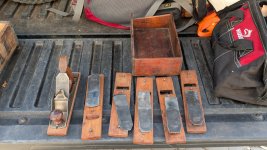


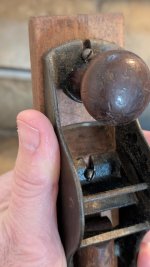

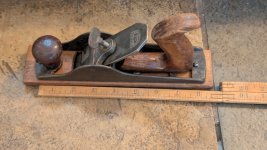


A lot of that type of plane were made by the pattern maker himself. I've owned a few, all of which were different, and some used Stanley plane parts for some of them. You're probably aware of the Phelps pattern makers planes also.Here is a plane I picked up last weekend. It’s an unmarked pattern maker’s plane, with 6 interchangeable wooden soles and blades. The blades are two different generations of Buck Bros logos, but the rest of the plane’s parts are unmarked, except for user supplied marks on the soles. The plane blades are 1.5” wide, and roughly 6” long, no keyhole , no lever cap, more like a Stanley #40 scrub, with a pressure / friction fit for the blade. Each of the blades’ cutting edge is arched to match the radius of the sole it goes with.
I’m pretty sure the plane body was made for this purpose, as the metal surface mating to the wooden sole is made much differently than a standard bench plane, with a raised rim around the underside, and cross bracing where the sole attaches. This may have been an early model, as the wooden soles attach with small round head wood screws, and two of the three are a bear to get to, and the one by the handle needs to come completely out to change soles. (More modern ones have a pin in the sole, and a keyhole shape in the sole.)
Pattern makers used these planes to cut large radii in the cores they made. For smaller radii, a set of Hollow & Rounds might be used, often getting to 2” radius. My Sandusky set isn’t complete, so I’m a little short. Rather than having a plane for each size, the used the interchangeable blade and sole to be more complete.
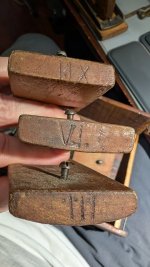
The set came with 6 soles, in radii of 3, 4, 5, 6, 8, & 12”. The were mostly marked, in Roman Numerals on the toe, but without knowing that, I used height & arc length of a chord to see where they were, and my rough measurements were very close.
The size of the plane is closer to a #3, but longer than a Stanley at 8.5”. The side cheek is set further forward than the Staley family as well.
Interestingly, I started doing a Google books search for pattern makers plane, and I found lots of books from the late 1890s, 1910ish, and 1925ish, aimed at teaching the trade, and none mention my plane, just a plethora of other planes. And there does not seem to be many educational books outside of those three eras, yet.
If anyone has clues as to who made this, I'd love to know more.




 Now I have two.

Rosewood or maybe Lignum? Nice plane. Will you attempt to remove the poly?Here is another recent find, grabbed at the Alameda antique flea market. My buddies saw it, passed on it. Being a sucker for unique planes, I looked at it, came back two hours later, and negotiated a lower price.
I don’t need another big jointer, having a #7 & #8 (9.75#) sized metal planes, Knight handled (6#) and unhandled jointers, and another 26” woodie (7.5#), just off the top of my head. But this one might be rosewood!! It’s heavy for a woodie, tipping in at a little over 8#. Looks like someone poly’d the poor thing at some point, probably after the other damage, like a poorly repaired handle, some gouges on top front, etc.
You can see the details of the repair to the tote, seems quite vintage and solid, and pre-poly. I imagine back in the day they may not have had access to a good epoxy to make that repair to rosewood, with it being an oily wood. The brass rod down the center seems stout, nothing wiggles. The plate on the front seems even more vintage, May be factory, may not. Have not determined what that orangish pink dot is on the left side of the handle.
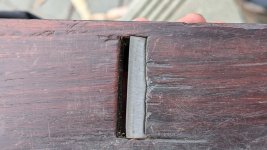
The plane shows signs of a bit of shrinkage, with the Buck Brothers iron being stuck in place, and may have cracked the cheeks. The bed where the blade lies was inconsistently wide, binding about 3/4 way down. I took a float to widen it just a hair, then stoned the sides of the iron just a bit. You can see what the mouth opening should be, without the cap iron in place. The cap iron is a hair narrower, so maybe a 1-7/8” iron was correct?
There is a mark between the blade bed and the handle, maybe A. Pallu, anyone see anything different there?
Thinking rosewood, but but haven’t done a density calculation yet. Friends thought rosewood as well.Rosewood or maybe Lignum? Nice plane. Will you attempt to remove the poly?
 . Is lacquer thinner the answer, or acetone? I know finger nail polish remover worked on a home made coffee table
 . Is either gentler to the system?
I would have been cool to find Stilley stamped in the end.Here is another recent find, grabbed at the Alameda antique flea market. My buddies saw it, passed on it. Being a sucker for unique planes, I looked at it, came back two hours later, and negotiated a lower price.
I don’t need another big jointer, having a #7 & #8 (9.75#) sized metal planes, Knight handled (6#) and unhandled jointers, and another 26” woodie (7.5#), just off the top of my head. But this one might be rosewood!! It’s heavy for a woodie, tipping in at a little over 8#. Looks like someone poly’d the poor thing at some point, probably after the other damage, like a poorly repaired handle, some gouges on top front, etc.
You can see the details of the repair to the tote, seems quite vintage and solid, and pre-poly. I imagine back in the day they may not have had access to a good epoxy to make that repair to rosewood, with it being an oily wood. The brass rod down the center seems stout, nothing wiggles. The plate on the front seems even more vintage, May be factory, may not. Have not determined what that orangish pink dot is on the left side of the handle.
The plane shows signs of a bit of shrinkage, with the Buck Brothers iron being stuck in place, and may have cracked the cheeks. The bed where the blade lies was inconsistently wide, binding about 3/4 way down. I took a float to widen it just a hair, then stoned the sides of the iron just a bit. You can see what the mouth opening should be, without the cap iron in place. The cap iron is a hair narrower, so maybe a 1-7/8” iron was correct?
There is a mark between the blade bed and the handle, maybe A. Pallu, anyone see anything different there?