To avoid these ads, REGISTER NOW!

Show us your handplanes

ez-duzit

Well-known member
Joined
Jun 24, 2013
Messages
5,094
Location
Marina del Rey
...The tote and knob look to be smooth and in good condition so tearing up his hands doesn't seem too likely...

Surely you can't believe that a woodworker only touches those two wooden parts of a plane while using it. :wtf:

No! Severe pitting can tear up the user's hands or the workpiece. And it is important that a plane be usable on its sides. This is why the sides of a plane are (normally) smooth, flat and square. Of course one that isn't is still usable.

Someone might enjoy doing an incomplete restoration and owning a large collection of old tools whose usefulness is limited by their flaws. But I prefer choosing better quality, fully functional examples and shun tools that are too messed up to be worth the storage space they occupy.
 
To avoid these ads, REGISTER NOW!

crguy

Well-known member
Joined
Jan 24, 2016
Messages
2,646
Location
SW Washington
Actually the pitting will tend to tear up the user's hands and make it virtually unusable on a shooting board.

That's really just plain funny. :lol_hitti Nobody holds a plane by the area with the heavy pitting at the back end, and nobody uses a small plane like that for shooting.
If you checked a few Stanley planes you would find out they usually aren't square from bottom to sides. They were hand finished on a belt sander.
 

MShaw

Well-known member
Joined
Mar 2, 2015
Messages
1,013
Location
York, Pa.
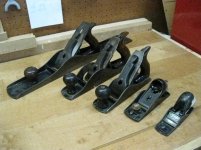
Here's my three. The smallest is a Stanley # 130, the next larger is a Millers Falls I bought new about 50 years ago, and the largest is a Stanley # 7.

The # 7 was a barn find. I cleaned it up and my father take the casting to where he worked and had the sole ground. There was very little left of the original paint and since I had some green epoxy machine enamel it became green. In retrospect I prob ably should not have painted the sides but it seemed like a good idea at the time.
 

Attachments

  • planes.jpg
    planes.jpg
    147.2 KB · Views: 80

LesserSon

Well-known member
Joined
Feb 7, 2016
Messages
5,050
Location
PA USA
Thanks for the differing feedback, everyone. I'm disappointed with the condition of the base, but I don't regret putting the time and effort into revealing what's good and what's not. Now it can sit and gather dust (but not rust) as a sentimental reminder, and get occasional use within its limitations. And I can keep my eyes open for the right donor, too...
 

Zeke

Well-known member
Joined
Aug 13, 2009
Messages
17,176
Location
Long Beach CA, the sewer by the sea.
Thanks for the differing feedback, everyone. I'm disappointed with the condition of the base, but I don't regret putting the time and effort into revealing what's good and what's not. Now it can sit and gather dust (but not rust) as a sentimental reminder, and get occasional use within its limitations. And I can keep my eyes open for the right donor, too...

You can use JB Weld on the base to fill the pitting. Just sand it on a flat surface. And JB Weld is removable with heat so you're not doing anything to the integrity of the tool.
 

drivesitfar

Well-known member
Joined
Oct 23, 2013
Messages
35,999
Location
Pacific Northwest
ALL: anybody have any planes to show off or maybe some to tell us a story about and show how it's used please do. this old thread needed a boost so kicking it up to see if anybody over on Woodworking 101 thread wants to post a few over here along with others that don't even know we have a WW 101 thread in General Tools.

i'm not sure when the first POWER WOOD PLANES were made or sold to the public and anybody know for sure or want to guess?

i use this fairly old Craftsman when it's too much trouble to get out my big planers from storage. it works pretty well even on 2x8's and 8x8's, but with only 3.5 inch wide cutter it's pretty hard to get it smooth like a good old hand plane or big power plane.

cheers
 

Attachments

  • WP_20171006_011.jpg
    WP_20171006_011.jpg
    151.3 KB · Views: 37
  • WP_20171006_010.jpg
    WP_20171006_010.jpg
    147.3 KB · Views: 22
  • WP_20171006_012.jpg
    WP_20171006_012.jpg
    151.5 KB · Views: 22

CRSINMICH

Well-known member
Joined
Aug 15, 2015
Messages
2,396
Location
Southeastern Michigan
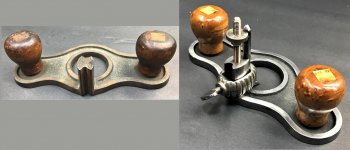
drives: Thanks for routing me to this thread. Speaking of routing, here's The Orphan router plane that I posted on the Woodworking 101 thread. I'll also include some pictures of the Stanley No. 606 I got last week. It's either a late Type 3 or an early Type 4. It has features of each.

NOTE: For those who didn't read the Woodworking 101 post here's a quick recap. I found The Orphan router at a garage sale for $1 and ordered the missing parts from Ebay. I had to buy a 1/4" rod and thread it because no one sells 1/4-24 threaded rod. After the post was drilled and tapped it was just a matter of assembling the parts and making everything shine.
 

Attachments

  • Stanley Bedrock N0 606 toe and lever cap.jpg
    Stanley Bedrock N0 606 toe and lever cap.jpg
    148.5 KB · Views: 34
  • Stanley Bedrock N0 606 left.jpg
    Stanley Bedrock N0 606 left.jpg
    152.9 KB · Views: 49
  • Orphan router B & A.jpg
    Orphan router B & A.jpg
    149.1 KB · Views: 61
Last edited:

CRSINMICH

Well-known member
Joined
Aug 15, 2015
Messages
2,396
Location
Southeastern Michigan
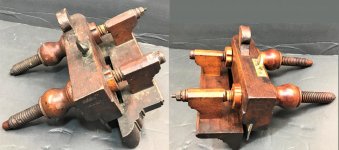
Here is a bronze Cincinnati Tool Co. convex sole spokeshave. In addition, a J. Webb plough plane that was given to me. Now that I have cleaned it, the next step is making new threaded rods for the fence. I've never done that but it looks like an interesting challenge.
 

Attachments

  • Cincinnati Tool Bronze spokeshave front and back.jpg
    Cincinnati Tool Bronze spokeshave front and back.jpg
    150.6 KB · Views: 45
  • J Webb plough plane Before and After.jpg
    J Webb plough plane Before and After.jpg
    152.2 KB · Views: 48

crguy

Well-known member
Joined
Jan 24, 2016
Messages
2,646
Location
SW Washington
Here is a bronze Cincinnati Tool Co. convex sole spokeshave. In addition, a J. Webb plough plane that was given to me. Now that I have cleaned it, the next step is making new threaded rods for the fence. I've never done that but it looks like an interesting challenge.

That spokeshave is neat! And yes, you're going to have a challenge making new arms for that plow.
 

CRSINMICH

Well-known member
Joined
Aug 15, 2015
Messages
2,396
Location
Southeastern Michigan
crguy: Thanks! For some reason I prefer the English spelling p-l-o-u-g-h when talking about planes. When talking about tractors I use p-l-o-w. If you're interested in how to make threaded dowels to fit an established nut look for Paul Hamler on You Tube. He has specialized in making working miniatures of many different tools. He once made a working 1/2 scale miniature of a Baby Wilton vise and then he made a working 1/3 scale replica of that! Amazing stuff. One or two of his videos are about repairing and reproducing threaded plough plane arms. Oh yeah, look for the video where he talks about making a replica of a presentation plane - out of solid ivory!
 

CRSINMICH

Well-known member
Joined
Aug 15, 2015
Messages
2,396
Location
Southeastern Michigan
KERFING PLANE​
(Previously posted on Woodworking 101)​
Here are some pictures of a plane I made. It's called a Kerfing Plane. Tom Fidgen has popularized them. A kerfing plane is used in hand resawing of boards. Instead of an iron, it has a saw blade. It also has an adjustable fence like a plough plane. The idea is to use it to cut a kerf along the two long edges and both ends of a board. The continuous kerf helps keep the wide blade of the frame saw on track as it saws through the board. The other pictures show a close up of the blade and fence in action and a frame saw beginning to resaw.

The frame saw is a working prototype I made from construction grade 2x4's to help figure out dimensions. It illustrates a problem I have with working prototypes - now that I have a functioning saw, the pressure to build the final version has nearly disappeared. I'm afraid it's in the When-I-Get-Around-To-It Zone now.
 

Attachments

  • 4 Frame saw  in kerf.jpg
    4 Frame saw in kerf.jpg
    149.3 KB · Views: 41
  • 3 Kerf completed.jpg
    3 Kerf completed.jpg
    128.8 KB · Views: 34
  • 2 back and forth.jpg
    2 back and forth.jpg
    146 KB · Views: 37
  • 1 Walnut kerfing plane right rear.jpg
    1 Walnut kerfing plane right rear.jpg
    138 KB · Views: 40
Last edited:

EricP

Well-known member
Joined
Jan 30, 2014
Messages
136
Location
Alabama
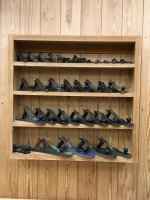
My woodworking, boatbuilding, and hunting partner recently passed away and I was given most of his woodworking machines and tools. This is about half his plane collection which is now mine. The other half, mostly Lie Nielsen, are staying with his father for the time being. These need a good cleaning/sharpening so for now will be decor. But eventually they will be put to use. Jeff had nice taste, to say the least. There are Stanley, Baleigh, Record, and Bedrock, among others.
 

Attachments

  • Img_1120.jpg
    Img_1120.jpg
    142.5 KB · Views: 98

Jim C.

Well-known member
Joined
Jan 8, 2010
Messages
2,598
^^^^^ You inherited a really nice collection. Sentiment makes them invaluable.
 

wrenchguy

Well-known member
Joined
Sep 22, 2011
Messages
4,697
Location
NW Indiana
My only oldie wall hanger. i been looking at vintage planes for over 50 years and ain't seen another. i got this in a box lot like 10 years ago. any info u might comment will be appreciated. thanks 4 looking.


CRSINMICH

Well-known member
Joined
Aug 15, 2015
Messages
2,396
Location
Southeastern Michigan
wrenchguy: That is a cool plane. I was able to find out a little bit about that type of plane. I knew that planes with that type of arching handle are called squirrel tails for obvious reasons. I also knew that planes that have a cutting iron that extends all the way across the sole are rabbet (or rebate) planes. Searching for "squirrel tail rabbet plane" I came up with this one. It's a carriage makers rabbet plane. I'm curious about yours. Does the front piece come off so that the plane could be used as a chisel plane?
 

Attachments

  • Rabbet Carriage Makers Plane.jpg
    Rabbet Carriage Makers Plane.jpg
    149.2 KB · Views: 39
Last edited:

wrenchguy

Well-known member
Joined
Sep 22, 2011
Messages
4,697
Location
NW Indiana
i don't know if the front comes off. i'll get more photos when i get another camera. you've educated me more than 100% from what i known before. thank you. do you collect planes and are u on tool talk? i posted this there years ago.
 

CRSINMICH

Well-known member
Joined
Aug 15, 2015
Messages
2,396
Location
Southeastern Michigan
wrenchguy: I asked about removing the front because that mechanism reminded me of certain Stanley shoulder planes that can be converted to a chisel plane.

I don't have a plane collection. It's more of an accumulation. I buy them when I can get them cheaply. I especially like the unusual ones like yours. I have a couple of squirrel tails but I don't think any of them are rabbet versions. I'll have to check. Lately I've been focusing on wooden planes. There are a lot of them out there and most of them still work great with only a little touch up.
 
To avoid these ads, REGISTER NOW!

hsvtoolfool

Well-known member
Joined
Jul 29, 2015
Messages
185
Location
Rocket City USA
There are Stanley, Baleigh, Record, and Bedrock, among others.

Sorry to hear about your friend, Eric. I also lost my
workshop and beer buddy not too long ago. It really *****.

Anyway, you probably already know all this, but...

The "Bailey" planes are Stanley planes. Stanley used Bailey
as a brand name to capitalize on Leonard Bailey's success and
reputation as the original patent holder. While it's possible
you have a genuine Leonard Bailey 1860s to 70s plane, it's
not very likely. It's most likely a Stanley product.

The "Bedrock" planes are also Stanley. These are considered
the best design and quality Stanley produced. These collectors
items command a much higher price than standard Stanley
bench planes. Lie Nelson based his modern recreations on
the Bedrocks, which thankfully lowered the market price
on the old planes a tiny amount.

The 1950s and 60s Record planes are awesome. Better build
quality than Stanley and usually pretty cheap when you find
them at garage sales. Collectors want the Stanley, so we
"Users" get a better plane at a lower price.
 

EricP

Well-known member
Joined
Jan 30, 2014
Messages
136
Location
Alabama
Appreciate the input and info. Not on the shelf is a toolbox full of plane parts and some partially assembled planes. I could probably go through it and complete three or four more planes. But before I do that there is the matter of several large woodworking machines that need their restorations completed. I have years of work ahead of me but its work I enjoy.
 

Sawdustmaker

Well-known member
Joined
Jan 15, 2017
Messages
928
Location
Placentia, Orange Co., California
This is actually from my avatar. There use to be a hand plane forum. Based in England, but recently became defunct. There are quite a few You-Tube videos on restoring. There are others in my collection, need to get photos. All of these belonged to my dad. All of them are in need of some clean up and minor restoration. All have sharp irons.

Update: Just used the big one today (11-11-17) to plane a door edge.
 

Attachments

  • IMG_1559.jpg
    IMG_1559.jpg
    139.4 KB · Views: 62
Last edited:

ALLFAST

Well-known member
Joined
Feb 20, 2017
Messages
1,233
Location
Northern California
Just got this last Tuesday. I believe it is a 1951 ? The paperwork.indicates such but I.dont know. It is a Sears.branded as.Dunlop 9 1/2 " smooth plane with rosewood bandle.. Never used and still in the original.box with all paperwork and.original paper wrapping. I probably overpaid at $35 but it is gorgeous, and.I will probably display it.

Can anyone give a crash course on.some.nice quality,.but economical.vintage planes.to look.for to.actually use ? Is this one here anything special ?

Thank You, Shawn
 

Attachments

  • 00A0A_6HkXdRmHhhT_600x450.jpg
    00A0A_6HkXdRmHhhT_600x450.jpg
    25.4 KB · Views: 50

CRSINMICH

Well-known member
Joined
Aug 15, 2015
Messages
2,396
Location
Southeastern Michigan
ALLFAST: Welcome to the wonderful wacky world of hand planes. That Dunlap is in exceptional shape and having the original box makes it even better. You may already know that neither Sears, Dunlap, nor Craftsman ever actually manufactured anything. Sears contracted with established manufacturers to make items on which they could put their name. Dunlap was Sears' "economy" line before they acquired the rights to the name Craftsman. For a time Sears sold tools with both of those names. I don't know who manufactured that Dunlap plane for Sears but I do know that about the same time Sargent was manufacturing some block planes that were sold as Craftsman. Here's where some wackiness comes in. I just found that Stanley made some planes for Sargent which really confuses things. As far as less expensive users go don't overlook Sargent or Millers Falls but Stanley has sold millions of planes over the years and they can be had relatively cheaply if you're patient and willing to hunt a little. Watch a few videos about rehabbing old planes. Paul Sellers has a good one. It's kind of fun to do and usually only takes an hour or two even for the most neglected plane.

WARNING: Hand planes are a deep dark rabbit hole.
 

wrenchguy

Well-known member
Joined
Sep 22, 2011
Messages
4,697
Location
NW Indiana
Some more photos of my squirreltail plane. It can't be adapted to a chisel plane as i can tell.


as best i can tell it seems to be a italian name.


CRSINMICH

Well-known member
Joined
Aug 15, 2015
Messages
2,396
Location
Southeastern Michigan
wrenchguy: Thanks for posting more pictures of your plane. It looks like you're right that it can't be used as a chisel plane. I think that the three letters that are stamped into it are probably the initials of a previous owner. There are some very indistinct letters visible too. Those may well be the maker's name but I can't make out enough to tell.

ALLFAST: You're welcome. I found this article by Christopher Schwarz. It has some good information about what to look for in a used plane. I would only add that I look at the cast iron bed first. Any cracks or missing pieces is a deal breaker. I attached an exploded view of a plane with the parts labeled in case you are not familiar with plane terminology.

Schwarz article:https://www.popularwoodworking.com/...log/vintage-planes-clues-to-sidestepping-****
 

Attachments

  • Hand plane exploded view edited.jpg
    Hand plane exploded view edited.jpg
    134.3 KB · Views: 28

hsvtoolfool

Well-known member
Joined
Jul 29, 2015
Messages
185
Location
Rocket City USA
My first impression of your patternmaker's / coachmaker's /
carriagemaker's T-rabbet is that it looks craftsman made.
It doesn't look commercially produced to me.

Maybe it's adjustable or damaged, but the mouth is
way too big for the plane to work well. The distance
from the blade to the front of the mouth should be very
tight like a shoulder plane.

Neat old plane though.
 

Fishingfoolemjak

Well-known member
Joined
Mar 21, 2017
Messages
176
Location
Sylva, NC
Are these worth saving / redoing?

Ff6FYbU.jpg


m9AbJkU.jpg


bualPwE.jpg


iVpm2Xt.jpg
 

CRSINMICH

Well-known member
Joined
Aug 15, 2015
Messages
2,396
Location
Southeastern Michigan
Fishingfool: The longer one (probably a No.5) is missing its lever cap. It could be worth finding a replacement cap and rehabbing the plane. It just depends on the other components.

The Capewell could also be a good user. Capewell was made by Peck, Stowe & Wilcox a well known American tool maker. They became Pexto after Peck and Stowe dumped Wilcox. Again, though, it would depend on the quality of the components. I did find a hint that Capewell may have used folded steel frogs which would not be good. I did find a photo of a rehabbed Capewell painted in Record (English tool maker) blue. It looked terrific!

The Stanley No.4 would almost certainly be a good one to rehab unless there is damage that cannot be seen in the photos. It will be a very versatile plane.

If you haven't read it already, look back at the link and plane illustration I posted for ALLFAST.

Good luck with those and enjoy putting good tools back in service.

EDIT: Here's a link to a site that will help you date your Stanley. All you have to do is answer a few questions about your plane and it will tell you what Type Number it is and when they were made: http://www.hyperkitten.com/tools/stanley_bench_plane/start_flowchart.php

ANOTHER EDIT: Looking over your photos again I see that I got two of them mixed up. The Capewell is the longer plane and the one that is missing the lever cap is one of the shorter ones. Everything else I said still stands though.
 
Last edited:

Fishingfoolemjak

Well-known member
Joined
Mar 21, 2017
Messages
176
Location
Sylva, NC
Fishingfool: The longer one (probably a No.5) is missing its lever cap. It could be worth finding a replacement cap and rehabbing the plane. It just depends on the other components.

The Capewell could also be a good user. Capewell was made by Peck, Stowe & Wilcox a well known American tool maker. They became Pexto after Peck and Stowe dumped Wilcox. Again, though, it would depend on the quality of the components. I did find a hint that Capewell may have used folded steel frogs which would not be good. I did find a photo of a rehabbed Capewell painted in Record (English tool maker) blue. It looked terrific!

The Stanley No.4 would almost certainly be a good one to rehab unless there is damage that cannot be seen in the photos. It will be a very versatile plane.

If you haven't read it already, look back at the link and plane illustration I posted for ALLFAST.

Good luck with those and enjoy putting good tools back in service.

EDIT: Here's a link to a site that will help you date your Stanley. All you have to do is answer a few questions about your plane and it will tell you what Type Number it is and when they were made: http://www.hyperkitten.com/tools/stanley_bench_plane/start_flowchart.php

Thank you very much! The capewell I cleaned a little this evening and put it back together and it worked pretty good. I’ll admit I’m not an avid enough woodworker to be using planes. I may have used a plane 3 or 4 times in my life. I just like the tool itself as a piece of woodworking history.

I do plan on taking them all part and giving them a thorough cleaning. I don’t know if I’m the guy for restoring them.
 

CRSINMICH

Well-known member
Joined
Aug 15, 2015
Messages
2,396
Location
Southeastern Michigan
FROGS​
The heart of a plane​

All of the separate components of a plane have to be well made and be well adjusted in order for a plane to work efficiently and cut smoothly. The frog is central to that process - just ask Leonard Bailey. Usually frogs are made of cast iron. The mass of the iron contributes to the stability of the cutting iron and helps control chatter when planing wood. Another way of making a frog is to press and fold it from a sheet of steel. It wouldn't have the mass of an iron frog but that wouldn't necessarily mean that it wouldn't perform well.

Here is a comparison picture of a pressed steel frog and a cast iron frog which also shows some of the features that are found on frogs. The components on the pressed steel frog are generally considered to be cost saving features that may negatively affect plane performance. Your results may vary.

I also included a photo of a Pexto plane to show another component that is usually cast iron but is sometimes made from pressed steel. It's easy to spot.

This was an attempt to show some things to look at when evaluating a plane. Of course, whatever type of frog is in the plane, it would have to be adjusted well in order to perform well which is another story for another time.
 

Attachments

  • Frog comparison annotated.jpg
    Frog comparison annotated.jpg
    129.5 KB · Views: 41
  • Pexto hand plane.jpg
    Pexto hand plane.jpg
    137.8 KB · Views: 41
Last edited:

wrenchguy

Well-known member
Joined
Sep 22, 2011
Messages
4,697
Location
NW Indiana
My first impression of your patternmaker's / coachmaker's /
carriagemaker's T-rabbet is that it looks craftsman made.
It doesn't look commercially produced to me.

Maybe it's adjustable or damaged, but the mouth is
way too big for the plane to work well. The distance
from the blade to the front of the mouth should be very
tight like a shoulder plane.

Neat old plane though.

more info on mine from cameron.

Hi Mike,

Looks like a Geral No. 1 to me, but probably from a user-made casting. I can't quite remember, but I think all Gerals were marked with the name on one side and the model number on the other side, but there may have been some unmarked planes made by Geral as well. They're not that common, but you do see them on eBay from time to time.

These planes were made for the wheelwright and coachmakers trade. They're essentially a metal version of a coachmaker's T-rabbet plane. They would've cost a lot more than the wooden varieties so that's probably why you don't see a lot of these about.

I can't remember what nationality the company was but I think it's either Canadian or French. I would have to check up n that though.

Regards,

Cameron.

his website, http://www.infill-planes.com

photo he sent me.


1 i have.


Last edited:
To avoid these ads, REGISTER NOW!
Top Bottom