
You are using an out of date browser. It may not display this or other websites correctly.
You should upgrade or use an alternative browser.
You should upgrade or use an alternative browser.
Show us your handplanes
- Thread starter trainman1385
- Start date

code4pay
Well-known member
Thanks for the dawn info. I will take some more photo's of my woodies.code: That really is a nice photo. Wooden planes can work amazingly well and they are fun to use. Please post more pictures if you have time.
p.s. Here's a little more Dawn information for you.
Mike
YouTube
CRSINMICH
Well-known member
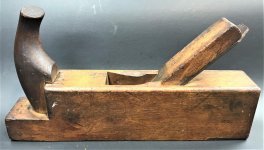
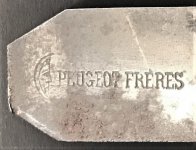
I bought this French plane (rabot) at an estate sale yesterday. It's a Peugeot Freres scrub plane. The version of the company name that is stamped into the cutting iron is one of the first used by them. The crescent moon indicates that it was probably made 1850-1870. It also indicates that the iron was made from 2nd quality steel.
Curiously, the Peugeot product that is most collectable today is peppermills.
The Peugeot tool company was related to the auto company.
Curiously, the Peugeot product that is most collectable today is peppermills.
The Peugeot tool company was related to the auto company.
Attachments
code4pay
Well-known member
Will you be using it?I bought this French plane (rabot) at an estate sale yesterday. It's a Peugeot Freres scrub plane.
Mike
YouTube
CRSINMICH
Well-known member
code: Yes I will use it, although it will probably only be just enough times to truthfully say that it is a user. I have to respect its age too. 100+ year old tools don't seem to be manufactured much anymore.
Last edited:
Magnum440d100
Well-known member
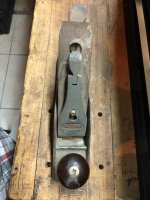
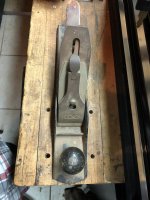
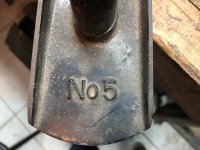
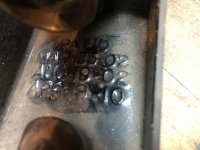
Bailey, Dunlap, and Craftsman.
What do I have here? Any way to put an age/era on them?
They’re all users, and will most likely get used in a few months
What do I have here? Any way to put an age/era on them?
They’re all users, and will most likely get used in a few months
Attachments
-
 B2194E02-BE95-4B08-B95B-73CB99AB38CC.jpg150.6 KB · Views: 27
 -
 640C7DC1-F8B9-4D82-AD10-94F9F4169656.jpg110.5 KB · Views: 33
 -
 0D808BA1-5D70-44E0-9D33-2AA3257CDDFA.jpg107.1 KB · Views: 34
 -
 3D288BC5-BFA8-4EB5-8D56-5B43D32D7323.jpg112 KB · Views: 36
 -
 6A9395A9-A970-4AB7-8A18-FCAAA4EAD794.jpg149.2 KB · Views: 31
 -
 86500DB1-1380-4FC7-9319-FAB17DB04018.jpg134.3 KB · Views: 38
 -
 FD59CED1-15D4-47D5-A337-733064ABDFC8.jpg151 KB · Views: 32
derosa
Well-known member
The Bailey can be dated here, its for the Bailey No4 but the 4 and 5 follow each other closely. Just scroll down till you get to the first question. The three dates printed already put it between 1910 and 1924 as a type 11 or 12, which of the two you can figure out on the site. The 5 is a jack, good general user and my typical go to plane. Don't know anything about Dunlop or Craftsman other then they're rebadged.Bailey, Dunlap, and Craftsman.
What do I have here? Any way to put an age/era on them?
They’re all users, and will most likely get used in a few months
100+ year old tools don't seem to be manufactured much anymore.
Actually, I think there are new ones everyday.
Bill vonSteuben
Well-known member
I find more info than I can use at one time on the "Stanley Blood and Gore" page. Not that the sites listed are not helpful, but Stanley was king in the plane world.
C1070RS
Well-known member
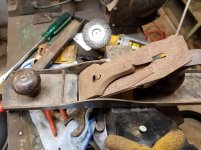
Found a dozen or so ranging from 3 inches to 18 inches. Cleaned up a 1902 Bailey #6 and corregated 1910 Bailey #5. I think I'm hooked....
Attachments



Modern Garage
Well-known member
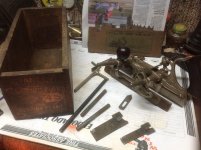
Went to an auction yesterday and came home with a Stanley 45 and accessories in the original box. Only missing one or two cutters, the photo shows it as I dumped it out of the box.
The auction was at the home of a retiring Amish machinist (does that seem like an oxymoron to anyone else?) and was a real step back in time: everything - including originally electric machinery - run by overhead line shafts and powered by an eight horse gas engine in an adjoining building. If you think an old machine shop is dark imagine one without electric lighting.
When I took the plane from the auctioneer's hand one of the bystanders smiled and said "You must have been waiting here all day for that one." I had to think about it for a while before I realized he meant I overpaid. The auctioneer held it up and started out asking for a hundred dollar bid. When no one bit he dropped to seventy five, fifty, then twenty five, which is when I held up my hand. He couldn't get anybody to bid thirty and I won it on one bid. Apparently everyone there thought it was a ten dollar tool.
The oil smoke environment of the machine shop did a good job of repelling the typical Wisconsin humidity, and I think the only cutter that saw any use is the one in the plane. The others in their own box are still razor sharp.
Even if I never use it I just like looking at the hundred year old design from when the people who made and used tools understood that aesthetics count, but I hope to use it on some future projects because that's what it was made for.
Joe
The auction was at the home of a retiring Amish machinist (does that seem like an oxymoron to anyone else?) and was a real step back in time: everything - including originally electric machinery - run by overhead line shafts and powered by an eight horse gas engine in an adjoining building. If you think an old machine shop is dark imagine one without electric lighting.
When I took the plane from the auctioneer's hand one of the bystanders smiled and said "You must have been waiting here all day for that one." I had to think about it for a while before I realized he meant I overpaid. The auctioneer held it up and started out asking for a hundred dollar bid. When no one bit he dropped to seventy five, fifty, then twenty five, which is when I held up my hand. He couldn't get anybody to bid thirty and I won it on one bid. Apparently everyone there thought it was a ten dollar tool.
The oil smoke environment of the machine shop did a good job of repelling the typical Wisconsin humidity, and I think the only cutter that saw any use is the one in the plane. The others in their own box are still razor sharp.
Even if I never use it I just like looking at the hundred year old design from when the people who made and used tools understood that aesthetics count, but I hope to use it on some future projects because that's what it was made for.
Joe
Attachments
CRSINMICH
Well-known member
C1070RS: That was a nice stash of planes you got. You should get plenty of use from the #5 and the #6
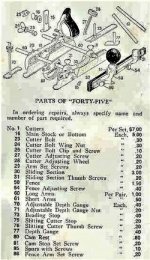
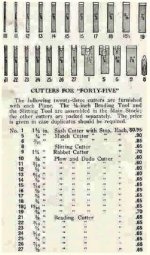
Modern Garage: Congratulations! That was a very good price for a very useful plane. By all means, put it to use. It does look like yours came with most, if not all, of its parts. Here's a diagram labeling all of the parts that originally came with it. It's handy for figuring out what each part is called. There's also a chart listing the cutters and a link to a site that may help date your 45 if you want to do that: http://www.oldtooluser.com/typestudy/stanno45combplanetypestudy.htm
EDIT: The cutters on your plane have a notch at the top of each. Some cutters (newer ones I think) have a small hole drilled in the same area. Look carefully at the lower end of Part 27 in the diagram. The shaft of the adjuster has a small pin sticking out. That pin goes into the slot or the hole of the cutter. The cutters with a hole might not work. I think they do but it's something to be aware of if you buy additional cutters for your 45.
Modern Garage: Congratulations! That was a very good price for a very useful plane. By all means, put it to use. It does look like yours came with most, if not all, of its parts. Here's a diagram labeling all of the parts that originally came with it. It's handy for figuring out what each part is called. There's also a chart listing the cutters and a link to a site that may help date your 45 if you want to do that: http://www.oldtooluser.com/typestudy/stanno45combplanetypestudy.htm
EDIT: The cutters on your plane have a notch at the top of each. Some cutters (newer ones I think) have a small hole drilled in the same area. Look carefully at the lower end of Part 27 in the diagram. The shaft of the adjuster has a small pin sticking out. That pin goes into the slot or the hole of the cutter. The cutters with a hole might not work. I think they do but it's something to be aware of if you buy additional cutters for your 45.
Attachments
Last edited:
Modern Garage
Well-known member
Thanks. I've found the parts list and user manual online to familiarize myself with the setup and function. I only seem to be missing a couple of the thumbscrews but nothing that will prevent me from putting it to work cutting a sliding lid for the box.
Joe
Joe
CRSINMICH
Well-known member
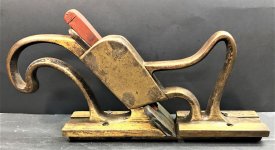
CARRIAGE MAKER'S RABBET PLANE
I don't know whether to call this is a carriage maker's plane or a coach maker's plane. There are no names anywhere even on the cutting iron. It's mostly bronze with a hard rubber wedge. I found some images of very similar planes but none of them had fences let alone moving fences. This one can be mounted on either the left side of the plane or the right side. The plane appears to be shop made but if so, it was a commercial shop and not a basement workshop.Does anyone have information about this plane or this type of plane? Any guesses?
Attachments

Last edited:
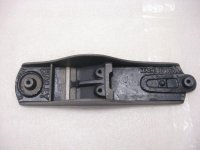
Question for all you bench plane gurus. I recently picked up a Stanley No. 3 Bailey. According to Patrick Leach's info online, it's a type 15, 1931-32. However, it's unusual in that the MADE IN USA is cast alongside the tote instead of behind the frog receiver where it usually is. I've seen my share of Stanleys, but have never seen this. Since the Type 15 was only made for 1-2 years, there's not all that many around, so perhaps the location is normal for these and I've simply never encountered one before.
Attached is a photo of the casting only so you can see the entire bed clearly. Anyone else ever seen this odd location for the MADE IN USA?.
Attached is a photo of the casting only so you can see the entire bed clearly. Anyone else ever seen this odd location for the MADE IN USA?.
Attachments
CRSINMICH
Well-known member
Dad: I have never seen a sideways USA myself but some other examples do exist. MADE IN USA didn't show up until Type 14 and was moved behind the frog by Type 15. I haven't found out anything else but if you search "Stanley sideways USA" you'll find some things.
I'm going to keep my eyes peeled for one now.
I'm going to keep my eyes peeled for one now.
Thanks. I had never seen one before with the USA next to the tote. Very unusual, so my first thoughts were it was some sort of special run or odd variation (Stanley pushed out all kinds of strange things I wouldn't likely recognize at first glance). I couldn't find any Type 15 comps to compare, looks like the 15 was a relatively short production run which makes them rather scarce.Dad: I have never seen a sideways USA myself but some other examples do exist. MADE IN USA didn't show up until Type 14 and was moved behind the frog by Type 15. I haven't found out anything else but if you search "Stanley sideways USA" you'll find some things.
I'm going to keep my eyes peeled for one now.
I'll make that search, and thanks! I'd like to find a 15 with USA in the normal place. That'll make this really crazy! Can't understand why Stanley would have decided to place the USA here on this plane when there's plenty of room for it in the normal location.
I conducted that web search for 'sideways USA' and found two examples being offered by the same seller, one is a 14B (don't know what the B stands for) and a 14C (corrugated sole), both having the sideways USA. In Leach's description, he states that the USA was first introduced in type 14 at the toe, then in type 15 behind the frog. But his online case study on hyperkitten is based on #4 planes. The type 3 is a smaller plane and so maybe there wasn't enough room to put the USA on the toe, hence the location behind the frog. Since the examples prove that at least some of the #3 type 14 had USA beside the tote, and later type 3 examples I've seen have it behind the frog, the sideways USA may have been standard for the #3 at least in some of the 14s. It could be that my 15 plane was made with a leftover 14 base. We'd have to see more examples of #3s in both 14 and 15 to get a better feel for this.Dad: I have never seen a sideways USA myself but some other examples do exist. MADE IN USA didn't show up until Type 14 and was moved behind the frog by Type 15. I haven't found out anything else but if you search "Stanley sideways USA" you'll find some things.
I'm going to keep my eyes peeled for one now.
CRSINMICH
Well-known member
Dad: Coincidentally, I scanned some pages of a Stanley plane study last week. The Type 14 and 15 information is the same as what we have both said. The introduction to the study also confirms that not all features were the same on all bench planes.
I want to try to shed light on something. I have a Type 16 #3 with Made in U.S.A just behind the frog. When I compared it to your #3 I noticed a small difference. MADE IN U.S.A. is the way yours is written. The small difference is that the U.S.A on mine has no period after the A. I measured the distance between the inside of the sides of the plane body and it's 1 29/32 inches (approximately). The length of U.S.A is 1 1/2 inches. If you would measure those two distances on your plane we might be able to tell if placement could have been a space issue. Be sure to measure from the left side of the M to the outside of the final period.
Don't laugh. Some tool identification depends on whether knurling is straight or slanted.
I want to try to shed light on something. I have a Type 16 #3 with Made in U.S.A just behind the frog. When I compared it to your #3 I noticed a small difference. MADE IN U.S.A. is the way yours is written. The small difference is that the U.S.A on mine has no period after the A. I measured the distance between the inside of the sides of the plane body and it's 1 29/32 inches (approximately). The length of U.S.A is 1 1/2 inches. If you would measure those two distances on your plane we might be able to tell if placement could have been a space issue. Be sure to measure from the left side of the M to the outside of the final period.
Don't laugh. Some tool identification depends on whether knurling is straight or slanted.
Attachments

Last edited:
No laughing here. Got a type 18 (another 1 to 2 year production model) that's characterized in part by the diagonal knurling on the adjustment nut. The inside width of my bed is the same as yours. The width of the MADE IN USA with the periods is 2-3/16". It may be that they wanted to display it prominently and did not want to shrink it to a size that will fit behind the frog where it would be obscure on such a small plane. Apparently, that possible concern didn't last very long, just a few years from the beginning of the 14 in 1929 to the end of 15 in 1932. There are many more examples of 16 to see, and by this time it looks like it's all tucked behind the frog.Dad: Coincidentally, I scanned some pages of a Stanley plane study last week. The Type 14 and 15 information is the same as what we have both said. The introduction to the study also confirms that not all features were the same on all bench planes.
I want to try to shed light on something. I have a Type 16 #3 with Made in U.S.A just behind the frog. When I compared it to your #3 I noticed a small difference. MADE IN U.S.A. is the way yours is written. The small difference is that the U.S.A on mine has no period after the A. I measured the distance between the inside of the sides of the plane body and it's 1 29/32 inches (approximately). The length of U.S.A is 1 1/2 inches. If you would measure those two distances on your plane we might be able to tell if placement could have been a space issue. Be sure to measure from the left side of the M to the outside of the final period.
Don't laugh. Some tool identification depends on whether knurling is straight or slanted.
The two examples of the Type 14 #3 from that search are the same with a sideways USA. I just can't find another 15. Finding more examples of the 15 will tell us if the design change happened sometime during that period or if all the 15s are sideways.
txlonghorn1989
Well-known member
- Joined
- Feb 27, 2017
- Messages
- 2,786
Picked up some hand planes yesterday. Included was my first Union, a #6. Looks and feels like a good plane. It is missing the lateral adjustment lever sadly. Hoping I can find the correct replacement somewhere. The Stanley planes all appear to be from the '20s except for one of the #4s which is a weird one. Not marked Stanley anywhere, has a whale tail lateral adj lever and the side walls are almost 1/8" thick. But for all intents and purposes it looks and feels like a Stanley. Thoughts anyone?
Attachments


txlonghorn1989
Well-known member
- Joined
- Feb 27, 2017
- Messages
- 2,786
CRS,
I checked my Stanley #3s. One is a type 9, the other 3 are all type 16 based on kidney-shaped hole in the lever caps and the raised rib at the back edge of the body. All have Bailey behind the knob and "Made in USA" behind the frog. I don't think that helps you guys though. I don't have a type 15 #3. Wish I had been able to provide another data point for you.
I checked my Stanley #3s. One is a type 9, the other 3 are all type 16 based on kidney-shaped hole in the lever caps and the raised rib at the back edge of the body. All have Bailey behind the knob and "Made in USA" behind the frog. I don't think that helps you guys though. I don't have a type 15 #3. Wish I had been able to provide another data point for you.
txlonghorn1989
Well-known member
- Joined
- Feb 27, 2017
- Messages
- 2,786
What do you guys use to prevent rust on your plane irons & chipbreakers? Johnson's paste wax? What else do you like to use?
hsvtoolfool
Well-known member
txlonghorn1989
Well-known member
- Joined
- Feb 27, 2017
- Messages
- 2,786
Camillia oil from Highland Hardware...
Camellia oil? I never heard of it but reading a couple of articles makes it sound like some of the best stuff out there. I will definitely give it a try. Thanks hsv!
Private Lugnutz
Well-known member
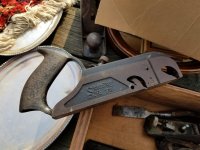
I don't know if you're describing the third from the right, but I saw one like that today. I don't know jack about planes. Like vises, it's tempting, but it's also one of those esoteric black holes I refuse to enter with both feet. And with planes I don't even have a little pinky toe in. It took me years to master the wartime Willys kit and GMTK and general mechanics tools from there. It just seems like a lot to know before you don't lose your shirt. Anyway, besides the skinny incomplete Stanley #78 with the fancy script, there was another strange Stanley, a Victor #20. Instead of solid, it looked hollow, with shells top and bottom for a body. And it didn't look like cast steel, but pot metal. Spaceshippy, almost. I forgot to take a pic of that one.The Stanley planes all appear to be from the '20s except for one of the #4s which is a weird one. Not marked Stanley anywhere, has a whale tail lateral adj lever and the side walls are almost 1/8" thick.
Attachments
txlonghorn1989
Well-known member
- Joined
- Feb 27, 2017
- Messages
- 2,786
I don't know if you're describing the third from the right, but I saw one like that today. I don't know jack about planes. Like vises, it's tempting, but it's also one of those esoteric black holes I refuse to enter with both feet. And with planes I don't even have a little pinky toe in. It took me years to master the wartime Willys kit and GMTK and general mechanics tools from there. It just seems like a lot to know before you don't lose your shirt. Anyway, besides the skinny incomplete Stanley #78 with the fancy script, there was another strange Stanley, a Victor #20. Instead of solid, it looked hollow, with shells top and bottom for a body. And it didn't look like cast steel, but pot metal. Spaceshippy, almost. I forgot to take a pic of that one.
Lugz,
I was talking about the 2nd one from the left (#4 bench plane). That #78 is a rabbet plane. I know hardly anything about them. But I'll be learning. I don't recall ever seeing a Victor #20 in the wild or anywhere else. Just googled it. Yep another level of handwork that I haven't achieved there with the circular planes.
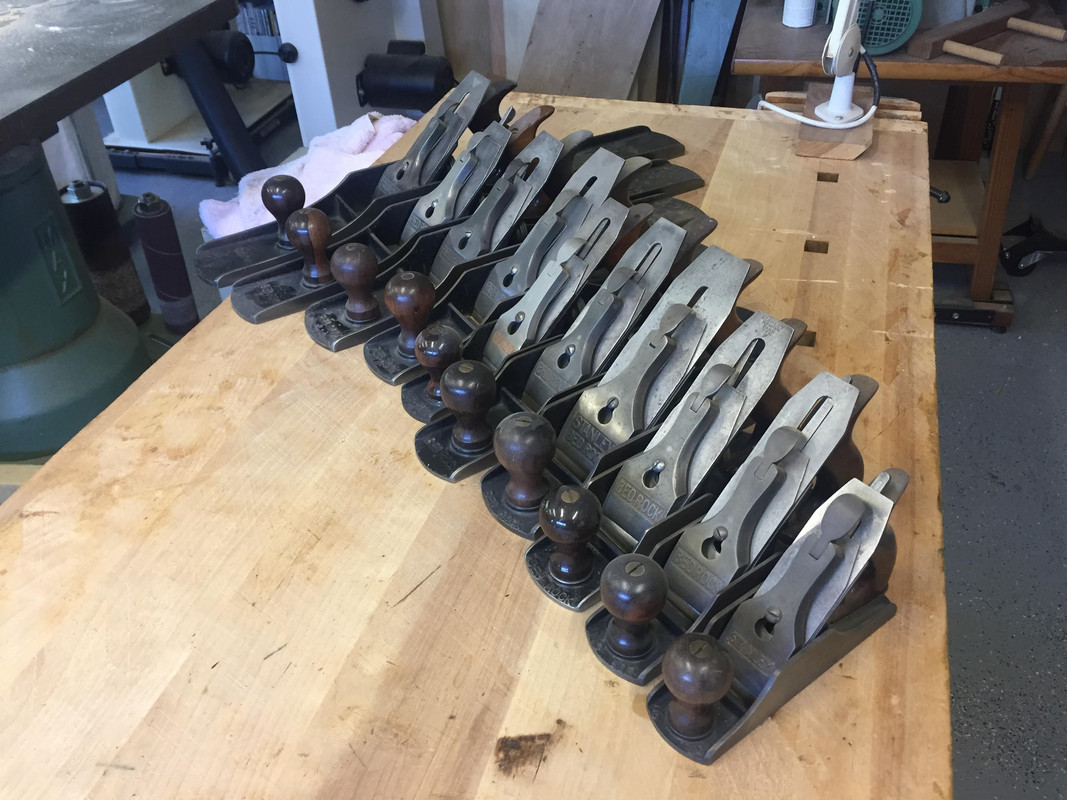
I tried to collect a complete set of type 6 Bedrocks many moons ago, 602-608, all except the 604-1/2 (typ 5) and 605-1/4 are type 6. I also have quite a few duplicates. I do use some of them - I just used the 608 to flatten my bench for example.
txlonghorn1989
Well-known member
- Joined
- Feb 27, 2017
- Messages
- 2,786
I tried to collect a complete set of type 6 Bedrocks many moons ago, 602-608, all except the 604-1/2 (typ 5) and 605-1/4 are type 6. I also have quite a few duplicates. I do use some of them - I just used the 608 to flatten my bench for example.
Hi Ken. I've got one Bedrock a 605 which I haven't used as of yet. I'm curious is there a something you particularly like about the type 6 planes versus other types? I'm not familiar with the Bedrock types as I am with the Stanley which isn't any kind of big claim on my part. For myself I like the Stanley planes after they added the frog adjustment screw which was a Bedrock feature up to the pre-war II versions. Just curious if there something about those type 6s you really like. Nice collection!
Thanks TX.
I just liked the "BEDROCK" script on the type 6 planes, later types had "STANLEY". I actually wanted to collect type 5 which had "STANLEY BEDROCK" on the lever cap(like my 604-1/2 in the above pic) , but type 5s are much more scarce. To my knowledge (which is very rusty) there were no changes in the square side Bedrocks through their lifetime other than markings on blade, body and lever cap. Regardless, the Stanley Bedrock is a great user plane, a slightly thicker Hock iron is a worthy improvement - not sure if Hock still makes irons but he did back in the day when I was really into bench planes.
I think I have a half dozen 605s, a couple 605-1/4s a couple 604-1/2s and maybe a couple others. I guess I should get to selling a few off, trouble is they're all worth less than I paid for them 15-20 years ago. Oh well.......
I just liked the "BEDROCK" script on the type 6 planes, later types had "STANLEY". I actually wanted to collect type 5 which had "STANLEY BEDROCK" on the lever cap(like my 604-1/2 in the above pic) , but type 5s are much more scarce. To my knowledge (which is very rusty) there were no changes in the square side Bedrocks through their lifetime other than markings on blade, body and lever cap. Regardless, the Stanley Bedrock is a great user plane, a slightly thicker Hock iron is a worthy improvement - not sure if Hock still makes irons but he did back in the day when I was really into bench planes.
I think I have a half dozen 605s, a couple 605-1/4s a couple 604-1/2s and maybe a couple others. I guess I should get to selling a few off, trouble is they're all worth less than I paid for them 15-20 years ago. Oh well.......
Last edited:
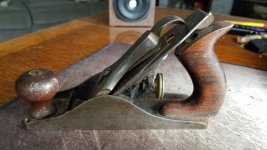
Probably the best deal I've gotten on a plane so far. Traded a record 10 1/2 inch bench vise that I acquired for $15. So I'm counting this as purchased for $15 
I think it's a type 3 or 4 number 2. I'm a little unfamiliar with dating this one, as they were different than the 3-8. Everything is in good shape, going to polish the tote and knob a bit, then put it on the shelf for lookin' at.
I think it's a type 3 or 4 number 2. I'm a little unfamiliar with dating this one, as they were different than the 3-8. Everything is in good shape, going to polish the tote and knob a bit, then put it on the shelf for lookin' at.
Attachments


crguy
Well-known member
Probably the best deal I've gotten on a plane so far. Traded a record 10 1/2 inch bench vise that I acquired for $15. So I'm counting this as purchased for $15
I think it's a type 3 or 4 number 2. I'm a little unfamiliar with dating this one, as they were different than the 3-8. Everything is in good shape, going to polish the tote and knob a bit, then put it on the shelf for lookin' at.
I don't believe they made any type 3 #2s. Your plane looks like a type 5 or 6 depending on the kind of lateral lever it has.
Last edited:
CRSINMICH
Well-known member
tx: When I refurbish old metal planes, the last step is to put a few drops of light machine oil on all the metal parts. I literally mean a FEW drops. I then spread the oil over all surfaces of each part using a nitrile gloved finger as a spreader. Next, using a clean dry rag, I wipe as much of the oil off as I can. As a bonus, the oil helps remove any residual grime. The one part I don't oil is the sole of the plane. On that, I use my brother's home brew he calls Blade Wax. It's a blend of beeswax and mineral oil. I put on a thin coat and then buff it in. If I feel it's necessary, I'll rewax during a working session. I also use it on handsaw blades and boring bits. I haven't had any problems applying finishes to the wood afterword.
On wooden bodied planes, I use a blend of BLO thinned with turpentine at about a 3:1 ratio. In a well ventilated area, use a rag to apply a good amount to the body, then, using 0000 steel wool, gently rub not scrub. Wipe dry with a clean dry cloth. Do not put BLO on the wedge. The metal parts get the same treatment as above.
CAUTION: Dispose of oily rags appropriately.
On wooden bodied planes, I use a blend of BLO thinned with turpentine at about a 3:1 ratio. In a well ventilated area, use a rag to apply a good amount to the body, then, using 0000 steel wool, gently rub not scrub. Wipe dry with a clean dry cloth. Do not put BLO on the wedge. The metal parts get the same treatment as above.
CAUTION: Dispose of oily rags appropriately.
Last edited:
crguy
Well-known member
It's not a #3, its a #2.
That "#3" was a typo on my part. No type 3 #2s were made.
I have owned several of the somewhat unique type 3 planes in the #3 = #8 size.
txlonghorn1989
Well-known member
- Joined
- Feb 27, 2017
- Messages
- 2,786
tx: When I refurbish old metal planes, the last step is to put a few drops of light machine oil on all the metal parts. I literally mean a FEW drops. I then spread the oil over all surfaces of each part using a nitrile gloved finger as a spreader. Next, using a clean dry rag, I wipe as much of the oil off as I can. As a bonus, the oil helps remove any residual grime. The one part I don't oil is the sole of the plane. On that, I use my brother's home brew he calls Blade Wax. It's a blend of beeswax and mineral oil. I put on a thin coat and then buff it in. If I feel it's necessary, I'll rewax during a working session. I also use it on handsaw blades and boring bits. I haven't had any problems applying finishes to the wood afterword.
On wooden bodied planes, I use a blend of BLO thinned with turpentine at about a 3:1 ratio. In a well ventilated area, use a rag to apply a good amount to the body, then, using 0000 steel wool, gently rub not scrub. Wipe dry with a clean dry cloth. Do not put BLO on the wedge. The metal parts get the same treatment as above.
CAUTION: Dispose of oily rags appropriately.
Thanks CRS. That's all good to know. I've used BLO on a Reed 214R vise I've got. I liked the results. I don't have any wooden bodied planes. Yet. Is 3-in-1 oil considered "light machine oil"?
CRSINMICH
Well-known member
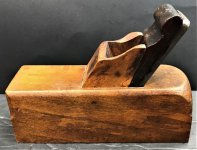
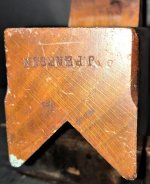
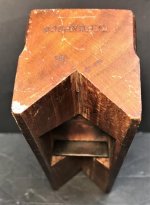
tx: BLO is wonderful stuff. One quirk about it is that it is not boiled. Go figure. Yes, 3-in-1 is light machine oil. Sewing machine oil would probably work too. Wooden planes are great to work with but if you think you fell into a rabbit hole with metal planes you aint seen nothing yet. Here's some pictures of my latest wooden plane. It's a chamfer plane. I've been looking for one, metal or wood, for a long time. I haven't done anything to clean it up yet. I may decide to leave it alone. It's in good shape.
Attachments
txlonghorn1989
Well-known member
- Joined
- Feb 27, 2017
- Messages
- 2,786
CRS: I don't have any sewing machine oil but given that I can't seem to pass up buying 3-in-1 oil cans when I see them at estate sales I'm loaded up with that. That is one fine looking wooden chamfer plane! I'm going to try and avoid that rabbit hole for now. However, if I find a vintage wooden bodied plane in that kind of condition for small bucks I'll be diving in headfirst!

Lugtz, "Victor 20" and its later Stanley 20 replacement are planes with adjustable curved bottoms for curved surfaces, like the edge of a round table. They tend to go for $150 and up on that evil auction site. That flimsy webbing is cast iron, not pot metal, and is very fragile. I had one snap (that had already been brazed many years before I got it) just sitting on a shelf untouched and as un-tensioned as possible. I've been looking for a cheap one in the wild for a long time. So, please don't tell me you saw it for $20 or so at the flea.